
BuddhistCatholicContemplativeEvangelicalGeneral ChristianHinduJewishLatter-day SaintMuslimNew VisionsProgressive Christian
Beliefs
- Buddhist
- Catholic
- Contemplative
- Evangelical
- General Christian
- Hindu
- Jewish
- Latter-day Saint
- More Voices
- Muslim
- New Visions
- Pagan
- Progressive Christian
Topics
- Religion News
- Food and Religion
- Sports and Religion
- Religious Art
- Religious Music and Entertainment
- Religious Events
- History and Religion
- Style and Religion
- Politics and Religion
- Women in Religion
- Recreation Outdoors and Religion
- Business Finance and Religion
- Careers Workplace and Religion
- Education and Religion
- Family Parenting and Religion
- Health Fitness and Religion
- Home and Religion
- Relationships and Religion
- Technology and Religion
- Travel and Religion
Columnists
- Buddhist Columnists
- Business Finance and Religion Columnists
- Careers Workplace and Religion Columnists
- Catholic Columnists
- Contemplative Columnists
- Education and Religion Columnists
- Evangelists Columnists
- Family Parenting and Religion Columnists
- General Christian Columnists
- Health Fitness and Religion Columnists
- Hindu Columnists
- History and Religion Columnists
- Home and Religion Columnists
- Jewish Columnists
- More Voices Columnists
- Latter Day Columnists
- Muslim Columnists
- New Visions Columnists
- Nonreligious Columnists
- Pagan Columnists
- Politics and Religion Columnists
- Progressive Columnists
- Recreation Outdoors and Religion Columnists
- Relationships and Religion Columnists
- Religion News Columnists
- Religious Art Columnists
- Religious Events Columnists
- Religious Music and Entertainment Columnists
- Sports and Religion Columnists
- Style and Religion Columnists
- Technology and Religion Columnists
- Travel and Religion Columnists
- Women in Religion Columnists
Resource Library
- 2026 Calendar
- Library of World Religions
- The 100 Most Holy Places on Earth
- Patheos Answers
- Podcasts
- Videos
- Faith Leaders Database
- Anglican Episcopalian
- Bahai
- Baptist
- Buddhism
- Christianity
- Confucianism
- Eastern Orthodoxy
- Hinduism
- Holiness and Pentecostal
- ISKCON
- Islam
- Judaism
- Lutheran
- Methodist
- The Church of Jesus Christ of Latter-day Saints
- New Age
- Paganism
- Presbytarian and Reformed
- Protestantism
- Religion Behind the Scenes
- Roman Catholic
- Scientology
- Shia Islam
- Sikhism
- Sufism
- Sunni Islam
- Taoism
- Zen
- See all religions
Research Tools
 Ad-Free & Subscriber Log-In Subscription Support
Ad-Free & Subscriber Log-In Subscription Support
Follow Patheos 

- Trending:
- Forgiveness
- |
- Marriage
- |
- Consciousness
- |
- Death Penalty
- |
- Election
- |
- Halloween
 Theology of Work Project
- Home
- Business, Finance and Religion
- Christians are expected to work
Christians are expected to work
Last updated on: June 5, 2014 at 5:19 pm by Theology of Work Project
Christians are expected to work 2014-06-05T17:19:47-05:00 Theology of Work Project
Patheos Explore the world's faith through different perspectives on religion and spirituality! Patheos has the views of the prevalent religions and spiritualities of the world.
 A reflection on 1 THESS. 4:9-12; 5:14
Christians Are Expected To Work To The Degree They Are Able
Paul highlights that God expects every Christian who can work to do so (1 Thess. 4:11-12). He exhorts the Thessalonians “to work with [their] hands” (1 Thess. 4:11) and to “have need of no one” (1 Thess. 4:12). Rather than evading work, the Thessalonian Christians are to be industrious, laboring so as to earn their own living and thereby avoid putting undue burdens on others. Being a manual laborer in a Greco-Roman city was a hard life by modern and ancient standards, and the thought that it might not be necessary must have been appealing. However, abandoning work in favor of living off the work of others is unacceptable. It is striking that Paul’s treatment of the issue in 1 Thessalonians is framed in terms of “brotherly love” (1 Thess. 4:9). The idea is plainly that love and respect are essential in Christian relationships, and that living off the charity of others unnecessarily is unloving and disrespectful to the charitable brother(s) or sister(s) concerned.
It is important to remember that work does not always mean paid work. Many forms of work — cooking, cleaning, repairing, making things beautiful, raising children, coaching youth and thousands of others — meet the needs of family or community but do not receive remuneration. Others — the arts come to mind — may be offered free of charge or at prices too low to support those who do them. Nonetheless, they are all work. Christians are not necessarily expected to earn money, but to work to support themselves, their families, and the church and community.
The Creation Mandate Remains In Effect
The mandate in Genesis 2:15 (“The Lord God took the man and put him in the Garden of Eden to work it and keep it”) is still in effect. The work of Christ has not eliminated or supplanted humankind’s original work, but it has made it more fruitful and ultimately valuable. Paul may have the Genesis 2:15 text in view when he refers to idlers with the Greek adjective, adverb and verb derived from the root atakt- (“disorder”) in 1 Thess. 5:14;2 Thess. 3:6 and 11; and 1 Thess. 5:7, respectively. These words all portray idlers’ behavior as disorderly. The order being violated may well be the work mandate in Genesis 2.
Paul’s insistence on the ongoing validity of work is not a concession to a bourgeois agenda, but rather reflects a balanced perspective on the already/not yet of God’s kingdom. Already, God’s kingdom has come to earth in the person of Jesus, but it has not yet been brought to completion (1 Thess. 4:9-10). When Christians work with diligence and excellence, they demonstrate that God’s kingdom is not an escapist fantasy, but a fulfillment of the world’s deepest reality.
Christians Are To Work With Excellence
Given the importance of work, Christians are to be the best workers that they can be. Failure to work with excellence may bring the Church into disrepute. Many Cynics (a philosophical school in the Greco-Roman world) abandoned their jobs, and this behavior was widely regarded as disgraceful. Paul is aware that when Christians evade their responsibility to work, the standing of the Church as a whole is undermined. In 1 Thess. 4:11-12, Paul is evidently very concerned that society was getting a wrong view of the church. In the context of the Greco-Roman world his concern makes a lot of sense, for what was happening in the Thessalonian church not only fell below society’s standards for decency, it also made charitable Christians look gullible and foolish. Paul does not want Christians to fall below society’s standards in regard to work, but rather to exceed them. Moreover, by failing to fulfill their proper role within society, these Christians were in danger of stirring up more anti-Christian rumors and resentment. Paul is eager that those who persecute the Church should have no legitimate grounds for their hostility. With respect to work, Christians should be model citizens. By placing idlers under discipline, the church would effectively be distancing itself from their defective behavior.
Mature Christians are also to set an example for young Christians by modeling a good work ethos. Although Paul knew that it was the right of a minister of the Gospel to be financially supported (1 Timothy 5:17-18), he himself refused to take advantage of this (1 Thess. 2:9; 2 Thess. 3:8). He saw the need to set new converts an example of what the Christian life looked like, and that meant joining them in manual labor. Itinerant philosophers in the Greco-Roman world were often very quick to burden their converts financially, but Paul did not care about living an easy life or projecting an image of superiority over his spiritual charges. Christian leadership is servant leadership, even in the arena of work.
Manual Labor And Hard Work Is Honorable
The positive view of hard work that Paul was promoting was counter-cultural. The Greco-Roman world had a very negative view of manual labor. To some extent, this is understandable in view of how unpleasant urban workhouses were. If the idle in Thessalonica were in fact unemployed manual laborers, it is not difficult to appreciate how easy it would have been to rationalize their exploitation of the charity of their brothers and sisters over against returning to their workhouses. After all, weren’t all Christians equal in Christ? However, Paul has no time for any rationalizations. He approaches the matter from an understanding strongly rooted in the Old Testament, where God is portrayed as creating Adam to work, and Adam’s manual labor is not divorced from worship, but rather is to be a form of worship. In Paul’s assessment, manual labor is not beneath Christians, and Paul himself had done what he demands that these idle brothers do. The apostle plainly regards work as one way believers may honor God, show love to their fellow-Christians, and display the transforming power of the Gospel to outsiders. He wants the idle brothers to embrace his perspective and to set an impressive, not disgraceful, example for their unbelieving contemporaries.
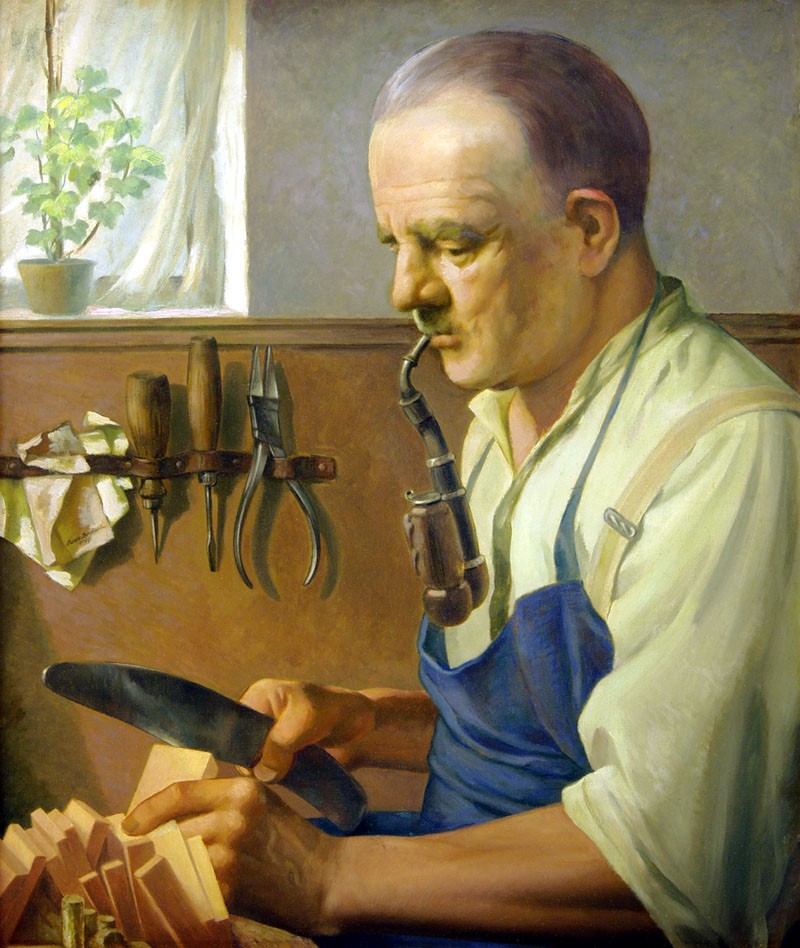
From Theology of Work Project. Image: Oscar Beckert, “The Piano Maker at Piano Key Manufacturing.” Courtesy of the Grohmann Museum at the Milwaukee School of Engineering.
Previous Post

March 5, 2014
Economic opportunities for the poor and vulnerable
Next Post
March 7, 2014 Abraham and Sarah's hospitality
Browse Our Archives
Select a Category Advent Ambition Bible and Work Business Calling Christmas Common Good Communication Conflict Culture Disappointment Discipleship Earth Day Easter Economics Environmental Sustainability Envy Faith and the Workplace Family and Work Generosity Giving Gossip Government Gratitude Hospitality Human Flourishing Humility Investing Justice Leadership Lent Local Church Making Mistakes Men and Work Millennials and Work Minimum Wage Money New Year Pastors Patience Pay Politics Poverty Prayer Race Rest Sabbath Sacred vs. Secular Sharing Faith Slavery Song of Songs Status Success Suffering Teamwork Thanksgiving Theology of Work TOW Project News Unemployment Valentine's Day Vocation Women and Work Work Life Balance
Select a Month September 2015 August 2015 July 2015 June 2015 May 2015 April 2015 March 2015 February 2015 January 2015 December 2014 November 2014 October 2014 September 2014 August 2014 July 2014 June 2014 May 2014 April 2014 March 2014 February 2014 January 2014 December 2013
Follow Us!
TAKE THE
Religious Wisdom Quiz
Who told Saul, "To obey is better than sacrifice"?
Select your answer to see how you score.
Samuel Eli David Nathan
Related posts from Theology of Work Project

Every Christian is Called to Full Time Ministry

6 Essential Principles to Guide You Toward Your...

What does the Wall Street Journal know about...

Investing in Microfinance, Social Enterprise and Business to...
TRENDING AT PATHEOS Business, Finance and Religion

St. Francis by Bill Droel Pope Leo XIV declares 2026 as “Year...

Catholics are schooled in the faith by memorizing dogmatic points and lots...

The Good News of Our Human Limitations -...
After another day of trying to meet deadlines and working on projects,...

Quiet Holy Attentiveness (podcast) with Sarah Clarkson
We know that quiet is an essential aspect of the spiritual life,...

Every Vocation Everywhere All At Once
What is a vocation? How does it endure through the years? Can...

I promise this is not going to become a Taylor Swift Studies...
view all Business, Finance and Religion blogs
Ad-Free & Subscriber Log-In Subscription Support
- About Us
- 2026 Calendar
- Videos
- Podcasts
- Library of World Religions
- Faith In Media Tracker
- Advertise With Us
- Write for Us
- Privacy Policy
- Terms of Service
- Do Not Sell My Data
- Contact Us
- Radiant Digital
- Manage Newsletter Subscriptions
- Unsubscribe From Notifications
- Sitemap
Copyright 2008-2026, Patheos. All rights reserved.
Subscription Support Ad-Free & Subscriber Log-In
Follow Patheos