
BuddhistCatholicContemplativeEvangelicalGeneral ChristianHinduJewishLatter-day SaintMuslimNew VisionsProgressive Christian
Beliefs
- Buddhist
- Catholic
- Contemplative
- Evangelical
- General Christian
- Hindu
- Jewish
- Latter-day Saint
- More Voices
- Muslim
- New Visions
- Pagan
- Progressive Christian
Topics
- Religion News
- Food and Religion
- Sports and Religion
- Religious Art
- Religious Music and Entertainment
- Religious Events
- History and Religion
- Style and Religion
- Politics and Religion
- Women in Religion
- Recreation Outdoors and Religion
- Business Finance and Religion
- Careers Workplace and Religion
- Education and Religion
- Family Parenting and Religion
- Health Fitness and Religion
- Home and Religion
- Relationships and Religion
- Technology and Religion
- Travel and Religion
Columnists
- Buddhist Columnists
- Business Finance and Religion Columnists
- Careers Workplace and Religion Columnists
- Catholic Columnists
- Contemplative Columnists
- Education and Religion Columnists
- Evangelists Columnists
- Family Parenting and Religion Columnists
- General Christian Columnists
- Health Fitness and Religion Columnists
- Hindu Columnists
- History and Religion Columnists
- Home and Religion Columnists
- Jewish Columnists
- More Voices Columnists
- Latter Day Columnists
- Muslim Columnists
- New Visions Columnists
- Nonreligious Columnists
- Pagan Columnists
- Politics and Religion Columnists
- Progressive Columnists
- Recreation Outdoors and Religion Columnists
- Relationships and Religion Columnists
- Religion News Columnists
- Religious Art Columnists
- Religious Events Columnists
- Religious Music and Entertainment Columnists
- Sports and Religion Columnists
- Style and Religion Columnists
- Technology and Religion Columnists
- Travel and Religion Columnists
- Women in Religion Columnists
Resource Library
- 2026 Calendar
- Library of World Religions
- The 100 Most Holy Places on Earth
- Patheos Answers
- Podcasts
- Videos
- Faith Leaders Database
- Anglican Episcopalian
- Bahai
- Baptist
- Buddhism
- Christianity
- Confucianism
- Eastern Orthodoxy
- Hinduism
- Holiness and Pentecostal
- ISKCON
- Islam
- Judaism
- Lutheran
- Methodist
- The Church of Jesus Christ of Latter-day Saints
- New Age
- Paganism
- Presbytarian and Reformed
- Protestantism
- Religion Behind the Scenes
- Roman Catholic
- Scientology
- Shia Islam
- Sikhism
- Sufism
- Sunni Islam
- Taoism
- Zen
- See all religions
Research Tools
 Ad-Free & Subscriber Log-In Subscription Support
Ad-Free & Subscriber Log-In Subscription Support
Follow Patheos 

- Trending:
- Forgiveness
- |
- Marriage
- |
- Consciousness
- |
- Death Penalty
- |
- Election
- |
- Halloween
 Theology of Work Project
- Home
- Business, Finance and Religion
- Faith in God’s provision
Faith in God’s provision
Last updated on: May 27, 2014 at 4:08 pm by Theology of Work Project
Faith in God’s provision 2014-05-27T16:08:42-05:00 Theology of Work Project
Patheos Explore the world's faith through different perspectives on religion and spirituality! Patheos has the views of the prevalent religions and spiritualities of the world.
 [Note: This is part of a longer study on the book of Jeremiah available here.]
We see in Jeremiah, chapter 5 that the people did not acknowledge God’s provision. If the people did not acknowledge God as the ultimate source of the good things they already had, how much less would they have faith to depend on God to provide for them in the future? John Cotton, the Puritan theologian, says that faith needs to underlie everything we do in life, including our work or vocation:
A true believing Christian…lives in his vocation by his faith. Not only my spiritual life but even my civil life in this world, and all the life I live, is by the faith of the Son of God: He exempts no life from the agency of his faith.
Here again lay the fundamental failure of the people of Judah in Jeremiah’s day, their lack of faith. Sometimes Jeremiah expressed it as not “knowing” the Lord, a term of fidelity. At other times he put it in the terms of failing to “hear” — to listen, obey, even care about what God has said. At still other times, he termed it a lack of “fear.” But all of these are simply a lack of faith — a living, working faith in who God is and what he does or says. This lack bled into the people’s view of work, leading to them blatantly violating the law of God and exploiting others for their own gain.
The great irony is that by depending on their own actions in place of faithfulness to the Lord in their work, the people ultimately failed to find enjoyment, fulfillment and the good of life. Jeremiah writes that God will eventually deal with their faithlessness, and “then death shall be preferred to life by all the remnant that remains of this evil family” (Jer. 8:3). The laws of God are aimed at our own good and are given to keep us focused on our proper purpose. When we set God’s laws aside because they hinder us from taking care of ourselves in our own way, we depart from God’s design for us becoming our true selves. When we work in such a way that we are dependent only on ourselves — and especially when we break God’s laws in order to do so — work fails to achieve its proper end. We deny of God’s presence in the world. We think we know better than God how to get the things we want. So we work according to our ways, not his. But our ways do not yield us the good things God intends to give us. As we experience this lack, we engage in increasingly desperate acts of self-interest. We cut corners, we oppress others and we hoard what little we have. Now we are not only failing to receive what God wants to give us, we are also failing to produce anything of value for ourselves or others. If others in the community or the nation act the same, we are soon fighting one another in pursuit of less-and-less satisfying products of our labor. We have become the opposite of who we are designed to be as the people of God. Now we “know and see that it is evil and bitter for you to forsake the Lord your God; the fear of me is not in you, says the Lord God of hosts” (Jer. 2:19).
The theme of the people abandoning God, losing faith in his provision, and oppressing each other in consequence is repeated at intervals through chapters 8 to 16. “They refuse to know me, says the Lord” (Jer. 9:6). Therefore their prosperity fades away, “the lowing of cattle is not heard; both the birds of the air and the animals have fled and are gone” (Jer. 9:10). As a consequence, they try to make up the loss by cheating one another. “They all deceive their neighbors and no one speaks the truth….Oppression upon oppression, deceit upon deceit!” (Jer. 9:5-6).
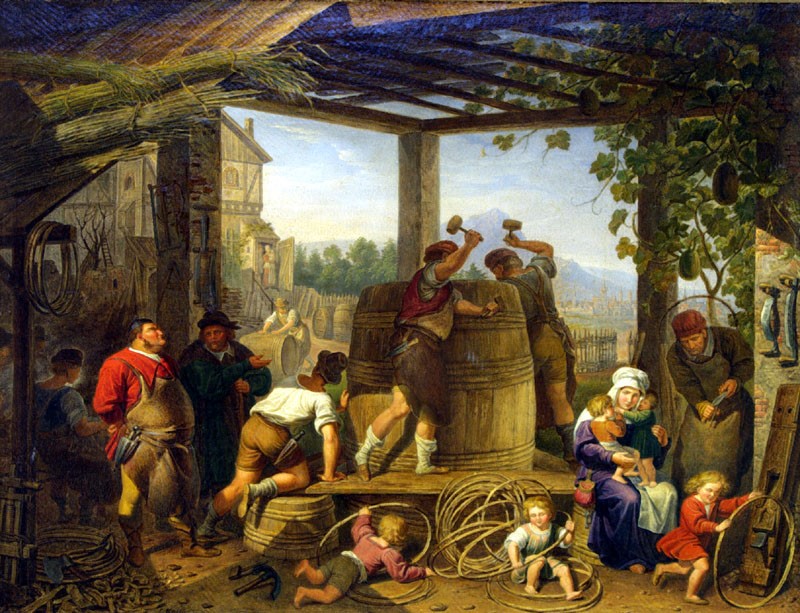
From Theology of Work Project. Image: Carl Wilhelm Kolbe, “Cooper Shop.” Courtesy of the Grohmann Museum at the Milwaukee School of Engineering.
Previous Post

February 11, 2014
Aiding the poor through spending
Next Post
February 25, 2014 The church and those who cannot work
Browse Our Archives
Select a Category Advent Ambition Bible and Work Business Calling Christmas Common Good Communication Conflict Culture Disappointment Discipleship Earth Day Easter Economics Environmental Sustainability Envy Faith and the Workplace Family and Work Generosity Giving Gossip Government Gratitude Hospitality Human Flourishing Humility Investing Justice Leadership Lent Local Church Making Mistakes Men and Work Millennials and Work Minimum Wage Money New Year Pastors Patience Pay Politics Poverty Prayer Race Rest Sabbath Sacred vs. Secular Sharing Faith Slavery Song of Songs Status Success Suffering Teamwork Thanksgiving Theology of Work TOW Project News Unemployment Valentine's Day Vocation Women and Work Work Life Balance
Select a Month September 2015 August 2015 July 2015 June 2015 May 2015 April 2015 March 2015 February 2015 January 2015 December 2014 November 2014 October 2014 September 2014 August 2014 July 2014 June 2014 May 2014 April 2014 March 2014 February 2014 January 2014 December 2013
Follow Us!
TAKE THE
Religious Wisdom Quiz
What weapon did David use to defeat Goliath?
Select your answer to see how you score.
A sword A bow and arrow A spear A sling and a stone
Related posts from Theology of Work Project

Theology of Work Bible Commentary Vol. 2 Now...

How to Be a Rich Christian (Part 3:...

How to Be a Rich Christian (Part 1:...

Every Christian is Called to Full Time Ministry
TRENDING AT PATHEOS Business, Finance and Religion

St. Francis by Bill Droel Pope Leo XIV declares 2026 as “Year...

Catholics are schooled in the faith by memorizing dogmatic points and lots...

The Good News of Our Human Limitations -...
After another day of trying to meet deadlines and working on projects,...

Quiet Holy Attentiveness (podcast) with Sarah Clarkson
We know that quiet is an essential aspect of the spiritual life,...

Every Vocation Everywhere All At Once
What is a vocation? How does it endure through the years? Can...

I promise this is not going to become a Taylor Swift Studies...
view all Business, Finance and Religion blogs
Ad-Free & Subscriber Log-In Subscription Support
- About Us
- 2026 Calendar
- Videos
- Podcasts
- Library of World Religions
- Faith In Media Tracker
- Advertise With Us
- Write for Us
- Privacy Policy
- Terms of Service
- Do Not Sell My Data
- Contact Us
- Radiant Digital
- Manage Newsletter Subscriptions
- Unsubscribe From Notifications
- Sitemap
Copyright 2008-2026, Patheos. All rights reserved.
Subscription Support Ad-Free & Subscriber Log-In
Follow Patheos