
BuddhistCatholicContemplativeEvangelicalGeneral ChristianHinduJewishLatter-day SaintMuslimNew VisionsProgressive Christian
Beliefs
- Buddhist
- Catholic
- Contemplative
- Evangelical
- General Christian
- Hindu
- Jewish
- Latter-day Saint
- More Voices
- Muslim
- New Visions
- Pagan
- Progressive Christian
Topics
- Religion News
- Food and Religion
- Sports and Religion
- Religious Art
- Religious Music and Entertainment
- Religious Events
- History and Religion
- Style and Religion
- Politics and Religion
- Women in Religion
- Recreation Outdoors and Religion
- Business Finance and Religion
- Careers Workplace and Religion
- Education and Religion
- Family Parenting and Religion
- Health Fitness and Religion
- Home and Religion
- Relationships and Religion
- Technology and Religion
- Travel and Religion
Columnists
- Buddhist Columnists
- Business Finance and Religion Columnists
- Careers Workplace and Religion Columnists
- Catholic Columnists
- Contemplative Columnists
- Education and Religion Columnists
- Evangelists Columnists
- Family Parenting and Religion Columnists
- General Christian Columnists
- Health Fitness and Religion Columnists
- Hindu Columnists
- History and Religion Columnists
- Home and Religion Columnists
- Jewish Columnists
- More Voices Columnists
- Latter Day Columnists
- Muslim Columnists
- New Visions Columnists
- Nonreligious Columnists
- Pagan Columnists
- Politics and Religion Columnists
- Progressive Columnists
- Recreation Outdoors and Religion Columnists
- Relationships and Religion Columnists
- Religion News Columnists
- Religious Art Columnists
- Religious Events Columnists
- Religious Music and Entertainment Columnists
- Sports and Religion Columnists
- Style and Religion Columnists
- Technology and Religion Columnists
- Travel and Religion Columnists
- Women in Religion Columnists
Resource Library
- 2026 Calendar
- Library of World Religions
- The 100 Most Holy Places on Earth
- Patheos Answers
- Podcasts
- Videos
- Faith Leaders Database
- Anglican Episcopalian
- Bahai
- Baptist
- Buddhism
- Christianity
- Confucianism
- Eastern Orthodoxy
- Hinduism
- Holiness and Pentecostal
- ISKCON
- Islam
- Judaism
- Lutheran
- Methodist
- The Church of Jesus Christ of Latter-day Saints
- New Age
- Paganism
- Presbytarian and Reformed
- Protestantism
- Religion Behind the Scenes
- Roman Catholic
- Scientology
- Shia Islam
- Sikhism
- Sufism
- Sunni Islam
- Taoism
- Zen
- See all religions
Research Tools
 Ad-Free & Subscriber Log-In Subscription Support
Ad-Free & Subscriber Log-In Subscription Support
Follow Patheos 

- Trending:
- Forgiveness
- |
- Marriage
- |
- Consciousness
- |
- Death Penalty
- |
- Election
- |
- Halloween
 Theology of Work Project
- Home
- Business, Finance and Religion
- Bloom where you are planted
Bloom where you are planted
Last updated on: May 27, 2014 at 4:08 pm by Theology of Work Project
Bloom where you are planted 2014-05-27T16:08:43-05:00 Theology of Work Project
Patheos Explore the world's faith through different perspectives on religion and spirituality! Patheos has the views of the prevalent religions and spiritualities of the world.
 In the middle of a chapter in I Corinthians that deals primarily with issues relating to marriage and singleness, Paul makes an important statement (I Corinthians 7:20-24) about calling and work. Other things being equal, believers should remain in the life situation in which they found themselves when they were converted (7:20). The specific question that Paul is dealing with does not directly impinge upon most people in the Western world, though it is of critical importance in many parts of the globe today. What should a believer who is a slave do if he or she has the chance to gain freedom?
Slavery in the ancient world was a complex phenomenon that is by no means identical to its modern manifestations—whether in the pre-civil-war American South, or in debt bondage in contemporary South Asia, or in sex trafficking in virtually every country on earth. Certainly, it was equally heinous in many cases, but some slaves, particularly the household slaves that Paul probably has in mind here, were better off, at least economically, than many free people. Many educated people, including doctors and accountants, actually chose slavery for precisely that reason. Thus, for Paul, it was a genuinely open question whether slavery or freedom would be the better lot in any given situation. Modern forms of slavery, on the other hand, always severely diminish the lives of those enslaved.
Paul’s question then is not whether slavery should be abolished, but whether slaves should seek to become free. It is very difficult to determine the precise nature of Paul’s instruction here because the Greek of 1 Corinthians 7:21 is ambiguous, so much so that it is open to two very divergent interpretations. As the NRSV and a number of commentators understand it, it should be rendered as follows: “Were you a slave when called? Do not be concerned about it. Even if you can gain your freedom, make use of your present condition now more than ever.” Equally possible (and more likely, in our opinion), however, is the sense given in the NIV, NASB, and KJV, which is, “Were you a slave when you were called? Don’t let it trouble you — although if you can gain your freedom, do so” (NIV). Whatever Paul’s advice, his underlying belief is that, compared to the difference between being in Christ and not in Christ, the difference between being a slave and a free person is relatively minor. “For whoever was called in the Lord as a slave is a freed person belonging to the Lord, just as whoever was free when called is a slave of Christ” (7:22). Thus, if there are no compelling reasons to change your status, it is probably best to remain in the situation in which you were called.
Paul’s teaching here has important application for the workplace. While we may feel that getting the right job is the most important factor in serving God or experiencing the life he intends for us, God is much more concerned that we make the most of every job we have over the course of our lives. In a given instance, there may be good reasons to change jobs or even professions. Fine, go ahead and do so. Yet any morally legitimate job can fulfill God’s calling, so don’t make finding your life’s work into your life’s work. There is no hierarchy of more godly and less godly professions. Certainly this cautions us against believing that God calls the most serious Christians into church jobs.
For more, read our article on vocation and calling here. You can also listen to a “Discover the Word” discussion on what it means to be called by God here.
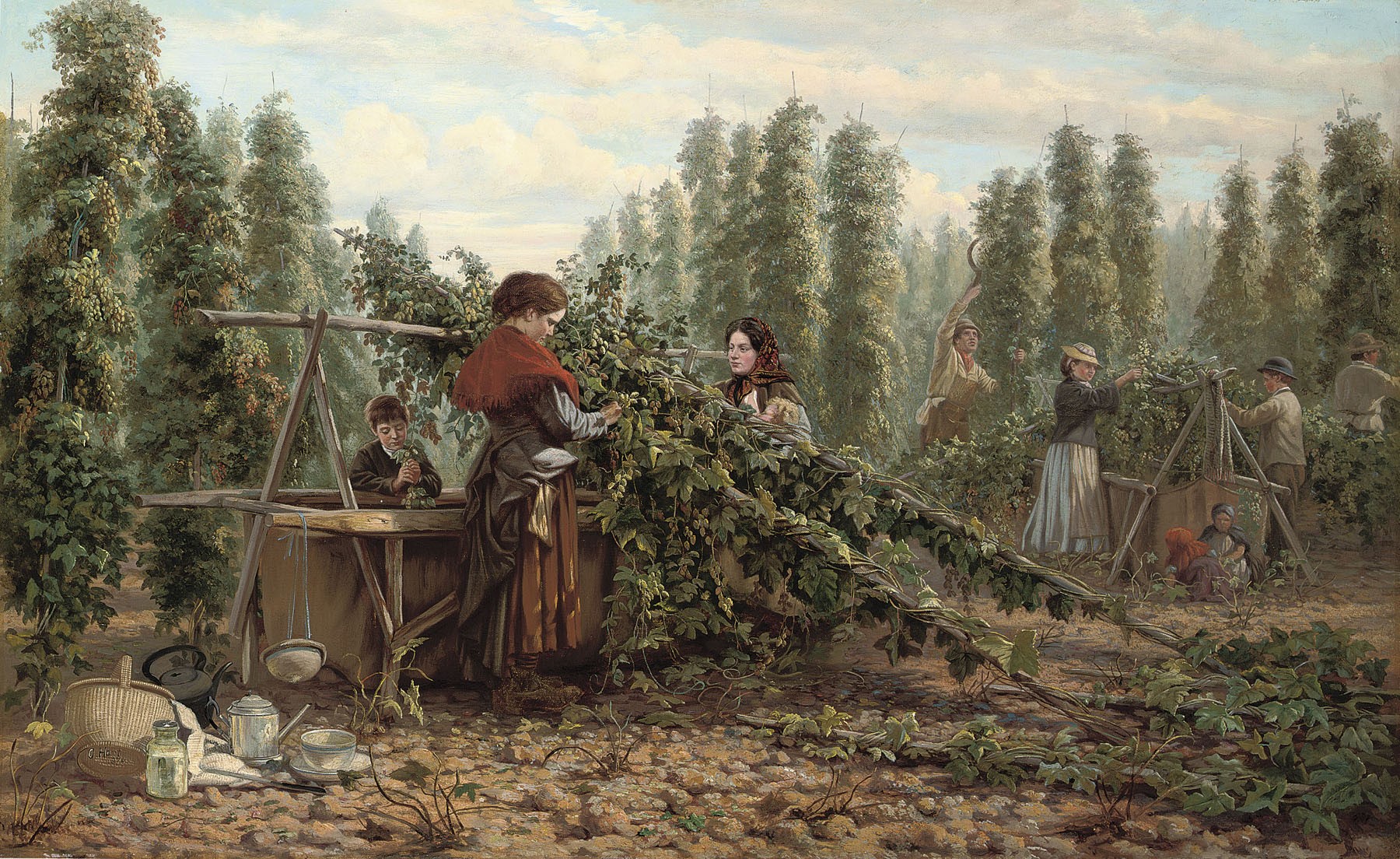
From Theology of Work Project. Image: “The Hop Pickers,” C. H. Hart. Courtesy of the Grohmann Museum at the Milwaukee School of Engineering.
Previous Post

January 28, 2014
Tent-making and the Christian life
Next Post
February 11, 2014 Aiding the poor through spending
Browse Our Archives
Select a Category Advent Ambition Bible and Work Business Calling Christmas Common Good Communication Conflict Culture Disappointment Discipleship Earth Day Easter Economics Environmental Sustainability Envy Faith and the Workplace Family and Work Generosity Giving Gossip Government Gratitude Hospitality Human Flourishing Humility Investing Justice Leadership Lent Local Church Making Mistakes Men and Work Millennials and Work Minimum Wage Money New Year Pastors Patience Pay Politics Poverty Prayer Race Rest Sabbath Sacred vs. Secular Sharing Faith Slavery Song of Songs Status Success Suffering Teamwork Thanksgiving Theology of Work TOW Project News Unemployment Valentine's Day Vocation Women and Work Work Life Balance
Select a Month September 2015 August 2015 July 2015 June 2015 May 2015 April 2015 March 2015 February 2015 January 2015 December 2014 November 2014 October 2014 September 2014 August 2014 July 2014 June 2014 May 2014 April 2014 March 2014 February 2014 January 2014 December 2013
Follow Us!
TAKE THE
Religious Wisdom Quiz
Like a sheep led to slaughter, silent before shearers, this servant was pierced for our transgressions. What chapter foretells this suffering?
Select your answer to see how you score.
Isaiah 61 Isaiah 53 Isaiah 9 Isaiah 7
Related posts from Theology of Work Project

Theology of Work Bible Commentary Vol. 2 Now...

How to Be a Rich Christian (Part 3:...

How to Be a Rich Christian (Part 1:...

Every Christian is Called to Full Time Ministry
TRENDING AT PATHEOS Business, Finance and Religion

St. Francis by Bill Droel Pope Leo XIV declares 2026 as “Year...

Catholics are schooled in the faith by memorizing dogmatic points and lots...

The Good News of Our Human Limitations -...
After another day of trying to meet deadlines and working on projects,...

Quiet Holy Attentiveness (podcast) with Sarah Clarkson
We know that quiet is an essential aspect of the spiritual life,...

Every Vocation Everywhere All At Once
What is a vocation? How does it endure through the years? Can...

I promise this is not going to become a Taylor Swift Studies...
view all Business, Finance and Religion blogs
Ad-Free & Subscriber Log-In Subscription Support
- About Us
- 2026 Calendar
- Videos
- Podcasts
- Library of World Religions
- Faith In Media Tracker
- Advertise With Us
- Write for Us
- Privacy Policy
- Terms of Service
- Do Not Sell My Data
- Contact Us
- Radiant Digital
- Manage Newsletter Subscriptions
- Unsubscribe From Notifications
- Sitemap
Copyright 2008-2026, Patheos. All rights reserved.
Subscription Support Ad-Free & Subscriber Log-In
Follow Patheos