
BuddhistCatholicContemplativeEvangelicalGeneral ChristianHinduJewishLatter-day SaintMuslimNew VisionsProgressive Christian
Beliefs
- Buddhist
- Catholic
- Contemplative
- Evangelical
- General Christian
- Hindu
- Jewish
- Latter-day Saint
- More Voices
- Muslim
- New Visions
- Pagan
- Progressive Christian
Topics
- Religion News
- Food and Religion
- Sports and Religion
- Religious Art
- Religious Music and Entertainment
- Religious Events
- History and Religion
- Style and Religion
- Politics and Religion
- Women in Religion
- Recreation Outdoors and Religion
- Business Finance and Religion
- Careers Workplace and Religion
- Education and Religion
- Family Parenting and Religion
- Health Fitness and Religion
- Home and Religion
- Relationships and Religion
- Technology and Religion
- Travel and Religion
Columnists
- Buddhist Columnists
- Business Finance and Religion Columnists
- Careers Workplace and Religion Columnists
- Catholic Columnists
- Contemplative Columnists
- Education and Religion Columnists
- Evangelists Columnists
- Family Parenting and Religion Columnists
- General Christian Columnists
- Health Fitness and Religion Columnists
- Hindu Columnists
- History and Religion Columnists
- Home and Religion Columnists
- Jewish Columnists
- More Voices Columnists
- Latter Day Columnists
- Muslim Columnists
- New Visions Columnists
- Nonreligious Columnists
- Pagan Columnists
- Politics and Religion Columnists
- Progressive Columnists
- Recreation Outdoors and Religion Columnists
- Relationships and Religion Columnists
- Religion News Columnists
- Religious Art Columnists
- Religious Events Columnists
- Religious Music and Entertainment Columnists
- Sports and Religion Columnists
- Style and Religion Columnists
- Technology and Religion Columnists
- Travel and Religion Columnists
- Women in Religion Columnists
Resource Library
- 2026 Calendar
- Library of World Religions
- The 100 Most Holy Places on Earth
- Patheos Answers
- Podcasts
- Videos
- Faith Leaders Database
- Anglican Episcopalian
- Bahai
- Baptist
- Buddhism
- Christianity
- Confucianism
- Eastern Orthodoxy
- Hinduism
- Holiness and Pentecostal
- ISKCON
- Islam
- Judaism
- Lutheran
- Methodist
- The Church of Jesus Christ of Latter-day Saints
- New Age
- Paganism
- Presbytarian and Reformed
- Protestantism
- Religion Behind the Scenes
- Roman Catholic
- Scientology
- Shia Islam
- Sikhism
- Sufism
- Sunni Islam
- Taoism
- Zen
- See all religions
Research Tools
 Ad-Free & Subscriber Log-In Subscription Support
Ad-Free & Subscriber Log-In Subscription Support
Follow Patheos 

- Trending:
- Forgiveness
- |
- Marriage
- |
- Consciousness
- |
- Death Penalty
- |
- Election
- |
- Halloween
 Theology of Work Project
- Home
- Business, Finance and Religion
- The universal call to work
The universal call to work
Last updated on: July 14, 2014 at 5:13 pm by Theology of Work Project
The universal call to work 2014-07-14T17:13:44-05:00 Theology of Work Project
Patheos Explore the world's faith through different perspectives on religion and spirituality! Patheos has the views of the prevalent religions and spiritualities of the world.
By Theology of Work Project
A remarkable connection between the book of Proverbs and the world of work occurs at the end of the book. Lady Wisdom, who we meet at the beginning of the book (Prov. 1:20-33, 8:1-9:12), reappears in street clothes in the final 22 verses of the book (Prov.31:10-31) as a living, breathing woman, termed “the virtuous woman” (KJV). She finds fulfillment in her family and ensures that “her husband is known in the city gates, taking his seat among the elders of the land” (Prov. 31:23). But the text focuses on the woman’s work as an entrepreneur with a cottage industry and its servants to manage (Prov. 31:15). Proverbs 31:10-31 does not merely apply to the workplace; it takes place in a workplace.
The book of Proverbs is summarized, then, in a poem praising a woman who is the wise manager of diverse enterprises ranging from weaving to wine making to trade in the market. Translators variously use the words “virtuous” (KJV), “capable” (NRSV), “excellent” (NASB), or “of noble character” (NIV) to describe this woman’s character in Prov. 31:10. But all these terms fail to capture the element of strength or might present in the underlying Hebrew word (chayil). When applied to a man, this same term is often translated “strength,” as in Prov. 31:3. In a great majority of its 246 appearances in the Old Testament, it applies to fighting men (e.g., David’s “mighty warriors,” 1 Chronicles 7:2).
Translators tend to downplay the element of strength when the word is applied to a woman, as with Ruth, whom English translations describe as “noble” (NIV, TNIV), “virtuous” (NRSV, KJV) or “excellent” (NASB). But the word is actually the same, whether applied to men or women. In describing the woman of Proverbs 31:10-31, its meaning is best understood as strong or valiant, as further indicated by Prov. 31:17, “She girds herself with strength, and makes her arms strong.”
To some people in the ancient near east, and even to some now, portraying a woman as a model of wise entrepreneurship would be surprising. Despite the fact that God gave the gift of work to men and women equally (Genesis 1 and 2), women’s work has often been denigrated and treated with less dignity than men’s.
But this concluding passage of Proverbs characterizes the Valiant Woman as a wise worker in five sets of practices in her workplace: trustworthiness, diligence, shrewdness or prudence, generosity, and justice. The five sets of practices observed in the Valiant Woman serve as a framework for exploring the entire book of Proverbs. She functions in the book as an affirmation of the dignity of every person’s work.
As always in the book of Proverbs, the way of wisdom flows out of the fear of the Lord. After all the Valiant Woman’s abilities and virtues are described and honored, the source of her wisdom is revealed. “A woman who fears the Lord is to be praised” (Prov. 31:30).
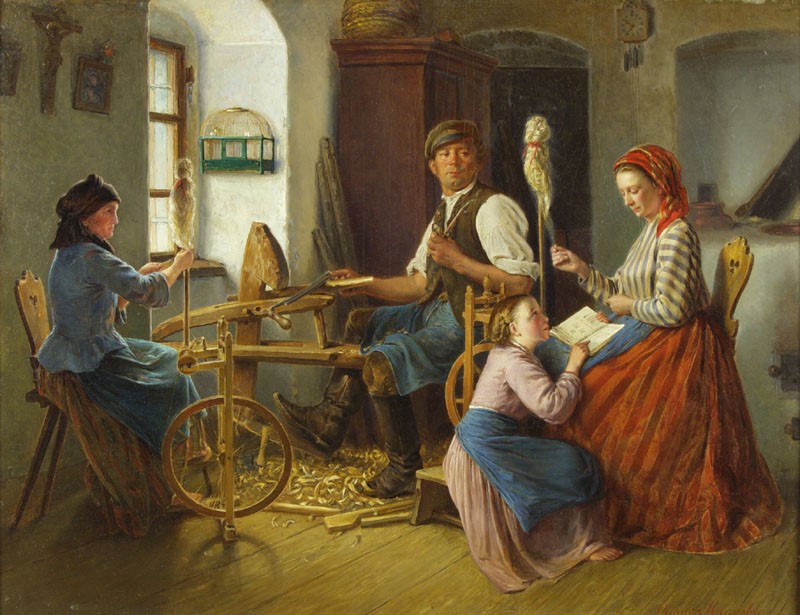
Adapted from Theology of Work Project. Image: “Interior with Artisan Family,” August Mansfeld. Courtesy of the Grohmann Museum.
Previous Post

December 20, 2013
Blessed to be a blessing
Next Post
December 26, 2013 Offering God the products of human labor
Browse Our Archives
Select a Category Advent Ambition Bible and Work Business Calling Christmas Common Good Communication Conflict Culture Disappointment Discipleship Earth Day Easter Economics Environmental Sustainability Envy Faith and the Workplace Family and Work Generosity Giving Gossip Government Gratitude Hospitality Human Flourishing Humility Investing Justice Leadership Lent Local Church Making Mistakes Men and Work Millennials and Work Minimum Wage Money New Year Pastors Patience Pay Politics Poverty Prayer Race Rest Sabbath Sacred vs. Secular Sharing Faith Slavery Song of Songs Status Success Suffering Teamwork Thanksgiving Theology of Work TOW Project News Unemployment Valentine's Day Vocation Women and Work Work Life Balance
Select a Month September 2015 August 2015 July 2015 June 2015 May 2015 April 2015 March 2015 February 2015 January 2015 December 2014 November 2014 October 2014 September 2014 August 2014 July 2014 June 2014 May 2014 April 2014 March 2014 February 2014 January 2014 December 2013
Follow Us!
TAKE THE
Religious Wisdom Quiz
What did Ezra famously do upon learning about the people's intermarriage?
Select your answer to see how you score.
Fled to Babylon Tore his robe and pulled hair Broke the tablets Fasted for 40 days
Related posts from Theology of Work Project

Theology of Work Bible Commentary Vol. 2 Now...

How to Be a Rich Christian (Part 3:...

How to Be a Rich Christian (Part 1:...

Every Christian is Called to Full Time Ministry
TRENDING AT PATHEOS Business, Finance and Religion

St. Francis by Bill Droel Pope Leo XIV declares 2026 as “Year...

Catholics are schooled in the faith by memorizing dogmatic points and lots...

The Good News of Our Human Limitations -...
After another day of trying to meet deadlines and working on projects,...

Quiet Holy Attentiveness (podcast) with Sarah Clarkson
We know that quiet is an essential aspect of the spiritual life,...

Every Vocation Everywhere All At Once
What is a vocation? How does it endure through the years? Can...

I promise this is not going to become a Taylor Swift Studies...
view all Business, Finance and Religion blogs
Ad-Free & Subscriber Log-In Subscription Support
- About Us
- 2026 Calendar
- Videos
- Podcasts
- Library of World Religions
- Faith In Media Tracker
- Advertise With Us
- Write for Us
- Privacy Policy
- Terms of Service
- Do Not Sell My Data
- Contact Us
- Radiant Digital
- Manage Newsletter Subscriptions
- Unsubscribe From Notifications
- Sitemap
Copyright 2008-2026, Patheos. All rights reserved.
Subscription Support Ad-Free & Subscriber Log-In
Follow Patheos