
BuddhistCatholicContemplativeEvangelicalGeneral ChristianHinduJewishLatter-day SaintMuslimNew VisionsProgressive Christian
Beliefs
- Buddhist
- Catholic
- Contemplative
- Evangelical
- General Christian
- Hindu
- Jewish
- Latter-day Saint
- More Voices
- Muslim
- New Visions
- Pagan
- Progressive Christian
Topics
- Religion News
- Food and Religion
- Sports and Religion
- Religious Art
- Religious Music and Entertainment
- Religious Events
- History and Religion
- Style and Religion
- Politics and Religion
- Women in Religion
- Recreation Outdoors and Religion
- Business Finance and Religion
- Careers Workplace and Religion
- Education and Religion
- Family Parenting and Religion
- Health Fitness and Religion
- Home and Religion
- Relationships and Religion
- Technology and Religion
- Travel and Religion
Columnists
- Buddhist Columnists
- Business Finance and Religion Columnists
- Careers Workplace and Religion Columnists
- Catholic Columnists
- Contemplative Columnists
- Education and Religion Columnists
- Evangelists Columnists
- Family Parenting and Religion Columnists
- General Christian Columnists
- Health Fitness and Religion Columnists
- Hindu Columnists
- History and Religion Columnists
- Home and Religion Columnists
- Jewish Columnists
- More Voices Columnists
- Latter Day Columnists
- Muslim Columnists
- New Visions Columnists
- Nonreligious Columnists
- Pagan Columnists
- Politics and Religion Columnists
- Progressive Columnists
- Recreation Outdoors and Religion Columnists
- Relationships and Religion Columnists
- Religion News Columnists
- Religious Art Columnists
- Religious Events Columnists
- Religious Music and Entertainment Columnists
- Sports and Religion Columnists
- Style and Religion Columnists
- Technology and Religion Columnists
- Travel and Religion Columnists
- Women in Religion Columnists
Resource Library
- 2026 Calendar
- Library of World Religions
- The 100 Most Holy Places on Earth
- Patheos Answers
- Podcasts
- Videos
- Faith Leaders Database
- Anglican Episcopalian
- Bahai
- Baptist
- Buddhism
- Christianity
- Confucianism
- Eastern Orthodoxy
- Hinduism
- Holiness and Pentecostal
- ISKCON
- Islam
- Judaism
- Lutheran
- Methodist
- The Church of Jesus Christ of Latter-day Saints
- New Age
- Paganism
- Presbytarian and Reformed
- Protestantism
- Religion Behind the Scenes
- Roman Catholic
- Scientology
- Shia Islam
- Sikhism
- Sufism
- Sunni Islam
- Taoism
- Zen
- See all religions
Research Tools
 Ad-Free & Subscriber Log-In Subscription Support
Ad-Free & Subscriber Log-In Subscription Support
Follow Patheos 

- Trending:
- Forgiveness
- |
- Marriage
- |
- Consciousness
- |
- Death Penalty
- |
- Election
- |
- Halloween
 Theology in the Raw
- Home
- About
- Publications
- Comment Policy
- Preston Sprinkle Website
- Eternity Bible College
- Speaking
- Event Calendar
- Living in a Gray World
- People to Be Loved
- Podcast
- Archive Index
- Home
- Evangelical
- Jerry Shepherd’s Response to Chris Date: Why Annihilation Is Wrong
Jerry Shepherd’s Response to Chris Date: Why Annihilation Is Wrong
Last updated on: March 7, 2016 at 7:54 am by Preston Sprinkle
Jerry Shepherd’s Response to Chris Date: Why Annihilation Is Wrong 2016-03-07T07:54:53-06:00 Preston Sprinkle
Patheos Explore the world's faith through different perspectives on religion and spirituality! Patheos has the views of the prevalent religions and spiritualities of the world.
We continue our discussion on the duration of hell. Here’s Jerry Shepherd’s response to Chris Date’s initial essay.
Introduction
My thanks to Chris for his well-articulated initial essay. I will, however, now attempt to “destroy” his arguments, though, of course,
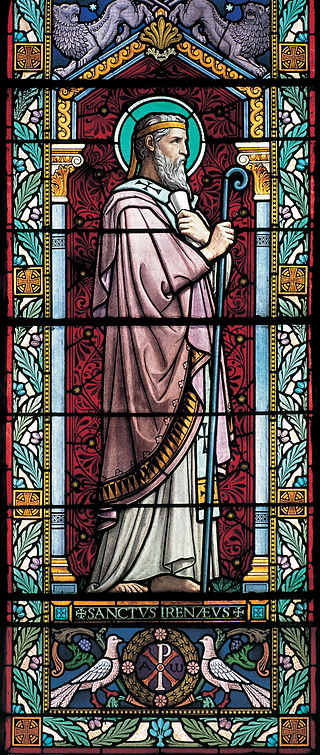
Irenaus, in Church of St Irenaeus, Lyon.
those arguments will continue to exist! And by the way, Chris, please feel free to call me Jerry in our continued discussion.
Before getting to Chris’s four main points, it is necessary for me to address some problems with his introductory comments. The citations from Ignatius and Irenaeus do not really support Chris’s point. Ignatius, in his Epistle to the Magnesians 10,[1] does not say that “we should cease to be.” This is an older and misleading translation of ouketi esmen, more literally “we are no longer,” and recognized by most translators to be better rendered idiomatically as something like “we are undone,” or “we are lost.”[2] This statement is not really addressing the question of existence; it is nothing more than a restatement of Ps 130:3.
Irenaeus (my hero!), in the same chapter which Chris cites, makes use of the Abraham/rich man/Lazarus passage in Luke 16 to argue for the continued existence of souls in eternity. And there are other passages in Against Heresies in which Irenaeus argues for the immortality (in terms of continued existence) of the soul; i.e., God has made all souls immortal.[3] Irenaeus can talk about conferred immortality on believers; yet he can also talk about an immortality which is the property of the soul as created. It is more likely, then, that in the cited passage, Irenaeus is referring here to immortality as life in the presence of God, and that he is contrasting that to what might be referred to as the merely sensate existence of souls in eternal punishment, a teaching which he received from his instructor, Justin Martyr.[4] So, as opposed to Chris’s statement that this conditionalist view was “eclipsed by the traditional view,” I would argue that this view was never really there to be eclipsed. Conditionalist attempts to turn the early church fathers into conditionalists have not proven to be convincing.
#1 Arguments from OT Analogies and Lexicography
The argument from NT passages which make analogies from OT citations fails, in my opinion, to consider the issue of continuity and discontinuity. One very important discontinuity to take into account is that the OT passages are referring to this-worldly judgments, whereas the NT passages are dealing with other-worldly judgments, on the other side of the resurrection of both the righteous and the wicked. The continuities highlighted in 2 Pet 2:4-9, e.g., have to do the sin of the wicked, the punishment they receive for their wickedness, and the Lord’s ability to save the righteous at the same time he is punishing the wicked. The point is not the method of punishment: for the fallen angels it’s chains and darkness; for Noah’s day it’s flood rather than fire. Nor is the point even the completeness of destruction—the angels are still very much alive! In other words, my point is that in this argument passages are being pressed into service to make a point which they really do not address.
The arguments made from the lexical definitions of apollymi, katakaiō, and thanatos, though not unimportant, I believe are relativized by passages which I argue necessitate our understanding these terms as being used in less than an absolute sense. Furthermore, a principle from the discipline of textual criticism has an analogy with regard to lexicography as well. Textual critics recognize that manuscripts must be weighed, not counted. I argue that the same thing is true with regard to lexical study. Lexical occurrences must be weighed, not counted. Fifty occurrences of appolymi, understood too absolutely and narrowly, do not outweigh, and must be interpreted in the context of, plain statements regarding the conscious nature of eternal punishment.
#2 Arguments from scriptural teaching on mortality and immortality
Much of what Chris says in this section I readily agree with. The problem I have, however, is the non sequitur involved. This is the reason why, in my initial essay, I made the points I did with regard to the OT. Yes, Adam and Eve did indeed lose their immortality (or hope of it). Yes, they were barred access to the Tree of Life. And, yes, they died. But they did not lose their immortality absolutely. The overarching OT conception is that everyone goes to sheol, and continues to exist there, at some level of consciousness, in a state of either rest or restlessness. They have lost their immortality, per se, and yet they exist. In the NT, as well as in the early church fathers, immortality does not always simply refer to continued existence. It certainly includes that, but it also refers to the quality of that existence. In the passage that Chris quoted earlier from Ignatius in his Epistle to the Ephesians 17 , “that he might breathe immortality into his church,” Michael Holmes translates rather as, “that he might breathe incorruptibility upon the church” (my emphasis; the Greek word is aphtharsia).[5] Immortality does not always simply mean “continued existence,” but it can also refer to the concomitants of that existence, and in some cases, primarily or even only to those concomitants: incorruptibility, life in God’s presence, life abundant. God alone is immortal, and he grants immortality to the righteous. But this does not mean that the wicked do not have a continued existence that can also in some sense be referred to as eternal or immortal, but without the same qualities of that existence which are enjoyed by the righteous.
#3 Arguments based on the atonement
First, let me commend my brother for strongly stating what he correctly identifies as the orthodox view of the atonement as substitutionary (which I will also affirm as penal and not “otherwise”). However, I am not sure I understand the point he is making. Nor do I understand what he means when, replying to a comment on his post, he says that in conditionalism Jesus’ death was “actually substitutionary,” and that conditionalism believes that Jesus’ death was “truly substitutionary,” and that “unlike ECT in which his death is arbitrary, conditionalism elevates the glory of the cross.” I’m afraid I’ll need Chris to unpack this one for me. But, just in case I actually do understand what he is saying, it seems to me to be a complete non sequitur. I believe that Christ died a death that was of infinite worth in atoning for sin. And I certainly believe that he did, indeed, actually die. But I do not believe that, for that period between three o’clock Friday afternoon and six o’clock Sunday morning, the Second Person of the Trinity ceased to have a conscious existence. Jesus died in our place, and Christ’s atonement, most particularly, had to with the “second death,” which I believe Scripture characterizes as an eternal conscious experience. And if this is the case, then Chris’s argument here has no force or substance.
#4 Arguments based on ECT’s misuse and misunderstanding of proof texts
I have already, in #1, commented on the use of imagery from OT texts in NT descriptions of the afterlife, so I won’t repeat that here, inasmuch as these are not my proof texts. I will say more about Matt 25:46 and 2 Thess 1:9 in later posts.
The only thing I will respond to here are the comments on Rev 14:9-11 and 20:10-15. First, I deny that these texts can be understood to be “better support of annihilationism.” They may be ignored, discounted, or relativized on account of the book’s apocalyptic imagery. But they cannot be used, opposite their express meaning, to support conditionalism. I completely agree with Chris that the “inspired interpretation” contained in these passages carries “more authority than that of anyone since.” But I would also argue that the best understanding—the only viable understanding—of these passages is that their very clear statements—“ the smoke of their torment will rise for ever and ever”; “they have no rest day or night”; “they will be tormented day and night for ever and ever”—inform us as to what is truly meant by the second death. It is, in fact, a conscious deathly existence, one that develops the OT concept of the “living corpse.”
Conclusion
I very much appreciate Chris’s first concluding paragraph, and, of course, disagree with the second, except for the statement about atonement. I look forward to our continued exchange.
Footnotes
[1] Rather than the Epistle to the Ephesians.
[2] See, e.g., the more idiomatic renderings of J. B. Lightfoot, J. H. Srawley, Kirsopp Lake, and more recently, Michael W. Holmes, Apostolic Fathers: Greek Texts and English Translations (3d ed.; Grand Rapids: Baker, 2007), 208-9.
[3] E.g., 5.4.1; 5.7.1; 5.13.3.
[4] E.g., First Apology 8, 18, 20, 52, 57.
[5] Holmes, Apostolic Fathers, 196-97.
Previous Post

March 4, 2016
Conscious in Death: A Response to Jerry Shepherd
Next Post
March 8, 2016 What Do You Believe About Hell?
Browse Our Archives
Select a Category 40 Questions A Letter to my congregation adoption Alan Chambers Alcohol America american Jesus andrew marin angels Anne Paulk Annihilation apology Apostles creed atonement AudioFeed Balkhu Baptism bastard being biblical believer's baptism bible Bible College biblical love biblical studies Boise book review Books buzzwords called celibacy Center for Pastoral Theologians Charis charleston shooting cherubim christian movies Christian teens Christianeze Christmas church Church Refugees civil rights college debt communal faith Conditional Immortality conference david gushee debt free education Dechurched derwin gray desiring the kingdom Discipleship Don Miller Dones ecclesia and ethics Erasing Hell Esther eternal conscious torment Eternity Bible College ethnic diversity ETS eunuch evangelicalism Fight Four Views on Hell Francis Chan Francis Watson Free Bible Resources French Quarter grace gran torino gun control haters hell holy war homeschool homosexuality house church immigration Incarnation individualism Infant Baptism interpretation Intersex Israel James Dunn james smith Jerry Fallwell Jr. Jessica Minassian Jesus Jesus refugee Joey Dodson John MacArthur John Piper John Stott Josh Packard Joshua Ryan Butler judgment Justification Karl Barth Ken Wilson Kevin DeYoung Lance Hancock Leper lesbian LGBT LGBTQ Life Love God liturgy living in a gray world Luke 22 martin luther king mary magdalene Matthew Vines Megan DeFranza Michael Bird millennials Ministry Missions mixed orientation marriage movies Multiethnic churches Music Festival My Exodus N.T. Wright nationalism New Perspective New Year resolution nonviolence obedience Old Testament Online Biblical Training orlando massacre Pacifism parenting pastoral ministry Pastoral Theologian patriotism people to be loved personal relationship with Jesus politics poverty Prayer Preston Sprinkle Project Bayview public square Q Conference qualifications for ministry Racial Reconciliation radio show Reading reading plan real Christianity Reformed refugee refugee crisis rick hogaboam robb bell robert gagnon Romans Romans 13 Romans 9 sam allberry same sex attraction sanctification school segrated churches seraphim sex Sex Difference in Christian Theology sexual fluidity Shawn Gordon short term missions Skeletons in God's Closet Slums Sodom Speaking syrian refugee crisis technology teen girls texting The Bible Project The Gospel Coalition the high definition leader theology Third Way Tim Mackie Touch Nepal trols UK Tour Uncategorized Urban Ministry Us vs. Us Vieux Carre Baptist Church violence vocation Waiting warfare welcome the stranger women women in ministry worship songs writing
Select a Month August 2016 June 2016 May 2016 April 2016 March 2016 February 2016 January 2016 December 2015 November 2015 October 2015 September 2015 August 2015 July 2015 June 2015 May 2015 April 2015 March 2015 February 2015 January 2015 December 2014 November 2014 October 2014 September 2014
Follow Us!
TAKE THE
Religious Wisdom Quiz
In 2 Thessalonians, what does Paul say the man of lawlessness will proclaim himself to be?
Select your answer to see how you score.
A prophet The Messiah God King of the world
Related posts from Theology in the Raw



Chris Date's Second Rebuttal to Jerry Shepherd
TRENDING AT PATHEOS Evangelical

The REST of Your Life: A Creative Wrestles...
This week I had a conversation with a good friend from church....

How the author of the world's best hymn...
I've been working with John Newton for a while now. This makes...

Long before this Lectio Divina, Psalm 130 - the song - started...

What About the Trees? Another Living Parable
After I finished writing the last article about falling leaves as a...

Why Classical Education Is a Conversation, Not a...
Come and Read: Joy in Classical Education When I was a little...

Cornell University has received a great deal of negative publicity and intense...
view all Evangelical blogs
Ad-Free & Subscriber Log-In Subscription Support
- About Us
- 2026 Calendar
- Videos
- Podcasts
- Library of World Religions
- Faith In Media Tracker
- Advertise With Us
- Write for Us
- Privacy Policy
- Terms of Service
- Do Not Sell My Data
- Contact Us
- Radiant Digital
- Manage Newsletter Subscriptions
- Unsubscribe From Notifications
- Sitemap
Copyright 2008-2026, Patheos. All rights reserved.
Subscription Support Ad-Free & Subscriber Log-In
Follow Patheos