
BuddhistCatholicContemplativeEvangelicalGeneral ChristianHinduJewishLatter-day SaintMuslimNew VisionsProgressive Christian
Beliefs
- Buddhist
- Catholic
- Contemplative
- Evangelical
- General Christian
- Hindu
- Jewish
- Latter-day Saint
- More Voices
- Muslim
- New Visions
- Pagan
- Progressive Christian
Topics
- Religion News
- Food and Religion
- Sports and Religion
- Religious Art
- Religious Music and Entertainment
- Religious Events
- History and Religion
- Style and Religion
- Politics and Religion
- Women in Religion
- Recreation Outdoors and Religion
- Business Finance and Religion
- Careers Workplace and Religion
- Education and Religion
- Family Parenting and Religion
- Health Fitness and Religion
- Home and Religion
- Relationships and Religion
- Technology and Religion
- Travel and Religion
Columnists
- Buddhist Columnists
- Business Finance and Religion Columnists
- Careers Workplace and Religion Columnists
- Catholic Columnists
- Contemplative Columnists
- Education and Religion Columnists
- Evangelists Columnists
- Family Parenting and Religion Columnists
- General Christian Columnists
- Health Fitness and Religion Columnists
- Hindu Columnists
- History and Religion Columnists
- Home and Religion Columnists
- Jewish Columnists
- More Voices Columnists
- Latter Day Columnists
- Muslim Columnists
- New Visions Columnists
- Nonreligious Columnists
- Pagan Columnists
- Politics and Religion Columnists
- Progressive Columnists
- Recreation Outdoors and Religion Columnists
- Relationships and Religion Columnists
- Religion News Columnists
- Religious Art Columnists
- Religious Events Columnists
- Religious Music and Entertainment Columnists
- Sports and Religion Columnists
- Style and Religion Columnists
- Technology and Religion Columnists
- Travel and Religion Columnists
- Women in Religion Columnists
Resource Library
- 2026 Calendar
- Library of World Religions
- The 100 Most Holy Places on Earth
- Patheos Answers
- Podcasts
- Videos
- Faith Leaders Database
- Anglican Episcopalian
- Bahai
- Baptist
- Buddhism
- Christianity
- Confucianism
- Eastern Orthodoxy
- Hinduism
- Holiness and Pentecostal
- ISKCON
- Islam
- Judaism
- Lutheran
- Methodist
- The Church of Jesus Christ of Latter-day Saints
- New Age
- Paganism
- Presbytarian and Reformed
- Protestantism
- Religion Behind the Scenes
- Roman Catholic
- Scientology
- Shia Islam
- Sikhism
- Sufism
- Sunni Islam
- Taoism
- Zen
- See all religions
Research Tools
 Ad-Free & Subscriber Log-In Subscription Support
Ad-Free & Subscriber Log-In Subscription Support
Follow Patheos 

- Trending:
- Forgiveness
- |
- Marriage
- |
- Consciousness
- |
- Death Penalty
- |
- Election
- |
- Halloween
 Theology in the Raw
- Home
- About
- Publications
- Comment Policy
- Preston Sprinkle Website
- Eternity Bible College
- Speaking
- Event Calendar
- Living in a Gray World
- People to Be Loved
- Podcast
- Archive Index
- Home
- Evangelical
- What Does it Mean to “Become More Like Jesus?”
What Does it Mean to “Become More Like Jesus?”
Last updated on: December 14, 2015 at 8:00 pm by Preston Sprinkle
What Does it Mean to “Become More Like Jesus?” 2015-12-14T11:32:03-06:00 Preston Sprinkle
Patheos Explore the world's faith through different perspectives on religion and spirituality! Patheos has the views of the prevalent religions and spiritualities of the world.
I’m one of those guys who has an extra sensitive Christian cliché antenna. Some call it a

Pic from Wiki (public domain)
BS meter. It picks up on all kinds of chatter through the church airwaves and demands a concrete explanation. So when I hear Christians say “I want to become more like Jesus,” my meter goes nuts. Not that it’s a bad thing. Becoming more like Jesus is a good thing. But what is this good thing? What does it look like? What does it smell like? What does it mean to “become more like Jesus?”
When people say they want to become more like Jesus, they usually mean they want to become a moral person. Such morality is often defined by religious values shaped by a modern Christian subculture—not all of which is bad. My suspicion, though, is that if we look closely at Jesus without our modern moralistic filter, fewer people would want to become more like Jesus.
Jesus was an unmarried peasant who didn’t put his “family first.” All of his followers were mothers and brothers and sisters and children. Most of his friends were criminals or living sinful lifestyles. Jesus had hardly any friends who would be considered “religious.” He spent most of his time with drunks, gluttons, fornicators, and thieves. He was so close to “sinners” that the religious leaders thought he was one. And nearly everything Jesus said and did made religious people mad.
Jesus was executed by the state for treason, and his followers, who took his words seriously, were seen as a threat—not a friend—to the political powers to be. The similarities between Roman values and American values are striking. Yet so is the American church’s unchecked adoption of such Roman (and American) values. Our addiction to comfort and security and material possessions that we stuff into our bulging barns mirrors the pax Romana but is a far cry from the peace of Christ which includes simplicity, suffering, and death.
One of Jesus’s favorite topics had to do with money. And this got people really riled up. “Sell your possessions, and give to the needy” (Luke 12:33). “Any one of you who does not renounce all that he has cannot be my disciple” (Luke 14:33). He told a wealthy and moral leader to “sell all that you have and distribute to the poor, and you will have treasure I heaven; and come, follow me” (Luke 18:22). In his first—and foundational—sermon, Jesus said he has been “anointed…to proclaim good news to the poor” (Luke 4:18). Not poor in Spirit but actual poor people (cf. Luke 6:20). In Matthew 25, one of the most terrifying passages in the Bible, Jesus describes judgment day in detail and His criterion for who’s in and who’s out has to do with whether you and I have served the poor and needy in this life (25:31-46).
Are you a Christian?
Are you serving the poor and needy?
If Jesus means what He says in Matthew 25, will you receive a positive or negative verdict on judgment day?
Some people say that what Jesus really means is that we are saved by grace through faith and whether we serve the poor is largely irrelevant for God’s verdict on judgment day. The classic evangelistic line, “If you were to die today and God were to ask you, ‘why should I let you into my kingdom?’ what would you say?” The expected right answer is usually limited to right belief (Jesus) divorced from the right behavior that follows that belief (serving the poor).
According to Matthew 25, part of what you should say—indeed, what we all need to say—is “I served the least of these.” Part of what it means to become more like (the biblical) Jesus is becoming excessively generous with our material wealth and having the scent of poverty on our hands and feet.
Jesus also talked a lot about love. “This is my commandment, that you love one another as I have loved you” (John 15:12) and “Greater love has no one than this, that someone lay down his life for his friends” (John 15:13). When most people think of Jesus, they think of love. And they’re right to do so. And Jesus didn’t just talk about it. He lived it. He love touched lepers, embraced sinners, healed the sick, and extended forgiveness to adulterers seconds after they sinned. It is love—unconditional, agape love—that binds believers together, and knits us to the heart of our triune God (John 17:26). Jesus breaks new ground by going beyond what Leviticus says about loving your neighbor as yourself (Lev 19:18). He extends love to include one’s enemies (Matt 5:44-45). Take a quick look at the early Church and you’ll see that enemy-love would become the hallmark of Christianity long after Jesus’s resurrection. When people thought of Christians, they recognized them as the people who, like Jesus, love their enemies.
Jesus also upheld many aspects of the Jewish law. He affirmed the Ten Commandments, though he did some interesting things with the Sabbath (Matt 12:1-8). When it came to sexual laws like lust, adultery, divorce and remarriage, Jesus was even stricter than most
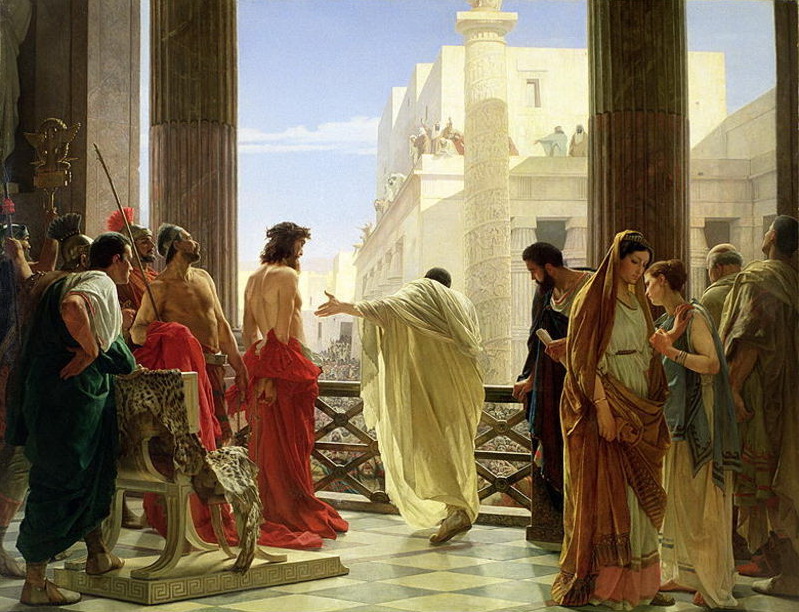
Ecce homo! Antonio Ciseri’s 1871 depiction of Pontius Pilate presenting Jesus to the public (pic is public domain)
rabbis of his day. Celibacy is praised. Divorce is ruled out except for fornication, and gazing on a woman is akin to adultery. Jesus’s deep friendship with sinners doesn’t change the fact that his sermon on the mount (Matt 5-7) still stands as one of the strictest ethical speeches in all of religious history, making even Moses look like he was soft on sin.
Jesus’s hard-hitting, enemy-loving, harlot-embracing, wild-eyed way of life is captured in his famed call to come die with him. “If anyone would come after me”—that is, become a disciple, a Christian—“let him deny himself and take up his cross daily and follow me” (Luke 9:23). As Deitrich Bonhoeffer used to say, “When Jesus calls a man, he bids him to come and die.”
If a one of the Na’vi left planet Pandora and visited earth, would they notice a peculiar people? Would they recognize a sub-section of humanity that’s marked by self-denial, enemy-love, and a counter-cultural sexual ethic? Or would we blend into the sea of those who are “lovers of self, lovers of money…lovers of pleasure rather than lovers of God” (1 Tim 3)?
Jesus looked very different than the religious and political majority culture. Do we?
Previous Post

December 10, 2015
Put Homophobia to Death
Next Post
December 16, 2015 5 Bad Reasons for Believing that Homosexuality Is a Sin
Browse Our Archives
Select a Category 40 Questions A Letter to my congregation adoption Alan Chambers Alcohol America american Jesus andrew marin angels Anne Paulk Annihilation apology Apostles creed atonement AudioFeed Balkhu Baptism bastard being biblical believer's baptism bible Bible College biblical love biblical studies Boise book review Books buzzwords called celibacy Center for Pastoral Theologians Charis charleston shooting cherubim christian movies Christian teens Christianeze Christmas church Church Refugees civil rights college debt communal faith Conditional Immortality conference david gushee debt free education Dechurched derwin gray desiring the kingdom Discipleship Don Miller Dones ecclesia and ethics Erasing Hell Esther eternal conscious torment Eternity Bible College ethnic diversity ETS eunuch evangelicalism Fight Four Views on Hell Francis Chan Francis Watson Free Bible Resources French Quarter grace gran torino gun control haters hell holy war homeschool homosexuality house church immigration Incarnation individualism Infant Baptism interpretation Intersex Israel James Dunn james smith Jerry Fallwell Jr. Jessica Minassian Jesus Jesus refugee Joey Dodson John MacArthur John Piper John Stott Josh Packard Joshua Ryan Butler judgment Justification Karl Barth Ken Wilson Kevin DeYoung Lance Hancock Leper lesbian LGBT LGBTQ Life Love God liturgy living in a gray world Luke 22 martin luther king mary magdalene Matthew Vines Megan DeFranza Michael Bird millennials Ministry Missions mixed orientation marriage movies Multiethnic churches Music Festival My Exodus N.T. Wright nationalism New Perspective New Year resolution nonviolence obedience Old Testament Online Biblical Training orlando massacre Pacifism parenting pastoral ministry Pastoral Theologian patriotism people to be loved personal relationship with Jesus politics poverty Prayer Preston Sprinkle Project Bayview public square Q Conference qualifications for ministry Racial Reconciliation radio show Reading reading plan real Christianity Reformed refugee refugee crisis rick hogaboam robb bell robert gagnon Romans Romans 13 Romans 9 sam allberry same sex attraction sanctification school segrated churches seraphim sex Sex Difference in Christian Theology sexual fluidity Shawn Gordon short term missions Skeletons in God's Closet Slums Sodom Speaking syrian refugee crisis technology teen girls texting The Bible Project The Gospel Coalition the high definition leader theology Third Way Tim Mackie Touch Nepal trols UK Tour Uncategorized Urban Ministry Us vs. Us Vieux Carre Baptist Church violence vocation Waiting warfare welcome the stranger women women in ministry worship songs writing
Select a Month August 2016 June 2016 May 2016 April 2016 March 2016 February 2016 January 2016 December 2015 November 2015 October 2015 September 2015 August 2015 July 2015 June 2015 May 2015 April 2015 March 2015 February 2015 January 2015 December 2014 November 2014 October 2014 September 2014
Follow Us!
TAKE THE
Religious Wisdom Quiz
Which Christian principle is in "Do unto others as you would have them do unto you"?
Select your answer to see how you score.
Keep to yourself The Golden Rule Never forgive Always judge
Related posts from Theology in the Raw


Jerry Shepherd's Second Rebuttal to Chris Date
Jerry Shepherd's Response to Chris Date: Why Annihilation...
TRENDING AT PATHEOS Evangelical

The REST of Your Life: A Creative Wrestles...
This week I had a conversation with a good friend from church....

How the author of the world's best hymn...
I've been working with John Newton for a while now. This makes...

Long before this Lectio Divina, Psalm 130 - the song - started...

What About the Trees? Another Living Parable
After I finished writing the last article about falling leaves as a...

Why Classical Education Is a Conversation, Not a...
Come and Read: Joy in Classical Education When I was a little...

Cornell University has received a great deal of negative publicity and intense...
view all Evangelical blogs
Ad-Free & Subscriber Log-In Subscription Support
- About Us
- 2026 Calendar
- Videos
- Podcasts
- Library of World Religions
- Faith In Media Tracker
- Advertise With Us
- Write for Us
- Privacy Policy
- Terms of Service
- Do Not Sell My Data
- Contact Us
- Radiant Digital
- Manage Newsletter Subscriptions
- Unsubscribe From Notifications
- Sitemap
Copyright 2008-2026, Patheos. All rights reserved.
Subscription Support Ad-Free & Subscriber Log-In
Follow Patheos