
BuddhistCatholicContemplativeEvangelicalGeneral ChristianHinduJewishLatter-day SaintMuslimNew VisionsProgressive Christian
Beliefs
- Buddhist
- Catholic
- Contemplative
- Evangelical
- General Christian
- Hindu
- Jewish
- Latter-day Saint
- More Voices
- Muslim
- New Visions
- Pagan
- Progressive Christian
Topics
- Religion News
- Food and Religion
- Sports and Religion
- Religious Art
- Religious Music and Entertainment
- Religious Events
- History and Religion
- Style and Religion
- Politics and Religion
- Women in Religion
- Recreation Outdoors and Religion
- Business Finance and Religion
- Careers Workplace and Religion
- Education and Religion
- Family Parenting and Religion
- Health Fitness and Religion
- Home and Religion
- Relationships and Religion
- Technology and Religion
- Travel and Religion
Columnists
- Buddhist Columnists
- Business Finance and Religion Columnists
- Careers Workplace and Religion Columnists
- Catholic Columnists
- Contemplative Columnists
- Education and Religion Columnists
- Evangelists Columnists
- Family Parenting and Religion Columnists
- General Christian Columnists
- Health Fitness and Religion Columnists
- Hindu Columnists
- History and Religion Columnists
- Home and Religion Columnists
- Jewish Columnists
- More Voices Columnists
- Latter Day Columnists
- Muslim Columnists
- New Visions Columnists
- Nonreligious Columnists
- Pagan Columnists
- Politics and Religion Columnists
- Progressive Columnists
- Recreation Outdoors and Religion Columnists
- Relationships and Religion Columnists
- Religion News Columnists
- Religious Art Columnists
- Religious Events Columnists
- Religious Music and Entertainment Columnists
- Sports and Religion Columnists
- Style and Religion Columnists
- Technology and Religion Columnists
- Travel and Religion Columnists
- Women in Religion Columnists
Resource Library
- 2026 Calendar
- Library of World Religions
- The 100 Most Holy Places on Earth
- Patheos Answers
- Podcasts
- Videos
- Faith Leaders Database
- Anglican Episcopalian
- Bahai
- Baptist
- Buddhism
- Christianity
- Confucianism
- Eastern Orthodoxy
- Hinduism
- Holiness and Pentecostal
- ISKCON
- Islam
- Judaism
- Lutheran
- Methodist
- The Church of Jesus Christ of Latter-day Saints
- New Age
- Paganism
- Presbytarian and Reformed
- Protestantism
- Religion Behind the Scenes
- Roman Catholic
- Scientology
- Shia Islam
- Sikhism
- Sufism
- Sunni Islam
- Taoism
- Zen
- See all religions
Research Tools
 Ad-Free & Subscriber Log-In Subscription Support
Ad-Free & Subscriber Log-In Subscription Support
Follow Patheos 

- Trending:
- Forgiveness
- |
- Marriage
- |
- Consciousness
- |
- Death Penalty
- |
- Election
- |
- Halloween

- Home
- Evangelical
- Sports and Religion
- Olympics 2024: Celebrating Dionysius at The Lord’s Table?
Olympics 2024: Celebrating Dionysius at The Lord’s Table?
Last updated on: August 2, 2024 at 11:44 am by Anthony Costello
Olympics 2024: Celebrating Dionysius at The Lord’s Table? 2024-08-02T11:44:53-07:00 Anthony Costello
Patheos Explore the world's faith through different perspectives on religion and spirituality! Patheos has the views of the prevalent religions and spiritualities of the world.
Editors Note: This is a guest post by Christian author and speaker Kaon Serjani.
Immediately following the Opening Ceremony of the Paris 2024 Olympics, there was global controversy among Christians who interpreted certain segments as a mockery of Da Vinci’s The Last Supper. Some organizers clarified that it was intended to depict Bacchanalia, an ancient Roman festival honoring (Dionysus). Throughout history, Bacchanalia has involved dancing, singing, and revelry, focused on the worship of Dionysus, the Olympian god revered in Greco-Roman religion as the deity of nature, fertility, vegetation, wine, and ecstasy. According to the Merriam-Webster dictionary, Bacchanalia also means “orgy.”
The Intent of the Organizer’s Imagery
For those unfamiliar with Da Vinci’s painting, it portrays the biblical account of Jesus sharing his last Passover meal with his disciples, where he discusses the forthcoming sacrifice he will make to atone for the sins of humanity. This image holds significant importance in Christian faith, and the portrayal of this scene in a mocking manner parallels the mockery Jesus endured in the hours leading up to his crucifixion.
Art historian, Sasha Grishin, who is professor emeritus at the Australian National University, said for The New York Times that
The idea of the central figure with a halo and a group of followers on either side — it’s so typical of ‘The Last Supper’ iconography that to read it in any other way might be a little foolhardy
“An Olympic Scene Draws Scorn. Did it Really Parody ‘The Last Supper?'” by Yan Zhuang
The ambiguity of the organizers’ intentions has finally been resolved. The producers of the Opening Ceremony admitted in a statement that
For the ‘Festivities’ segment, Thomas Jolly took inspiration from Leonardo da Vinci’s famous painting to create the setting,
and then added that
Clearly, there was never an intention to show disrespect towards any religious group or belief … [Jolly] is not the first artist to make a reference to what is a world-famous work of art. From Andy Warhol to ‘The Simpsons,’ many have done it before him.
“Paris Olympic Producers Say ‘Las Supper’ Inspired The Opening Ceremony Scene” by Stephanie Kaloi
After hearing from all parties—the organizers, Christian leaders, and independent observers—it appears unnecessary to decide whether the show depicted The Last Supper or Bacchanalia. It encompassed both. This dual portrayal may itself be enlightening. The event celebrated Dionysus at the table of Jesus’s last supper with his disciples, making the show not just a mockery of Christianity but also an affirmation of ancient Greek paganism. It can be seen as a statement of substitution, replacing the former with the latter.
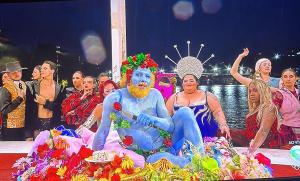
A Pagan Parody of “The Last Supper?”
But Why Dionysius?
Why Dionysus? If we give it some thought, it appears to be a deliberate choice rather than a coincidence. When the German philosopher Friedrich Nietzsche critiqued Christianity in the 19th century and called for a return to pagan culture, he selected Dionysus as his ideal among the Olympian gods. Nietzsche viewed Dionysus as a counterpart to Jesus, famously coining the phrase “Dionysus against the Crucified.” For Nietzsche, “The god on the cross [Christ] is a curse on life,” while “Dionysus … is a promise of life.”
Nietzsche explained,
We few or many who again dare to live in a demoralized world, we pagan in faith: we are probably also first to grasp what a pagan faith is . . . We believe in Olympus—and not in the ‘Crucified.’
Nietzsche, The Will to Power
Thus, despite his generic anti-religious stance, Nietzsche clarified there was one kind of religious man he did not exclude from his philosophy of life: the pagan.
The scene that sparked controversy during the Opening Ceremony seemed to endorse a revival of pre-Christian morality, evoking the Greek pagan era through a Nietzschean lens. It openly suggested celebrating Dionysus over Jesus. One fundamental reason for this perspective stems from Jesus’s advocacy for an exclusive moral framework that delineates clear boundaries between right and wrong in various aspects of human life, including sexuality—a stance that conflicts with the sentiments of many in the West today.
No serious historian disputes that Western civilization has been deeply influenced by Christian morals for millennia. Larry W. Hurtado argued in his 2017 book that since the first century, Jesus has been depicted as a “destroyer of the gods.” Hurtado illustrates how Jesus’ movement introduced a distinctive religious identity with ethical principles that set it apart from Greek religions. If Jesus, and consequently Christianity, were merely one among many moral interpretations, Nietzsche would probably not have objected. In The Birth of Tragedy, Nietzsche observed, in paganism, an inclusive and pluralistic religious culture where multiple moralities coexisted. No pagan god asserted dominance over any other; each presided over their own domain of life: for example, the god of war did not interfere with the god of fertility, and there was no “claim to priority of rank.”
The Christian God, on the other hand, in alignment with the Jewish concept of deity, exalted Himself above all other gods, condemning them as false deities. In Thus Spake Zarathustra, Nietzsche wrote that
That happened, when the most godless word issued from one of the gods themselves—the word: ‘There is one god. Thou shalt have no other god before me!’
Consequently, Nietzsche blamed Judeo-Christian faith for the demise of pagan gods and accused it of advocating an exclusive morality. In The Will to Power, he went even further to add
I have declared war on the anemic Christian ideal…, not with the aim of destroying it but only of putting an end to its tyranny and clearing the way for new ideals, for more robust ideals.
Olympics 2024 and The New Old Ideals of Neopaganism
English philosopher Frederick Copleston concurred that
Dionysus, for Nietzsche, symbolizes the unbridled stream of life itself, breaking down all barriers and disregarding all restraints.
Copleston, A History of Philosophy, Vol. VII
The Festivals of Dionysus in ancient Athens are known in history for gatherings where societal norms were challenged and behaviors, typically taboo, such as indulging in sexual activities, were embraced. Christianity, from its inception, opposed this ethos. That is why, the “will to a single morality” is for Nieztsche “a tyranny over other types.” Within this context, featuring Dionysus at “The Last Supper” during the Opening Ceremony serves as a Nietzschean declaration aimed at overthrowing the perceived “tyranny” of Christian ideals and ethics. It is the pagan reassertion over its one-time conqueror. As Chesterton once quipped, “Paganism was the biggest thing, Christianity was bigger, everything since has been comparatively small.” Well, in Paris, paganism made the most recent attempt to get big again.
Both Christianity and Nietzsche’s paganism aim at the salvation of humanity, each with soteriological objectives. Giles Fraser in his book Redeeming Nietzsche, agrees that “Nietzsche uses Dionysus to articulate a post-Christian soteriology parallel to ‘traditional’ atonement theology.” While Christianity seeks to redeem humanity from the consequences of sin, Nietzsche sought to liberate humanity from Christianity itself, which he perceived as attributing inherent sinfulness to every individual. Christianity aims to unite humanity with Christ, whereas Nietzsche seeks a connection with Dionysus. Christianity aims to save humanity from sin and guilt through the crucifixion; Nietzsche aims to liberate humanity from sin and guilt by denying their existence.
Hence, the Opening Ceremony aligned with Nietzsche’s Dionysian ethos, which seeks to replace Christian morality. This event is not an isolated incident; instead, it highlights a profound, ongoing struggle for the soul of the West: the struggle between God and the gods.
About the Author:
Kaon Serjani studied journalism at University of Tirana and later completed an MA in Christian Apologetics and Ethics at Denver Seminary in the US. For 15 years, he was engaged in evangelism through Cru ministry until the summer of 2022, when, together with his wife, he founded the Institute for Faith and Cultural Engagement, an initiative aimed at creating a safe environment for raising questions about faith and receiving credible answers. Kaon is passionate about literature, philosophy, apologetics and theology and particularly answering the heartfelt questions and objections people have about the Christian faith. He has an expertise on the philosophy of German philosopher Friedrich Nietzsche. Kaon is married to Danjela, has two young boys, and they live in Tirana, Albania.
Sports and Religion
Previous Post

June 28, 2024
Paganism Book Review: Response to "Under The Ancient Oaks"
Next Post
October 22, 2024 More Fake Political Umbrage by Evangelical "Leaders"
Recent Comments
"Good morning Anthony I sure this will change your mind. I highly doubt Noah was ..."
"Tony,Yes, there are more differences than similarities when one compares the Gospels to any discrete ..."
Pagan Jesus?: The Easter Mystery vs. ..."
"I don't know that much about pagan mythology of the ancient Egyptians, Greeks, etc. but ..."
Pagan Jesus?: The Easter Mystery vs. ..."
"David,Is "Thou shalt not covet" a rule?Anthony"
Vischer, Jethani, and “Creeds Only” Christianity
Browse Our Archives
Select a Category Analytic Theology Apologetics Biblical Theology Critical Theory Cultural Apologetics Devotional Epistemology Existentialism Fred Sanders Historical Jesus Historical Theology Metaphysics Moral Theology Philosophy of Religion Politics Problem of Evil Roman Catholicism Social Justice Spiritual Formation Systematic Theology The Trinity Uncategorized
Select a Month April 2026 March 2026 February 2026 January 2026 December 2025 October 2025 September 2025 July 2025 May 2025 April 2025 February 2025 January 2025 December 2024 November 2024 October 2024 July 2024 June 2024 May 2024 April 2024 March 2024 February 2024 January 2024 December 2023 November 2023 October 2023 September 2023 August 2023 July 2023 June 2023 May 2023 April 2023 March 2023 February 2023 January 2023 December 2022 November 2022 October 2022 September 2022 August 2022 July 2022 June 2022 May 2022 April 2022 March 2022 February 2022 January 2022 December 2021 November 2021 October 2021 September 2021 August 2021 July 2021 June 2021
Follow Us!
TAKE THE
Religious Wisdom Quiz
Who said: "If we confess our sins, he is faithful and just and will forgive us our sins"?
Select your answer to see how you score.
John Paul Jesus Peter
Related posts from Anthony Costello

Pagan Jesus?: The Easter Mystery vs. The Mystery...

Vischer, Jethani, and "Creeds Only" Christianity

What the Hell: Annihilationism vs. Eternal Conscious Torment

Moral Combat: Critical Theory versus Christianity
TRENDING AT PATHEOS Evangelical

Swimfan: Forgotten Aughts Pleasures
This is a recovery effort. In 2002, My Big Fat Greek Wedding...

Top Three Anti-Catholic Lies About Catholicism
This is my initial transcript for the video, "THE 3 WORST...

Pope Leo Celebrates Mass for Nurses & Docs...
I don't have any idea how he did it, but Pope Leo...

The Sermon on the Mount, Part I: Matthew...
The Sermon on the Mount, Part I (Matthew 4:12-5:12) St. Matthew moves...

What's up from Crossway: Reviewing some of their latest A few weeks...

Janie Learns the Way of the Cross: A...
Teaching children about Jesus' Passion can be challenging. Many parents and educators...
view all Evangelical blogs
What Are Your Thoughts?leave a comment
Ad-Free & Subscriber Log-In Subscription Support
- About Us
- 2026 Calendar
- Videos
- Podcasts
- Library of World Religions
- Faith In Media Tracker
- Advertise With Us
- Write for Us
- Privacy Policy
- Terms of Service
- Do Not Sell My Data
- Contact Us
- Radiant Digital
- Manage Newsletter Subscriptions
- Unsubscribe From Notifications
- Sitemap
Copyright 2008-2026, Patheos. All rights reserved.
Subscription Support Ad-Free & Subscriber Log-In
Follow Patheos