
BuddhistCatholicContemplativeEvangelicalGeneral ChristianHinduJewishLatter-day SaintMuslimNew VisionsProgressive Christian
Beliefs
- Buddhist
- Catholic
- Contemplative
- Evangelical
- General Christian
- Hindu
- Jewish
- Latter-day Saint
- More Voices
- Muslim
- New Visions
- Pagan
- Progressive Christian
Topics
- Religion News
- Food and Religion
- Sports and Religion
- Religious Art
- Religious Music and Entertainment
- Religious Events
- History and Religion
- Style and Religion
- Politics and Religion
- Women in Religion
- Recreation Outdoors and Religion
- Business Finance and Religion
- Careers Workplace and Religion
- Education and Religion
- Family Parenting and Religion
- Health Fitness and Religion
- Home and Religion
- Relationships and Religion
- Technology and Religion
- Travel and Religion
Columnists
- Buddhist Columnists
- Business Finance and Religion Columnists
- Careers Workplace and Religion Columnists
- Catholic Columnists
- Contemplative Columnists
- Education and Religion Columnists
- Evangelists Columnists
- Family Parenting and Religion Columnists
- General Christian Columnists
- Health Fitness and Religion Columnists
- Hindu Columnists
- History and Religion Columnists
- Home and Religion Columnists
- Jewish Columnists
- More Voices Columnists
- Latter Day Columnists
- Muslim Columnists
- New Visions Columnists
- Nonreligious Columnists
- Pagan Columnists
- Politics and Religion Columnists
- Progressive Columnists
- Recreation Outdoors and Religion Columnists
- Relationships and Religion Columnists
- Religion News Columnists
- Religious Art Columnists
- Religious Events Columnists
- Religious Music and Entertainment Columnists
- Sports and Religion Columnists
- Style and Religion Columnists
- Technology and Religion Columnists
- Travel and Religion Columnists
- Women in Religion Columnists
Resource Library
- 2026 Calendar
- Library of World Religions
- The 100 Most Holy Places on Earth
- Patheos Answers
- Podcasts
- Videos
- Faith Leaders Database
- Anglican Episcopalian
- Bahai
- Baptist
- Buddhism
- Christianity
- Confucianism
- Eastern Orthodoxy
- Hinduism
- Holiness and Pentecostal
- ISKCON
- Islam
- Judaism
- Lutheran
- Methodist
- The Church of Jesus Christ of Latter-day Saints
- New Age
- Paganism
- Presbytarian and Reformed
- Protestantism
- Religion Behind the Scenes
- Roman Catholic
- Scientology
- Shia Islam
- Sikhism
- Sufism
- Sunni Islam
- Taoism
- Zen
- See all religions
Research Tools
 Ad-Free & Subscriber Log-In Subscription Support
Ad-Free & Subscriber Log-In Subscription Support
Follow Patheos 

- Trending:
- Forgiveness
- |
- Marriage
- |
- Consciousness
- |
- Death Penalty
- |
- Election
- |
- Halloween

- Home
- Evangelical
- Education and Religion
- My New eBook: “The Return of Paganism”
My New eBook: “The Return of Paganism”
Last updated on: June 13, 2024 at 2:18 pm by Anthony Costello
My New eBook: “The Return of Paganism” 2024-06-13T14:18:51-07:00 Anthony Costello
Patheos Explore the world's faith through different perspectives on religion and spirituality! Patheos has the views of the prevalent religions and spiritualities of the world.
Roughly three and a half years ago I started writing for Patheos. Around that time, I was reading quite a few academic articles on Critical Race Theory. One of the articles I came across, which I highlighted in this two-part series, opened my eyes to something I had not expected, namely, that there was an organic connection between Critical Race Theory, as well as Queer Theory, and paganism.
That article, published in July 2021, was called “CRT And The Return of the Old Gods.” It highlighted how the attack on what critical race theorists call “Whiteness” was, at bottom, an attack on the entire biblical concept of God. In short, the Judeo-Christian idea that God is not immanent in the world, but that God is transcendent–metaphysically speaking–and separate from His creation was anathema to many critical theorists. The term this idea went under was “desacralization.” “Desacralization” is the idea that “white” religion didn’t emphasize the divinity of nature, meaning that “white” religion “left no room for the operation of sacred forces” in the world (see Kenneth Nunn, “Law as Eurocentric Enterprise”).
The fact that this kind of mystical language was in an article published in a legal journal was eye-opening. Moreover, the idea that God is not a part of His creation is hardly “white,” unless by “white” one really means “Judaic” and “Christian.”
Could Paganism Really Make a Come-Back?
For me, this made the possibility of a return of Paganism in the West, a return many thought could never happen, quite plausible. After all, if the entire Judeo-Christian foundation upon which Western law and governance needed to be radically uprooted, upon what other foundation might our institutions be rebuilt? Moreover, if human beings are inherently spiritual, i.e., more homo religiosus than homo politicus, then whatever alternative for the rebuilding of so-called “white” institutions and systems critical theorists might invoke, it would likely itself be religious.
A sort of pure secularism had reached its academic heyday in the 1950’s with the Logical Positivists, and had gasped its last breath with the New Atheists in the early 2000’s. But that kind of scientistic atheism was on the wane, and, at this point, as dead as its own conception of matter. The new alternative to theistic belief, especially Christian theism, was not some sterile, atheistic rationalism. The new alternative was new-age pantheism and its natural counterpart: pagan spirituality.
For example, that all of the founding “mothers” of Black Lives Matter are not only “trained Marxists” but also active practitioners of African folk religion, manifested this new, spiritual shift in the political culture. The scions of social justice were no longer Christian ministers– liberal theologians of the Ritschlian school carrying out the social Gospel of Rauschenbusch or the liberation theology of Cone. Nor were they reluctant political existentialists like Sartre or Andre Gide. The new Left was deeply religious, and overtly pagan. Could it be then that Paganism, the old religion, was reemerging as the new basis for political enterprise?
Of course, this was only one strain of paganism that I had stumbled across. Little did I know that as I further researched the idea of a reemerging Paganism, I would find myself drowning in a sea of evidence from a wide variety of sources: political, economic, scientific, pedagogic, and, perhaps most obviously, the world of entertainment. One of the books I would recommend to any Christian who thinks this is overblown alarmism, or some updated “Satanic Panic,” is Carl Teichrib’s incredible journalist accounting of the rising new-age Paganism “Game of Gods.” Indeed, my hunch was correct, and now, as I find more and more Christian authors pointing out the same, I have been motivated to write a short book on the subject: “The Return of Paganism,” published by Ratio Christi Press.
The Return Of Paganism
Some excerpts from the eBook:
Renowned Catholic thinker, G. K. Chesterton, summarized the history of religion in a single sentence: “Paganism was the biggest thing in the world, and Christianity was bigger, and everything since has been comparatively small.” Could it be that paganism is about to get big again? If so, the need to understand it is also great, especially from a Christian perspective. Christianity and paganism are closer relatives than Christianity and atheism, but their family resemblance is skin deep, and their relationship more rivalry than reunion. Where and how paganism and orthodox Christianity align and diverge is becoming critical for the Church to recognize. But the task is not as easy as one would think. It’s time to take a closer look. (3)
In The Abolition of Man, C. S. Lewis wrote of respecting the pagan impulse. “To respect” means to look seriously at and properly grasp the object of intellectual engagement. We’ve attempted that here. The great Christian authors of the past century: Lewis, Tolkien, Eliot, Chesterton, and MacDonald, all respected paganism. They saw the desire for connection, for mystery, for adventure, and for an experience of the divine through nature. They shared misgivings about reducing ourselves and our societies to mere mechanisms, objects capable of and vulnerable to political and economic exploitation and control. Through their own myths (Lord of the Rings, Chronicles of Narnia) they warned about technology and its potential affects on our humanity. These desires and misgivings are common to both the modern Christian and neopagan. (19)
To get your copy of the new Ebook, just click here.
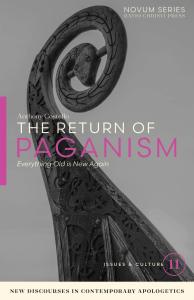
Is Paganism The Next, Big Thing?
Education and Religion

About Anthony Costello
Anthony Costello is a theologian and author. He has a BA in German from the University of Notre Dame, an MA in Christian Apologetics, and MA in Theology from Talbot School of Theology, Biola University, where he was awarded the 2018 Baker Book Award for Excellence in Theology. He has published in journals such as Luther Rice Journal of Christian Studies, the Journal of Christian Legal Thought and the Journal of Christian Higher Education. He co-authored two chapters in Josh and Sean McDowell's Evidence That Demands a Verdict (2016), and has published apologetics' resources for Ratio Christi Ministries and in magazines such as Touchstone. He has made online contributions to The Christian Post and Patheos. Anthony is a US Army Veteran, former 82D Airborne paratrooper and OEF veteran. Currently, he is the president of The Kirkwood Center for Theology and Ethics (kirkwoodcenter.org), a ministry dedicated to helping the local church navigate culture, and is the host of the Theology and Ethics Podcast of the Kirkwood Center. You can read more about the author here.
Previous Post
May 30, 2024
What is a Saint in Christianity?
Next Post

June 28, 2024 Paganism Book Review: Response to "Under The Ancient Oaks"
Recent Comments
"Good morning Anthony I sure this will change your mind. I highly doubt Noah was ..."
"Tony,Yes, there are more differences than similarities when one compares the Gospels to any discrete ..."
Pagan Jesus?: The Easter Mystery vs. ..."
"I don't know that much about pagan mythology of the ancient Egyptians, Greeks, etc. but ..."
Pagan Jesus?: The Easter Mystery vs. ..."
"David,Is "Thou shalt not covet" a rule?Anthony"
Vischer, Jethani, and “Creeds Only” Christianity
Browse Our Archives
Select a Category Analytic Theology Apologetics Biblical Theology Critical Theory Cultural Apologetics Devotional Epistemology Existentialism Fred Sanders Historical Jesus Historical Theology Metaphysics Moral Theology Philosophy of Religion Politics Problem of Evil Roman Catholicism Social Justice Spiritual Formation Systematic Theology The Trinity Uncategorized
Select a Month April 2026 March 2026 February 2026 January 2026 December 2025 October 2025 September 2025 July 2025 May 2025 April 2025 February 2025 January 2025 December 2024 November 2024 October 2024 July 2024 June 2024 May 2024 April 2024 March 2024 February 2024 January 2024 December 2023 November 2023 October 2023 September 2023 August 2023 July 2023 June 2023 May 2023 April 2023 March 2023 February 2023 January 2023 December 2022 November 2022 October 2022 September 2022 August 2022 July 2022 June 2022 May 2022 April 2022 March 2022 February 2022 January 2022 December 2021 November 2021 October 2021 September 2021 August 2021 July 2021 June 2021
Follow Us!
TAKE THE
Religious Wisdom Quiz
Which Psalm ends the Book of Psalms with "Let everything that has breath praise the Lord"?
Select your answer to see how you score.
Psalm 150 Psalm 50 Psalm 100 Psalm 23
Related posts from Anthony Costello

Pagan Jesus?: The Easter Mystery vs. The Mystery...

Vischer, Jethani, and "Creeds Only" Christianity

What the Hell: Annihilationism vs. Eternal Conscious Torment

Peter Thiel and Antichrist: Lectures on the End...
TRENDING AT PATHEOS Evangelical

A new article, written by Jeff Lindsay and Gale L. Pooley,...

Swimfan: Forgotten Aughts Pleasures
This is a recovery effort. In 2002, My Big Fat Greek Wedding...

Top Three Anti-Catholic Lies About Catholicism
This is my initial transcript for the video, "THE 3 WORST...

Pope Leo Celebrates Mass for Nurses & Docs...
I don't have any idea how he did it, but Pope Leo...

The Sermon on the Mount, Part I: Matthew...
The Sermon on the Mount, Part I (Matthew 4:12-5:12) St. Matthew moves...

What's up from Crossway: Reviewing some of their latest A few weeks...
view all Evangelical blogs
What Are Your Thoughts?leave a comment
Ad-Free & Subscriber Log-In Subscription Support
- About Us
- 2026 Calendar
- Videos
- Podcasts
- Library of World Religions
- Faith In Media Tracker
- Advertise With Us
- Write for Us
- Privacy Policy
- Terms of Service
- Do Not Sell My Data
- Contact Us
- Radiant Digital
- Manage Newsletter Subscriptions
- Unsubscribe From Notifications
- Sitemap
Copyright 2008-2026, Patheos. All rights reserved.
Subscription Support Ad-Free & Subscriber Log-In
Follow Patheos