
BuddhistCatholicContemplativeEvangelicalGeneral ChristianHinduJewishLatter-day SaintMuslimNew VisionsProgressive Christian
Beliefs
- Buddhist
- Catholic
- Contemplative
- Evangelical
- General Christian
- Hindu
- Jewish
- Latter-day Saint
- More Voices
- Muslim
- New Visions
- Pagan
- Progressive Christian
Topics
- Religion News
- Food and Religion
- Sports and Religion
- Religious Art
- Religious Music and Entertainment
- Religious Events
- History and Religion
- Style and Religion
- Politics and Religion
- Women in Religion
- Recreation Outdoors and Religion
- Business Finance and Religion
- Careers Workplace and Religion
- Education and Religion
- Family Parenting and Religion
- Health Fitness and Religion
- Home and Religion
- Relationships and Religion
- Technology and Religion
- Travel and Religion
Columnists
- Buddhist Columnists
- Business Finance and Religion Columnists
- Careers Workplace and Religion Columnists
- Catholic Columnists
- Contemplative Columnists
- Education and Religion Columnists
- Evangelists Columnists
- Family Parenting and Religion Columnists
- General Christian Columnists
- Health Fitness and Religion Columnists
- Hindu Columnists
- History and Religion Columnists
- Home and Religion Columnists
- Jewish Columnists
- More Voices Columnists
- Latter Day Columnists
- Muslim Columnists
- New Visions Columnists
- Nonreligious Columnists
- Pagan Columnists
- Politics and Religion Columnists
- Progressive Columnists
- Recreation Outdoors and Religion Columnists
- Relationships and Religion Columnists
- Religion News Columnists
- Religious Art Columnists
- Religious Events Columnists
- Religious Music and Entertainment Columnists
- Sports and Religion Columnists
- Style and Religion Columnists
- Technology and Religion Columnists
- Travel and Religion Columnists
- Women in Religion Columnists
Resource Library
- 2026 Calendar
- Library of World Religions
- The 100 Most Holy Places on Earth
- Patheos Answers
- Podcasts
- Videos
- Faith Leaders Database
- Anglican Episcopalian
- Bahai
- Baptist
- Buddhism
- Christianity
- Confucianism
- Eastern Orthodoxy
- Hinduism
- Holiness and Pentecostal
- ISKCON
- Islam
- Judaism
- Lutheran
- Methodist
- The Church of Jesus Christ of Latter-day Saints
- New Age
- Paganism
- Presbytarian and Reformed
- Protestantism
- Religion Behind the Scenes
- Roman Catholic
- Scientology
- Shia Islam
- Sikhism
- Sufism
- Sunni Islam
- Taoism
- Zen
- See all religions
Research Tools
 Ad-Free & Subscriber Log-In Subscription Support
Ad-Free & Subscriber Log-In Subscription Support
Follow Patheos 

- Trending:
- Forgiveness
- |
- Marriage
- |
- Consciousness
- |
- Death Penalty
- |
- Election
- |
- Halloween

- Home
- Evangelical
- 5 Dumb Things (Some) Pastors Say
5 Dumb Things (Some) Pastors Say
Last updated on: May 22, 2023 at 9:20 pm by Anthony Costello
5 Dumb Things (Some) Pastors Say 2023-05-22T21:20:13-07:00 Anthony Costello
Patheos Explore the world's faith through different perspectives on religion and spirituality! Patheos has the views of the prevalent religions and spiritualities of the world.
I hate to be the guy who points this out, but we need to do some semantic housekeeping in the Church. I won’t name names, but we have to acknowledge we are living in a culture of “memes” and that this is a legitimate problem. It is a culture where vacuous, silly and just plain dumb things get said and then passed along without much thought, usually because somebody famous said them. As the Church, the community on earth that should be most dedicated to the clear articulation of truth, we really must do a better job at saying what we mean, and meaning what we say. I know this is hard given our cultural moment and the technology we use. But we, myself included, have to be more careful about the claims we make. That said, here are 5 statements we often hear in our churches, or from our Christian “thought leaders” that we either need to stop saying, or do a better job of qualifying when we say them.
Dumb Thing #1: “Hey look, I get attacked from both the Right and the Left” (therefore, I must be correct)
The first part of this sentence is not necessarily the dumb part. It could be true that a particular pastor or Christian leader gets attacked from both those to the theological or political right as well as the theological or political left. What is dumb is the implied premise: that if you are getting attacked “from both sides” your claim is therefore somehow correct. That is just a logical fallacy: a non-sequitur known as the argument to moderation. Yet we hear pastors or Christian public intellectuals often lead-in with some kind of statement like this. I guess if we hear this statement, we are supposed to assume that what follows is somehow true, or, at least, more true than the claims being made by those who disagree with said speaker.
A version of this vacuous claim is that Jesus Himself came to do just this: find the golden mean between warring theological or political factions. While there may be a golden mean in the pursuit of virtue, a valid Aristotelian concept, Jesus nowhere suggests there is something special about being in the middle of two opposing factions. As if simply being in the middle means you are right. Jesus, being the author of Logic (well, at least according to Descartes) would not have made such a blatant logical error. Furthermore, Jesus makes it crystal clear that His very presence and mission are meant to divide, not to bring together:
34 “Do not think that I have come to bring peace to the earth. I have not come to bring peace, but a sword. 35 For I have come to set a man against his father, and a daughter against her mother, and a daughter-in-law against her mother-in-law. 36 And a person’s enemies will be those of his own household. 37 Whoever loves father or mother more than me is not worthy of me, and whoever loves son or daughter more than me is not worthy of me. 38 And whoever does not take his cross and follow me is not worthy of me. 39 Whoever finds his life will lose it, and whoever loses his life for my sake will find it.
Matt 10:34-39
While moderation may be the key in many areas of life, being “in the middle” between two groups in itself says nothing about whether what one is saying is right or wrong. Finally, it may even be the case that you are getting attacked from those on the Right and the Left of an issue simply because your view is that terrible. It may be that literally no one, not even warring factions, can believe it and that is why they are both after you.
Dumb Thing #2 “The Real Problem in the Church is We Just Need To Love More”
The problem here is not that this statement is false. The problem is it is vague to the point of being absolutely useless. The whole reason we come to Church is to learn what it means to love! Thus, to simply repeat ad nauseam “we just need to love more,” or to constantly condemn a congregation for “being unloving” is a clear case of putting the cart in front of the horse (like miles in front of it). We already know we don’t love enough. Now what!?
The job of the Bible teacher, the artist formerly known as “pastor,” has to be to demonstrate what love is: both in its theological abstraction and practical, day-to-day application. “What does a biblically-inspired morality look like, and how do we fulfill it?” is a much more worthwhile topic of prayerful reflection and sermonic articulation than ambiguous charges about not loving enough. A look at specific biblical virtues, like (gasp!) modesty or patience, and how one can display them is not only a more interesting thing to talk about, but it puts actual meat on the bones of our Christian walk. Everything else is just vacuous fluff.
Dumb Thing #3 “We should have women pastors because, after all, it was women who discovered the empty tomb”
I’ve heard prominent pastors and even serious theologians use this one. While I do not have a particularly strong position on the egalitarian versus complementarian debate within the church (although I certainly lean complementarian), this claim is a total non-sequitur. What does the women finding Jesus’ empty tomb have to do with the structure and functioning of the Church? Answer: nothing.
There may be good arguments for women pastors, uh, I mean “Bible teachers,” but clearly this cannot be one of them. The fact that it was women who found the risen Lord certainly speaks to the character of those women. It also says something about the Apostles’ character. But it says nothing about the future structure of the Church or the roles of men and women within it. For one of the most egregious misuses of this claim (and some basic rebuttals), see here, and here and here.
Dumb Thing #4 “(Illegal) Immigrants are Made in the Image and Likeness of God too!”
Can you say “strawman?” This one is, admittedly, far more political than the previous three statements. However, pastors will often say something like this in or around election cycles. The idea here is either to use this vacuous claim a) to reprimand one’s congregation or b) to distance oneself from complex political issues. Usually it is made by left-leaning pastors or “thought” leaders as a not-so-subtle attack on Christians concerned about a porous southern border. Or, sometimes, it is said by more right-leaning pastors who hold more reasonable beliefs about immigration to reemphasize the obvious. In doing so, they shield themselves from the character assassination that inevitably results from having such reasonable beliefs.
The obvious problem with this statement is that no one, LITERALLY NO ONE, disbelieves it. Thus, it is a purely rhetorical statement– a piece of shameless propaganda. As such, it shouldn’t be made from the pulpit. To do so is to not-so-subtley accuse your entire congregation of something like racism. Of course, in our era of faux social justice activism, this type of accusation has become quite commonplace, as demonstrated here. Rather than listening to such drivel, one could instead listen to an actual biblical exegesis on the thorny issue of immigration, like this one here.
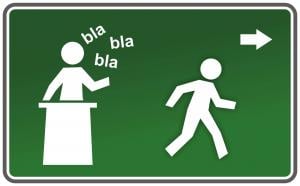
Dumb Things from the Pulpit? Run!
Dumb Thing #5 “LGBTQ+ Are the Most Vulnerable Members of Our Community (and need special help)”
This one also touches on a hot-button, political issue. However, it needn’t been understood as a political comment. It is heard often in our churches today, and usually without much qualification. First, it is questionable what pastors mean when they say the LGBTQ+ community is “vulnerable.” There is definitely one sense in which that is totally the case, namely, spiritually. But, then again, we are all spiritually vulnerable, so why point this out specifically about LGBTQ+ people?
Moreover, it is hard to say who is the “most vulnerable” spiritually. It could be there are many gay men or bi-sexual women or transgender persons who are, at any given moment, far closer to the Kingdom of God than some heterosexual man or women sitting in the pews. After all, spiritually speaking, we don’t know much about most people, especially who is saved and who is not among the elect. Jesus makes this crystal clear:
28 “What do you think? A man had two sons. And he went to the first and said, ‘Son, go and work in the vineyard today.’ 29 And he answered, ‘I will not,’ but afterward he changed his mind and went. 30 And he went to the other son and said the same. And he answered, ‘I go, sir,’ but did not go.31 Which of the two did the will of his father?” They said, “The first.” Jesus said to them, “Truly, I say to you, the tax collectors and the prostitutes go into the kingdom of God before you. 32 For John came to you in the way of righteousness, and you did not believe him, but the tax collectors and the prostitutes believed him. And even when you saw it, you did not afterward change your minds and believe him.
As such, why think the transgender or gay person is more spiritually vulnerable than the person struggling with anger or pride? Answer: no reason. In fact, if concupiscence is what is at issue here, many theologians of the past have considered such carnal sins far more superficial than those of the spirit, like pride.
Another thing this could mean is that LGBTQ+ members are psychologically vulnerable. This may be the case if we are talking about Christians who are trying to live an LGBTQ+ lifestyle. That is a dynamic that naturally leads to all kinds of cognitive dissonance, since the two positions are irreconcilable. If this were the case, if this really was what pastors were pointing to, then it would be right to talk about it. Lesbians, gays and transpersons struggling with their sexual identity may need special kind of pastoral care: a kind of care that perhaps is not quite the same as care for those who don’t struggle with same-sex desire or gender confusion. Nevertheless, I am skeptical that this is what pastors or theologians mean when they talk about the LGBTQ+ community being vulnerable.
Unfortunately, I am pretty certain that what most pastors mean when they make this vacuous claim is something like: “the LGBTQ+ community is the most socially vulnerable among us and, therefore, we should treat them as special.” This is, I think, what is usually meant, and I think it is really dumb. It is dumb for a few reasons: 1) it is incredibly hard to quantify social vulnerability to begin with, 2) even if we were able, it is almost impossible to believe that the LGBTQ+ has this particular problem, and 3) even if the LGBTQ+ community was socially marginalized, which, given the almost unanimous support it receives from every major cultural institution, that that marginalizing is coming from other church-goers.
The obvious thing going on here, if we had the courage to speak about it openly, is there are dishonest Christian leaders who have infiltrated the church and who want to demonize those who still hold to a relatively clear biblical and historic teaching (just look at the current state of the Church of England for an explicit example of this). Because there are no good biblical arguments in favor of homosexual sex or transgenderism, and even fewer natural law arguments for them, pastors must resort to subtle ad-hominem attacks and shaming tactics to slowly steer their churches in this new, culturally acceptable direction. As such, this statement is not only as vacuous as the others, it is far more dangerous and deceitful.

About Anthony Costello
Born and raised on the South Side of Chicago to a devout and loving Roman Catholic family, I fell away from my childhood faith as a young man. For years I lived a life of my own design-- a life of sin. But, at the age of 34, while serving in the United States Army, I set foot in my first Evangelical church. Hearing the Gospel preached, as if for the first time, I had a powerful, reality-altering experience of Jesus Christ. That day, He called me to Himself and to His service, and I have walked with Him ever since. You can read more about the author here.
Previous Post

May 17, 2023
Are Demons Real?: Movie Review of "Nefarious"
Next Post

May 22, 2023 The Religious Views of Tucker Carlson
Recent Comments
"Good morning Anthony I sure this will change your mind. I highly doubt Noah was ..."
"Tony,Yes, there are more differences than similarities when one compares the Gospels to any discrete ..."
Pagan Jesus?: The Easter Mystery vs. ..."
"I don't know that much about pagan mythology of the ancient Egyptians, Greeks, etc. but ..."
Pagan Jesus?: The Easter Mystery vs. ..."
"David,Is "Thou shalt not covet" a rule?Anthony"
Vischer, Jethani, and “Creeds Only” Christianity
Browse Our Archives
Select a Category Analytic Theology Apologetics Biblical Theology Critical Theory Cultural Apologetics Devotional Epistemology Existentialism Fred Sanders Historical Jesus Historical Theology Metaphysics Moral Theology Philosophy of Religion Politics Problem of Evil Roman Catholicism Social Justice Spiritual Formation Systematic Theology The Trinity Uncategorized
Select a Month April 2026 March 2026 February 2026 January 2026 December 2025 October 2025 September 2025 July 2025 May 2025 April 2025 February 2025 January 2025 December 2024 November 2024 October 2024 July 2024 June 2024 May 2024 April 2024 March 2024 February 2024 January 2024 December 2023 November 2023 October 2023 September 2023 August 2023 July 2023 June 2023 May 2023 April 2023 March 2023 February 2023 January 2023 December 2022 November 2022 October 2022 September 2022 August 2022 July 2022 June 2022 May 2022 April 2022 March 2022 February 2022 January 2022 December 2021 November 2021 October 2021 September 2021 August 2021 July 2021 June 2021
Follow Us!
TAKE THE
Religious Wisdom Quiz
I saw my master taken up to heaven in a whirlwind and received a double portion of his spirit. Who am I?
Select your answer to see how you score.
Joshua Elijah Samuel Elisha
Related posts from Anthony Costello

Vischer, Jethani, and "Creeds Only" Christianity

Peter Thiel and Antichrist: Lectures on the End...

Of Prophets and Pedants: A "New" Split Among...
TRENDING AT PATHEOS Evangelical

57th Dove Awards Honor Dolly Parton, Crown New...
On gospel music’s biggest night, the 57th annual GMA Dove Awards honored...

The First Eucharistic Controversy: Christ’s Real Presence
For Catholics, the Eucharist is the source and summit of the Christian...

What a Stop Sign Can Teach Us About...
How to Make a Decision When You Can't Hear God Main point:...

Archdiocese Hosts Military Marriage Retreat in Germany
RASTATT, Germany — The transient military lifestyle, with its frequent deployments and...

Nearly every morning, I make the drive to Detroit with my high-school-age...

The Real AI Story Is Adoption Without Trust
Artificial intelligence has crossed a political threshold. It is no longer a...
view all Evangelical blogs
What Are Your Thoughts?leave a comment
Ad-Free & Subscriber Log-In Subscription Support
- About Us
- 2026 Calendar
- Videos
- Podcasts
- Library of World Religions
- Faith In Media Tracker
- Advertise With Us
- Write for Us
- Privacy Policy
- Terms of Service
- Do Not Sell My Data
- Contact Us
- Radiant Digital
- Manage Newsletter Subscriptions
- Unsubscribe From Notifications
- Sitemap
Copyright 2008-2026, Patheos. All rights reserved.
Subscription Support Ad-Free & Subscriber Log-In
Follow Patheos