
BuddhistCatholicContemplativeEvangelicalGeneral ChristianHinduJewishLatter-day SaintMuslimNew VisionsProgressive Christian
Beliefs
- Buddhist
- Catholic
- Contemplative
- Evangelical
- General Christian
- Hindu
- Jewish
- Latter-day Saint
- More Voices
- Muslim
- New Visions
- Pagan
- Progressive Christian
Topics
- Religion News
- Food and Religion
- Sports and Religion
- Religious Art
- Religious Music and Entertainment
- Religious Events
- History and Religion
- Style and Religion
- Politics and Religion
- Women in Religion
- Recreation Outdoors and Religion
- Business Finance and Religion
- Careers Workplace and Religion
- Education and Religion
- Family Parenting and Religion
- Health Fitness and Religion
- Home and Religion
- Relationships and Religion
- Technology and Religion
- Travel and Religion
Columnists
- Buddhist Columnists
- Business Finance and Religion Columnists
- Careers Workplace and Religion Columnists
- Catholic Columnists
- Contemplative Columnists
- Education and Religion Columnists
- Evangelists Columnists
- Family Parenting and Religion Columnists
- General Christian Columnists
- Health Fitness and Religion Columnists
- Hindu Columnists
- History and Religion Columnists
- Home and Religion Columnists
- Jewish Columnists
- More Voices Columnists
- Latter Day Columnists
- Muslim Columnists
- New Visions Columnists
- Nonreligious Columnists
- Pagan Columnists
- Politics and Religion Columnists
- Progressive Columnists
- Recreation Outdoors and Religion Columnists
- Relationships and Religion Columnists
- Religion News Columnists
- Religious Art Columnists
- Religious Events Columnists
- Religious Music and Entertainment Columnists
- Sports and Religion Columnists
- Style and Religion Columnists
- Technology and Religion Columnists
- Travel and Religion Columnists
- Women in Religion Columnists
Resource Library
- 2026 Calendar
- Library of World Religions
- The 100 Most Holy Places on Earth
- Patheos Answers
- Podcasts
- Videos
- Faith Leaders Database
- Anglican Episcopalian
- Bahai
- Baptist
- Buddhism
- Christianity
- Confucianism
- Eastern Orthodoxy
- Hinduism
- Holiness and Pentecostal
- ISKCON
- Islam
- Judaism
- Lutheran
- Methodist
- The Church of Jesus Christ of Latter-day Saints
- New Age
- Paganism
- Presbytarian and Reformed
- Protestantism
- Religion Behind the Scenes
- Roman Catholic
- Scientology
- Shia Islam
- Sikhism
- Sufism
- Sunni Islam
- Taoism
- Zen
- See all religions
Research Tools
 Ad-Free & Subscriber Log-In Subscription Support
Ad-Free & Subscriber Log-In Subscription Support
Follow Patheos 

- Trending:
- Forgiveness
- |
- Marriage
- |
- Consciousness
- |
- Death Penalty
- |
- Election
- |
- Halloween

- Home
- Evangelical
- Relationships and Religion
- Reconstructing Humanity – Part 4: The Crushing Burden of Guilt
Reconstructing Humanity – Part 4: The Crushing Burden of Guilt
Last updated on: August 31, 2022 at 2:08 pm by Anthony Costello
Reconstructing Humanity – Part 4: The Crushing Burden of Guilt 2022-08-31T14:08:38-07:00 Anthony Costello
Patheos Explore the world's faith through different perspectives on religion and spirituality! Patheos has the views of the prevalent religions and spiritualities of the world.
In this series I’ve been arguing that there are features of daily life which remind us our human identity is not just a socially constructed identity or one reducible to the sum of our biological parts. Instead, our identity is grounded in a metaphysical fact and our stories constructed within certain universal parameters. The goal or aim of any well-intended story is to convey truth– not “my truth” or “your truth” but the truth about “my experience” or “your experience.”
Subsequently, any good story shows how those experiences fit into the whole of human experience. The truth about human identity itself is that we are all made in the image of our Creator. This identity is fundamentally sacred, then biological and social. Identity being sacred fits each and every human being into the whole, something that biological identity and social identity alone cannot do.
Not every story, therefore, is one told by the powerful to keep the marginalized at bay, an assumption C.S. Lewis memorably called “Bulverism.” There is a genuine curiosity about the world that drives the process of deconstruction, and we do discover from time to time things that really are “out there.” Moreover, some of those things we discover are not about the external world but about our own selves living in the world. They are features of our God-given identity that bind us all together, crossing any boundaries of time or culture.
In the last post I told a story of how fear and the overcoming of fear is a common characteristic of all people, everywhere. The triumph over the unknown, be it a personal or a societal unknown, is a pervasive theme in every culture. It is an intimate truth that each and every one of us experience daily. Overcoming fear is but one of these shared features of our common human nature. Another such feature, equally as troubling to us, is the crushing burden of guilt we feel when we do wrong.
The Angry Man in the Car
Years ago, a 30-something male lived in a certain part of the city of Chicago, not too far from downtown. This biological male, who happened to be white and upper-middle class, lived in a neighborhood apartment and drove to work every morning, leaving around 6:30am. He worked in the restaurant business, for the most part. In his spare time he had learned how to dance, competing at local competitions. He was a gym rat who also trained in martial arts. His body was athletic, well-trained, quick and fairly powerful.
This same man also worked in the inner city with school children. He taught dance to 4th and 5th graders who were all black-skinned and lower-middle class, if not under the poverty line. He loved being with these school children and they loved having him teach their class. The young boys especially liked him because he was one of the few male teachers, perhaps one of the few males in general, they interacted with on a daily basis. He would sometimes do push-up competitions with them, which got them super motivated. He got along with the other teachers in the school and especially with the principal, a lovely woman infatuated with the idea of visiting Egypt and seeing the pyramids.
Most acquaintances of this man considered him a good person. He was likeable and had many friends from a wide variety of backgrounds: his friends were gay and straight, white, black, Asian and Hispanic. He was vaguely religious but not too explicit about any aspect of it. He was charitable and impressed many with his willingness to donate time and money. Otherwise there was nothing terribly remarkable about this man.
However, this man had developed a habit of judging people while driving. He would get visibly upset if he saw other drivers breaking the traffic laws, cutting people off in traffic, failing to close the gap at left-turn lanes or driving on the shoulder to pass up slow moving traffic. Over time, his judgements about other people’s bad driving became harsher and harsher, to the point where he began exiting his vehicle to verbally chastise those he thought were being selfish on the road. He felt very self-righteous in doing this, considering himself a protector of society and its norms.
One morning he drove up to the four-way intersection in front of his apartment. A gold SUV approached the intersection from the North heading South. The man was traveling westward and had clearly stopped at the stop sign first. He obviously had the right-of-way to proceed out into the intersection. But, the gold SUV, not paying attention, shot out into the intersection and the front driver side of the SUV came within inches of the front passenger side of the man’s car. Furious at such incompetence, the man, as was now his habit, exited his vehicle, prepared to teach the driver of the SUV a lesson in good driving.
But, this is not a story about anger or irrational action, themselves features common to us all. It is what that self-righteous anger lead to that I am interested in. For in previous encounters this man had always approached drivers who happened to be biologically male, middle-aged and at least commensurate in apparent size and strength. This time, however, that was not the case.
As the man approached the gold SUV in the middle of the intersection, face red with moralizing anger, fists clenched and already hurling condemnations about such irresponsible driving, the first thing he noticed was the child car seat in the middle row of the SUV. Then he saw the terrified face of the mother driving the car, frozen at the sight of this ogre coming at her with veins popping in his forehead. What must have been shooting through this poor mother’s mind, this mother who was taking her son to preschool? The fear in her eyes was vivid. After all, there she was, there was her little child and there was the angry man coming at her.
Did the child begin to cry at the sight of the angry man in the car?
I don’t recall. But what I do recall, being that angry man, is recoiling at my own self; realizing in stark fashion that I was the monster in this scene. But how could this be? How could I, a good person in the eyes of so many, especially my own, terrify a young mother– a mother who had simply been distracted by her little child fidgeting in his car seat? In that moment, like Adam, my eyes were opened to my own guilt and my own shame. Indeed, I was a transgressor, a breaker of a moral law I knew was real but had chosen to ignore so many times prior this one.
I walked back to my car, head hung very low, crushed by the wickedness of my own heart. Guilt weighed upon me, heavy like a millstone.
The Moral Law Within
Immanuel Kant, the great rationalist of the Enlightenment, summed up his reasons for believing in God in his Critique of Practical Reason, saying:
Two things fill the mind with ever new and increasing admiration and awe, the more often and steadily we reflect upon them: the starry heavens above me and the moral law within me. I do not seek or conjecture either of them as if they were veiled obscurities or extravagances beyond the horizon of my vision; I see them before me and connect them immediately with the consciousness of my existence.
Kant’s wonder at the cosmos above and the moral law within lead his otherwise skeptical mind to postulate God as a necessary Being. Without God there could be no legitimate reasoning about morality. Kant knew God was required for us to rationally ground moral values and ethical obligations, even if he thought this same God could not be demonstrated through rational proofs. Regarding rational thought about moral values he argues:
Accordingly, the existence of a cause of all nature, distinct from nature itself, and containing the principle of this connexion, namely, of the exact harmony of happiness with morality, is also postulated….This supreme cause must contain the principle of harmony of nature…
Immanuel Kant, Critique of Practical Reason [emphasis added]
God, being the cause of all nature, must also be the cause of the nature of morality, or “the exact harmony of happiness with morality,” and “the principle of harmony of nature.”
That principle of the harmony of nature that is contained in nature’s Creator is the summum bonum of all practical (or prudential) reasoning. The total harmony of nature is the desideratum of all moral thought. This total harmony of all created things is what we all intuitively know as “good,” and when we find ourselves operating to promote that harmony we call this “right.” When we realize we have worked against that harmony, we correctly experience it as “wrong.” Kant would go on to say that our consciousness of this harmony, this summum bonum, and our desire to see it realized is what constitutes moral duty.
The ancient Hebrew word “shalom” captures the same idea of the perfect ordering of creation. Such an ordering, should it ever be realized, would culminate in genuine and lasting peace for man, in final rest for his immortal soul. Both Israel’s prophets and sages longed for this shalom in different ways. The prophets expressed the longing for shalom in emphatic condemnation of the injustices (the disharmony) that engulfed their own immediate society. Alternatively, the wisdom writers spoke of it in timeless reflection on mankind’s foolish and wicked ways (my thanks to Fr. Patrick Henry Reardon for pointing out this biblical pattern to me). The greatest disorder, of course, being the disordered relationship of man to His Creator. This is the source of all other disorders, the wellspring of all other injustices.
Breaking The Law of Harmony
We know when we have transgressed the harmony of God’s world. The indicator of this transgression is our shared experience of guilt. What we do not always know nor always share in common (either at the individual or cultural level) is what that harmony is supposed to be like and how we can properly participate in it. We only experience the guilt of breaking it– the guilt is what we have in common. We argue over the rest, lost without a revelation from the Cause of that Harmony to tell us about what shalom is or what our role in it should be.
Still, that guilt and the accompanying experience of shame over doing wrong is common to us all is uncontroversial. As St. Paul tells us in his letter to the Romans, referencing earlier sages of the biblical revelation,
There is no one righteous,
not even one;
there is no one who seeks God.
All have turned away,
together they have become useless;
there is no one who does good,
there is not even one.Romans 3:10-12 (Psalm 14:1-3, 53:1-3)
But, one need not draw from a revealed source to know that guilt is universal. The mundane reality of guilt and shame is proven every day in our own society. So much so that both are played upon by workers of evil with political agendas who exploit it for their own ends.
Universal Feature #2: The Crushing Burden of Guilt
Guilt and shame are so central to our human identity that those with evil in their hearts know full well that to motivate an individual or population to action, one need not bother with rational calculation or logical argumentation. The deep weight of guilt and shame are sufficient to get people to do what you want them to do. As such, we rarely engender action using the language of numbers or statistics. Instead our calls to arms are always motivated by appeals to virtues and presumed vices, to moral values and the obligations they set upon us.
Master activists like Saul Alinsky understood the universal experience of guilt quite well. In his manual on radical politicism, he offers tactical rules aimed at pressing on the human person where he or she is most sensitive:
The fourth rule is: Make the enemy live up to their own book of rules. You can kill them with this, for they can no more obey their own rules than the Christian church can live up to Christianity.
The fourth rule carries within it the fifth rule: Ridicule is man’s most potent weapon. It is almost impossible to counterattack ridicule. Also it infuriates the opposition, who then react to your advantage.
Saul Alinksy, Rules for Radicals, 128.
Alinsky, no friend of God, nevertheless understood well His creatures are all transgressors, or at least, that we experience ourselves as such. There must truly be a special place in hell for those who use other’s feelings of guilt and shame for their own benefit and their own lust for power. One reason we know to trust the prophetic voices of Scripture, is because they were all persecuted for pointing out the guilt and shame of the people. The true prophet never thrives in the culture he prophesies against, he always is met with suffering. Jesus knew this well when he said that no prophet is welcome in his own town (Luke 4:24).
In the end, however, it is the crushing burden of guilt that either plunges us to insanity, motivates us to evil doing or, God willing, drives us into the arms of the Savior.
Free at Last?
While guilt can motivate us, either to good and harmonious action, as well as to cruel and chaotic acts, we all long to ultimately be set free from guilt. No one hopes to languish in their guilt forever. No one yearns to relish eternally in their shame. This doesn’t even need to be argued.
When I transgressed the harmony of God’s world at the intersection of Southport and Webster so many years ago, I felt the wrongness of that transgression. The wrongness lie in the breaking of shalom, specifically in the form of the stronger (physically speaking) of two sacred image bearers threatening the weaker. It is a dynamic that plays out everywhere and that takes on a wide variety of forms. It is not limited to any one social group or pairing of groups (black, white, male or female, gay or straight) and it is not dependent on biology either. Anyone can break shalom and everyone at some point does.
That incident opened my eyes to one more truth that binds us all: the need to be forgiven for our transgressions. The need to have guilt lifted from our hearts and minds, for every one of us has to some degree found ourselves guilty of breaking the harmony of God. But, to what or to whom do we turn for this deliverance? Perhaps it would have sufficed to simply ask forgiveness of that particular woman on that particular day. Or, since I did not do it then, perhaps it would suffice to track her and her son down and ask for it these 15 some odd years later.
But, not only is the latter essentially impossible, is it not the case that on that day I did something far worse than just sin against this particular woman? Did I not transgress against the full order and harmony of God’s world? After all, isn’t every human person like an entire cosmos unto themselves, a mysterious being full of imaginations, ideas, hopes, dreams and desires? Did I not transgress against the divine image itself, the image of the Creator, the image that made that particular person far more than just her gendered or racialized identity or her biological sex?
But how is one to be forgiven of a transgression against a sacred identity? How is one to be delivered from the guilt of attacking the very image of the Divine?
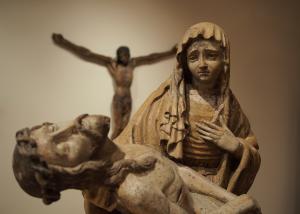
Can Our Burden Be Lifted?
Photo: National Gallery of Slovenia, CC BY-SA 4.0 <https://creativecommons.org/licenses/by-sa/4.0>, via Wikimedia Commons
General Christian
Relationships and Religion

About Anthony Costello
Born and raised on the South Side of Chicago to a devout and loving Roman Catholic family, I fell away from my childhood faith as a young man. For years I lived a life of my own design-- a life of sin. But, at the age of 34, while serving in the United States Army, I set foot in my first Evangelical church. Hearing the Gospel preached, as if for the first time, I had a powerful, reality-altering experience of Jesus Christ. That day, He called me to Himself and to His service, and I have walked with Him ever since. You can read more about the author here.
Previous Post

October 25, 2021
Reconstructing Humanity - Part 3: Facing And Overcoming Fear
Next Post
November 3, 2021 Reconstructing Humanity - Part 5: Longing For Recognition
Browse Our Archives
Select a Category Analytic Theology Apologetics Biblical Theology Critical Theory Cultural Apologetics Devotional Epistemology Existentialism Fred Sanders Historical Jesus Historical Theology Metaphysics Moral Theology Philosophy of Religion Politics Problem of Evil Roman Catholicism Social Justice Spiritual Formation Systematic Theology The Trinity Uncategorized
Select a Month April 2026 March 2026 February 2026 January 2026 December 2025 October 2025 September 2025 July 2025 May 2025 April 2025 February 2025 January 2025 December 2024 November 2024 October 2024 July 2024 June 2024 May 2024 April 2024 March 2024 February 2024 January 2024 December 2023 November 2023 October 2023 September 2023 August 2023 July 2023 June 2023 May 2023 April 2023 March 2023 February 2023 January 2023 December 2022 November 2022 October 2022 September 2022 August 2022 July 2022 June 2022 May 2022 April 2022 March 2022 February 2022 January 2022 December 2021 November 2021 October 2021 September 2021 August 2021 July 2021 June 2021
Follow Us!
TAKE THE
Religious Wisdom Quiz
Who saw a vision of four beasts coming out of the sea?
Select your answer to see how you score.
Joel Daniel Ezekiel Amos
Related posts from Anthony Costello

Vischer, Jethani, and "Creeds Only" Christianity

Moral Combat: Critical Theory versus Christianity

Peter Thiel and Antichrist: Lectures on the End...

TRENDING AT PATHEOS Evangelical

Dolly Parton’s Last Song Wins Dove Award with...
Bluegrass band The Grascals, speaking on the red carpet at the 57th...

The Image: On the Horror of Capitalism and...
The Image Then went the Pharisees, and took counsel how they might...

We are approaching the date of our new American national holiday: October...

Letters on Living the Faith by C.S. Lewis
Most of us met C.S. Lewis as a public intellectual. Mere Christianity....

When Halloween Unmasks Married Hearts
Written by Dr. David K. Ewen from Eternal Truth Bible College Behind...

Aristotle. He’s been called the father of logic, the father of the...
view all Evangelical blogs
Ad-Free & Subscriber Log-In Subscription Support
- About Us
- 2026 Calendar
- Videos
- Podcasts
- Library of World Religions
- Faith In Media Tracker
- Advertise With Us
- Write for Us
- Privacy Policy
- Terms of Service
- Do Not Sell My Data
- Contact Us
- Radiant Digital
- Manage Newsletter Subscriptions
- Unsubscribe From Notifications
- Sitemap
Copyright 2008-2026, Patheos. All rights reserved.
Subscription Support Ad-Free & Subscriber Log-In
Follow Patheos