
BuddhistCatholicContemplativeEvangelicalGeneral ChristianHinduJewishLatter-day SaintMuslimNew VisionsProgressive Christian
Beliefs
- Buddhist
- Catholic
- Contemplative
- Evangelical
- General Christian
- Hindu
- Jewish
- Latter-day Saint
- More Voices
- Muslim
- New Visions
- Pagan
- Progressive Christian
Topics
- Religion News
- Food and Religion
- Sports and Religion
- Religious Art
- Religious Music and Entertainment
- Religious Events
- History and Religion
- Style and Religion
- Politics and Religion
- Women in Religion
- Recreation Outdoors and Religion
- Business Finance and Religion
- Careers Workplace and Religion
- Education and Religion
- Family Parenting and Religion
- Health Fitness and Religion
- Home and Religion
- Relationships and Religion
- Technology and Religion
- Travel and Religion
Columnists
- Buddhist Columnists
- Business Finance and Religion Columnists
- Careers Workplace and Religion Columnists
- Catholic Columnists
- Contemplative Columnists
- Education and Religion Columnists
- Evangelists Columnists
- Family Parenting and Religion Columnists
- General Christian Columnists
- Health Fitness and Religion Columnists
- Hindu Columnists
- History and Religion Columnists
- Home and Religion Columnists
- Jewish Columnists
- More Voices Columnists
- Latter Day Columnists
- Muslim Columnists
- New Visions Columnists
- Nonreligious Columnists
- Pagan Columnists
- Politics and Religion Columnists
- Progressive Columnists
- Recreation Outdoors and Religion Columnists
- Relationships and Religion Columnists
- Religion News Columnists
- Religious Art Columnists
- Religious Events Columnists
- Religious Music and Entertainment Columnists
- Sports and Religion Columnists
- Style and Religion Columnists
- Technology and Religion Columnists
- Travel and Religion Columnists
- Women in Religion Columnists
Resource Library
- 2026 Calendar
- Library of World Religions
- The 100 Most Holy Places on Earth
- Patheos Answers
- Podcasts
- Videos
- Faith Leaders Database
- Anglican Episcopalian
- Bahai
- Baptist
- Buddhism
- Christianity
- Confucianism
- Eastern Orthodoxy
- Hinduism
- Holiness and Pentecostal
- ISKCON
- Islam
- Judaism
- Lutheran
- Methodist
- The Church of Jesus Christ of Latter-day Saints
- New Age
- Paganism
- Presbytarian and Reformed
- Protestantism
- Religion Behind the Scenes
- Roman Catholic
- Scientology
- Shia Islam
- Sikhism
- Sufism
- Sunni Islam
- Taoism
- Zen
- See all religions
Research Tools
 Ad-Free & Subscriber Log-In Subscription Support
Ad-Free & Subscriber Log-In Subscription Support
Follow Patheos 

- Trending:
- Forgiveness
- |
- Marriage
- |
- Consciousness
- |
- Death Penalty
- |
- Election
- |
- Halloween

- Home
- Evangelical
- Technology and Religion
- Violent People Living in A Virtual World
Violent People Living in A Virtual World
Last updated on: August 30, 2022 at 1:16 pm by Anthony Costello
Violent People Living in A Virtual World 2022-08-30T13:16:00-07:00 Anthony Costello
Patheos Explore the world's faith through different perspectives on religion and spirituality! Patheos has the views of the prevalent religions and spiritualities of the world.
What does it mean to be “civil” or to live in a “civil society?” There is a lot of clamor these days about being civil toward each other. Most of us want to see ourselves as a good, civilized people after all. But are we really civil, or do we hold ourselves in too high a regard?
Recent statistics on the rise of phenomena like “cyber-bullying” and increased suicide rates over the last 15 years suggest that we are not nearly as civil or polite as we think ourselves to be. At least not if we equate civility or politeness with real virtue or genuine goodness. In a technology-driven culture, where our violent thoughts are carried out online, could it be that we are revealing our true nature virtually? Might it be a nature much more barbaric than we like to admit?
The Dawn of Civil Society
According to philosopher Charles Taylor, the age of “civility” emerged out of the late-medieval sociological order. In this order, armed violence was the primary means for attaining contested material goods as well as social status. However, as economic dimensions started to overtake the life of Europe and its cities, the earlier warrior culture (the bellatores) began to diminish. An armed and aggressive aristocracy was no longer needed to resolve conflict or secure goods. Commerce became the preferred route to personal and corporate success and social dominance. Eventually the “polite society” was born:
Mediaeval society had been violent, full of the disordered clashes of an armed aristocracy, whose members defined themselves as warriors; the ancient poleis and republics had also been led by a warrior class, and had been in their own way dedicated to war. The members of a “polite” society were dedicated primarily to the arts of peace.
(Taylor, A Secular Age, 235)
However, the natural aggression of man did not simply vanish with the advent of the polite society. They remained in spite of Enlightenment optimism they would not. Nevertheless, as armed conflict threatened the course of “economic exchange for mutual enrichment” (Taylor 235), man’s violent tendencies and warlike dispositions were channeled into this new cultural context.
As such, acts of violence acquired a more ceremonial form. Duels, for example, became one way in which those of refined manners and a more political orientation could resolve mutual grievances. This was violence within acceptable social boundaries. Thus, if you were to kill someone, you were at least going to kill them in style, and they would die in similar fashion. Military strategy even became more ceremonial in its tactics and maneuvers, at least until the emergence of technological-warfare (until 1914).
Cinematic portrayals of “gentlemanly” duels remind us of the strangeness of this transitional period in human history– the shift from a warrior culture to an economic and political one. In America today, Mixed Martial Arts is the nearest simulacra of the gentleman’s duel where both honor and fortune are at stake. Prize fighting is the cultural synthesis of the warrior ethos and economic interests of man.
In addition to the duel, there was another feature of the warrior culture that lingered in the West. This was the public execution.
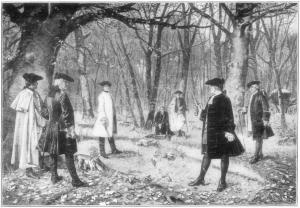
Burr and Hamilton, Polite Violence
Dumas’ Modern Man and Public Executions in Civil Society
Capital punishment as public spectacle is an ancient practice, one at the very heart of the Christian faith. In the early-modern era, public displays of justice continued to act as deterrents to criminal activity, but also provided a means to satiate man’s lust for blood. However, as the values of the Enlightenment advanced, people sought more humane means of capital punishment. Guillotine, for example, developed his device as an instrument of mercy. Death was quick and painless under the blade. This was quite different from the drawing and quartering or consigning to the flames of the Middle Ages.
In his classic revenge novel, The Count of Monte Cristo, Alexander Dumas described a uniquely barbaric means of modern execution: “la mazzolata.” In 18th century Rome this method of capital punishment was especially brutal. It relied on little technology or sophistication. The executioner, wielding a massive mace or blunt mallet (the mazzatello), simply pounds the head of the convicted criminal, smashing the skull to bits. Ironically, it was none other than the Papal States that utilized this particular form of punishment.
Dumas chose the mazzolata method to highlight the total transformation of his main character: from the once innocent and naive Edmund Dantes into the vengeful Monte Cristo. In Dumas’ fictionalized version of this real form of execution, not only does the executioner bring the dull mallet down upon the cranium of the accused, he then cuts the throat and stomps on the convict’s back. This forces the blood to spurt wildly from the slit neck of the victim. Monte Cristo, the archetypal blood avenger, relishes in the scene.
While the execution scene advances the plot, Dumas, writing in the 1840’s, captures something unsettling about modern man and his newly developed sense of “polite” society. As refined, as courtly and as well-mannered as Monte Cristo appears, deep down he is a savage beast. As “civilized” man he is proficient in his mastery and use of technology, to include modern medicine and economics. His imprisonment and extreme wealth have made him practically omnipotent. Like modern man he has an incredible capacity to do things, to affect his world, manage his affairs, control himself and manipulate his environment. He possess vast knowledge of things and how they work, to include human psychology. He is well-traveled and well-versed. His manners and outward presentation are impeccable. He is a symbol of the new society.
Yet morally he is defective. He is ferocious– his savagery only thinly veiled by the novel moors of the new society that surrounds him. Of course this savagery has, in part, been imposed upon him. His accusers did not resort to violence but only trickery, collusion and calumny in their attempt to destroy him. The once innocent Dantes is now the worldly Monte Cristo. 14 years of solitary confinement have redefined his soul. As such, we sympathize with the Count’s desire for vengeance. As his intricate plan unfolds, the reader starts to want to see it succeed. His [the reader’s] baser instincts kick in, perhaps something the book’s author had counted on.
When asked about dueling as a means to rectify injustice, the Count responds to these more “civil” forms of satisfaction:
Oh, yes,” replied the count; “understand me, I would fight a duel for a trifle, for an insult, for a blow; and the more so that, thanks to my skill in all bodily exercises, and the indifference to danger I have gradually acquired, I should be almost certain to kill my man. Oh, I would fight for such a cause; but in return for a slow, profound, eternal torture, I would give back the same, were it possible; an eye for an eye, a tooth for a tooth, as the Orientalists say…
For Monte Cristo there is more to retributive justice than just seeing an enemy eliminated. True justice demands a one-to-one equivalent in pain. A quick ball through the head is not sufficient to rectify a ruined life and 14 years of isolation from the world. More is demanded if justice is to be served. In the bygone era, the warrior era, Monte Cristo might have just raised his army and sacked the castle complexes of his enemies. But in the era of economics he must work through more subtle means. He must ruin his enemies financially and socially, in some ways a more brutal kind of death than a physical one.
In Dumas’ story, it is the Count’s excessively intricate scheme of revenge that funds the bulk of the plot line and the novel’s entertainment value. Anyone who has watched a recent Liam Neeson or Denzel Washington film knows that revenge themes are still a very popular and very lucrative form of art.
However, the vestiges of violence and revenge in our contemporary version of the “polite” society, i.e., in our culture of “tolerance,” are not confined to the realm of fiction alone. Even in the era of “love is love” it seems that vengeance is not just the Lord’s.
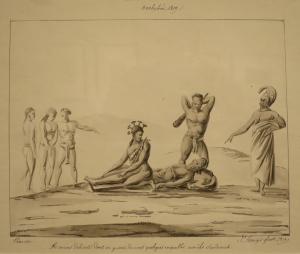
La mazzolata, Hawaiian-version (1819)
Social Violence and Virtual Executions
In America today we not only have eliminated duels but also public executions. We are coming close to eliminating capital punishment entirely, if not in principle then in practice. And, as mentioned above, MMA and professional boxing are about as close as we get to a violent duel between gentlemen (or “gentlewomen”). One could include football and rugby, but that would stretch the analogy.
Nevertheless, we must be careful to think ourselves so evolved. Two errors confront us if we think our human nature has changed even as social conditions have improved. The statistics above provide empirical evidence that something is still very amiss within the human machine. The truth may be that even in our culture of tolerance, most of us are seeking revenge just as Monte Cristo sought his. We may be too lazy to learn how to shoot a pistol or wield a sabre or to plan for 10 years on how to do it. Nevertheless, we do have other weapons and means available to us: we can execute each other virtually.
Two Errors We Make in Our Virtual and Tolerant Society
Error 1: Believing we are not violent creatures
In our virtual age, the first error we can make is to fool ourselves into thinking we are not violent creatures because we don’t carry out physical violence. In his seminal work on killing in combat, Lt. Col. David Grossman talks about how the modern West sequestered itself from the daily experience of violence:
Slaughterhouses and refrigeration insulated us from the necessity of killing our own food animals. Modern medicine began to cure disease, and it became increasingly rare for us to die in the youth or prime of our lives, and nursing homes, hospitals and mortuaries insulated us from the death of the elderly. Children began to grow up having never truly understood where their food came from, and suddenly Western civilization seemed to have decided that killing, killing anything at all, was increasingly hidden, private, mysterious, frightening, and dirty.
David Grossman, On Killing, xxix
This distance from death and dying and from violence itself pushes our natural tendency toward violence entirely inward. It does not make us non-violent. Changing the external conditions has no effect on what we are. The technical “fixes” to our violence problem are not bad themselves, but they do not eliminate the reality of human violence:
It seems that when a society does not have natural processes (such as sex, death, and killing) before it, that society will respond by denying and warping that aspect of nature. As our technology insulates us from a specific aspect of reality, our societal response seems to be to slip deep into bizarre dreams about that which we flee….Dreams that can become dangerous societal nightmares as we sink deeper into their tempting web of fantasy.
Grossman, xxx
And so instead of dueling, or even fighting on the playground, we arrive at cyber-bullying. Now we have a form of violence that is non-physical but still effective. Virtual violence can still result in the destruction of its intended target. It could at first be only economic, social or psychological destruction. But these often lead to physical destruction. Our “bizarre dreams” of violence become “dangerous societal nightmares.”
Error 2: Believing that all violence is wrong
The second error we make in our ironically intolerant culture of tolerance is to think that all violence, “all killing” is unjustified. That is not true. As with anything in life, there are higher forms of things and lower ones. Violence and killing can be just, depending on the prior conditions that call for its use. If there are higher things at stake, then violence may very well be an answer. Most today agree that both the Civil War in America and World War II in Europe were just wars. The necessity of liberating thousands from death camps or plantations, can make the application of violence just.
The problem we encounter today is the wielding of violent intentions over inherently trivial things. Edmund Dantes suffering 14 years of solitary confinement in an island prison, losing his fiancee, his fortune and nearly his wits, makes us sympathize with Monte Cristo’s plan of retribution. There was a great injustice that demanded restitution.
Today, however, culture has devolved to a point where the vengeful intent of the petty can take aim at a wide range of trivialities. We simply have no clue as to what is worth getting angry over and what is not. Professors, scholars and pundits are “canceled” for using unpopular language or words on so-called “oppressive language lists.” CEOs of major companies are sent packing because they exercise their free speech to make innocuous critiques of incredibly powerful and influential cultural institutions. Teens who make simple, dumb mistakes are pounced upon and their dreams ruined to teach them a lesson. And then there is the bullying over everything from clothing, to hair-styles, to tastes in music or movies.
Of course, we might expect this behavior from children, but from adults? From a nation’s leaders? Let’s face it, we love the violence and the vengeance. Only now, in our age of tolerance, we can carry it out virtually and over the most silly things.
How trifling and pernicious we have become. And yet we deign to call ourselves civil, or tolerant? Far from it!
“But what comes out of the mouth comes from the heart, and this defiles a man. For from the heart come evil thoughts, murders, adulteries, sexual immoralities, thefts, false testimonies, blasphemies.” (Matt 15:18-19)
“When the LORD saw that man’s wickedness was widespread on the earth and that every scheme his mind thought of was nothing but evil all the time, the LORD regretted that He had made man on the earth, and He was grieved in His heart.” (Genesis 6:5-6)
Image of Burr-Hamilton Duel: Illustrator not identified. From a painting by J. Mund., Public domain, via Wikimedia Commons
“The Death Penalty of Public Execution by Clubbing”: Jacques Arago, Public domain, via Wikimedia Commons
General Christian
Technology and Religion
Relationships and Religion
History and Religion
Previous Post

July 16, 2021
Living a Life of Grievance Can Lead to A Very Scary Death
Next Post

July 23, 2021 Angela Harris and C.S. Lewis on Identity and Liberation
Browse Our Archives
Select a Category Analytic Theology Apologetics Biblical Theology Critical Theory Cultural Apologetics Devotional Epistemology Existentialism Fred Sanders Historical Jesus Historical Theology Metaphysics Moral Theology Philosophy of Religion Politics Problem of Evil Roman Catholicism Social Justice Spiritual Formation Systematic Theology The Trinity Uncategorized
Select a Month April 2026 March 2026 February 2026 January 2026 December 2025 October 2025 September 2025 July 2025 May 2025 April 2025 February 2025 January 2025 December 2024 November 2024 October 2024 July 2024 June 2024 May 2024 April 2024 March 2024 February 2024 January 2024 December 2023 November 2023 October 2023 September 2023 August 2023 July 2023 June 2023 May 2023 April 2023 March 2023 February 2023 January 2023 December 2022 November 2022 October 2022 September 2022 August 2022 July 2022 June 2022 May 2022 April 2022 March 2022 February 2022 January 2022 December 2021 November 2021 October 2021 September 2021 August 2021 July 2021 June 2021
Follow Us!
TAKE THE
Religious Wisdom Quiz
Where did David spare Saul's life when he found him in a cave?
Select your answer to see how you score.
Gilgal Bethlehem En Gedi Hebron
Related posts from Anthony Costello

Vischer, Jethani, and "Creeds Only" Christianity

Peter Thiel and Antichrist: Lectures on the End...


Of Prophets and Pedants: A "New" Split Among...
TRENDING AT PATHEOS Evangelical

Letters on Living the Faith by C.S. Lewis
Most of us met C.S. Lewis as a public intellectual. Mere Christianity....

When Halloween Unmasks Married Hearts
Written by Dr. David K. Ewen from Eternal Truth Bible College Behind...

Aristotle. He’s been called the father of logic, the father of the...

Methodist Central Hall and Westminster Abbey
Situated on the same square is Methodist Central Hall and Westminster Abbey. ...

57th Dove Awards Honor Dolly Parton, Crown New...
On gospel music’s biggest night, the 57th annual GMA Dove Awards honored...

The First Eucharistic Controversy: Christ’s Real Presence
For Catholics, the Eucharist is the source and summit of the Christian...
view all Evangelical blogs
Ad-Free & Subscriber Log-In Subscription Support
- About Us
- 2026 Calendar
- Videos
- Podcasts
- Library of World Religions
- Faith In Media Tracker
- Advertise With Us
- Write for Us
- Privacy Policy
- Terms of Service
- Do Not Sell My Data
- Contact Us
- Radiant Digital
- Manage Newsletter Subscriptions
- Unsubscribe From Notifications
- Sitemap
Copyright 2008-2026, Patheos. All rights reserved.
Subscription Support Ad-Free & Subscriber Log-In
Follow Patheos