
BuddhistCatholicContemplativeEvangelicalGeneral ChristianHinduJewishLatter-day SaintMuslimNew VisionsProgressive Christian
Beliefs
- Buddhist
- Catholic
- Contemplative
- Evangelical
- General Christian
- Hindu
- Jewish
- Latter-day Saint
- More Voices
- Muslim
- New Visions
- Pagan
- Progressive Christian
Topics
- Religion News
- Food and Religion
- Sports and Religion
- Religious Art
- Religious Music and Entertainment
- Religious Events
- History and Religion
- Style and Religion
- Politics and Religion
- Women in Religion
- Recreation Outdoors and Religion
- Business Finance and Religion
- Careers Workplace and Religion
- Education and Religion
- Family Parenting and Religion
- Health Fitness and Religion
- Home and Religion
- Relationships and Religion
- Technology and Religion
- Travel and Religion
Columnists
- Buddhist Columnists
- Business Finance and Religion Columnists
- Careers Workplace and Religion Columnists
- Catholic Columnists
- Contemplative Columnists
- Education and Religion Columnists
- Evangelists Columnists
- Family Parenting and Religion Columnists
- General Christian Columnists
- Health Fitness and Religion Columnists
- Hindu Columnists
- History and Religion Columnists
- Home and Religion Columnists
- Jewish Columnists
- More Voices Columnists
- Latter Day Columnists
- Muslim Columnists
- New Visions Columnists
- Nonreligious Columnists
- Pagan Columnists
- Politics and Religion Columnists
- Progressive Columnists
- Recreation Outdoors and Religion Columnists
- Relationships and Religion Columnists
- Religion News Columnists
- Religious Art Columnists
- Religious Events Columnists
- Religious Music and Entertainment Columnists
- Sports and Religion Columnists
- Style and Religion Columnists
- Technology and Religion Columnists
- Travel and Religion Columnists
- Women in Religion Columnists
Resource Library
- 2026 Calendar
- Library of World Religions
- The 100 Most Holy Places on Earth
- Patheos Answers
- Podcasts
- Videos
- Faith Leaders Database
- Anglican Episcopalian
- Bahai
- Baptist
- Buddhism
- Christianity
- Confucianism
- Eastern Orthodoxy
- Hinduism
- Holiness and Pentecostal
- ISKCON
- Islam
- Judaism
- Lutheran
- Methodist
- The Church of Jesus Christ of Latter-day Saints
- New Age
- Paganism
- Presbytarian and Reformed
- Protestantism
- Religion Behind the Scenes
- Roman Catholic
- Scientology
- Shia Islam
- Sikhism
- Sufism
- Sunni Islam
- Taoism
- Zen
- See all religions
Research Tools
 Ad-Free & Subscriber Log-In Subscription Support
Ad-Free & Subscriber Log-In Subscription Support
Follow Patheos 

- Trending:
- Forgiveness
- |
- Marriage
- |
- Consciousness
- |
- Death Penalty
- |
- Election
- |
- Halloween
 The Mormon Politico
- Home
- Latter-day Saint
- Religion News
- Trump Cabinet Meeting: Rameumpton Edition
Trump Cabinet Meeting: Rameumpton Edition
Last updated on: September 13, 2017 at 10:02 pm by Gary A.
Trump Cabinet Meeting: Rameumpton Edition 2017-09-13T22:02:42-04:00 Gary A.
Patheos Explore the world's faith through different perspectives on religion and spirituality! Patheos has the views of the prevalent religions and spiritualities of the world.
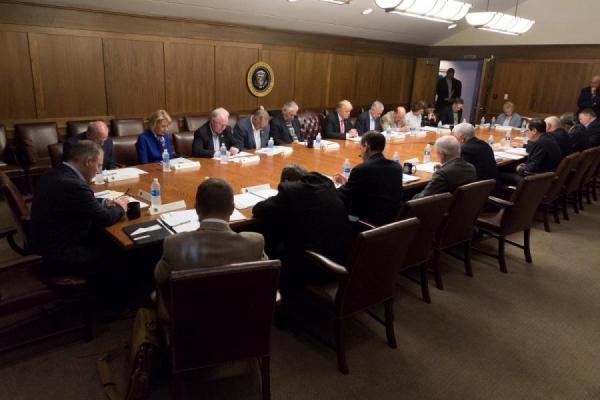
Trump and his Cabinet “pray” at Camp David. Obtained through Creative Commons.
Donald Trump cynically uses prayer just like the ancient Zoramites – as a political tool to promote his own power and marginalize others.
If you look at Donald Trump’s Twitter account right now (I know, “The horror! The horror!”), you’ll see that his cover photo shows him and his entire Cabinet bowing their heads in prayer. There’s nothing out of the ordinary about that – prayer by government figures or their designees in official meetings has long been practiced in America and received the official sanction of the Supreme Court yet again in the 2014 case Town of Greece v. Galloway. Further, pretty much all politicians co-opt religious terms and devotion in order to promote themselves and further their aims. Observe how Democratic politicians have recently taken to citing the “I was a stranger” passage from Matthew to justify their support for DACA and for refugee admissions – and how Republicans repeatedly resort to scripture to shore up their stance on abortion.
But what is different about Trump is just how performative and blatantly insincere his religious pandering is. Trump, by all accounts, is a man with little in the way of religious sentiments or knowledge. In fact, after his election, when he met with Presbyterian ministers (Trump himself is a baptized Presbyterian), he didn’t seem to know that Presbyterians were Christian. When he talks about the afterlife, it is with such flippant and cartoonish terms that he may as well be cribbing from a South Park episode’s portrayal of the subject. And while it is customary for politicians, and especially the president, to sprinkle their speeches with references to deity, Trump has broken open his religious salt shaker to slather his public addresses and comments in faith-based verbiage.
Trump knows that he’s in office mostly thanks to religious voters who were willing to overlook the wasteland that is his personal character and vote for a man who would safeguard their “interests.” In a nod to them, he’s chosen to shamelessly play the God card like there’s no tomorrow. Trump’s photo of his Cabinet prayer is only the most recent example of this cynical deployment of faith as a political mascot. And it reminds me of a group of people in the Book of Mormon who also used prayer as a power play – the Zoramites.
The Zoramites were a group of dissenters from the Nephites who adopted a peculiar form of worship. On a particular day each week, they would gather in their houses of worship to recite, on a raised stand called a Rameumpton, the same performative prayer, in which they would extoll their virtues and disparage those who believed differently than them. After their weekly service, they wouldn’t mention God again until the next week’s meeting.
The rote nature of the Zoramites’ prayers, and their limitation to one day each week, suggests that they were likely not being offered for devotional purposes. Rather, one could plausibly claim that these “prayers” were being recited to solidify in-group cohesion and vilify those in out-groups. Just as national pledges and anthems are designed to promote loyalty to a country, prayer for the Zoramites had simply become a civic ritual – a “prayer” in form only, devoid of meaning. Later, the misbegotten civil cohesion spawned by the Zoramites’ “prayers” would be used to persecute those with differing religious beliefs and to launch a treasonous war against the Nephites’ central government.
It’s easy to see the parallels between the “civic religion” of the Zoramites and the performative prayer and rhetoric of Trump. Trump, not a religious man himself, wants to enhance his own power and preserve the coalition that elected him, and he deploys prayer and God-talk to this end. Similarly, the Zoramites sought to enhance their own power by using public “prayer” to strengthen civic solidarity. In addition, when Trump engages in “prayer performances,” they inevitably have explicitly Christian overtones that marginalize the millions of Americans who are atheists or belong to minority faiths. Likewise, the Zoramites’ prayers were geared at denigrating and marginalizing those who believed differently from them – they eventually went so far as to exile/deport thousands of their fellow Zoramites who had converted to a different belief system.
In the Book of Mormon, the prophet and missionary Alma the Younger was able to see the Zoramites’ “faith” for what it was – jingoistic, xenophobic nationalism dressed up in the robes of religion. Hopefully, people of faith in America will be able to see that Trump is just taking a page out of the old Zoramite playbook.
Previous Post
September 13, 2017
“They Were [Not] Still His Brethren in the Lord”
Next Post

September 15, 2017 Fahrenheit 2016
Browse Our Archives
Select a Category Book of Mormon Brigham Young BYU Donald Trump General Conference Hillary Clinton Islam LDS Mormon nationalism Nuclear weapons Philosophy Politics Racism Romney The Church of Jesus Christ of Latter-day Saints Uncategorized War
Select a Month February 2018 December 2017 October 2017 September 2017 August 2017 July 2017
Follow Us!
TAKE THE
Religious Wisdom Quiz
How long did the judges rule before kings?
Select your answer to see how you score.
400 years Approximately 350 years 300 years 200 years
Related posts from The Mormon Politico

"I should have told her to divorce him":...
Remind me why Mormons hang out with the...

The Evening Redness in Alabama: Roy Moore and...
TRENDING AT PATHEOS Latter-day Saint

Did Prayer Cure His Cancer? Or Was It...
At 4 AM one morning, Joshua W. Brown’s wife awoke to a...

8 Ways a Near-Death Experience Rewires the Soul
Does Consciousness Survive Physical Death? After 50 Years of Research, Dr. Raymond...

Holy Longing: What Our Restlessness Is Telling Us
“One can find so many pains when the rain is falling.” -John...

What this is NOT about. This blog is definitely not about...

Who said the Israelites were God’s chosen? That’s right, they did. Who...

The Spirit World Is the Real World: God...
A Monk’s Wisdom on Body and Spirit I sit with Brother Martin...
view all Latter-day Saint blogs
Ad-Free & Subscriber Log-In Subscription Support
- About Us
- 2026 Calendar
- Videos
- Podcasts
- Library of World Religions
- Faith In Media Tracker
- Advertise With Us
- Write for Us
- Privacy Policy
- Terms of Service
- Do Not Sell My Data
- Contact Us
- Radiant Digital
- Manage Newsletter Subscriptions
- Unsubscribe From Notifications
- Sitemap
Copyright 2008-2026, Patheos. All rights reserved.
Subscription Support Ad-Free & Subscriber Log-In
Follow Patheos