
BuddhistCatholicContemplativeEvangelicalGeneral ChristianHinduJewishLatter-day SaintMuslimNew VisionsProgressive Christian
Beliefs
- Buddhist
- Catholic
- Contemplative
- Evangelical
- General Christian
- Hindu
- Jewish
- Latter-day Saint
- More Voices
- Muslim
- New Visions
- Pagan
- Progressive Christian
Topics
- Religion News
- Food and Religion
- Sports and Religion
- Religious Art
- Religious Music and Entertainment
- Religious Events
- History and Religion
- Style and Religion
- Politics and Religion
- Women in Religion
- Recreation Outdoors and Religion
- Business Finance and Religion
- Careers Workplace and Religion
- Education and Religion
- Family Parenting and Religion
- Health Fitness and Religion
- Home and Religion
- Relationships and Religion
- Technology and Religion
- Travel and Religion
Columnists
- Buddhist Columnists
- Business Finance and Religion Columnists
- Careers Workplace and Religion Columnists
- Catholic Columnists
- Contemplative Columnists
- Education and Religion Columnists
- Evangelists Columnists
- Family Parenting and Religion Columnists
- General Christian Columnists
- Health Fitness and Religion Columnists
- Hindu Columnists
- History and Religion Columnists
- Home and Religion Columnists
- Jewish Columnists
- More Voices Columnists
- Latter Day Columnists
- Muslim Columnists
- New Visions Columnists
- Nonreligious Columnists
- Pagan Columnists
- Politics and Religion Columnists
- Progressive Columnists
- Recreation Outdoors and Religion Columnists
- Relationships and Religion Columnists
- Religion News Columnists
- Religious Art Columnists
- Religious Events Columnists
- Religious Music and Entertainment Columnists
- Sports and Religion Columnists
- Style and Religion Columnists
- Technology and Religion Columnists
- Travel and Religion Columnists
- Women in Religion Columnists
Resource Library
- 2026 Calendar
- Library of World Religions
- The 100 Most Holy Places on Earth
- Patheos Answers
- Podcasts
- Videos
- Faith Leaders Database
- Anglican Episcopalian
- Bahai
- Baptist
- Buddhism
- Christianity
- Confucianism
- Eastern Orthodoxy
- Hinduism
- Holiness and Pentecostal
- ISKCON
- Islam
- Judaism
- Lutheran
- Methodist
- The Church of Jesus Christ of Latter-day Saints
- New Age
- Paganism
- Presbytarian and Reformed
- Protestantism
- Religion Behind the Scenes
- Roman Catholic
- Scientology
- Shia Islam
- Sikhism
- Sufism
- Sunni Islam
- Taoism
- Zen
- See all religions
Research Tools
 Ad-Free & Subscriber Log-In Subscription Support
Ad-Free & Subscriber Log-In Subscription Support
Follow Patheos 

- Trending:
- Forgiveness
- |
- Marriage
- |
- Consciousness
- |
- Death Penalty
- |
- Election
- |
- Halloween
 The Mormon Politico
- Home
- Latter-day Saint
- Religion News
- Trump’s Confederate Nostalgia: Rooted in Georgia History?
Trump’s Confederate Nostalgia: Rooted in Georgia History?
Last updated on: August 18, 2017 at 12:28 pm by Gary A.
Trump’s Confederate Nostalgia: Rooted in Georgia History? 2017-08-18T12:28:42-04:00 Gary A.
Patheos Explore the world's faith through different perspectives on religion and spirituality! Patheos has the views of the prevalent religions and spiritualities of the world.
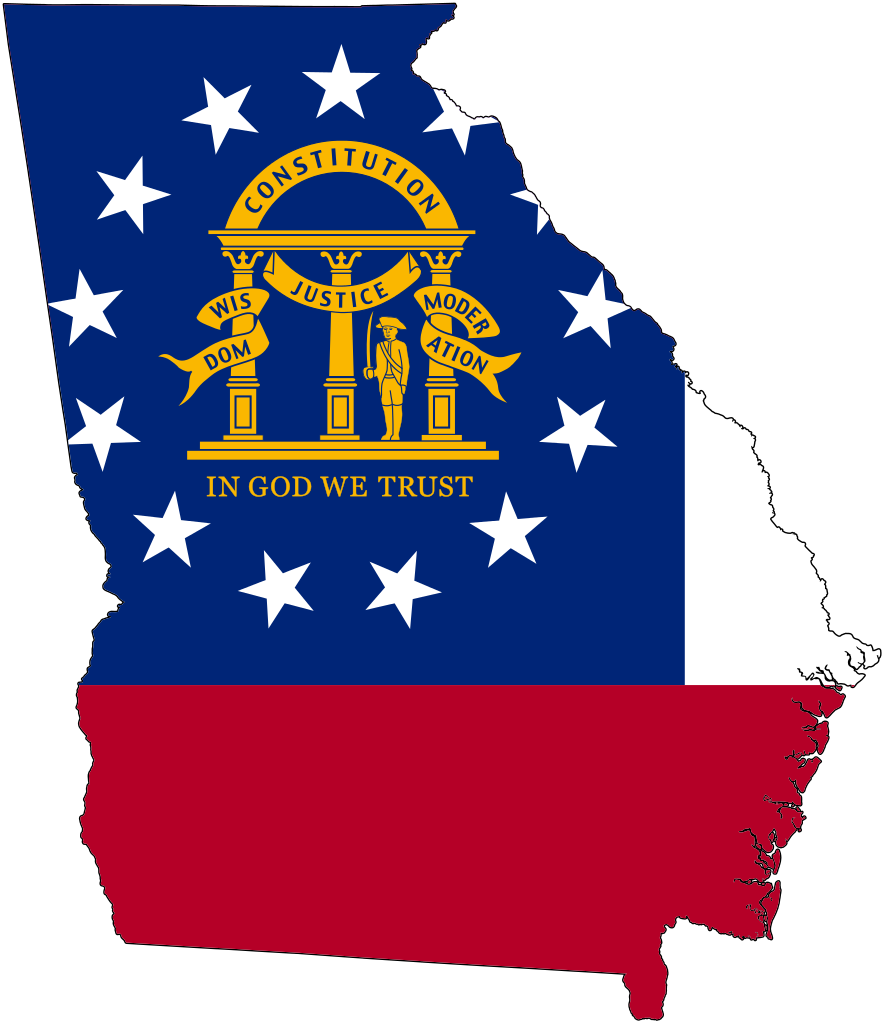
The flag of Georgia superimposed on a map of the state. Obtained through Creative Commons.
Trump’s bizarre embrace of Confederate nostalgia may be rooted in the electoral history of his Secretary of Agriculture.
Donald Trump loves statues.
At least that’s what you would gather from reading his Twitter feed yesterday, where he pecked-out a tirade about how removing Confederate statutes erases history. Given the controversy surrounding his comments about radical white terrorism in Charlottesville, one would think that he would want to avoid any topic even remotely linked to race or white supremacy. Also, what does a lifelong New Yorker care about “participation trophies” erected to honor a bunch of Southern “losers”?
So why is Trump embracing Confederate monuments?
To answer that question, you might want to talk to his Secretary of Agriculture, Sonny Perdue.
Sonny Perdue is a former veterinarian who rose to the height of Georgia state politics, occupying the governor’s mansion in Atlanta from 2003 to 2011. But for our purposes, what’s more important than his term in office is how he got there.
It all had to do with the Confederate flag.
Let’s review the backstory. In 1956, in the midst of a backlash to the 1954 Supreme Court case Brown v. Board of Education, which mandated the integration of public schools, the Georgia legislature adopted a new state flag, one which incorporated the Confederate battle flag (otherwise known as the “Southern Cross” or Beauregard flag). The purpose of this change was obvious: it was a big middle finger to those who sought to eradicate racial discrimination, a defiant gesture that, regardless of what the courts and federal government said, Georgia would not abandon its Jim Crow ways.
Georgia’s new flag would remain in place for over four decades, incongruously clashing with the “New South” image that the state was trying to cultivate – an image that sought to show the world that, far from being a provincial backwater filled with racists, Georgia was a cosmopolitan place friendly to business. The increasing distance between what Georgia was becoming, and what its flag was a reminder of, finally prompted Democratic Governor Roy Barnes to lead a charge to change the flag in 2001. In the place of the prominent Southern Cross, Barnes commissioned this banner:
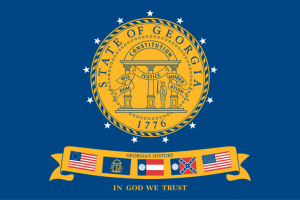
The 2001 Georgia flag commissioned by Governor Roy Barnes.
Admittedly, Barnes’s new flag wasn’t the prettiest thing to look at, and it still contained a tiny representation of the Confederate battle flag, an attempt to assuage the “historical nostalgia” of groups like the Sons of Confederate Veterans. But the fact was, it was a step in the right direction – Barnes was demonstrating to the nation and the world that Georgians had finally gotten over the legacy of their treasonous forebears.
If only that were true.
The backlash was swift and furious. Confederate nostalgists across the state condemned what they described as the destruction of their heritage. At public events, Barnes was often confronted by protesters defiantly wielding the old state pennant, and opponents of the change began to display signs calling for Barnes’s ouster. While Barnes sought to show the world that Georgia had changed, it was painfully evident that many Georgians were still hung up on their Confederate past.
Cannily watching all of this was Republican State Senator Sonny Perdue. A native of Houston County, a rural locale far removed from the liberal bastion of Atlanta, Perdue was familiar with the reverence many Georgians still felt for the rebel standard. With this in mind, as Perdue challenged Barnes in the 2002 gubernatorial election, he promised that, if elected, he would commission a referendum to allow Georgians to vote on a new state flag.
Rural white Georgians embraced Perdue’s promise, and they turned out in record numbers to vote for him in the November 2002 elections. When all the votes were tallied, Perdue had vanquished Barnes by over five percentage points and took office on January 13, 2003, as the first Republican governor of Georgia since Reconstruction.
But unbeknownst to the neo-Confederates who had supported him, Perdue had a little trick up his sleeve. In 2004, he did allow Georgians to vote on a new state flag, but there was a catch: the pre-2001 flag was not an option. Instead, voters could choose between the Barnes flag and a new flag designed by the legislature, one which didn’t feature the Confederate banner (voters overwhelming opted for the legislature’s new flag).
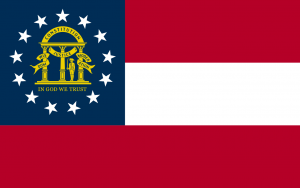
The current flag of Georgia, approved by voters in a 2004 referendum.
Confederate flag aficionados were, predictably, outraged – Perdue had hoodwinked them! Prior to and after the flag referendum, they hounded the governor during his public appearances, condemning him for his supposed duplicity and issuing calls to “Boot Perdue.” But despite their ire, Perdue had nothing to worry about: in 2006, he was reelected to a second term as governor by an almost 20-point margin.
Which brings us back to the present. On January 18th, then-President-elect Trump announced that he would nominate Perdue to be his Secretary of Agriculture, and on April 25th Perdue assumed office. On August 17, Trump issued what amounted to a full-throated endorsement of Confederate symbols, despite the already fraught racial controversy in which he had immersed himself. Although Trump’s Confederate sympathies may seem self-defeating, they may be driven by his knowledge of Perdue’s electoral history. After all, embracing the Confederacy worked for Sonny – why couldn’t it shore up the Donald’s failing presidency?
But if this is Trump’s calculus, he may be sorely disappointed. Perdue’s electoral successes happened prior to devastating incidents of white terrorism like the Dylan Roof massacre and the Charlottesville attack. In other words, while Perdue’s victories took place during a period of relative racial calm, when Americans could kid themselves that celebrating the Confederacy didn’t mean identifying with white nationalism, Trump’s statements are deployed in an atmosphere of fraught race relations, one in which bigoted white supremacists menace minorities while lofting the Confederate flag alongside swastikas. Far from boosting his support and electoral prospects, Trump’s Confederate apologism may cause further defections from his already-shrinking base.
Trump’s bizarre embrace of the South’s infernal “Lost Cause” may be rooted in his study of Perdue’s success. But 2017 America isn’t 2002 or 2006 Georgia, and Trump’s words won’t strengthen his power – they’ll likely just make more Americans hate him.
The Church of Jesus Christ of Latter-day Saints
Previous Post

August 17, 2017
Confederate Treason is Not My Culture
Next Post

August 19, 2017 Steve Bannon, Meet Amlici
Browse Our Archives
Select a Category Book of Mormon Brigham Young BYU Donald Trump General Conference Hillary Clinton Islam LDS Mormon nationalism Nuclear weapons Philosophy Politics Racism Romney The Church of Jesus Christ of Latter-day Saints Uncategorized War
Select a Month February 2018 December 2017 October 2017 September 2017 August 2017 July 2017
Follow Us!
TAKE THE
Religious Wisdom Quiz
How old was Noah when flood began?
Select your answer to see how you score.
500 years 450 years 600 years 550 years
Related posts from The Mormon Politico

"I should have told her to divorce him":...

Remind me why Mormons hang out with the...


The Evening Redness in Alabama: Roy Moore and...
TRENDING AT PATHEOS Latter-day Saint

Did Prayer Cure His Cancer? Or Was It...
At 4 AM one morning, Joshua W. Brown’s wife awoke to a...

8 Ways a Near-Death Experience Rewires the Soul
Does Consciousness Survive Physical Death? After 50 Years of Research, Dr. Raymond...

Holy Longing: What Our Restlessness Is Telling Us
“One can find so many pains when the rain is falling.” -John...

What this is NOT about. This blog is definitely not about...

Who said the Israelites were God’s chosen? That’s right, they did. Who...

The Spirit World Is the Real World: God...
A Monk’s Wisdom on Body and Spirit I sit with Brother Martin...
view all Latter-day Saint blogs
Ad-Free & Subscriber Log-In Subscription Support
- About Us
- 2026 Calendar
- Videos
- Podcasts
- Library of World Religions
- Faith In Media Tracker
- Advertise With Us
- Write for Us
- Privacy Policy
- Terms of Service
- Do Not Sell My Data
- Contact Us
- Radiant Digital
- Manage Newsletter Subscriptions
- Unsubscribe From Notifications
- Sitemap
Copyright 2008-2026, Patheos. All rights reserved.
Subscription Support Ad-Free & Subscriber Log-In
Follow Patheos