
BuddhistCatholicContemplativeEvangelicalGeneral ChristianHinduJewishLatter-day SaintMuslimNew VisionsProgressive Christian
Beliefs
- Buddhist
- Catholic
- Contemplative
- Evangelical
- General Christian
- Hindu
- Jewish
- Latter-day Saint
- More Voices
- Muslim
- New Visions
- Pagan
- Progressive Christian
Topics
- Religion News
- Food and Religion
- Sports and Religion
- Religious Art
- Religious Music and Entertainment
- Religious Events
- History and Religion
- Style and Religion
- Politics and Religion
- Women in Religion
- Recreation Outdoors and Religion
- Business Finance and Religion
- Careers Workplace and Religion
- Education and Religion
- Family Parenting and Religion
- Health Fitness and Religion
- Home and Religion
- Relationships and Religion
- Technology and Religion
- Travel and Religion
Columnists
- Buddhist Columnists
- Business Finance and Religion Columnists
- Careers Workplace and Religion Columnists
- Catholic Columnists
- Contemplative Columnists
- Education and Religion Columnists
- Evangelists Columnists
- Family Parenting and Religion Columnists
- General Christian Columnists
- Health Fitness and Religion Columnists
- Hindu Columnists
- History and Religion Columnists
- Home and Religion Columnists
- Jewish Columnists
- More Voices Columnists
- Latter Day Columnists
- Muslim Columnists
- New Visions Columnists
- Nonreligious Columnists
- Pagan Columnists
- Politics and Religion Columnists
- Progressive Columnists
- Recreation Outdoors and Religion Columnists
- Relationships and Religion Columnists
- Religion News Columnists
- Religious Art Columnists
- Religious Events Columnists
- Religious Music and Entertainment Columnists
- Sports and Religion Columnists
- Style and Religion Columnists
- Technology and Religion Columnists
- Travel and Religion Columnists
- Women in Religion Columnists
Resource Library
- 2026 Calendar
- Library of World Religions
- The 100 Most Holy Places on Earth
- Patheos Answers
- Podcasts
- Videos
- Faith Leaders Database
- Anglican Episcopalian
- Bahai
- Baptist
- Buddhism
- Christianity
- Confucianism
- Eastern Orthodoxy
- Hinduism
- Holiness and Pentecostal
- ISKCON
- Islam
- Judaism
- Lutheran
- Methodist
- The Church of Jesus Christ of Latter-day Saints
- New Age
- Paganism
- Presbytarian and Reformed
- Protestantism
- Religion Behind the Scenes
- Roman Catholic
- Scientology
- Shia Islam
- Sikhism
- Sufism
- Sunni Islam
- Taoism
- Zen
- See all religions
Research Tools
 Ad-Free & Subscriber Log-In Subscription Support
Ad-Free & Subscriber Log-In Subscription Support
Follow Patheos 

- Trending:
- Forgiveness
- |
- Marriage
- |
- Consciousness
- |
- Death Penalty
- |
- Election
- |
- Halloween
 The Witching Hour
- Home
- Pagan
- THE EAGLE: Oh, those bloodthirsty pagan Celts!
THE EAGLE: Oh, those bloodthirsty pagan Celts!
Last updated on: February 15, 2011 at 6:17 am by Peg Aloi
THE EAGLE: Oh, those bloodthirsty pagan Celts! 2011-02-15T06:17:00+00:00 Peg Aloi
Patheos Explore the world's faith through different perspectives on religion and spirituality! Patheos has the views of the prevalent religions and spiritualities of the world.

Happy Lupercalia, everyone! In honor of this ancient Roman festival, today’s review seems particularly appropriate. Stories about the Romans in Britain and Hadrian’s Wall are part of a strange and growing cinematic micro-trend. It’s, odd, isn’t it, in an age where we are so terribly modern, with our portable technology and whirlwind mental stimulation, that we should be seeing so many stories drawn from ancient history. We saw a taste of Roman Britain in Antoine Fuqua’s King Arthur several years ago: in which both Guinevere (Keira Knightley) and Merlin (Stephen Dillane) are portrayed as being part of a tribe of forest-dwelling Druids. That particular incarnation of the story was based on “exciting new” archaeological findings suggesting that Arthur may have been of Roman, and thereby Christian, origin. Arthur (played by Clive Owen) is portrayed as a Crusades knight whose faith and allegiance are conflicted between his British origins and his Roman military service. A very provocative thesis, really, though not a very likely one.
 Kevin Macdonald’s story of Roman Britain The Eagle, which opened last weekend, is based on Rosemary Sutcliff’s novel The Eagle of the Ninth, about the legendary Roman legion that invaded Britain in the 12th century. If this storyline sounds familiar, you may have managed to see Neil Marshall’s Centurion (it was one of the lowest grossing films of 2010), starring Michael Fassenden and Imogen Poots. (If you didn’t see Centurion I highly recommend it; a brief review appears here.) This version also pits Roman warriors against Pictish tribes, but the story line differs slightly, and there is no romantic intrigue with a female character (like Poots’ sexy exiled witch, Ariane, in Centurion).
In fact, The Eagle barely has any women at all. The main characters are a young Roman commander named Marcus Aquila (Channing Tatum, who resembles a young Josh Hartnett (same pinch-faced fratboy look) and his Brigantian slave Esca (Billy Elliott‘s Jamie Bell). Aquila rescues Esca from death during a gladiator death match by encouraging the crowd to cheer his bravery, and the slave, despite his tribal hatred for the Romans, pledges loyalty. When Aquila, against the advice of his elders (including his doting uncle, a war veteran played by Donald Sutherland) decides he must travel north, beyond the safe barrier of Hadrian’s Wall, to retrieve a lost war relic (the golden eagle that topped his father’s sword), he brings Esca as a guide. But the tables are turned when Esca’s Celtic language skills and tribal connections allow him to gain the upper hand.
 Despite the occasionally silly dialogue that makes this feel a bit like a collegiate buddy romp, I liked the look and feel of this film. All of the visual and cultural trappings (costumes, music, Celtic languages, pagan rituals) are nicely authentic, although the northern Pictish tribes are a bit over the top, like refugees from Burning Man. Painted with chalk, and with hairstyles that combine baldness and long dreadlocks, these muscular tribesmen and women prove themselves to be ruthless and bloodthirsty, even with their own children.
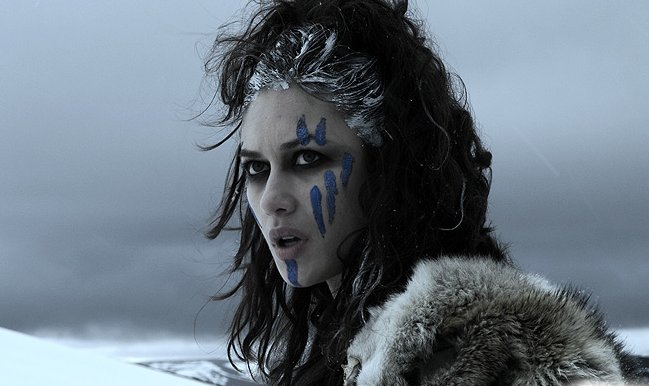 The same was true of the Picts in Centurion: and a female Pictish tracker (who never speaks) accompanies the lone Roman also on a pilgrimage to restore lost honor. The decision to make the Celts ruthless and the Romans noble is not just arbitrary; after all, the main documents we have from history that describe the Celtic peoples (including the Druids) were mostly written by Romans.
  A well-known pre-Raphaelite painting (“A Converted British Family Sheltering a Christian Missionary from the Persecution of the Druids,” by William Holman Hunt) that depicts the Druids as savages hunting down Roman citizens was obviously what Christine O’Donnell (remember her?) was referring to when she claimed, on Bill Maher’s Politically Incorrect back in the 1990s, that the origin of trick or treat at Halloween was based in the fact that “the Druids would go door to door, looking for a human sacrifice.” Clearly a more sympathetic portrayal is needed on film. Come on, you pagan screenwriters!
The Eagle doesn’t condemn all pagan Celtic tribes: just the Picts. The Brigantians (like Esca) come off fairly well, and the various Northern peoples of Scotland are portrayed as rustic, peaceful shepherds. And the film doesn’t shy away from admitting that the Romans have brutally invaded this green and pleasant land and deserve what they get. Thankfully, there is not an abundance of violence or gratuitous fighting here; just enough to be convincing (unlike other medieval era films of 2010, like Robin Hood), and the final battle scene is grand, reminiscent of Lancelot’s heroic return in John Boorman’s Excalibur. Interestingly, Boorman is also tackling this same story in his forthcoming Memoirs of Hadrian, which will star Antonio Banderas and Charlie Hunnam (star of the excellent FX series Sons of Anarchy). A wonderful article on Hadrian and Boorman’s forthcoming film appeared in The Guardian in 2008, showing how in-depth and involved this project is.
The Eagle is beautifully photographed by Anthony Dod Mantle (who worked with Danny Boyle on 28 Days Later and Slumdog Millionaire), shot on location in Great Britain and Hungary. Tatum is somewhat wooden, but the diminutive Bell holds his own, and the many extras that people this ambitious film look straight out of central casting, which is nice to see, given recent failures in this area on the part of TV shows like the BBC’s Robin Hood (where the dialogue, costumes and hairstyles are unintentionally and embarrassingly anachronistic).
I hope this new trend of ancient history in film will continue, even with younger and less literary audiences guiding the profit missiles of Hollywood. Maybe we can see stories of other nations, their folklore brought to rich life on the silver screen. Certainly two films on the ninth Roman legion in one year feels legendary.
Previous Post

February 9, 2011
Don't Look Now...
Browse Our Archives
Select a Category American Horror Story: COVEN American Horror Story: FREAKSHOW Beltane Faery magic News & Reviews occult pagan festivals Paganism Review Reviews ritual Sabbats Samhain Satanic Panic Tuesday Muse News & Reviews TV Uncategorized Wheel of the Year witches in film witches on TV
Select a Month February 2017 January 2017 December 2016 November 2016 October 2016 September 2016 July 2016 April 2016 March 2016 February 2016 January 2016 December 2015 October 2015 August 2015 July 2015 June 2015 May 2015 April 2015 March 2015 February 2015 January 2015 November 2014 October 2014 August 2014 July 2014 May 2014 April 2014 March 2014 February 2014 January 2014 December 2013 November 2013 October 2013 September 2013 August 2013 July 2013 June 2013 May 2013 April 2013 November 2012 October 2012 September 2012 August 2012 June 2012 May 2012 April 2012 March 2012 February 2012 January 2012 December 2011 November 2011 October 2011 September 2011 August 2011 June 2011 May 2011 April 2011 March 2011 February 2011 January 2011 December 2010 November 2010 October 2010
TAKE THE
Religious Wisdom Quiz
I destroyed the world but saved eight people and many animals in a floating vessel. What am I?
Select your answer to see how you score.
A great storm The flood God's judgment The deluge
Related posts from The Witching Hour
The Man Who Put a Spell on Trump:...
Witchery and the Women's March

Yuletide Movie Watching: Beyond the Basics
Why Real Witches Are Going to Love (or...
TRENDING AT PATHEOS Pagan

I was recently chatting with someone on Instagram. She asked me what...

While there are many people who share their results, the end of...

On July 23, I saw Christopher Nolan's The Odyssey which is Homer’s...

As I write this two big events have just finished up. One...

Restoring the Watershed of Divine Love
Perhaps cooperation is not something we manufacture through legislation, ideology, or moral...

Many UUs don’t pray because of bad experiences in a previous religion,...
view all Pagan blogs
Ad-Free & Subscriber Log-In Subscription Support
- About Us
- 2026 Calendar
- Videos
- Podcasts
- Library of World Religions
- Faith In Media Tracker
- Advertise With Us
- Write for Us
- Privacy Policy
- Terms of Service
- Do Not Sell My Data
- Contact Us
- Radiant Digital
- Manage Newsletter Subscriptions
- Unsubscribe From Notifications
- Sitemap
Copyright 2008-2026, Patheos. All rights reserved.
Subscription Support Ad-Free & Subscriber Log-In
Follow Patheos