
BuddhistCatholicContemplativeEvangelicalGeneral ChristianHinduJewishLatter-day SaintMuslimNew VisionsProgressive Christian
Beliefs
- Buddhist
- Catholic
- Contemplative
- Evangelical
- General Christian
- Hindu
- Jewish
- Latter-day Saint
- More Voices
- Muslim
- New Visions
- Pagan
- Progressive Christian
Topics
- Religion News
- Food and Religion
- Sports and Religion
- Religious Art
- Religious Music and Entertainment
- Religious Events
- History and Religion
- Style and Religion
- Politics and Religion
- Women in Religion
- Recreation Outdoors and Religion
- Business Finance and Religion
- Careers Workplace and Religion
- Education and Religion
- Family Parenting and Religion
- Health Fitness and Religion
- Home and Religion
- Relationships and Religion
- Technology and Religion
- Travel and Religion
Columnists
- Buddhist Columnists
- Business Finance and Religion Columnists
- Careers Workplace and Religion Columnists
- Catholic Columnists
- Contemplative Columnists
- Education and Religion Columnists
- Evangelists Columnists
- Family Parenting and Religion Columnists
- General Christian Columnists
- Health Fitness and Religion Columnists
- Hindu Columnists
- History and Religion Columnists
- Home and Religion Columnists
- Jewish Columnists
- More Voices Columnists
- Latter Day Columnists
- Muslim Columnists
- New Visions Columnists
- Nonreligious Columnists
- Pagan Columnists
- Politics and Religion Columnists
- Progressive Columnists
- Recreation Outdoors and Religion Columnists
- Relationships and Religion Columnists
- Religion News Columnists
- Religious Art Columnists
- Religious Events Columnists
- Religious Music and Entertainment Columnists
- Sports and Religion Columnists
- Style and Religion Columnists
- Technology and Religion Columnists
- Travel and Religion Columnists
- Women in Religion Columnists
Resource Library
- 2026 Calendar
- Library of World Religions
- The 100 Most Holy Places on Earth
- Patheos Answers
- Podcasts
- Videos
- Faith Leaders Database
- Anglican Episcopalian
- Bahai
- Baptist
- Buddhism
- Christianity
- Confucianism
- Eastern Orthodoxy
- Hinduism
- Holiness and Pentecostal
- ISKCON
- Islam
- Judaism
- Lutheran
- Methodist
- The Church of Jesus Christ of Latter-day Saints
- New Age
- Paganism
- Presbytarian and Reformed
- Protestantism
- Religion Behind the Scenes
- Roman Catholic
- Scientology
- Shia Islam
- Sikhism
- Sufism
- Sunni Islam
- Taoism
- Zen
- See all religions
Research Tools
 Ad-Free & Subscriber Log-In Subscription Support
Ad-Free & Subscriber Log-In Subscription Support
Follow Patheos 

- Trending:
- Forgiveness
- |
- Marriage
- |
- Consciousness
- |
- Death Penalty
- |
- Election
- |
- Halloween
 The Witching Hour
- Home
- Pagan
- SEASON OF THE WITCH: A Medieval Muddle
SEASON OF THE WITCH: A Medieval Muddle
Last updated on: January 7, 2011 at 5:59 pm by Peg Aloi
SEASON OF THE WITCH: A Medieval Muddle 2011-01-07T17:59:00+00:00 Peg Aloi
Patheos Explore the world's faith through different perspectives on religion and spirituality! Patheos has the views of the prevalent religions and spiritualities of the world.
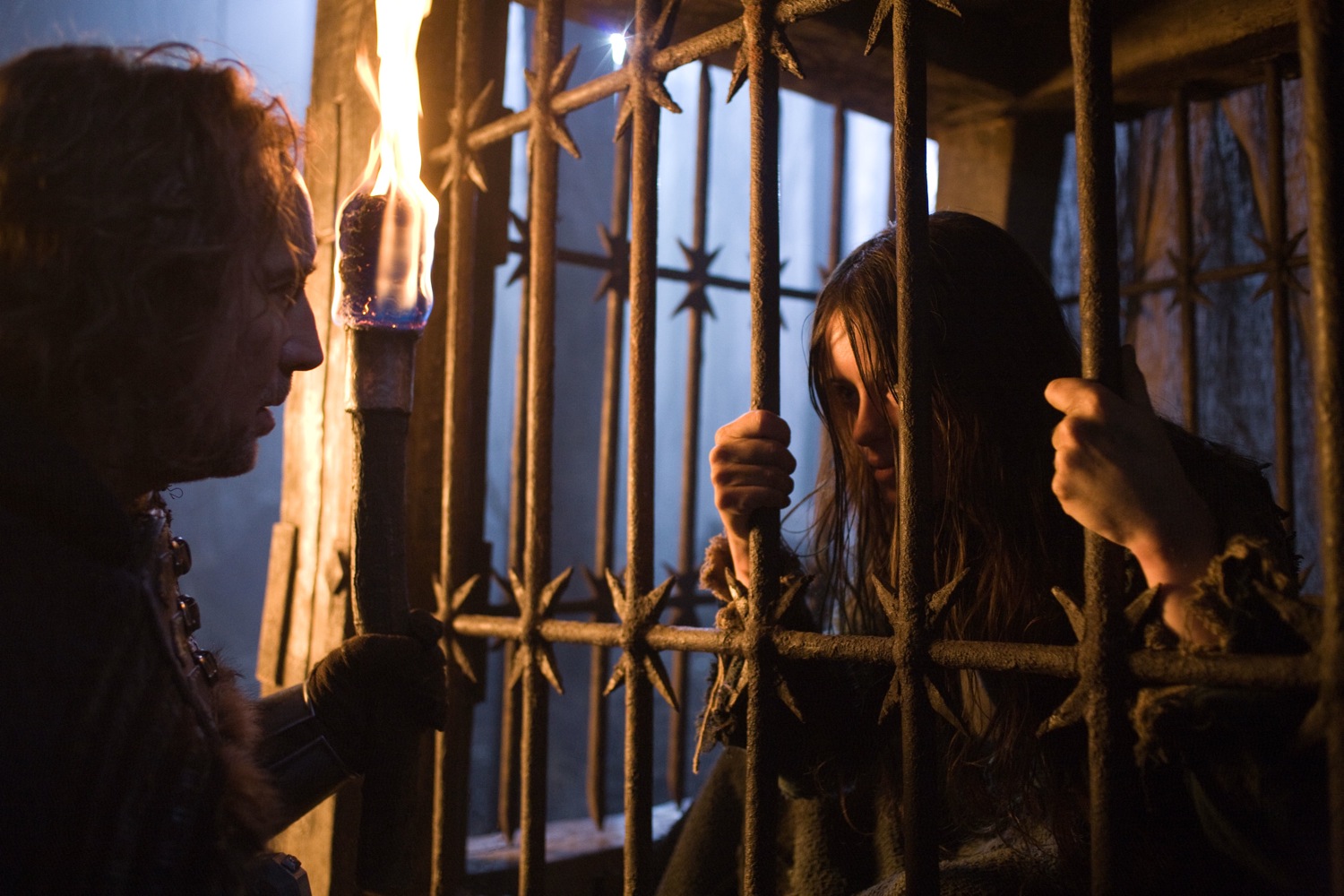
You’d think it was the 1970s all over again, what with so many occult-themed stories in film recently. 2010 brought us The Last Exorcism (a clever, subversive premise that unfortunately dissolves into precious chaos), Devil (a kinda spooky but mostly lame story of random folks trapped in an elevator who just start dying), last year gave us The House of the Devil (a cool cinema verite story of a cult leader), and in just a few weeks The Rite opens (a contemporary story of exorcists-in-training in Rome, based on true events). Later this year: Black Death, about plague victims who won’t stay dead, and from Norwegian director Tommy Wirkola (of last year’s Dead Snow, about Nazi zombies), a comedy-horror mash-up called Hansel and Gretel: Witch Hunters.
Historical thrillers are often framed as commentary on modern problems; the last time a medieval film did this, we had The Navigator: A Medieval Odyssey (1988), which linked the black plague in medieval Britain to AIDS in contemporary Australia. A tiny Scottish village believed it could remain immune from the plague if they climbed the tallest steeple they could find and hung a metal cross on it. The central event and climax is as simple and as thrilling as it could possibly be: but alas, it doesn’t prevent the plague from striking the film’s young hero.
In Season of the Witch, similarly superstitious beliefs surround the plague’s decimation of humanity. But, since we don’t currently have a “plague” that parallels those of ancient times, I’m going to have to conclude that the film’s main sub-commentary has to do with mindless religion-based superstition. Given this last week’s reports of massive deaths of birds and fish all over the globe and the resultant apocalyptic panic-mongering…yeah, I’m gonna go with that.
In the film’s prologue, in 1235, three witches are hung and drowned after confessing to consorting with the devil. The attending priest, troubled when the executioner won’t help him redeem the women’s souls, hauls their bodies from the water and reads incantations over them. But one of them won’t stay dead. Fast forward 100 years, and two Crusade knights, Behmen (Nicolas Cage, whose best work lately is in quirky comedies like Kickass or Bad Lieutenant, Port of Call: New Orleans, is a bit wooden here) and Felson (Ron Perlman, so wonderful in Sons of Anarchy, who seems uncomfortable here), hack and maim their way across the Middle East and Asia Minor. Disillusioned and haunted by their unwitting murder of women and children, they desert their holy army, only to be recognized in a remote village that has been ravaged by the plague. They’re captured and thrown in a dungeon.
A priest named Debelzaq (Stephen Campbell Moore) recognizes Behmen’s crest on his sword hilt and brings the two knights to the bishop (Christopher Lee, in a nice little cameo). Disfigured and dying, the cleric insists Behmen and Felson escort an accused witch to a remote abbey, where the monks possess an ancient book containing rituals that will purge the witch of evil and, presumably, remove the plague from the land. (How one woman could cause a disease that killed millions of people is not explained.)
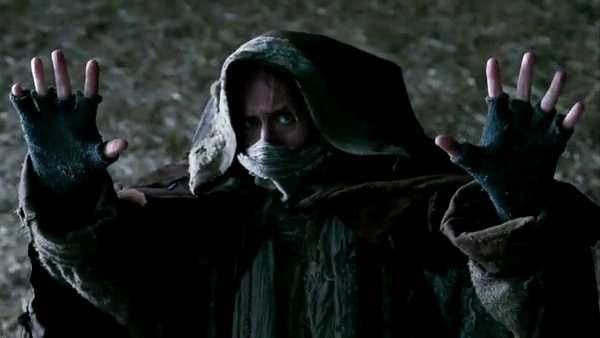
Annoyed to be serving the church yet again, Behmen and Felson agree to the task, but under the condition that the witch be given a fair trial. They set off, accompanied by Debelzaq, Eckhart, a knight named Eckhart (Danish heartthrob Ulrich Thomsen) whose family has been killed by plague, Kay, an altar boy who wants to be a knight (Red Riding’s Robert Sheehan), and an imprisoned swindler who agrees to be their tracker (Stephen Graham, an English actor who nevertheless speaks with a New York accent).
The witch (Claire Foy) is young, pretty, and devious. Behmen sympathizes with her, but as his compatriots begin to fall prey to accidents, he understands she is more dangerous than she looks. I don’t want to give too much away, but suffice it to say, by the time the party reaches the abbey, all hell breaks loose…literally.
And therein lies the worst thing about this movie: the ludicrous special effects and the needless reliance on supernatural silliness. Shot on location in Budapest, Hungary and Salzberg, Austria by cinematographer Amir Mokri (Vantage Point) and with terrific costumes by Carlo Poggioli (whose credits include The Mists of Avalon and The Brothers Grimm), this is not a bad-looking film. But the story is a mess: disjointed, illogical and ultimately a poor exploration of a terrifically momentous time in human history. Millions of people were dying, and didn’t know why, and they looked to the Church to save them, and it didn’t.
Now, THAT’s a movie.
Just once, I’d love to see a film that has as its premise a pervasive cultural belief in occult powers…but that portrays these beliefs as being difficult, if not impossible. to defend when confronted with the facts. In this way, such a film is not about whether magic or witchcraft are “real” or not; but instead is about the fascinating psychological implications of belief in such matters.
I’m not saying paranormal events don’t occur, or that evil doesn’t exist. But in truth, it is the belief in the human capability for evil, the human propensity for evil, and the fear of being victimized by that evil, that propels the main witch hunts of history. How refreshing it would be to see an historical film that confronts this fear and this pervasive delusion in a grounded and plausible manner.
But instead, we want our witches to shoot lightning bolts from their hands. We want wolves skulking in the forest to grow huge lantern jaws and glowing red eyes (hello? Slobbering wolves in the dark aren’t already scary?), and we want winged demons to croak curses from their shriveled walnut heads and break our spines like jackstraws. Gods help us, we want so badly for there to be a zombie apocalypse that there are days when we can think of little else. We want for there to be evil we can’t defeat, horrors we can’t escape.
Why this is, I can’t say. But, I fear our current social climate, cynical and apathetic though it may be, is moving inexorably backward in time to the fearful, superstitious days of our medieval forebears, hiding in the shadows from a perceived punishment, stinking and starving and praying, instead of walking into the sun and meeting their mortality head on with a smile….and maybe a broadsword.
Previous Post

January 6, 2011
Best Witches Ever?
Browse Our Archives
Select a Category American Horror Story: COVEN American Horror Story: FREAKSHOW Beltane Faery magic News & Reviews occult pagan festivals Paganism Review Reviews ritual Sabbats Samhain Satanic Panic Tuesday Muse News & Reviews TV Uncategorized Wheel of the Year witches in film witches on TV
Select a Month February 2017 January 2017 December 2016 November 2016 October 2016 September 2016 July 2016 April 2016 March 2016 February 2016 January 2016 December 2015 October 2015 August 2015 July 2015 June 2015 May 2015 April 2015 March 2015 February 2015 January 2015 November 2014 October 2014 August 2014 July 2014 May 2014 April 2014 March 2014 February 2014 January 2014 December 2013 November 2013 October 2013 September 2013 August 2013 July 2013 June 2013 May 2013 April 2013 November 2012 October 2012 September 2012 August 2012 June 2012 May 2012 April 2012 March 2012 February 2012 January 2012 December 2011 November 2011 October 2011 September 2011 August 2011 June 2011 May 2011 April 2011 March 2011 February 2011 January 2011 December 2010 November 2010 October 2010
TAKE THE
Religious Wisdom Quiz
What city did the Good Samaritan's story happen on the road to?
Select your answer to see how you score.
Jerusalem Nazareth Bethlehem Jericho
Related posts from The Witching Hour
The Man Who Put a Spell on Trump:...
Witchery and the Women's March
Yuletide Movie Watching: Beyond the Basics
Why Real Witches Are Going to Love (or...
TRENDING AT PATHEOS Pagan

I was recently chatting with someone on Instagram. She asked me what...

While there are many people who share their results, the end of...

On July 23, I saw Christopher Nolan's The Odyssey which is Homer’s...

As I write this two big events have just finished up. One...

Restoring the Watershed of Divine Love
Perhaps cooperation is not something we manufacture through legislation, ideology, or moral...

Many UUs don’t pray because of bad experiences in a previous religion,...
view all Pagan blogs
Ad-Free & Subscriber Log-In Subscription Support
- About Us
- 2026 Calendar
- Videos
- Podcasts
- Library of World Religions
- Faith In Media Tracker
- Advertise With Us
- Write for Us
- Privacy Policy
- Terms of Service
- Do Not Sell My Data
- Contact Us
- Radiant Digital
- Manage Newsletter Subscriptions
- Unsubscribe From Notifications
- Sitemap
Copyright 2008-2026, Patheos. All rights reserved.
Subscription Support Ad-Free & Subscriber Log-In
Follow Patheos