
BuddhistCatholicContemplativeEvangelicalGeneral ChristianHinduJewishLatter-day SaintMuslimNew VisionsProgressive Christian
Beliefs
- Buddhist
- Catholic
- Contemplative
- Evangelical
- General Christian
- Hindu
- Jewish
- Latter-day Saint
- More Voices
- Muslim
- New Visions
- Pagan
- Progressive Christian
Topics
- Religion News
- Food and Religion
- Sports and Religion
- Religious Art
- Religious Music and Entertainment
- Religious Events
- History and Religion
- Style and Religion
- Politics and Religion
- Women in Religion
- Recreation Outdoors and Religion
- Business Finance and Religion
- Careers Workplace and Religion
- Education and Religion
- Family Parenting and Religion
- Health Fitness and Religion
- Home and Religion
- Relationships and Religion
- Technology and Religion
- Travel and Religion
Columnists
- Buddhist Columnists
- Business Finance and Religion Columnists
- Careers Workplace and Religion Columnists
- Catholic Columnists
- Contemplative Columnists
- Education and Religion Columnists
- Evangelists Columnists
- Family Parenting and Religion Columnists
- General Christian Columnists
- Health Fitness and Religion Columnists
- Hindu Columnists
- History and Religion Columnists
- Home and Religion Columnists
- Jewish Columnists
- More Voices Columnists
- Latter Day Columnists
- Muslim Columnists
- New Visions Columnists
- Nonreligious Columnists
- Pagan Columnists
- Politics and Religion Columnists
- Progressive Columnists
- Recreation Outdoors and Religion Columnists
- Relationships and Religion Columnists
- Religion News Columnists
- Religious Art Columnists
- Religious Events Columnists
- Religious Music and Entertainment Columnists
- Sports and Religion Columnists
- Style and Religion Columnists
- Technology and Religion Columnists
- Travel and Religion Columnists
- Women in Religion Columnists
Resource Library
- 2026 Calendar
- Library of World Religions
- The 100 Most Holy Places on Earth
- Patheos Answers
- Podcasts
- Videos
- Faith Leaders Database
- Anglican Episcopalian
- Bahai
- Baptist
- Buddhism
- Christianity
- Confucianism
- Eastern Orthodoxy
- Hinduism
- Holiness and Pentecostal
- ISKCON
- Islam
- Judaism
- Lutheran
- Methodist
- The Church of Jesus Christ of Latter-day Saints
- New Age
- Paganism
- Presbytarian and Reformed
- Protestantism
- Religion Behind the Scenes
- Roman Catholic
- Scientology
- Shia Islam
- Sikhism
- Sufism
- Sunni Islam
- Taoism
- Zen
- See all religions
Research Tools
 Ad-Free & Subscriber Log-In Subscription Support
Ad-Free & Subscriber Log-In Subscription Support
Follow Patheos 

- Trending:
- Forgiveness
- |
- Marriage
- |
- Consciousness
- |
- Death Penalty
- |
- Election
- |
- Halloween
 The Living Room Disciple
- Home
- General Christian
- Home and Religion
- A Father’s Reflection on The Wingfeather Saga
A Father’s Reflection on The Wingfeather Saga
Last updated on: July 28, 2023 at 1:37 am by Phillip Snyder
A Father’s Reflection on The Wingfeather Saga 2023-07-25T10:37:55-04:00 Phillip Snyder
Patheos Explore the world's faith through different perspectives on religion and spirituality! Patheos has the views of the prevalent religions and spiritualities of the world.
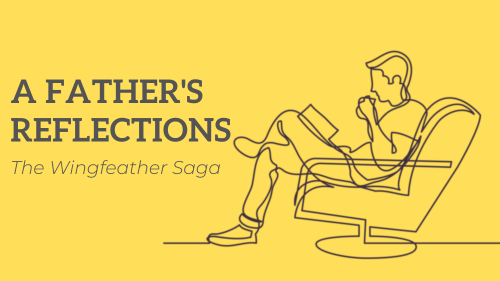
Credit Adobe Stock Photo
“He means to make his subjects merciful and wise; sorrow and struggle bringeth both. We will, he tells me, grow by grieving, live by dying, love by losing. The heart itself is the field of battle and the garden green.” – Andrew Peterson, The Monster in the Hollows
More Than That
It took me too long, perhaps, to start reading every night to my children. My oldest was seven when we finally began the tradition, but now our nightly reading time is the source of some of my deepest joy. Yet, I’m somewhat ashamed to say that my motivation to start our nightly escapades into fantastical worlds was driven by my personal desire to read The Wingfeather Saga by Andrew Peterson. I had seen a trailer in my YouTube feed for the animated show, and it piqued my interest. Buying the books to read to my boys was as much about connecting with them as having an excuse to read the children’s fantasy series.
But oh, I am so glad we did.
It would be hard to summarize the four-book series of The Wingfeather Saga without spoiling anything, and this blog isn’t meant as a review or a summary. For those of you who haven’t read the books, let’s just say that it’s a tale of 3 siblings who get caught up into the greater war and turmoil of the age.
It’s a fantasy adventure, yet more than that. It’s a coming-of-age story, but also much more than that. It’s a classic tale of good versus evil… but, yes, even more than that.
The Wingfeather Saga is a true story, of sorts. Or perhaps it is better to say that it is a fantasy story built upon a foundation of truth. It’s allegorical at times, without being Christian allegory. Something like a parable of Jesus: a fictitious story that communicates truths too deep to explain any other way.
A Quick Example
I’m aware that what I’m saying is vague, at best. So let me give a brief example of what I mean.
At one point in the third novel, A Monster in the Hollows, one of the main characters has done things that are wrong and shameful. He’s acting in a way he doesn’t want to, feeling unable to control himself, and swimming in his own guilt and shame.
In describing this character in this moment, Peterson writes, “He wanted to be alone, and he wanted to be found.”
It’s a simple line. Perhaps one that was added in the first draft, surviving numerous revisions. It is a perfect sentence that describes at a deep level what most all of us have experienced in our own shame and guilt. We desire to be alone and totally unseen, and yet we just as deeply desire someone to seek us out, to find us. A war is waged within us as we both don’t want to have someone see us in our shame while longing for someone who will see us despite our shame.
It’s a fantasy book for middle-grade children.
And it’s also so very true.
A Father’s Reflection
As a father of four young boys, I’m perhaps too protective of who I allow to have influence over them and their young minds. Children are, for better or worse, easily influenced. It is all too easy to lead a child astray by exposing them to what is wrong and unholy. And yet it is just as easy to lead a child astray by not exposing them to the sins of the world, and instead having them face the ugliness of the world unprepared and unprotected.
That being said, there are a few men in my life, close friends and mentors, who I think to myself, “if my boys become like them, that would be a good thing”. These are people who I let influence me, and who I allow to influence my children. Michael comes to mind, in moments like this. An even-tempered musician and worship pastor (check out his Spotify page here), I’m always grateful when he takes time to talk to one of my sons, giving them his time and attention. I want my boys to grow up to be like Michael in some ways, and so I allow him influence in my boys’ lives.
In a strange way, The Wingfeather Saga is like that: a story that I want to influence my boys, to shape them and grow them. The deeper truths the fictional tale tells are truths found in Scripture. They’re truths of hard-fought forgiveness, of complicated people, of a Maker who works in ways that are not our own. The books take place in a world filled with evil, and with good. A place where bad things happen, and they aren’t explained away. A place where you will cry (at least I did), but they will be “the right kind of tears” (Peterson, North! or Be Eaten).
I think this is because (and I don’t know this to be true) that Peterson didn’t set out to create Biblical analogies per say. Instead, it seems that his writing was just an outflow of his thoughts, his imagination, and his life as a follower of Jesus. This is something I’m learning as I grow as a writer: that my writing should simply be an outflow of who I am, and who I am becoming. Or, perhaps more accurately: my writing should be an outflow of who the Father is creating me to be.
I talked a little bit about this in my series on the Sanctified Imagination. Essentially, if I am being sanctified, then the outflow of my imagination will be as well. Peterson’s stories don’t ring of prepared Biblical analogies that point us to Christ, but instead they feel like the outflow of a life that is pointing to Christ.
C.S. Lewis’s career reminds me of this as well.
The Chronicles of Narnia is something like an early work for him, in the area of fiction at least. Excellent books to be sure, they are carefully orchestrated and planned to bring elements of the Biblical story into analogy. Yet later in his life he wrote another work alongside his wife: Till We Have Faces. Comparatively little known, it’s a far more nuanced work that seems less a planned analogy and far more the outflow of an imagination that has been serving God for decades. While Narnia is sure to get me pondering, Till We Have Faces was a book that had me weeping. It’s a book that was speaking less to my mind and far more to my soul.
That’s not to say the Peterson’s Wingfeather Saga and Lewis’s Till We Have Faces weren’t carefully crafted to point to Jesus. I’m sure they were. I’m simply saying they feel like works in which that connection is effortless because the authors themselves are writing from a point in their own sanctification, in which they’ve gone “on to maturity” (see Hebrews 6: 1-2).
For more content like this, check out the Living Room Disciple Podcast here, or check out our website.
Evangelical
Family, Parenting and Religion

About Phillip Snyder
Phillip Snyder pastors a Home Church in Central Florida and co-hosts The Living Room Disciple Podcast. He is on the wonderful and (sometimes) terrifying journey of following Jesus. Through marriage and parenting, teaching and pastoring, failing and repenting. You can read more about the author here.
Previous Post
July 7, 2023
A Disloyal Church
Next Post
August 18, 2023 Quick Thoughts on Minimalism and Discipleship
Recent Comments
Browse Our Archives
Select a Category Discipleship Home Church House Church Mentoring Uncategorized Unity
Select a Month October 2023 September 2023 August 2023 July 2023 June 2023 May 2023 April 2023 March 2023 February 2023
TAKE THE
Religious Wisdom Quiz
What city is the headquarters of the Roman Catholic Church?
Select your answer to see how you score.
Vatican City Florence Jerusalem Rome
Related posts from The Living Room Disciple

Our Individualistic Blind Spot (Part 1)

Why You Should Stop Avoiding Conflict
Fighting the Culture of Loneliness
Quick Thoughts on Minimalism and Discipleship
TRENDING AT PATHEOS General Christian

Seventy and Five Years Old: God Still Starts...
There is a small detail tucked into Genesis 12 that I skipped...

A Biblical Vision of Success in Christian Life...
The Concern and Quest Recent trends and tendencies I note around me...

Indigenous Peoples’ Day and the Church
Indigenous' Peoples Day or Columbus Day? Depending on where you live...

When Spiritual Growth Looks Like Losing Ground
Four Passive Spiritual Disciplines: An Introduction When I was a college freshman,...

Faith and Finding Your Current Season
“To everything there is a season,” Ecclesiastes tells us, “and a time...

Did Jesus Fear God's Wrath in Gethsemane?
That Time Jesus Was Terrified Before we begin, let me say at...
view all General Christian blogs
Ad-Free & Subscriber Log-In Subscription Support
- About Us
- 2026 Calendar
- Videos
- Podcasts
- Library of World Religions
- Faith In Media Tracker
- Advertise With Us
- Write for Us
- Privacy Policy
- Terms of Service
- Do Not Sell My Data
- Contact Us
- Radiant Digital
- Manage Newsletter Subscriptions
- Unsubscribe From Notifications
- Sitemap
Copyright 2008-2026, Patheos. All rights reserved.
Subscription Support Ad-Free & Subscriber Log-In
Follow Patheos