
BuddhistCatholicContemplativeEvangelicalGeneral ChristianHinduJewishLatter-day SaintMuslimNew VisionsProgressive Christian
Beliefs
- Buddhist
- Catholic
- Contemplative
- Evangelical
- General Christian
- Hindu
- Jewish
- Latter-day Saint
- More Voices
- Muslim
- New Visions
- Pagan
- Progressive Christian
Topics
- Religion News
- Food and Religion
- Sports and Religion
- Religious Art
- Religious Music and Entertainment
- Religious Events
- History and Religion
- Style and Religion
- Politics and Religion
- Women in Religion
- Recreation Outdoors and Religion
- Business Finance and Religion
- Careers Workplace and Religion
- Education and Religion
- Family Parenting and Religion
- Health Fitness and Religion
- Home and Religion
- Relationships and Religion
- Technology and Religion
- Travel and Religion
Columnists
- Buddhist Columnists
- Business Finance and Religion Columnists
- Careers Workplace and Religion Columnists
- Catholic Columnists
- Contemplative Columnists
- Education and Religion Columnists
- Evangelists Columnists
- Family Parenting and Religion Columnists
- General Christian Columnists
- Health Fitness and Religion Columnists
- Hindu Columnists
- History and Religion Columnists
- Home and Religion Columnists
- Jewish Columnists
- More Voices Columnists
- Latter Day Columnists
- Muslim Columnists
- New Visions Columnists
- Nonreligious Columnists
- Pagan Columnists
- Politics and Religion Columnists
- Progressive Columnists
- Recreation Outdoors and Religion Columnists
- Relationships and Religion Columnists
- Religion News Columnists
- Religious Art Columnists
- Religious Events Columnists
- Religious Music and Entertainment Columnists
- Sports and Religion Columnists
- Style and Religion Columnists
- Technology and Religion Columnists
- Travel and Religion Columnists
- Women in Religion Columnists
Resource Library
- 2026 Calendar
- Library of World Religions
- The 100 Most Holy Places on Earth
- Patheos Answers
- Podcasts
- Videos
- Faith Leaders Database
- Anglican Episcopalian
- Bahai
- Baptist
- Buddhism
- Christianity
- Confucianism
- Eastern Orthodoxy
- Hinduism
- Holiness and Pentecostal
- ISKCON
- Islam
- Judaism
- Lutheran
- Methodist
- The Church of Jesus Christ of Latter-day Saints
- New Age
- Paganism
- Presbytarian and Reformed
- Protestantism
- Religion Behind the Scenes
- Roman Catholic
- Scientology
- Shia Islam
- Sikhism
- Sufism
- Sunni Islam
- Taoism
- Zen
- See all religions
Research Tools
 Ad-Free & Subscriber Log-In Subscription Support
Ad-Free & Subscriber Log-In Subscription Support
Follow Patheos 

- Trending:
- Forgiveness
- |
- Marriage
- |
- Consciousness
- |
- Death Penalty
- |
- Election
- |
- Halloween
 The Liturgical Theologian
- Home
- Evangelical
- Eucharist, Eschatology, and Parousia
Eucharist, Eschatology, and Parousia
Last updated on: December 13, 2015 at 4:27 pm by Porter Case Taylor
Eucharist, Eschatology, and Parousia 2015-12-13T16:27:06-05:00 Porter Case Taylor
Patheos Explore the world's faith through different perspectives on religion and spirituality! Patheos has the views of the prevalent religions and spiritualities of the world.
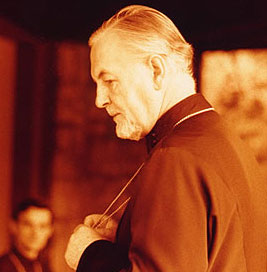
This post is part of an ongoing series entitled, “Sunday with Schmemann.” If you have not yet read some of Fr. Alexander Schmemann’s works you can begin with my inaugural post here. My first doctoral writing assignment focuses exclusively on Schmemann’s writing corpus and liturgical theology.
Today marks the 32nd anniversary of Fr. Schmemann’s “falling asleep.” May Fr. Schmemann rest in peace and rise in glory! Memory eternal!
Fr. Schmemann wrote heavily on the theme of liturgical time. I made my own attempt to talk about “Learning to Tell Time Liturgically” here. He is insistent upon the eschatological nature of liturgy and time. That is, he emphasizes the transformation of time through the first advent of Christ as the means by which we await his second coming. We are caught in between these two advents and our very understanding of time and worship ought to reflect this reality. He writes:
The event which is “actualized” in the Eucharist is an event of the past when viewed within the categories of time, but by virtue of its eschatological, determining, completing significance it is also an event which is taking place eternally. – Introduction to Liturgical Theology, 72.
For Fr. Schmemann, and for all Christians, the crucifixion of Jesus Christ and the resurrection of the Son of God is the center point of human history. Israel’s story with God finds its climax and fulfillment in the sacrifice of the Faithful Israelite. The Church is gathered up and grafted into Israel’s history and memory and thus looks forward to the time when Christ shall come again and bring the fullness of his Kingdom.
The Eucharist is therefore far more than a mere memorial. Time is utterly other and utterly real in the celebration of the Eucharist. He continues:
The Eucharist is therefore the manifestation of the Church as the new aeon; it is participation in the Kingdom as the parousia, as the presence of the Resurrected and Resurrecting Lord. It is not the ‘repetition’ of His advent or coming into the world. But the lifting up of the Church in His parousia, the Church’s participation in His heavenly glory. – Introduction to Liturgical Theology, 72.
When God is finally our all in all, when his new heaven and new earth are made real and fully known, our participation in His heavenly glory will be all that we know. We look forward to the eschatological banquet with great joy, hope, and excitement but such a look toward Christ does not mean that we turn away from the world.
In other words the eschatology of the Eucharist is not ‘world renouncing,’ not a turning away from time, but above all the affirmation of the reality, the certainty and the presence of the King of Christ which is ‘within,’ which is already here within the Church, but which will be manifest in all glory only at the end of ‘this world.’ – 73
Our response to participating in the Eucharist is to offer ourselves for the life of the world. We love as He loves. We are present as He is present. We offer ourselves as the presence of Christ so that others may know Him fully. “But this expectation is not a passive state, it is a responsible service—it is to ‘be as He was in this world,'” (p. 74). This is why we celebrate the Eucharist and the Daily Office: that our time may be transformed through Christ and that we may invite others to participate in His renewing of all things. The Eucharist is the pinnacle of the Church’s worship and therefore has ramifications and implications for the whole of Christian life.
Previous Post

November 20, 2015
We Are Not Worthy: A Response to Kelly Pigott
Next Post

December 14, 2015 Repost: Learning to Tell Time Liturgically
Browse Our Archives
Select a Category Ascension Asceticism Ash Wednesday Baptism Book Review Church Calendar Creation Care Discipleship Dissertation Easter Eastern Orthodox Eastertide Ecclesiology English Reformation Eucharist Exodus Feast Day Flash Essay Fridays With Fr. Kavanagh Good Friday Guest Post Holy Lent Holy Saturday Kavanagh Language Lessons Lectionary Preaching Liturgical Sense Liturgical Theology Liturgy Maundy Thursday New Testament Studies Ordinary Time Palm Sunday Patriarch Pentecost PhD Poetry Pope Francis Proper Preface Recovery Reflections Reformation Resource Round-Up Ressourcement Resurrection Roman Catholic Church Sacraments Saint Schmemann Sermon Sermon Notes Sobriety St. Mark Sundays With Schmemann The Eucharistic Life The Work of Research Transfiguration Uncategorized Weekend Reading
Select a Month July 2017 June 2017 May 2017 April 2017 March 2017 February 2017 September 2016 August 2016 July 2016 June 2016 April 2016 March 2016 February 2016 January 2016 December 2015 November 2015 October 2015 September 2015 August 2015 July 2015 June 2015 May 2015 April 2015 March 2015 February 2015
Follow Us!
TAKE THE
Religious Wisdom Quiz
What did the Israelites eat in the wilderness?
Select your answer to see how you score.
Grapes and figs Honey and milk Manna Bread and fish
Related posts from The Liturgical Theologian
Reflections on Communion in One Kind


Your Guide to Weekend Reading - July 1
TRENDING AT PATHEOS Evangelical

The REST of Your Life: A Creative Wrestles...
This week I had a conversation with a good friend from church....

How the author of the world's best hymn...
I've been working with John Newton for a while now. This makes...

Long before this Lectio Divina, Psalm 130 - the song - started...

What About the Trees? Another Living Parable
After I finished writing the last article about falling leaves as a...

Why Classical Education Is a Conversation, Not a...
Come and Read: Joy in Classical Education When I was a little...

Cornell University has received a great deal of negative publicity and intense...
view all Evangelical blogs
Ad-Free & Subscriber Log-In Subscription Support
- About Us
- 2026 Calendar
- Videos
- Podcasts
- Library of World Religions
- Faith In Media Tracker
- Advertise With Us
- Write for Us
- Privacy Policy
- Terms of Service
- Do Not Sell My Data
- Contact Us
- Radiant Digital
- Manage Newsletter Subscriptions
- Unsubscribe From Notifications
- Sitemap
Copyright 2008-2026, Patheos. All rights reserved.
Subscription Support Ad-Free & Subscriber Log-In
Follow Patheos