
BuddhistCatholicContemplativeEvangelicalGeneral ChristianHinduJewishLatter-day SaintMuslimNew VisionsProgressive Christian
Beliefs
- Buddhist
- Catholic
- Contemplative
- Evangelical
- General Christian
- Hindu
- Jewish
- Latter-day Saint
- More Voices
- Muslim
- New Visions
- Pagan
- Progressive Christian
Topics
- Religion News
- Food and Religion
- Sports and Religion
- Religious Art
- Religious Music and Entertainment
- Religious Events
- History and Religion
- Style and Religion
- Politics and Religion
- Women in Religion
- Recreation Outdoors and Religion
- Business Finance and Religion
- Careers Workplace and Religion
- Education and Religion
- Family Parenting and Religion
- Health Fitness and Religion
- Home and Religion
- Relationships and Religion
- Technology and Religion
- Travel and Religion
Columnists
- Buddhist Columnists
- Business Finance and Religion Columnists
- Careers Workplace and Religion Columnists
- Catholic Columnists
- Contemplative Columnists
- Education and Religion Columnists
- Evangelists Columnists
- Family Parenting and Religion Columnists
- General Christian Columnists
- Health Fitness and Religion Columnists
- Hindu Columnists
- History and Religion Columnists
- Home and Religion Columnists
- Jewish Columnists
- More Voices Columnists
- Latter Day Columnists
- Muslim Columnists
- New Visions Columnists
- Nonreligious Columnists
- Pagan Columnists
- Politics and Religion Columnists
- Progressive Columnists
- Recreation Outdoors and Religion Columnists
- Relationships and Religion Columnists
- Religion News Columnists
- Religious Art Columnists
- Religious Events Columnists
- Religious Music and Entertainment Columnists
- Sports and Religion Columnists
- Style and Religion Columnists
- Technology and Religion Columnists
- Travel and Religion Columnists
- Women in Religion Columnists
Resource Library
- 2026 Calendar
- Library of World Religions
- The 100 Most Holy Places on Earth
- Patheos Answers
- Podcasts
- Videos
- Faith Leaders Database
- Anglican Episcopalian
- Bahai
- Baptist
- Buddhism
- Christianity
- Confucianism
- Eastern Orthodoxy
- Hinduism
- Holiness and Pentecostal
- ISKCON
- Islam
- Judaism
- Lutheran
- Methodist
- The Church of Jesus Christ of Latter-day Saints
- New Age
- Paganism
- Presbytarian and Reformed
- Protestantism
- Religion Behind the Scenes
- Roman Catholic
- Scientology
- Shia Islam
- Sikhism
- Sufism
- Sunni Islam
- Taoism
- Zen
- See all religions
Research Tools
 Ad-Free & Subscriber Log-In Subscription Support
Ad-Free & Subscriber Log-In Subscription Support
Follow Patheos 

- Trending:
- Forgiveness
- |
- Marriage
- |
- Consciousness
- |
- Death Penalty
- |
- Election
- |
- Halloween
 The Liturgical Theologian
- Home
- Evangelical
- A Seminarian’s Sermon for Trinity Sunday
A Seminarian’s Sermon for Trinity Sunday
Last updated on: May 28, 2015 at 3:14 pm by Porter Case Taylor
A Seminarian’s Sermon for Trinity Sunday 2015-05-28T15:14:09-05:00 Porter Case Taylor
Patheos Explore the world's faith through different perspectives on religion and spirituality! Patheos has the views of the prevalent religions and spiritualities of the world.
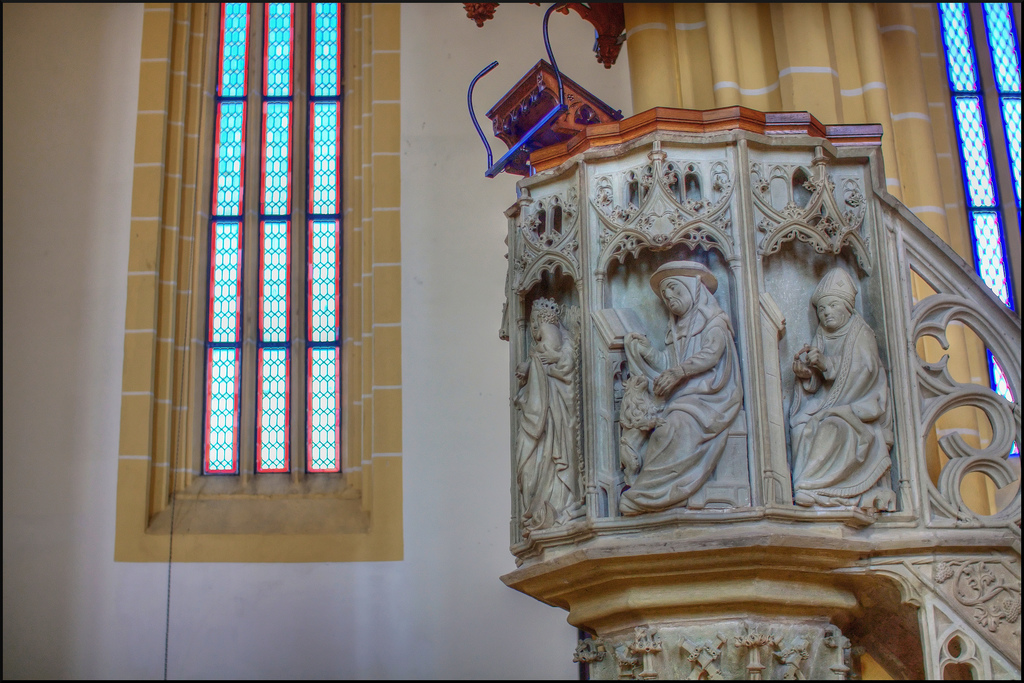
This is a sermon I wrote for Trinity Sunday while still in seminary. The Gospel lesson was Matthew 28:16-20. I offer it now in the hopes that it helps us all get in the right spirit for worship this Sunday.
In the name of God: Father, Son and Holy Spirit. Amen.
Ellis [my father-in-law and Anglican priest] once gave me an anecdote about a former Rector of his. This Rector used to joke with Ellis about Trinity Sunday by saying that Trinity Sunday was the one day of the year that he would always ask a seminarian to preach. Why? It would help him or her earn their theological chops! And guess what? I am preaching today and I am in seminary – thank you for that!
All joking aside, I think that Jesus’ words in Matthew 28 have great significance for us as a church plant, but I also think they have been taken out of context and/or misinterpreted. As with any passage, in my opinion, our first task is to look at the text.
Verse 16 clues us into the fact the disciples, as we have known them in the rest of the Gospel accounts, are incomplete – there are only 11 after Judas’ betrayal and subsequent suicide. That will need to be remedied in Acts. But the disciples have gone to the prescribed place in obedience to Jesus’ command after having enjoyed 40 days with him on earth after the Resurrection.
Thus the disciples gather and Jesus meets them there. The text says that some worshipped and some doubted; more on this later, but for now please notice that neither response in condemned or condoned necessarily. Have you ever heard that in a church before? Doubt is okay…for now.
In verse 18 we begin to get into the meat. Jesus says, “All authority on heaven and on earth has been given to him.” This is a robust statement. Jesus has been given the authority from God to reign and rule over all things. God had already spoken two words over Jesus – first at the baptism and second at the Transfiguration – of loving approval. But now we see that Jesus has been entrusted with an overwhelming, all-encompassing authority. Why does he say this? This is the background to his next claim, or commission, but it also shows that in Jesus God has answered all of his promises with a “yes.” Jesus is about to ascend to God’s right hand, the typical seat of power, to reign over all and Jesus is sharing that this reality has significance for the disciples. That is, if they are to minister in his name then they do so with his authority which is really God’s authority.
Verse 18 informs verse 19 and we know this because Jesus then says, “Therefore.” Based on his authority he is commissioning the disciples to action. Dietrich Bonheoffer, in “Discipleship” posits that we follow Jesus because he has the authority to call us. The same is true of this commissioning. We obey Jesus because he has the authority to command and commend us.
This is the verse that is grossly mistranslated by some Christians to be God’s authoritative word for and on overseas missionary work. It all has to do with how we translate the word “Go.” Those who affirm the view I just mentioned translated this word as “Go!” and therefore a command to physically go somewhere else. However, the Greek does not agree with this view. The right translation of this word would be something like “as you are going.” Jesus is calling the disciples to obedience in the totality of their lives and to the task of baptizing and making disciples in all that they do. As you go to the grocery store make disciples. As you go to pick up your child from school, teach all that I have commanded. The significance of this verse is that it is not a call to a one-time event but to a life-time reality. I hope you can already see how this bears much weight for us as a church plant.
And now, being Trinity Sunday, we need to look at the name into which and by which all are baptized: in the name of God, Father, Son and Holy Spirit. This is the name that we will worship for eternity, the everliving reality of the triune God. The imagery and meaning of this phrase cannot be quenched over a lifetime, let alone a 20-minute sermon, but suffice it to say that in this phrase Jesus is combining, encapsulating and making voluminous the mighty deeds, acts and stories of God through Israel’s history, his own life, death, and resurrection, and the promise of the Holy Spirit in one phrase. This phrase is bursting at the seams with life and power.
Finally, Jesus gives the assurance to the disciples that YHWH gave to Moses and Joshua. “I will never leave you nor forsake you” is what YHWH said to Israel’s leaders, and Jesus says, “I am with you always, to the very end of the age.” We cannot separate Jesus from Israel’s story because he is the fulfillment of the promise and the climax of the covenant.
But what does this mean for us today, in Mission Viejo, CA as a community of light, love and expectation? It means a great deal!
First, we have been invited to participate in the mutually-indwelling, overflowing with abundant love and life of the triune God. As Jesus extends his authority via commission he is also extending an invitation to participation. This is the covenant relationship to which we have been restored. The power, beauty and majesty of the Trinity are life and love. Ministry apart from or outside of the Trinity is not ministry but social work. To fulfill this commission as we are going is to live life with God and in his presence, drawing our words and actions from his unrelenting love, and inviting others into that relationship.
Second, there are only two responses to God: worship or doubt. A response outside of worship is unequivocally a response of doubt. Worship is the goal but doubt is not to be discouraged on the journey toward true worship. Thomas doubted before he could proclaim “My Lord and my God!” However, once Thomas had placed his hands in Jesus’ hand and side the time for doubt had ceased and the time of worship had begun. As we call people to the triune God we must discourage their doubt and force them into submission under Christ. No! God was all of us, every fiber of our being, and that does not happen over night. Even the prophets and the judges went through periods of doubt, but it is in those seasons that we must pray for the strength to still say, “But I know that my redeemer lives.” Embrace doubt only as it relates to and leads to worship. Worship is the lifestyle of the disciple, of one who serves the triune God. We cannot help but worship once we have encounter God in his throne room, his majesty and his glory.
Finally, and of great importance to those seeking out the Anglican expression of the Christian tradition, Jesus tells us exactly what to teach and preach. We are handed down (paradosis/paralambano) the teaching and tradition of Jesus. As Anglicans we uphold Apostolic Succession and can trace our episcopacy right back to this very moment in history – Matthew 28 – via Peter. Jesus’ inclusion of baptism by name and Eucharist by “all that I have taught” has been preserved and handed down over two centuries. Our Book of Common Prayer, though human words, is basically Scripture being prayed back to God. Our very gathering tonight, with the use of liturgy, is way of retelling and reenacting the story of God and the basis for this are Jesus’ words in Matthew. We are not making anything up on our own but continuing that which was handed down to us over the past two millennia.
Participation, worship and ongoing tradition are the call to this Anglican church plant and are part of the life of the triune God. We have been drawn up into a story that is ours but that is much bigger than us and we have been given a new identity. Like the disciples atop the hillside in Matthew 28 we are being commissioned this day to go into the world “telling the Good News to neighbors and strangers with compassionate words and creative service, walking the way of Christ.” The initiation is to a journey that is a lifestyle. As you are going. As we are going together. Let us lift high the name of the triune God and invite others into that covenant relationship. Amen? Amen!
If you are enjoying the posts on this blog consider subscribing in the top right corner to be kept up to date with future posts. Find me on Facebook as well!
Previous Post

May 27, 2015
Celebrating the Feast of the First Book of Common Prayer, 1549
Next Post

May 29, 2015 Resource Round-Up for Weekend Reading
Browse Our Archives
Select a Category Ascension Asceticism Ash Wednesday Baptism Book Review Church Calendar Creation Care Discipleship Dissertation Easter Eastern Orthodox Eastertide Ecclesiology English Reformation Eucharist Exodus Feast Day Flash Essay Fridays With Fr. Kavanagh Good Friday Guest Post Holy Lent Holy Saturday Kavanagh Language Lessons Lectionary Preaching Liturgical Sense Liturgical Theology Liturgy Maundy Thursday New Testament Studies Ordinary Time Palm Sunday Patriarch Pentecost PhD Poetry Pope Francis Proper Preface Recovery Reflections Reformation Resource Round-Up Ressourcement Resurrection Roman Catholic Church Sacraments Saint Schmemann Sermon Sermon Notes Sobriety St. Mark Sundays With Schmemann The Eucharistic Life The Work of Research Transfiguration Uncategorized Weekend Reading
Select a Month July 2017 June 2017 May 2017 April 2017 March 2017 February 2017 September 2016 August 2016 July 2016 June 2016 April 2016 March 2016 February 2016 January 2016 December 2015 November 2015 October 2015 September 2015 August 2015 July 2015 June 2015 May 2015 April 2015 March 2015 February 2015
Follow Us!
TAKE THE
Religious Wisdom Quiz
Vanity of vanities! Everything is fleeting and meaningless. Where is this pessimistic proclamation found?
Select your answer to see how you score.
Ecclesiastes Psalms Job Proverbs
Related posts from The Liturgical Theologian

Your Guide to Weekend Reading: July 8

Your Guide to Weekend Reading - July 1

Apprenticeship and Discipleship
TRENDING AT PATHEOS Evangelical

The REST of Your Life: A Creative Wrestles...
This week I had a conversation with a good friend from church....

How the author of the world's best hymn...
I've been working with John Newton for a while now. This makes...

Long before this Lectio Divina, Psalm 130 - the song - started...

What About the Trees? Another Living Parable
After I finished writing the last article about falling leaves as a...

Why Classical Education Is a Conversation, Not a...
Come and Read: Joy in Classical Education When I was a little...

Cornell University has received a great deal of negative publicity and intense...
view all Evangelical blogs
Ad-Free & Subscriber Log-In Subscription Support
- About Us
- 2026 Calendar
- Videos
- Podcasts
- Library of World Religions
- Faith In Media Tracker
- Advertise With Us
- Write for Us
- Privacy Policy
- Terms of Service
- Do Not Sell My Data
- Contact Us
- Radiant Digital
- Manage Newsletter Subscriptions
- Unsubscribe From Notifications
- Sitemap
Copyright 2008-2026, Patheos. All rights reserved.
Subscription Support Ad-Free & Subscriber Log-In
Follow Patheos