
BuddhistCatholicContemplativeEvangelicalGeneral ChristianHinduJewishLatter-day SaintMuslimNew VisionsProgressive Christian
Beliefs
- Buddhist
- Catholic
- Contemplative
- Evangelical
- General Christian
- Hindu
- Jewish
- Latter-day Saint
- More Voices
- Muslim
- New Visions
- Pagan
- Progressive Christian
Topics
- Religion News
- Food and Religion
- Sports and Religion
- Religious Art
- Religious Music and Entertainment
- Religious Events
- History and Religion
- Style and Religion
- Politics and Religion
- Women in Religion
- Recreation Outdoors and Religion
- Business Finance and Religion
- Careers Workplace and Religion
- Education and Religion
- Family Parenting and Religion
- Health Fitness and Religion
- Home and Religion
- Relationships and Religion
- Technology and Religion
- Travel and Religion
Columnists
- Buddhist Columnists
- Business Finance and Religion Columnists
- Careers Workplace and Religion Columnists
- Catholic Columnists
- Contemplative Columnists
- Education and Religion Columnists
- Evangelists Columnists
- Family Parenting and Religion Columnists
- General Christian Columnists
- Health Fitness and Religion Columnists
- Hindu Columnists
- History and Religion Columnists
- Home and Religion Columnists
- Jewish Columnists
- More Voices Columnists
- Latter Day Columnists
- Muslim Columnists
- New Visions Columnists
- Nonreligious Columnists
- Pagan Columnists
- Politics and Religion Columnists
- Progressive Columnists
- Recreation Outdoors and Religion Columnists
- Relationships and Religion Columnists
- Religion News Columnists
- Religious Art Columnists
- Religious Events Columnists
- Religious Music and Entertainment Columnists
- Sports and Religion Columnists
- Style and Religion Columnists
- Technology and Religion Columnists
- Travel and Religion Columnists
- Women in Religion Columnists
Resource Library
- 2026 Calendar
- Library of World Religions
- The 100 Most Holy Places on Earth
- Patheos Answers
- Podcasts
- Videos
- Faith Leaders Database
- Anglican Episcopalian
- Bahai
- Baptist
- Buddhism
- Christianity
- Confucianism
- Eastern Orthodoxy
- Hinduism
- Holiness and Pentecostal
- ISKCON
- Islam
- Judaism
- Lutheran
- Methodist
- The Church of Jesus Christ of Latter-day Saints
- New Age
- Paganism
- Presbytarian and Reformed
- Protestantism
- Religion Behind the Scenes
- Roman Catholic
- Scientology
- Shia Islam
- Sikhism
- Sufism
- Sunni Islam
- Taoism
- Zen
- See all religions
Research Tools
 Ad-Free & Subscriber Log-In Subscription Support
Ad-Free & Subscriber Log-In Subscription Support
Follow Patheos 

- Trending:
- Forgiveness
- |
- Marriage
- |
- Consciousness
- |
- Death Penalty
- |
- Election
- |
- Halloween
 The Liturgical Theologian
- Home
- Evangelical
- Baptism is Eucharistic and Eucharist is Baptismal
Baptism is Eucharistic and Eucharist is Baptismal
Last updated on: May 5, 2015 at 11:23 am by Porter Case Taylor
Baptism is Eucharistic and Eucharist is Baptismal 2015-05-05T11:23:37-05:00 Porter Case Taylor
Patheos Explore the world's faith through different perspectives on religion and spirituality! Patheos has the views of the prevalent religions and spiritualities of the world.
Last week Billy Kangas, a Patheos colleague on the Catholic Channel, wrote about his support of Roman Catholic Bishop Larry Silva’s recent decision to return the “Sacraments of Initiation” to their original order. The Sacraments of Initiation are the rites (baptism, confirmation and Eucharist) of that Church that initiate believers into the covenant family of God.
Bishop Silva of Honolulu is proposing that infant or child baptism be followed at a later date by a joint celebration of confirmation and first communion. For those who have not read the article the main argument is that over time confirmation and first communion have moved further away from baptism and the result is that confirmation is now functioning as some sort of graduation or “farewell” from the church as teenagers walk out her doors. To counteract this problem, Bishop Silva is instructing his diocese to prepare children for confirmation at the time of their first communion as a means of further and deeper initiation.
As a liturgical theologian I am grateful to Billy for his words and study and to Bishop Silva for his boldness and historical sensitivity. I agree with Bishop Silva and Kangas for their desire to make sure confirmation is not viewed as a type of graduation from the Church. I too want to see the Sacraments of Initiation “regain their theological logic and their sacramental cohesion.”
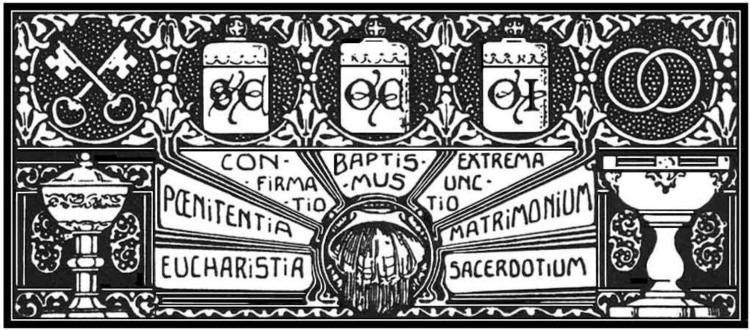
A picture with the 7 Sacraments in Latin from http://stpiusxsa.org/traditional-rite-sacraments
Where I diverge from Kangas and Bishop Silva is that I think baptism and the Eucharist cannot be separated. I believe baptism and communion make a better theological and sacramental pairing with confirmation as a joyous fulfillment of the baptismal covenant.
Historical Developments
The liturgical development of the “Sacraments of Initiation” has varied between the East and West. For the apostolic (undivided) church there was no separation between baptism, confirmation/chrismation and Eucharist. Fr. Alexander Schmemann writes about the “three-fold structure of the liturgy of initiation—Baptism, Chrismation and Eucharist—so clearly evidenced in the early liturgical tradition.”[1] Originally converts to the faith would celebrate all three Sacraments of Initiation in the same service beginning with baptism and moving immediately to chrismation and finally to communion. In baptism we are initiated into the church as we die to self and are raised to new life in Christ, in confirmation/chrismation we are sealed with the Holy Spirit and in the Eucharist we partake in the sacrament of sacraments, the sacrament of the Kingdom. Fr. Aidan Kavanagh also notes the historical unity of these rites but he contends that only the Orthodox continue to practice this discipline today.[2]
Liturgical and sacramental challenges arose as the church grew and bishops had to delegate sacerdotal (the functions and duties of a priest) responsibilities to their presbyters. This resulted in a separation of baptism and Eucharist. The Eastern Church continued to give the newly baptized—be they young or old—the Body and Blood of Jesus as their first meal. Kangas writes, “While many in the earlier generations of the Church received their First Communion as infants, now many were being refrained from participation until their teen years.”
By the sixth to eighth centuries, according to Fr. Kavanagh, many of the “subjects of initiation are in fact largely small children or babies.”[3] This claim is made based on inferences from the rubrics of the Gelasian Sacramentary and the Ordo Romanus XXVIII. Through the lens of Vatican II, adult initiation still bears the continuity of the early church:
“‘According to the ancient practice maintained in the Roman liturgy, an adult is not to be baptized unless he receives confirmation immediately afterward, provided no serious obstacles exist. This connection signifies the unity of the paschal mystery, the close relationship between the mission of the Son and the pouring out of the Holy Spirit, and the joint celebration of the sacraments by which the Son and the Spirit come with the Father upon those who are baptized,’ [34].”[4]
Bradshaw, Kavanagh and Schmemann all confirm the belief that Baptism, Confirmation/Chrismation and Eucharist belong in a proper liturgical sequence. They also confirm that the Orthodox Church still views such a sequence within the context of one ordo or liturgical service.[5] The witness of the undivided church is not a progression of Baptism-Confirmation-Eucharist over time, but a liturgical movement and celebration of the Rites of Initiation during Easter Vigil.
Eucharist and Baptism
In 2003, “View From the Top” starring Gwyneth Paltrow and Mike Meyers was produced. It received poor reviews and is not well known, but there’s a fabulous scene when Meyers quips about putting “the wrong emPHAsis on the wrong syLLAble.” In my opinion, to place First Communion after Confirmation, thereby separating it from baptism, is to put the wrong emphasis on the wrong liturgical syllable.
Baptism is eucharistic and Eucharist is baptismal.
Liturgically it is not possible to celebrate the Rite of Baptism without also celebrating Holy Communion as well. To approach the Altar one must first pass through the waters of baptism.
In baptism we are united with Christ in his crucifixion and resurrection. We are plunged under the water (or sprinkled) to symbolize our death to self and we are raised out of the water with Christ in the newness of his life. Baptism is initiation into God’s covenant family, the Church, and it is a ritual cleansing of sin. Many baptismal liturgies also include an epiclesis (invocation of the Holy Spirit) over the water that it may be sanctified and the newly baptized is anointed with oil. Baptism is preceded by the Apostles’ Creed, the Church’s most primal creedal statement of faith in the triune God. Most importantly, the Eucharist follows baptism.
If baptism is initiation then the Eucharist is both nourishment for the pilgrim people of God and the Sacrament of sacraments—the Sacrament of the Kingdom—when the church becomes that which she already is. In the Eucharist, the faithful offer their own sacrifice of praise and thanksgiving and they join their voices with the angels and heavenly host in praising God. The Eucharist is the Church’s worship par excellence and in weekly/regular celebration the people of God are fed with and by her Lord.
Therefore, to remove Eucharist from baptism is to make baptism lesser than. Baptism is a whole sacrament and to do such a thing would be to tell a member that his or her membership is not complete. The message we are sending as a church when we baptize someone but will not then feed him or her with the Body and Blood of Jesus is stark. We inadvertently suggest that it is necessary to become ‘worthy’ of the Eucharist by means of cognition or understanding. How can we withhold the Sacrament of the Kingdom from the newest members of the Church?
As Bishop Silva’s announcement states, teenagers are leaving the church after Confirmation and are doing so at a fast rate. However, rather than joining First Communion and Confirmation, I’d like to see our children nourished and sustained by the Holy Spirit through both baptism and the Eucharist.
Perhaps a steady diet of bread and wine—with Christ mysteriously present—may be more efficacious than we realize.
Perhaps our children need to be included as full members of the church rather than half members who are initiated but not able to partake.
What Then With Confirmation?
As stated above, the Roman Catholic Church began separating confirmation from baptism in order to accommodate rapid church growth. Bishops could not feasibly or realistically be present at every church in their diocese on a weekly basis thereby making liturgical changes necessary. Due to great size of the church, to return to the original order and ordo of the sacraments would mean requiring bishops to make more frequent episcopal visits and confirm at a young age or authorizing senior clergy (priests) to confirm on their behalf. I have proposed something different. I have been arguing that placing “first communion” back with baptism and celebrating confirmation as the joyous and willing fulfillment of baptism at a later date acknowledges historical origins and subsequent developments.
Due to growth, the undivided church practiced mystagogy (the teaching of the church’s mysteries to the newly baptized) during Bright Week, the week following Easter. The early church transitioned from meeting secretly in the catacombs to building basilicas for public worship. While church attendance increased, the average level of theological understanding and Christian maturity decreased. Thus it became necessary to instruct converts in the faith after baptism/chrismation. Bradshaw writes:
“This [the drama of the baptismal rite in the Constantinian era] seems to have resulted in most places in the retention of a period of reserved teaching, but transferred from before baptism to the week after baptism, when it could be used to reveal the hidden meaning of the initiatory and eucharistic rites for the first time to those who had just experienced them.”[6]
Notice two important points: first, the newly baptized were taught about Eucharist after having received it. Second, Bradshaw sees a separation in the rites and refers to the “initiatory” and “eucharistic” rites. Therein lies part of the solution, our children can be instructed in the mysteries and sacraments of the church at a very young age after they have received them.
I agree with Kangas and Bishop Silva in that confirmation is not to be considered a “graduation.” It is the fulfillment of baptism. Leonel Mitchell claims, “Confirmation is the renewal of the baptismal covenant, not its completion.”[7] The Church can and should work with her children to teach, instruct, lead and guide toward deeper discipleship and the confirmation of one’s baptism by the bishop. Seen this way, Eucharist and Confirmation are Sacraments for the Initiated.
I think a sacramental pairing of baptism and Eucharist requires a robust view of catechesis. Children can and should be prepared for confirmation by formal and liturgical catechesis (instruction) as they experience the fullness of the Church’s worshipping life. We can therefore invite children to grow up in the faith as we model for them the teachings of our Lord and the life of discipleship.
*This post was written as a grateful response to Billy Kangas’ article last week. It is an invitation to start a liturgical and sacramental dialogue or to stretch our thinking on these matters.
[1] Alexander Schmemann, Of Water and the Spirit: A Liturgical Study of Baptism (Crestwood, N.Y.: St. Vladimir, 1974), 115-116.
[2] Aidan Kavanagh, Studies in the Reformed Rites of the Catholic Church, vol. v. 1, The Shape of Baptism: the Rite of Christian Initiation (Collegeville, Minn.: Liturgical Press, ©1991), 139.
[3] Ibid, 67.
[4] Ibid, 138.
[5] Fr. Schmemann later stated, “In the early tradition Baptism, Chrismation and Eucharist “belong together,” form one liturgical sequence and “ordo” because each sacrament within it is fulfilled in the other in such a way that it is impossible fully to understand the meaning of one in separation and isolation form the other two,” 116.
[6] Paul F. Bradshaw, Reconstructing Early Christian Worship (Collegeville, Minn.: Liturgical Press, 2010), 67.
[7] Leonel L. Mitchell, Praying Shapes Believing: A Theological Commentary On the Book of Common Prayer(Harrisburg, PA: Morehouse Pub., 1991, ©1985), 119.
Next Post

May 6, 2015 Proper Preface or Collect for the Seventh Sunday of Easter
Browse Our Archives
Select a Category Ascension Asceticism Ash Wednesday Baptism Book Review Church Calendar Creation Care Discipleship Dissertation Easter Eastern Orthodox Eastertide Ecclesiology English Reformation Eucharist Exodus Feast Day Flash Essay Fridays With Fr. Kavanagh Good Friday Guest Post Holy Lent Holy Saturday Kavanagh Language Lessons Lectionary Preaching Liturgical Sense Liturgical Theology Liturgy Maundy Thursday New Testament Studies Ordinary Time Palm Sunday Patriarch Pentecost PhD Poetry Pope Francis Proper Preface Recovery Reflections Reformation Resource Round-Up Ressourcement Resurrection Roman Catholic Church Sacraments Saint Schmemann Sermon Sermon Notes Sobriety St. Mark Sundays With Schmemann The Eucharistic Life The Work of Research Transfiguration Uncategorized Weekend Reading
Select a Month July 2017 June 2017 May 2017 April 2017 March 2017 February 2017 September 2016 August 2016 July 2016 June 2016 April 2016 March 2016 February 2016 January 2016 December 2015 November 2015 October 2015 September 2015 August 2015 July 2015 June 2015 May 2015 April 2015 March 2015 February 2015
Follow Us!
TAKE THE
Religious Wisdom Quiz
Commanded to go to Nineveh, I fled in the opposite direction on a ship to Tarshish. Who am I?
Select your answer to see how you score.
Jonah Jeremiah Elijah Hosea
Related posts from The Liturgical Theologian
Reflections on Communion in One Kind

Your Guide to Weekend Reading: July 8

Your Guide to Weekend Reading - July 1
TRENDING AT PATHEOS Evangelical

The REST of Your Life: A Creative Wrestles...
This week I had a conversation with a good friend from church....

How the author of the world's best hymn...
I've been working with John Newton for a while now. This makes...

Long before this Lectio Divina, Psalm 130 - the song - started...

What About the Trees? Another Living Parable
After I finished writing the last article about falling leaves as a...

Why Classical Education Is a Conversation, Not a...
Come and Read: Joy in Classical Education When I was a little...

Cornell University has received a great deal of negative publicity and intense...
view all Evangelical blogs
Ad-Free & Subscriber Log-In Subscription Support
- About Us
- 2026 Calendar
- Videos
- Podcasts
- Library of World Religions
- Faith In Media Tracker
- Advertise With Us
- Write for Us
- Privacy Policy
- Terms of Service
- Do Not Sell My Data
- Contact Us
- Radiant Digital
- Manage Newsletter Subscriptions
- Unsubscribe From Notifications
- Sitemap
Copyright 2008-2026, Patheos. All rights reserved.
Subscription Support Ad-Free & Subscriber Log-In
Follow Patheos