
BuddhistCatholicContemplativeEvangelicalGeneral ChristianHinduJewishLatter-day SaintMuslimNew VisionsProgressive Christian
Beliefs
- Buddhist
- Catholic
- Contemplative
- Evangelical
- General Christian
- Hindu
- Jewish
- Latter-day Saint
- More Voices
- Muslim
- New Visions
- Pagan
- Progressive Christian
Topics
- Religion News
- Food and Religion
- Sports and Religion
- Religious Art
- Religious Music and Entertainment
- Religious Events
- History and Religion
- Style and Religion
- Politics and Religion
- Women in Religion
- Recreation Outdoors and Religion
- Business Finance and Religion
- Careers Workplace and Religion
- Education and Religion
- Family Parenting and Religion
- Health Fitness and Religion
- Home and Religion
- Relationships and Religion
- Technology and Religion
- Travel and Religion
Columnists
- Buddhist Columnists
- Business Finance and Religion Columnists
- Careers Workplace and Religion Columnists
- Catholic Columnists
- Contemplative Columnists
- Education and Religion Columnists
- Evangelists Columnists
- Family Parenting and Religion Columnists
- General Christian Columnists
- Health Fitness and Religion Columnists
- Hindu Columnists
- History and Religion Columnists
- Home and Religion Columnists
- Jewish Columnists
- More Voices Columnists
- Latter Day Columnists
- Muslim Columnists
- New Visions Columnists
- Nonreligious Columnists
- Pagan Columnists
- Politics and Religion Columnists
- Progressive Columnists
- Recreation Outdoors and Religion Columnists
- Relationships and Religion Columnists
- Religion News Columnists
- Religious Art Columnists
- Religious Events Columnists
- Religious Music and Entertainment Columnists
- Sports and Religion Columnists
- Style and Religion Columnists
- Technology and Religion Columnists
- Travel and Religion Columnists
- Women in Religion Columnists
Resource Library
- 2026 Calendar
- Library of World Religions
- The 100 Most Holy Places on Earth
- Patheos Answers
- Podcasts
- Videos
- Faith Leaders Database
- Anglican Episcopalian
- Bahai
- Baptist
- Buddhism
- Christianity
- Confucianism
- Eastern Orthodoxy
- Hinduism
- Holiness and Pentecostal
- ISKCON
- Islam
- Judaism
- Lutheran
- Methodist
- The Church of Jesus Christ of Latter-day Saints
- New Age
- Paganism
- Presbytarian and Reformed
- Protestantism
- Religion Behind the Scenes
- Roman Catholic
- Scientology
- Shia Islam
- Sikhism
- Sufism
- Sunni Islam
- Taoism
- Zen
- See all religions
Research Tools
 Ad-Free & Subscriber Log-In Subscription Support
Follow Patheos 

- Trending:
- Advent
- |
- Forgiveness
- |
- Thanksgiving
- |
- Election
- |
- Seasonal Holidays
- |
- Marriage

- Home
- Catholic
- History and Religion
- The West’s Christian Moral Inheritance: A Legacy Denied
The West’s Christian Moral Inheritance: A Legacy Denied
Last updated on: November 22, 2026 at 8:08 pm by Dennis Knapp
The West’s Christian Moral Inheritance: A Legacy Denied 2026-11-22T20:08:05-06:00 Dennis Knapp
Patheos Explore the world's faith through different perspectives on religion and spirituality! Patheos has the views of the prevalent religions and spiritualities of the world.
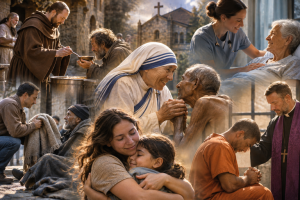
Image created using AI.
Whether we like it or not, our environment matters, shaping us both culturally and morally. This is especially true of Christianity’s influence on Western culture—a fact many secularists and atheist thinkers often overlook or underappreciate. It is as if the morality underpinning most Western sensibilities emerged fully formed with the advent of modernity. In fact, regardless of whether one believes in God, the West remains culturally Christian—and that’s a good thing.
Consider the recent comments by historian Tom Holland, author of Dominion: How the Christian Revolution Remade the World:
There is no one who is more culturally Christian than the atheist who says, ‘I don’t need some bronze-aged sky fairy telling me how to behave, but I just know how to behave. I’m a good person. I don’t need the Bible to tell me to care for the weak and poor and the refugee.’ Manifesting the fact that they are the result of centuries worth of biblical weathering. So, in a sense, to be a culture Christian is to believe stuff. To believe stuff to, say, a Roman, a pre-Christian Roman would have seemed mad and not at all self-evident.
“Centuries worth of biblical weathering,” indeed. The atheist regards certain moral obligations as self-evident without necessarily recognizing—and perhaps conveniently overlooking—their historical Christian inheritance.
This raises several important historical questions:
- Were these moral convictions always self-evident?
- Would Western civilization possess the same moral assumptions without Christianity?
- Can those assumptions survive Christianity’s cultural decline?
To explore these questions, let’s begin by examining a world that had yet to experience Christianity and its moral revolution.
When Christianity Was the Strange Religion
Before Christianity emerged as a dominant cultural influence during the fourth and fifth centuries, pagan Roman morality largely shaped the Western world. Roman society valued honor, civic duty, courage, hierarchy, and social obligation as foundational virtues. Furthermore, many Romans accepted slavery, infanticide, and violent public spectacles, including gladiatorial combat and public executions such as the crucifixion of Jesus. Moral worth and social standing often went hand in hand.
Ancient philosophers, particularly the Stoics, developed sophisticated ideas about universal human nature and moral responsibility. However, Roman society did not consistently apply these principles across social classes or to all people.
Turning to the Germanic world, we encounter societies that placed considerable emphasis on kinship, loyalty, honor, reputation, and reciprocal obligations. Vengeance and compensation also played significant roles in maintaining social order. As Christianity spread among the Germanic tribes, its teachings challenged aspects of these traditions by emphasizing forgiveness, humility, and concern for those outside one’s immediate kinship group.
Like the pagan Romans, Germanic peoples also practiced hospitality, generosity, and mutual assistance. However, these obligations often centered on family, tribe, and established social relationships rather than extending equally to everyone.
Christianity did not introduce morality into a world devoid of virtue. Rather, it challenged existing moral assumptions, particularly the notion that one’s social standing, strength, or relationship to others determined the extent of one’s moral obligations.
The Christian Moral Revolution
What exactly did Christianity offer the ancient pagan world that made its influence a “revolution”? First, Christianity proclaimed a crucified man as Lord. In a world that celebrated conquest and worldly success, the Cross challenged conventional understandings of power by presenting sacrificial love and humility as expressions of true greatness. Christ’s teachings likewise challenged prevailing notions of power and moral obligation. Consider His commands to pray for those who persecute you (Matthew 5:44), turn the other cheek (Matthew 5:39), and recognize that the first shall be last (Matthew 19:30).
Next, Christianity proclaimed the revolutionary concept of the inherent dignity of every human person, regardless of origin or social standing. Christianity teaches that God created humanity in His image (Genesis 1:27) and that unity in Christ transcends social distinctions (Galatians 3:28). Christ also identifies Himself with the hungry, the stranger, the sick, and the imprisoned rather than the powerful and privileged (Matthew 25:31–46). Moreover, He commands His followers to love their enemies (Matthew 5:44).
These teachings also produced practical consequences. Christians established charitable institutions, including hospitals, to care for the sick and poor. Over time, Christian moral principles also influenced debates concerning slavery, human rights, and society’s obligations toward its most vulnerable members.
Of course, Christians have not always lived according to these principles. Yet those very principles supplied the moral standards by which Christians and Christian societies could be judged and called to reform.
What If Christianity Had Never Existed?
Allow me to present a historical thought experiment. Imagine that Christianity never emerged and the ancient world developed along other religious and philosophical trajectories. I see four possible consequences for moral principles the modern West largely takes for granted.
- Human dignity: In a world without Christianity, human worth might remain more closely tied to citizenship, social status, and personal achievement. The notion that every human being possesses inherent dignity, regardless of position or circumstance, might not occupy the same central place in Western moral thought.
- Charity and the vulnerable: Without Christianity’s influence, strangers, the poor, and the socially marginalized might receive less attention and protection. Compassion and charitable obligations could remain more closely centered on family, community, and reciprocal relationships rather than extending universally to those in need.
- Power and justice: In a world without Christianity, strength, honor, and conquest might retain greater cultural prestige, while the moral obligation of the powerful toward the weak might receive less emphasis. Slavery, too, might have followed a different historical trajectory without Christianity’s teachings on human dignity and the spiritual equality of all people.
- Marriage, family, and sexual morality: Without Christianity, marriage might have retained more of its ancient character as a legal and social arrangement centered on inheritance, family alliances, and male authority. Women’s rights and social standing might have developed differently, while sexual morality could remain more closely tied to social hierarchy and family obligations.
Of course, none of these possibilities suggests that morality itself depends upon Christianity’s existence. Other civilizations developed sophisticated moral traditions, and human beings possessed moral obligations long before Christ’s birth. The question is not whether morality could exist without Christianity, but whether Western civilization would have developed the same moral convictions without its influence.
Christianity Did Not Invent Morality: The Natural Law Distinction
A brief word about natural law is necessary here.
In Romans 2:14–15, St. Paul teaches that Gentiles can recognize moral obligations through conscience, even without possessing the revealed Law. Likewise, Catholicism teaches that human reason can recognize objective moral truths. Pre-Christian philosophers such as Aristotle and Cicero also recognized important principles of justice and virtue.
In other words, moral truths exist independently of whether people recognize Christianity as true. Nevertheless, Christianity profoundly influenced how Western civilization came to recognize, articulate, and institutionalize particular moral truths.
Why does this matter?
Because atheists can recognize and practice genuine moral virtues, just as non-Christian civilizations have developed sophisticated moral systems. Yet Christianity played a distinctive historical role in reinforcing and spreading the truth that every human being possesses inherent dignity, regardless of social standing, wealth, or personal achievement.
Christianity did not create human dignity. It proclaimed a dignity that human beings already possessed by nature.
The Post-Christian Paradox: Keeping the Morality, Rejecting the Faith
Let’s return to Holland’s original observation. He argues that many modern secularists and atheists take the West’s Christian moral inheritance for granted. They often regard principles such as concern for the poor and marginalized as self-evident, without recognizing the centuries of Christian influence that helped establish them as Western moral expectations. In doing so, they overlook how Christianity’s understanding of human dignity challenged and transformed aspects of pagan Roman and Germanic morality.
These Christian moral values remain prominent even as Western culture grows increasingly secular and, in some quarters, hostile toward Christianity. Modern society continues to appeal to dignity, justice, compassion, and equality. Yet disagreements persist over what these concepts mean and require. Without a shared understanding of human nature, the same moral language can support competing, even contradictory, conclusions.
This raises an important question: What happens when a civilization continues to embrace Christianity’s moral inheritance while increasingly rejecting the faith that helped shape it?
As the West moves further into a post-Christian future, I see three possible developments:
- Moral continuity: Western society preserves much of its Christian moral inheritance by grounding principles such as human dignity, equality, and compassion in secular philosophical frameworks.
- Moral transformation: Society retains the language of Christian morality but gradually redefines its meaning. Concepts such as dignity, freedom, and justice remain important, yet their application increasingly departs from traditional Christian understandings of the human person.
- Moral fragmentation: Without a shared understanding of human nature or moral authority, competing interpretations of dignity, justice, and compassion become increasingly difficult to reconcile, leaving society divided over fundamental moral questions.
These possibilities need not exclude one another. Indeed, we may already see elements of all three in contemporary Western society. The question is whether the West can preserve its Christian moral inheritance while progressively distancing itself from the faith that helped give that inheritance its cultural prominence.
Final Thoughts… The Moral Landscape We Inherited
Many atheists take pride in the belief that, unlike Christians, they require no external authority—a “sky fairy”—to recognize their moral obligations toward the vulnerable. However, such moral convictions did not emerge in a historical vacuum. Like it or not, Christianity helped reshape the West’s understanding of power, dignity, suffering, and moral responsibility. Of course, human reason can recognize these moral truths even without religious belief. The important distinction lies between recognizing moral truths and understanding the historical and philosophical foundations that helped shape their place in Western civilization.
Perhaps the greatest irony of our increasingly post-Christian civilization is that many who believe they have left Christianity behind continue to inhabit a moral world Christianity helped create. The question is not whether atheists can be moral. Of course they can. The more consequential question is whether the West can continue taking its inherited moral convictions for granted while forgetting the civilization-shaping faith that helped make them seem so obvious.
Thank you!
If you liked this article, please leave your comments below. I am very interested in your opinion on this topic.
Read The Latin Right’s other writing here.
Please visit my Facebook page and IM your questions (and follow my page) or topics for articles you would like covered.
History and Religion
Previous Post

November 18, 2026
Pope Leo in Lima: The Speech That Inconveniences Everyone
Recent Comments
"Saying "she has no reason to feel guilty" is a legalistic, out of touch response. ..."
Pope Leo in Lima: The Speech ..."
"You're right about one thing: there is evidence that average female sexual desire increases around ..."
Pope Leo in Lima: The Speech ..."
"If you really believe that the purpose of sex is procreation, you can't deny that ..."
Pope Leo in Lima: The Speech ..."
"Several things are being conflated here. I think your imaginary Eileen illustrates the problem with ..."
Pope Leo in Lima: The Speech ..."
Browse Our Archives
Select a Category Abortion Arius Atheists Catholic Apologetics Catholic Culture Catholic History Catholic Humor Catholic Poetry Catholic Politics Catholic Theology Dr. James White Faith Alone Joe Heschmeyer Kamala Harris Martin Luther Pope Francis Preborn Children President Biden Science and Catholicism Sola Scriptura Synod of Synodality Trinity
Select a Month November 2026 October 2026 September 2026 August 2026 July 2026 June 2026 May 2026 April 2026 March 2026 February 2026 January 2026 December 2025 November 2025 October 2025 September 2025 August 2025 July 2025 June 2025 May 2025 April 2025 March 2025 February 2025 January 2025 December 2024 November 2024 October 2024 September 2024 August 2024 July 2024 June 2024 May 2024 April 2024 March 2024 February 2024 January 2024 December 2023 November 2023 October 2023 September 2023 August 2023 July 2023 June 2023 May 2023 April 2023 March 2023 February 2023 January 2023 December 2022 November 2022 October 2022 September 2022 August 2022 July 2022 June 2022 May 2022 April 2022 March 2022 February 2022 January 2022 December 2021 November 2021
Follow Us!
TAKE THE
Religious Wisdom Quiz
How should Christians handle anger according to Ephesians?
Select your answer to see how you score.
Ignore it completely Do not let the sun go down on it Shout to release it Hold it in for years
Related posts from The Latin Right

Pope Leo in Lima: The Speech That Inconveniences...

Will God Raise Us as We Are or...

Radicals: The Minds We Shape Become the Society...
TRENDING AT PATHEOS Catholic

How Does Tôḏâ Connect Florida & Thanksgiving?
The big news this weekend has been about the continued flooding on...

Were Early Christians Drinking Psychedelic Wine?
The Secret Sacrament the Church Took Away The early Christian church was...

As we in the United States approach the national Thanksgiving holiday...

‘Fjord’ Director Mungiu on Religious Family, Bias, Tolerance
Cristian Mungiu’s new film “Fjord” follows a Christian family trying to make...

Miller’s Station UMC| 21 November 2026| Anchor Verse Luke 1: 26-38; 46-56...

Spirituality without Supernaturalism
view all Catholic blogs
What Are Your Thoughts?leave a comment
Ad-Free & Subscriber Log-In Subscription Support
- About Us
- 2026 Calendar
- Videos
- Podcasts
- Library of World Religions
- Faith In Media Tracker
- Advertise With Us
- Write for Us
- Privacy Policy
- Terms of Service
- Do Not Sell My Data
- Contact Us
- Radiant Digital
- Manage Newsletter Subscriptions
- Unsubscribe From Notifications
- Sitemap
Copyright 2008-2026, Patheos. All rights reserved.
Subscription Support Ad-Free & Subscriber Log-In
Follow Patheos