
BuddhistCatholicContemplativeEvangelicalGeneral ChristianHinduJewishLatter-day SaintMuslimNew VisionsProgressive Christian
Beliefs
- Buddhist
- Catholic
- Contemplative
- Evangelical
- General Christian
- Hindu
- Jewish
- Latter-day Saint
- More Voices
- Muslim
- New Visions
- Pagan
- Progressive Christian
Topics
- Religion News
- Food and Religion
- Sports and Religion
- Religious Art
- Religious Music and Entertainment
- Religious Events
- History and Religion
- Style and Religion
- Politics and Religion
- Women in Religion
- Recreation Outdoors and Religion
- Business Finance and Religion
- Careers Workplace and Religion
- Education and Religion
- Family Parenting and Religion
- Health Fitness and Religion
- Home and Religion
- Relationships and Religion
- Technology and Religion
- Travel and Religion
Columnists
- Buddhist Columnists
- Business Finance and Religion Columnists
- Careers Workplace and Religion Columnists
- Catholic Columnists
- Contemplative Columnists
- Education and Religion Columnists
- Evangelists Columnists
- Family Parenting and Religion Columnists
- General Christian Columnists
- Health Fitness and Religion Columnists
- Hindu Columnists
- History and Religion Columnists
- Home and Religion Columnists
- Jewish Columnists
- More Voices Columnists
- Latter Day Columnists
- Muslim Columnists
- New Visions Columnists
- Nonreligious Columnists
- Pagan Columnists
- Politics and Religion Columnists
- Progressive Columnists
- Recreation Outdoors and Religion Columnists
- Relationships and Religion Columnists
- Religion News Columnists
- Religious Art Columnists
- Religious Events Columnists
- Religious Music and Entertainment Columnists
- Sports and Religion Columnists
- Style and Religion Columnists
- Technology and Religion Columnists
- Travel and Religion Columnists
- Women in Religion Columnists
Resource Library
- 2026 Calendar
- Library of World Religions
- The 100 Most Holy Places on Earth
- Patheos Answers
- Podcasts
- Videos
- Faith Leaders Database
- Anglican Episcopalian
- Bahai
- Baptist
- Buddhism
- Christianity
- Confucianism
- Eastern Orthodoxy
- Hinduism
- Holiness and Pentecostal
- ISKCON
- Islam
- Judaism
- Lutheran
- Methodist
- The Church of Jesus Christ of Latter-day Saints
- New Age
- Paganism
- Presbytarian and Reformed
- Protestantism
- Religion Behind the Scenes
- Roman Catholic
- Scientology
- Shia Islam
- Sikhism
- Sufism
- Sunni Islam
- Taoism
- Zen
- See all religions
Research Tools
 Ad-Free & Subscriber Log-In Subscription Support
Follow Patheos 

- Trending:
- Advent
- |
- Forgiveness
- |
- Thanksgiving
- |
- Election
- |
- Seasonal Holidays
- |
- Marriage

- Home
- Catholic
- History and Religion
- The Trouble with Taking Chesterton Literally
The Trouble with Taking Chesterton Literally
Last updated on: November 27, 2026 at 10:28 am by Dennis Knapp
The Trouble with Taking Chesterton Literally 2026-11-27T10:28:59-06:00 Dennis Knapp
Patheos Explore the world's faith through different perspectives on religion and spirituality! Patheos has the views of the prevalent religions and spiritualities of the world.
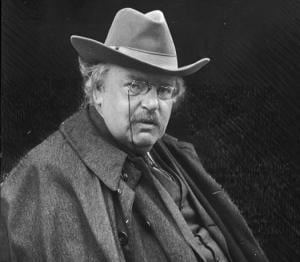
Image provided by guest author.
Guest writer: Pilgrim.
On paradox, human nature and the art of seeing what is in front of us
Preface
In a recent essay, I mentioned Chesterton in passing.
Chesterton would have appreciated the joke. The world is brimming with wonders, and our chief difficulty is that we keep demanding something more wonderful.
A reader took exception and offered three sentences as evidence that Chesterton saw no complexity in people. Taken as statements of fact, the sentences he cited run from doubtful to false.
What a startling sentence is for
Chesterton explained his method in The Everlasting Man. He says that when familiarity breeds contempt, the remedy is to make the familiar thing strange, so that we “see the thing as new, if only by seeing it as unnatural.” He warns that his style may sometimes be “deliberately grotesque and fanciful.” His explanation is theological: “for fallen men it is often true that familiarity is fatigue.” The trouble lies within us. The world remains strange. A startling sentence is one way to wake us to its mystery.
For him, such a sentence has two jobs. It has to disclose something true, and it has to leave us seeing it more clearly than the plain version would.
The three sentences the commenter cited as evidence against Chesterton all need to be considered and assessed separately.
Neighbours and enemies
The Bible tells us to love our neighbours, and also to love our enemies; probably because they are generally the same people.
This is from The Uses of Diversity. Read as a report on how the world is arranged, it overreaches. The joke leans on the command to love our enemies (Matthew 5:44), which most of us hear as a demand for heroic feeling towards distant villains. Chesterton brings it close to home, down to the street, to our close neighbours. The people we find hardest to love are seldom strangers. They tend to live next door.
The paragraph that follows spells this out. A stranger hundreds of miles away is easy to think well of. We picture him as a fellow human being with a history, loves, disappointments and fears. The man next door often becomes the noisy dog, the disputed boundary, the unkempt garden, the irritating habit. We see his inconveniences before we see his humanity.
Abstract love of humanity is cheap. Love of the person at our fence costs something.
One may object that enmity usually grows from misunderstanding, and that misunderstanding is greater at a distance. That may well be true of war and ideology. Chesterton was writing about garden hedges.
It’s a joke that succeeds through exaggeration.
The poor and the problem
The honest poor can sometimes forget poverty. The honest rich can never forget it.
This comes from “Cockneys and Their Jokes”. Out of context, it sounds like a rich man telling the poor how fortunate they are. In context, it is something else. Chesterton is responding to a Yorkshire newspaper writer who disliked his column. He is defending the London poor, saying their great boast is that they are both the unhappiest and the most hilarious part of the population.
The poor can forget that social problem which we (the moderately rich) ought never to forget. Blessed are the poor; for they alone have not the poor always with them.
The last sentence plays on two gospel passages: the beatitude for the poor (Luke 6:20) and the saying that the poor will always be with us (Matthew 26:11). The sentence before it hinges on a pronoun. Chesterton writes “we” and counts himself among the comfortable. The poor have a life larger than their troubles, and the burden of remembering falls on those who can afford to forget.
Here, the context helps. The moral point lands. A possible weak spot is its admiration. A comfortable man who praises the poor’s resilience risks romanticising poverty. That paternalistic edge is real, but the wider point stands. The comfortable have a duty not to forget the social problem, and people on low incomes should not be reduced to it as their defining feature.
Opinions and the cosmos
The modern habit of saying, ‘This is my opinion, but I may be wrong,’ is entirely irrational. If I say that it may be wrong, I say that is not my opinion.
This is in Chesterton’s Introduction to the Book of Job. Read literally, it is mistaken. Someone who says “I believe this, though I may be mistaken” is being honest, and conversation depends on such admissions.
But the following sentence shows what he is actually attacking. He dismisses the habit of saying, “Every man has a different philosophy; this is my philosophy, and it suits me,” as “mere weak-mindedness.” He targets the idea that beliefs about the universe are matters of temperament, as though a belief were true because it suits us. In the same discussion, he writes:
A cosmic philosophy is not constructed to fit a man; a cosmic philosophy is constructed to fit a cosmos. A man can no more possess a private religion than he can possess a private sun and moon.
The difficulty lies in the word “opinion.” It can mean a considered judgement about what is true, or a personal preference that makes no such claim. Chesterton is attacking the second, but his sentence can be misunderstood as the first.
We can admit that we might be wrong about whether the universe has meaning. We cannot, however, treat the question as a matter of taste. Chesterton is right to distinguish uncertainty from indifference to truth. True humility means caring about the answer while admitting that we may be mistaken. That is a good argument, but it is not the one the sentence necessarily makes. Attacking beliefs held as matters of taste does not show that admitting possible error is irrational. The humble speaker is caught in an argument aimed at the relativist, and the context helps explain the overstatement.
Impartiality and indifference
A fourth sentence arrived while I was writing this.
Impartiality is a pompous name for indifference, which is an elegant name for ignorance.
Read alone, it sounds like a sneer at fairness, as though a judge who hears both sides in a case is a fool in a wig. It comes from Chesterton’s review of Edward Dowden’s Puritan and Anglican. Dowden studied the literature of the Puritans and the Cavaliers, and Chesterton calls them the two great schools of faith and valour. His complaint is about what came after. The national heart, he writes, was chilled by the “ice-fiends of judgment and prudence” until early eighteenth-century rationalism produced what he calls “impartiality.”
He is criticising an age for confusing indifference with impartiality. The sentence says that a nation which had stopped caring about truth was giving the loss a respectable name. That is historical polemic, and a one-sided one, since it reduces the eighteenth century to indifference. The target is narrower than the wording, and a reader who meets the sentence out of context will take it for an attack on fairness itself.
Chesterton was not hostile to fairness as such. The Chesterton Society notes that he generally praised tolerance as the opposite of bigotry. Anyone who has watched people mistake not caring for fairness will recognise what he was attacking.
Where paradox earns its name
Chesterton’s sentences do different things. A joke can reveal a paradox, and a polemic overstate a truth. Those labels tell us what a sentence is doing, not whether it succeeds. They can help reveal a truth that a plainer statement would hide. An overstatement can point us to a truth.
He describes the first kind himself. In “The Twelve Men,” Chesterton says that the truths a man most needs are “mere plain truths,” yet “we cannot easily state them in words without being guilty of seeming verbal contradictions.” He calls the Gospel saying that whoever will lose his life shall save it (Mark 8:35) “an entirely practical and prosaic statement.”
In Orthodoxy, he gives courage as an example of such a truth. “Courage is almost a contradiction in terms,” he writes in “The Paradoxes of Christianity”. “It means a strong desire to live taking the form of a readiness to die.” That paradox does honest work, and it describes the soldier and the mountaineer better than any tidy definition.
The courage sentence survives unpacking. The desire to live and the readiness to die both stay in the definition, and nothing in it needs conceding. Some opinion sentences are the opposite case. Even with the context supplied, their wording may remain objectionable.
Did he see complexity in people?
That brings us back to the reader’s charge that Chesterton saw no complexity in people. Four sentences cannot settle the matter. However, where Chesterton writes directly about people, the evidence disproves the claim.
In Heretics, he says that when we really see men as they are, we do not criticise but worship, because “every face in the street has the incredible unexpectedness of a fairy-tale.” He asks us to look far enough into A Hypocrite to see even his sincerity. Father Brown works on this principle. In The Secret of Father Brown, the priest explains that he understands a murderer by imagining how he himself might commit the crime. He recognises his likeness to the murderer “in everything except actual final consent to the action.”
In “The Maniac”, Chesterton links sanity to recognising human complexity. He describes the madman as “the man who has lost everything except his reason.” His mind runs in a closed circle that explains everything and leaves most of reality out. The sane man knows himself to be complex, with a touch of the beast, the devil, the saint and the citizen, and a bit of the madman too. A writer who made that knowledge the mark of sanity can hardly be said to have been unaware of human complexity.
That view of human nature also helps explain his preference for stating his philosophy “in a set of mental pictures rather than in a series of deductions.” We may question the choice, but it was deliberate.
All this carries a risk. An explained joke is a dead joke, and a paradox is a near relation to the joke. I’ve explained four sentences because a reader asked. I hope the explanation sends him and others back to Chesterton rather than discouraging them from reading him.
What survives
None of this makes Chesterton a safe guide in everything. He could be sweeping and unfair, and his polemics sometimes flattened opponents who deserved better. His grasp of human complexity in principle did not always translate into the particular men and groups he judged. His writing about women, Jews and other groups deserves the criticism it receives. The assumptions of his age explain some of it without excusing it, and some of it is not a paradox or exaggeration, because he meant it.
That said, there is something impressive about a writer who can take an observation about neighbours, poverty, or conviction and compress it into a line that makes us stop and look again. That is not a lack of complexity. It can be complexity understood well enough to be expressed briefly. Given the scale of his output, finding a sentence to hold against him is easy. The harder task is to judge what it says and what it does within the writing around it.
The fair way to read a provocative sentence is to ask what it is trying to show us by reading the surrounding pages. Sometimes it may show us nothing at all. Sometimes it will show us the man next door, whom we had stopped seeing.
Thank you!
If you liked this article, please leave your comments below. I am very interested in your opinion on this topic.
Read The Latin Right’s other writing here.
Please visit my Facebook page and IM your questions (and follow my page) or topics for articles you would like covered.
History and Religion
Previous Post

November 22, 2026
The West's Christian Moral Inheritance: A Legacy Denied
Recent Comments
"I once had an discussion with someone who was adamant that immigrants to the U.S. ..."
The West’s Christian Moral Inheritance: A ..."
""If some things were different, other things would be otherwise," said the Griffin to the ..."
The West’s Christian Moral Inheritance: A ..."
"Can we look forward to the orans decision in the Portland, Oregan diocese continuing "Christianity's ..."
The West’s Christian Moral Inheritance: A ..."
"And again, your attempt to be clever reveals your denial of the humanity of the ..."
Why Is Abortion a Lost Cause ..."
Browse Our Archives
Select a Category Abortion Arius Atheists Catholic Apologetics Catholic Culture Catholic History Catholic Humor Catholic Poetry Catholic Politics Catholic Theology Dr. James White Faith Alone Joe Heschmeyer Kamala Harris Martin Luther Pope Francis Preborn Children President Biden Science and Catholicism Sola Scriptura Synod of Synodality Trinity
Select a Month November 2026 October 2026 September 2026 August 2026 July 2026 June 2026 May 2026 April 2026 March 2026 February 2026 January 2026 December 2025 November 2025 October 2025 September 2025 August 2025 July 2025 June 2025 May 2025 April 2025 March 2025 February 2025 January 2025 December 2024 November 2024 October 2024 September 2024 August 2024 July 2024 June 2024 May 2024 April 2024 March 2024 February 2024 January 2024 December 2023 November 2023 October 2023 September 2023 August 2023 July 2023 June 2023 May 2023 April 2023 March 2023 February 2023 January 2023 December 2022 November 2022 October 2022 September 2022 August 2022 July 2022 June 2022 May 2022 April 2022 March 2022 February 2022 January 2022 December 2021 November 2021
Follow Us!
TAKE THE
Religious Wisdom Quiz
True or False: Ezekiel saw a vision of a valley of dry bones that came to life.
Select your answer to see how you score.
FALSE TRUE
Related posts from The Latin Right

Snoopy and the Gift of an Ordinary Afternoon

What the Guilty Taught Me, and What I...

Amoris Laetitia Deserves a Better Defence
TRENDING AT PATHEOS Catholic
The Trouble with Taking Chesterton Literally
Guest writer: Pilgrim. On paradox, human nature and the art of seeing...

Somewhere right now, someone is sitting in a parked car with a...

Just as the emergence of leaves on the fig tree signals the...
Belief and Disbelief in Christ's Presence in Holy...
A study found that only 29% of Catholics believe that the bread...

Blue Christmas: Making Room for Grief at Church
A Blue Christmas service makes room for grief, remembrance, and hope. Explore...

We Can Trust That God Will Use Our...
A Jesus-loving young friend who is going through deep suffering sent me...
view all Catholic blogs
What Are Your Thoughts?leave a comment
Ad-Free & Subscriber Log-In Subscription Support
- About Us
- 2026 Calendar
- Videos
- Podcasts
- Library of World Religions
- Faith In Media Tracker
- Advertise With Us
- Write for Us
- Privacy Policy
- Terms of Service
- Do Not Sell My Data
- Contact Us
- Radiant Digital
- Manage Newsletter Subscriptions
- Unsubscribe From Notifications
- Sitemap
Copyright 2008-2026, Patheos, part of the Radiant Digital network of media brands. All rights reserved.
Subscription Support Ad-Free & Subscriber Log-In
Follow Patheos