
BuddhistCatholicContemplativeEvangelicalGeneral ChristianHinduJewishLatter-day SaintMuslimNew VisionsProgressive Christian
Beliefs
- Buddhist
- Catholic
- Contemplative
- Evangelical
- General Christian
- Hindu
- Jewish
- Latter-day Saint
- More Voices
- Muslim
- New Visions
- Pagan
- Progressive Christian
Topics
- Religion News
- Food and Religion
- Sports and Religion
- Religious Art
- Religious Music and Entertainment
- Religious Events
- History and Religion
- Style and Religion
- Politics and Religion
- Women in Religion
- Recreation Outdoors and Religion
- Business Finance and Religion
- Careers Workplace and Religion
- Education and Religion
- Family Parenting and Religion
- Health Fitness and Religion
- Home and Religion
- Relationships and Religion
- Technology and Religion
- Travel and Religion
Columnists
- Buddhist Columnists
- Business Finance and Religion Columnists
- Careers Workplace and Religion Columnists
- Catholic Columnists
- Contemplative Columnists
- Education and Religion Columnists
- Evangelists Columnists
- Family Parenting and Religion Columnists
- General Christian Columnists
- Health Fitness and Religion Columnists
- Hindu Columnists
- History and Religion Columnists
- Home and Religion Columnists
- Jewish Columnists
- More Voices Columnists
- Latter Day Columnists
- Muslim Columnists
- New Visions Columnists
- Nonreligious Columnists
- Pagan Columnists
- Politics and Religion Columnists
- Progressive Columnists
- Recreation Outdoors and Religion Columnists
- Relationships and Religion Columnists
- Religion News Columnists
- Religious Art Columnists
- Religious Events Columnists
- Religious Music and Entertainment Columnists
- Sports and Religion Columnists
- Style and Religion Columnists
- Technology and Religion Columnists
- Travel and Religion Columnists
- Women in Religion Columnists
Resource Library
- 2026 Calendar
- Library of World Religions
- The 100 Most Holy Places on Earth
- Patheos Answers
- Podcasts
- Videos
- Faith Leaders Database
- Anglican Episcopalian
- Bahai
- Baptist
- Buddhism
- Christianity
- Confucianism
- Eastern Orthodoxy
- Hinduism
- Holiness and Pentecostal
- ISKCON
- Islam
- Judaism
- Lutheran
- Methodist
- The Church of Jesus Christ of Latter-day Saints
- New Age
- Paganism
- Presbytarian and Reformed
- Protestantism
- Religion Behind the Scenes
- Roman Catholic
- Scientology
- Shia Islam
- Sikhism
- Sufism
- Sunni Islam
- Taoism
- Zen
- See all religions
Research Tools
 Ad-Free & Subscriber Log-In Subscription Support
Ad-Free & Subscriber Log-In Subscription Support
Follow Patheos 

- Trending:
- Forgiveness
- |
- Marriage
- |
- Consciousness
- |
- Death Penalty
- |
- Election
- |
- Halloween

- Home
- Catholic
- Religion News
- The Suggestive Power of “Perhaps”
The Suggestive Power of “Perhaps”
Last updated on: September 1, 2026 at 1:30 am by Dennis Knapp
The Suggestive Power of “Perhaps” 2026-08-30T12:59:49-06:00 Dennis Knapp
Patheos Explore the world's faith through different perspectives on religion and spirituality! Patheos has the views of the prevalent religions and spiritualities of the world.
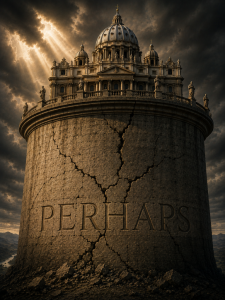
Image created by author using AI.
Can Permanent Discernment Work Around Catholicism’s Safeguards Against Doctrinal Change?
To frequent readers, my concerns about the Synod on Synodality are well established. I do not so much resist the stated intent of synodality as I question its potential theological consequences. Synodality’s focus on “listening,” “cultural migration,” and becoming the Church “in a different way” appears to do something quite unique, subtle, and theologically sophisticated when considered alongside Catholicism’s strict safeguards against explicit doctrinal reversal.
Synodality invokes the suggestive power of “perhaps.”
For example, at the recent conference of the LCWR (Leadership Conference of Women Religious), Sr. Nathalie Becquart, XMCJ, Under-Secretary of the General Secretariat of the Synod, gave the keynote address. She stated that synodality:
…is not about being another Church but about being the Church in a different way to be more faithful to the Gospel in a changing world facing many challenges. It is moving from one culture to another: from a culture of clericalism, hierarchicalism and institutional self-sufficiency to a culture of listening, co-responsibility, discernment and genuine exchange.
Naturally, her appeals to “clericalism, hierarchicalism and institutional self-sufficiency” drew criticism, including from canon lawyer Fr. Gerald Murray. In his article, Selling Radical ‘Synodality’ as ‘Social Prophecy’, Murray asks several questions that demand answers:
- What is “hierarchicalism”?
- What does “co-responsibility” actually mean?
- How does Sr. Becquart know that the Holy Spirit is calling the Church toward this particular transformation?
Fr. Murray sees the ambiguity of Sr. Becquart’s language, coupled with the lack of substantive answers, as “sloganeering.”
Another critic of Sr. Becquart—and synodality more broadly—Brad Miner goes further in Synodality Will Kill Catholicism. Perhaps the vagueness is “a feature, not a bug.” Fr. Murray and Mr. Miner, in different ways, expose what may actually be going on here.
Catholicism possesses powerful safeguards against explicit doctrinal reversal. The suggestive power of “perhaps” is that synodality can potentially work around those safeguards by relocating contested questions into an indefinite process of listening, discernment, pastoral experimentation, and reception. A teaching can thereby become practically unsettled without ever being formally repudiated.
Brilliant.
Why Catholicism Is Difficult to Change
Of all the major world religions, Catholicism possesses some of the most stringent safeguards against easily changing established beliefs. Unlike legislative policy, Catholic doctrine cannot simply change with the prevailing consensus. Catholic teaching is constrained by Scripture, Apostolic Tradition (big “T”), the previous Magisterium, councils, and the Church’s claims concerning indefectibility and doctrinal continuity. A straightforward reversal therefore creates an enormous theological problem because it invokes a definitive “No!”—a not-X that leaves little room for theological creativity or the suggestive power of “perhaps.”
For example, if the Church authoritatively taught X for centuries and now authoritatively teaches not-X, Catholics must explain how both claims can coexist with the Church’s claims about her own teaching authority.
Pastoral practice, discernment, disciplinary structures, and terminology, however, allow considerably more flexibility. They introduce the possibility of change occurring not by confronting Catholicism’s doctrinal safeguards directly, but by moving around them.
This need not imply a conspiracy or hidden plan. My argument does not depend upon proving anyone’s intentions. We need only recognize what the synodal mechanism permits, regardless of the intentions of those employing it.
The Power of “Perhaps”
Now, let’s identify the true power of “perhaps.” Consider the following statements:
Catholic teaching X should change.
Versus:
Perhaps the Holy Spirit is inviting us to listen more deeply to experiences that challenge how we understand and apply X.
The first statement immediately encounters Catholicism’s doctrinal safeguards if the proposed change contradicts Catholic teaching. The second formally denies nothing, requires no doctrinal reversal, calls only for listening, invokes discernment, and keeps the question open. In short, the power of “perhaps” shifts the presumption.
A settled teaching encounters a pastoral question, which prompts listening to lived experience and further discernment. Then comes the “perhaps,” followed by experimentation, still more discernment, and an emerging consensus—all under the umbrella of synodality.
Nobody ever needs to announce, “The Church was wrong.” Instead, Church teaching remains formally unchanged, but “perhaps” we can look at that teaching from a different angle. “Perhaps” its pastoral application requires development. “Perhaps” we have not listened sufficiently. “Perhaps” the Holy Spirit is inviting us to discern further.
Eventually, the burden of proof moves from “Why should the Church change?” to “Why won’t you remain open to further discernment?”
Therein lies the power of “perhaps.” It does not necessarily change the answer. It changes whether Catholics are still permitted to regard the question as answered.
Synodality as the Mechanism
Now, let’s return to Sr. Becquart’s own language. In her keynote address, she uses ambiguous terms while offering little clarification. She speaks of “cultural migration” and “structural reform,” of moving away from “clericalism, hierarchicalism and institutional self-sufficiency” toward “listening, co-responsibility, discernment and genuine exchange,” without clearly defining what these terms actually mean or where their boundaries lie.
Naturally, Fr. Murray asks for definitions because definitions establish the boundaries of change. In a sense, Fr. Murray seeks to reassert Catholic safeguards by forcing ambiguous possibilities into concrete propositions that Catholics can evaluate. However, as Miner observes, “a standing, undefined, participatory process for generating endless, contemporary ecclesial consensuses” may operate as a feature, not a bug. The mechanism matters more than any single decision.
After all, a synod deliberates about particular questions. Synodality can institutionalize permanent deliberability. Under such a mechanism, Catholic doctrine can remain formally intact while practices change, exceptions develop, local experimentation occurs, alternative interpretations proliferate, and further discernment remains perpetually possible. There need never be a clearly identifiable moment of doctrinal reversal.
“Perhaps” creates the room necessary to accommodate change without requiring anyone to acknowledge that change has occurred.
But Who Discerns the Discernment?
…the Holy Spirit is not waiting for us to be ready.
Catholicism certainly teaches that the Holy Spirit continues to guide the Church. However, Catholicism also requires that discernment be tested. Consider this thought experiment:
One synodal body prayerfully discerns a controversial development, while another prayerfully discerns fidelity to traditional teaching. Both listen. Both pray. Both engage in discernment. Yet contradictory conclusions cannot both represent the Holy Spirit’s will. Therefore, the synodal process cannot authenticate itself.
Something outside the process must judge its conclusions. For Catholicism, this means the received faith: Scripture, Tradition, and the Magisterium.
We must therefore ask of synodality: Does the deposit of faith judge what emerges from synodal discernment, or can synodal discernment place the deposit of faith back under judgment?
If the former, Tradition judges synodality, establishing clear boundaries and safeguards for authentic discernment. If the latter, synodality can continually reopen settled teaching, and Mr. Miner has identified something much more consequential than merely another consultative structure.
Final Thoughts… The Sophisticated Workaround
To conclude, Catholicism has used synods throughout her history. Listening poses no problem. Neither does lay participation. Nor does authentic doctrinal development. Instead, synodality raises a different question for modern Catholics: Can permanent discernment make permanent teaching functionally provisional?
Fr. Murray demands definitions because definitions establish limits. Mr. Miner identifies vagueness as a potential “feature” because it creates room for developments that could not survive Catholic doctrinal scrutiny if proponents stated them as explicit propositions.
Synodality need not overturn Catholicism’s doctrinal safeguards to diminish their practical force. It need only keep asking “perhaps” where the Church once said, “This has been settled.”
The Holy Spirit undoubtedly guides the Church, and Catholics must always remain attentive to Him. But the Spirit who speaks today is the same Spirit who guided the Church yesterday. If “perhaps the Spirit is calling us” can indefinitely reopen what the Church previously taught as settled, then we no longer face merely the question of whether Catholics are willing to listen.
We face a more fundamental question: Has synodality left anything that the listening Church no longer possesses the authority to renegotiate?
Other Writings on Synodality
Why Does Synodality Only Go One-Way?
Synod on Synodality II: Is Fr. Martin Really “Listening?”
Cracking the Code of Synodality
Where Is the Faithful’s Voice in the Synod of Synodality?
A Way to Schism and Crisis: the German Synodal Path and the Synod of Synodality
The Misuse of the Faithful in the Synod of Synodality
Thank you!
If you liked this article, please leave your comments below. I am very interested in your opinion on this topic.
Read The Latin Right’s other writing here.
Please visit my Facebook page and IM your questions (and follow my page) or topics for articles you would like covered.
Religion News
Previous Post

August 30, 2026
God's Delight: Why a Perfect God Made a World
Next Post
September 6, 2026 Gloria Steinem, John Paul II, and Two Visions of Freedom
Recent Comments
"I agree that St John Paul II did not equivocate. He was insistent that the ..."
Amoris Laetitia Deserves a Better Defence
"Not a different answer.Peter, you have an occasional problem with the truth. Mike Lewis pointed ..."
Amoris Laetitia Deserves a Better Defence
"So, no answer."
Amoris Laetitia Deserves a Better Defence
"Thanks, Mike, but the history points in a different direction to the one you suggest.John ..."
Amoris Laetitia Deserves a Better Defence
Browse Our Archives
Select a Category Abortion Arius Atheists Catholic Apologetics Catholic Culture Catholic History Catholic Humor Catholic Poetry Catholic Politics Catholic Theology Dr. James White Faith Alone Joe Heschmeyer Kamala Harris Martin Luther Pope Francis Preborn Children President Biden Science and Catholicism Sola Scriptura Synod of Synodality Trinity
Select a Month October 2026 September 2026 August 2026 July 2026 June 2026 May 2026 April 2026 March 2026 February 2026 January 2026 December 2025 November 2025 October 2025 September 2025 August 2025 July 2025 June 2025 May 2025 April 2025 March 2025 February 2025 January 2025 December 2024 November 2024 October 2024 September 2024 August 2024 July 2024 June 2024 May 2024 April 2024 March 2024 February 2024 January 2024 December 2023 November 2023 October 2023 September 2023 August 2023 July 2023 June 2023 May 2023 April 2023 March 2023 February 2023 January 2023 December 2022 November 2022 October 2022 September 2022 August 2022 July 2022 June 2022 May 2022 April 2022 March 2022 February 2022 January 2022 December 2021 November 2021
Follow Us!
TAKE THE
Religious Wisdom Quiz
What did God command Job to do after his friends were rebuked?
Select your answer to see how you score.
Go to Uz Pray for his friends Offer more sacrifices Fast for 40 days
Related posts from The Latin Right

Amoris Laetitia Deserves a Better Defence

Rich Man, Poor Man: Altruism and Agency

The Order We Did Not Make: The World...

Is This “Culture War” Catholicism—or Evangelization?
TRENDING AT PATHEOS Catholic

Nearly every morning, I make the drive to Detroit with my high-school-age...

The Real AI Story Is Adoption Without Trust
Artificial intelligence has crossed a political threshold. It is no longer a...

A new article, written by Jeff Lindsay and Gale L. Pooley,...

Swimfan: Forgotten Aughts Pleasures
This is a recovery effort. In 2002, My Big Fat Greek Wedding...

Top Three Anti-Catholic Lies About Catholicism
This is my initial transcript for the video, "THE 3 WORST...

Pope Leo Celebrates Mass for Nurses & Docs...
I don't have any idea how he did it, but Pope Leo...
view all Catholic blogs
What Are Your Thoughts?leave a comment
Ad-Free & Subscriber Log-In Subscription Support
- About Us
- 2026 Calendar
- Videos
- Podcasts
- Library of World Religions
- Faith In Media Tracker
- Advertise With Us
- Write for Us
- Privacy Policy
- Terms of Service
- Do Not Sell My Data
- Contact Us
- Radiant Digital
- Manage Newsletter Subscriptions
- Unsubscribe From Notifications
- Sitemap
Copyright 2008-2026, Patheos. All rights reserved.
Subscription Support Ad-Free & Subscriber Log-In
Follow Patheos