
BuddhistCatholicContemplativeEvangelicalGeneral ChristianHinduJewishLatter-day SaintMuslimNew VisionsProgressive Christian
Beliefs
- Buddhist
- Catholic
- Contemplative
- Evangelical
- General Christian
- Hindu
- Jewish
- Latter-day Saint
- More Voices
- Muslim
- New Visions
- Pagan
- Progressive Christian
Topics
- Religion News
- Food and Religion
- Sports and Religion
- Religious Art
- Religious Music and Entertainment
- Religious Events
- History and Religion
- Style and Religion
- Politics and Religion
- Women in Religion
- Recreation Outdoors and Religion
- Business Finance and Religion
- Careers Workplace and Religion
- Education and Religion
- Family Parenting and Religion
- Health Fitness and Religion
- Home and Religion
- Relationships and Religion
- Technology and Religion
- Travel and Religion
Columnists
- Buddhist Columnists
- Business Finance and Religion Columnists
- Careers Workplace and Religion Columnists
- Catholic Columnists
- Contemplative Columnists
- Education and Religion Columnists
- Evangelists Columnists
- Family Parenting and Religion Columnists
- General Christian Columnists
- Health Fitness and Religion Columnists
- Hindu Columnists
- History and Religion Columnists
- Home and Religion Columnists
- Jewish Columnists
- More Voices Columnists
- Latter Day Columnists
- Muslim Columnists
- New Visions Columnists
- Nonreligious Columnists
- Pagan Columnists
- Politics and Religion Columnists
- Progressive Columnists
- Recreation Outdoors and Religion Columnists
- Relationships and Religion Columnists
- Religion News Columnists
- Religious Art Columnists
- Religious Events Columnists
- Religious Music and Entertainment Columnists
- Sports and Religion Columnists
- Style and Religion Columnists
- Technology and Religion Columnists
- Travel and Religion Columnists
- Women in Religion Columnists
Resource Library
- 2026 Calendar
- Library of World Religions
- The 100 Most Holy Places on Earth
- Patheos Answers
- Podcasts
- Videos
- Faith Leaders Database
- Anglican Episcopalian
- Bahai
- Baptist
- Buddhism
- Christianity
- Confucianism
- Eastern Orthodoxy
- Hinduism
- Holiness and Pentecostal
- ISKCON
- Islam
- Judaism
- Lutheran
- Methodist
- The Church of Jesus Christ of Latter-day Saints
- New Age
- Paganism
- Presbytarian and Reformed
- Protestantism
- Religion Behind the Scenes
- Roman Catholic
- Scientology
- Shia Islam
- Sikhism
- Sufism
- Sunni Islam
- Taoism
- Zen
- See all religions
Research Tools
 Ad-Free & Subscriber Log-In Subscription Support
Follow Patheos 

- Trending:
- Advent
- |
- Forgiveness
- |
- Thanksgiving
- |
- Election
- |
- Seasonal Holidays
- |
- Marriage

- Home
- Catholic
- History and Religion
- Where Should God Draw the Line on Allowing Suffering?
Where Should God Draw the Line on Allowing Suffering?
Last updated on: August 5, 2026 at 1:41 pm by Dennis Knapp
Where Should God Draw the Line on Allowing Suffering? 2026-08-05T13:41:53-06:00 Dennis Knapp
Patheos Explore the world's faith through different perspectives on religion and spirituality! Patheos has the views of the prevalent religions and spiritualities of the world.
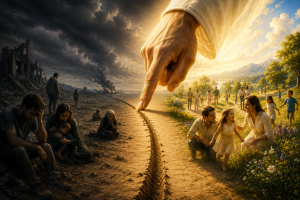
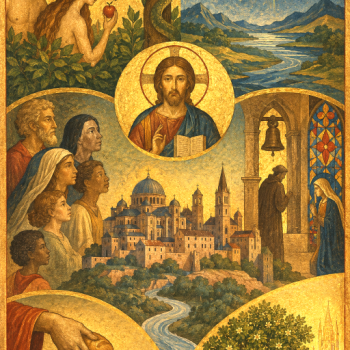
Image created by author using AI.
Job’s Wife, Heaven, and the Search for a World Without Evil
Recently, guest contributor Peter (Pilgrim) wrote a pair of articles on theodicy and the problem of evil (or suffering). In them, he explored why a good God allows suffering in the world, or, in his words, “how a good God can create a world with a genuine wound in it, and govern that world without either overriding its freedom or abandoning it to itself.”
Many—perhaps most—of the responses to Peter ultimately reduce to the same question: Why would a good God allow any suffering at all? In these objections, I hear an echo of Job’s wife during her husband’s affliction:
Do you still hold fast your integrity? Curse God and die. (Job 2:9)
When Peter offers explanations that seek to reconcile God’s goodness with human freedom, one atheist comment captures the heart of the objection:
I’m not saying that every good should exist, only that gratuitous evil shouldn’t exist.
No Christian defends gratuitous evil. But how do we know which evils truly qualify as gratuitous? Skeptics often point to childhood cancer, parasitic diseases, torture, or natural disasters and conclude that no good God could have a sufficient reason for permitting them.
That conclusion resembles Job’s wife’s reasoning. The suffering appears so great that God no longer seems worthy of trust.
Perhaps, however, we should begin with a different question:
Where should God draw the line on allowing suffering?
That question exposes an assumption hidden within many modern objections. They often proceed like this:
- A good God would eliminate the worst suffering.
- Horrific suffering exists.
- Therefore, a good God cannot exist.
But why only the worst suffering?
Why should that serve as the moral boundary?
How do we determine where that threshold lies?
Where Should God Draw the Line?
Let’s conduct a thought experiment.
Suppose a truly good God removed every form of suffering that most people would regard as unquestionably gratuitous. Childhood cancer disappears. Parasites that blind children disappear. Genocide, torture, and devastating natural disasters vanish. Wonderful! Those evils no longer exist.
But what now counts as the worst remaining suffering?
Whatever remains now occupies the very position those horrors once held.
What must God do next?
If a perfectly good God must always eliminate the worst suffering, then He must remove whatever now stands in its place.
You can see where this leads.
Soon, the “worst” suffering consists of chronic illness, broken bones, grief, loneliness, headaches, scraped knees, and eventually even ordinary discomfort.
If God must always eliminate the greatest remaining suffering, where could He consistently stop?
Follow the logic. If God removes Level 10 suffering, then Level 9 becomes the worst. Remove Level 9, and Level 8 becomes the worst. Continue the process, and eventually every form of suffering disappears.
At that point, the objection has quietly changed. It no longer argues that a good God should prevent horrific suffering. It argues that a good God should permit no suffering whatsoever.
Has Comfort Changed Our Expectations?
Why does the modern West seem especially averse to suffering?
For most of human history, people accepted suffering as an unavoidable part of life. Until fairly recently, disease, famine, infant mortality, dangerous childbirth, war, and short life expectancy shaped the ordinary human experience.
Today, however, much of the Western world has dramatically reduced many of these hardships. We often expect medicine to cure disease, technology to protect us, governments to maintain peace, and safety regulations to minimize risk. Has our remarkable success in reducing suffering subtly reshaped our expectations of God?
Asking that question does not minimize anyone’s suffering. Nor does it romanticize the hardships of the past. Rather, it asks whether modern comfort has changed what we believe a normal human life ought to look like. Have we become so accustomed to reducing suffering that we now expect a good God to eliminate it altogether?
A World Without Suffering and the Cross
Now imagine a world completely devoid of suffering: no pain, no disease, no danger, no tragedy, and no death.
Would such a world still cultivate courage, self-sacrifice, perseverance, compassion, mercy, and forgiveness?
Christianity does not claim that suffering is good in itself. Rather, it asks whether certain virtues become possible only in a world where suffering can exist.
Yet Christianity goes even further. It does not merely argue that God has reasons for permitting suffering; it proclaims that God Himself entered into it.
The Cross reveals something unique about the relationship between God and suffering. God does not simply explain suffering from a distance—He bears it. The Cross affirms that evil, suffering, and death are real. Yet Christ willingly endures all three, transforming the greatest injustice—the execution of the only truly innocent man—into the means of the world’s redemption.
At this point, the Christian answer moves beyond philosophy and enters the realm of history and relationship. Christianity does not offer merely an abstract explanation for suffering. It points to a God who willingly suffered alongside His creation and promises that suffering and death will not have the final word.
If Heaven Has No Suffering, Why Didn’t God Create Heaven Immediately?
At this point, many atheists raise a strong objection: If Heaven contains freedom without suffering, why didn’t God simply create us there?
Because this question concerns the Christian understanding of freedom, suffering, and Heaven, we must first distinguish between Eden—humanity’s original home—and Heaven—redeemed humanity’s ultimate destiny.
In Eden, humanity existed in innocence yet remained capable of falling. Adam and Eve were free, but their holiness had not yet been confirmed through perseverance.
Heaven, by contrast, is the home of the redeemed. There, the saints exist fully sanctified and perfected. They remain genuinely free, yet they no longer turn away from God because their wills are perfectly united with His. They no longer desire sin because they behold God face to face.
For Catholics, this perfection includes the work of sanctification during earthly life and, when necessary, purification before entering Heaven.
Heaven, then, is not populated by creatures who never experienced temptation, suffering, or the consequences of sin. It is populated by people whose love has been perfected through God’s redeeming grace.
History, therefore, is not a mistake God reluctantly tolerates. It is the arena in which redemption unfolds, culminating in a humanity that freely and perfectly loves God forever.
Final Thoughts… Job’s Wife’s Advice Revisited
In the face of Job’s suffering, his wife concluded, “Curse God and die.” Modern critics usually express themselves in philosophical rather than biblical language, yet many arrive at a similar conclusion: If God permits profound suffering, then He cannot be good and is therefore unworthy of our worship.
Yet this objection has no obvious principled stopping point. If applied consistently, it leads not merely to a world with less suffering but to a world with none at all.
Christianity offers a different vision. It teaches that history is ordered toward something greater than the mere elimination of pain: the free and loving union of redeemed persons with God—a union fully realized in Heaven. That hope does not erase the mystery of suffering, but it places suffering within the larger story of creation, the Fall, redemption, sanctification, and glory.
Perhaps, then, the deeper question is not whether God should eliminate some suffering rather than more suffering. Perhaps the real question is whether we believe a good God should permit any suffering at all.
If that is our assumption, then we have moved well beyond the problem of horrific evil. We have begun to question whether any world containing suffering could ever be the work of a good God.
If every remaining suffering eventually becomes “the worst” suffering, then where, exactly, should a good God draw the line?
Thank you!
If you liked this article, please leave your comments below. I am very interested in your opinion on this topic.
Read The Latin Right’s other writing here.
Please visit my Facebook page and IM your questions (and follow my page) or topics for articles you would like covered.
History and Religion
Previous Post
August 3, 2026
If God Is Good, Why Evil? A Composer and His Score
Next Post

August 10, 2026 Why Catholics Who Share an Altar Still Can't Agree
Recent Comments
"You sort of reference it above, but Christianity is a relatively flexible religion, able to ..."
The West’s Christian Moral Inheritance: A ..."
""In a book called The Ancient Civilizations of Peru you read that 'The Inca state ..."
The West’s Christian Moral Inheritance: A ..."
""Do the things other people want to do with your body. Don't make your own ..."
Why Is Abortion a Lost Cause ..."
"Actually there is a perfectly pure solution. Don’t kill your children. Don’t engage in procreative ..."
Why Is Abortion a Lost Cause ..."
Browse Our Archives
Select a Category Abortion Arius Atheists Catholic Apologetics Catholic Culture Catholic History Catholic Humor Catholic Poetry Catholic Politics Catholic Theology Dr. James White Faith Alone Joe Heschmeyer Kamala Harris Martin Luther Pope Francis Preborn Children President Biden Science and Catholicism Sola Scriptura Synod of Synodality Trinity
Select a Month November 2026 October 2026 September 2026 August 2026 July 2026 June 2026 May 2026 April 2026 March 2026 February 2026 January 2026 December 2025 November 2025 October 2025 September 2025 August 2025 July 2025 June 2025 May 2025 April 2025 March 2025 February 2025 January 2025 December 2024 November 2024 October 2024 September 2024 August 2024 July 2024 June 2024 May 2024 April 2024 March 2024 February 2024 January 2024 December 2023 November 2023 October 2023 September 2023 August 2023 July 2023 June 2023 May 2023 April 2023 March 2023 February 2023 January 2023 December 2022 November 2022 October 2022 September 2022 August 2022 July 2022 June 2022 May 2022 April 2022 March 2022 February 2022 January 2022 December 2021 November 2021
Follow Us!
TAKE THE
Religious Wisdom Quiz
I smashed a clay jar in the Valley of Ben Hinnom to illustrate coming destruction. What did this dramatic act symbolize?
Select your answer to see how you score.
The breaking of Jerusalem Breaking the covenant The end of idolatry The captivity
Related posts from The Latin Right
The West's Christian Moral Inheritance: A Legacy Denied
Pope Leo in Lima: The Speech That Inconveniences...

Will God Raise Us as We Are or...
TRENDING AT PATHEOS Catholic

For many years, Catholicism has been caught up in division over the...

'Statements of Faith' never get shorter
Nothing demonstrates a conservative commitment to faith and faithfulness like a "statement...

Michele's Reviews - Future Grace by John Piper
In God's Place, at God's Pace, by Future Grace Impatience is...

Bama Gramma's Blackout Christmas: the Power of Light...
Another Christmas Skit: I have an alter ego: Bama Gramma. She shows...

Thanksgiving as a Way of Life: A Christian...
Each year, Thanksgiving brings families and friends together to share meals, stories,...

Two Women Doctors Who Went Against the Current
Women physicians who transformed healthcare for "Indians" “I shall have an advantage...
view all Catholic blogs
What Are Your Thoughts?leave a comment
Ad-Free & Subscriber Log-In Subscription Support
- About Us
- 2026 Calendar
- Videos
- Podcasts
- Library of World Religions
- Faith In Media Tracker
- Advertise With Us
- Write for Us
- Privacy Policy
- Terms of Service
- Do Not Sell My Data
- Contact Us
- Radiant Digital
- Manage Newsletter Subscriptions
- Unsubscribe From Notifications
- Sitemap
Copyright 2008-2026, Patheos, part of the Radiant Digital network of media brands. All rights reserved.
Subscription Support Ad-Free & Subscriber Log-In
Follow Patheos