
BuddhistCatholicContemplativeEvangelicalGeneral ChristianHinduJewishLatter-day SaintMuslimNew VisionsProgressive Christian
Beliefs
- Buddhist
- Catholic
- Contemplative
- Evangelical
- General Christian
- Hindu
- Jewish
- Latter-day Saint
- More Voices
- Muslim
- New Visions
- Pagan
- Progressive Christian
Topics
- Religion News
- Food and Religion
- Sports and Religion
- Religious Art
- Religious Music and Entertainment
- Religious Events
- History and Religion
- Style and Religion
- Politics and Religion
- Women in Religion
- Recreation Outdoors and Religion
- Business Finance and Religion
- Careers Workplace and Religion
- Education and Religion
- Family Parenting and Religion
- Health Fitness and Religion
- Home and Religion
- Relationships and Religion
- Technology and Religion
- Travel and Religion
Columnists
- Buddhist Columnists
- Business Finance and Religion Columnists
- Careers Workplace and Religion Columnists
- Catholic Columnists
- Contemplative Columnists
- Education and Religion Columnists
- Evangelists Columnists
- Family Parenting and Religion Columnists
- General Christian Columnists
- Health Fitness and Religion Columnists
- Hindu Columnists
- History and Religion Columnists
- Home and Religion Columnists
- Jewish Columnists
- More Voices Columnists
- Latter Day Columnists
- Muslim Columnists
- New Visions Columnists
- Nonreligious Columnists
- Pagan Columnists
- Politics and Religion Columnists
- Progressive Columnists
- Recreation Outdoors and Religion Columnists
- Relationships and Religion Columnists
- Religion News Columnists
- Religious Art Columnists
- Religious Events Columnists
- Religious Music and Entertainment Columnists
- Sports and Religion Columnists
- Style and Religion Columnists
- Technology and Religion Columnists
- Travel and Religion Columnists
- Women in Religion Columnists
Resource Library
- 2026 Calendar
- Library of World Religions
- The 100 Most Holy Places on Earth
- Patheos Answers
- Podcasts
- Videos
- Faith Leaders Database
- Anglican Episcopalian
- Bahai
- Baptist
- Buddhism
- Christianity
- Confucianism
- Eastern Orthodoxy
- Hinduism
- Holiness and Pentecostal
- ISKCON
- Islam
- Judaism
- Lutheran
- Methodist
- The Church of Jesus Christ of Latter-day Saints
- New Age
- Paganism
- Presbytarian and Reformed
- Protestantism
- Religion Behind the Scenes
- Roman Catholic
- Scientology
- Shia Islam
- Sikhism
- Sufism
- Sunni Islam
- Taoism
- Zen
- See all religions
Research Tools
 Ad-Free & Subscriber Log-In Subscription Support
Follow Patheos 

- Trending:
- Advent
- |
- Forgiveness
- |
- Thanksgiving
- |
- Election
- |
- Seasonal Holidays
- |
- Marriage

- Home
- Catholic
- Politics and Religion
- Why Catholics Who Share an Altar Still Can’t Agree
Why Catholics Who Share an Altar Still Can’t Agree
Last updated on: August 10, 2026 at 9:21 pm by Dennis Knapp
Why Catholics Who Share an Altar Still Can’t Agree 2026-08-10T21:21:44-06:00 Dennis Knapp
Patheos Explore the world's faith through different perspectives on religion and spirituality! Patheos has the views of the prevalent religions and spiritualities of the world.
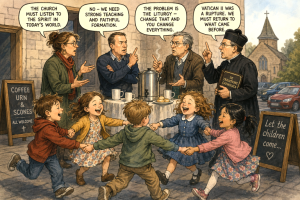
Image provided by guest author.
The Carpark Argument: Musings Over the Coffee and Scones
Guest writer: Pilgrim.
Two people kneel side by side before the same altar, profess the same Creed, receive the same Body and Blood, and then walk out into the carpark to disagree, with real heat, about what the Church is, what she has always been, and what she ought to do next. They are not members of rival sects. They share a pope, a canon law, and on most Sunday mornings, a coffee urn and scones. And yet they inhabit, in some meaningful sense, different versions of Catholicism.
The progressive arrives carrying stories. The conservative arrives carrying documents. The traditionalist arrives carrying photographs from 1954. The radical traditionalist arrives carrying a timeline. All four stand around the same coffee urn, each convinced the other three are the innovators.
The Fault Line
Every visible argument in contemporary Catholicism is the surface expression of a single deeper one. It is usually framed as rules versus lives, or authority versus conscience, or Vatican II versus everything before it. The real question sits underneath all three: where has the Church gone wrong, and how far back does the failure run?
Each faction may best be understood as a diagnosis:
The progressive locates the failure in institutions; a Church in love with its own authority has failed to listen to history, to the margins, to the Spirit.
The conservative locates it in formation; the faith became a set of conclusions handed down without the vision that generated them, the communities that made them liveable, or the sacramental life that supplies what formation alone cannot.
The traditionalist locates it in worship; change what happens at the altar, and you will, over time, change what people think the altar is for.
The radical traditionalist locates it earlier than any of them; the reforms themselves were the rupture, not the remedy.
The Root Question
The diagnoses diverge because of a prior disagreement, skipped over in favour of the more immediately interesting arguments about this or that teaching: does the Church receive the faith from the apostles as a deposit to be transmitted and unfolded, or does it construct the faith in ongoing response to historical experience?
The traditionalist and conservative rest on a hermeneutic of continuity: the deposit was given once, whole, and may be clarified across the centuries but not revised. A tree may grow taller than the sapling from which it emerged, but if it becomes a giraffe, something has gone badly wrong.
The progressive begins from the conviction that every formulation of faith is conditioned by its cultural moment and therefore liable to require fresh expression if the Gospel is to remain intelligible.
The Holy Spirit did not retire after Trent, though one occasionally suspects, reading certain post-conciliar documents, that He has been working rather harder than usual to keep up with the demands placed upon Him. Each side is certain it is reading the text straight, and the other is smuggling in an agenda. It is one of the few points on which they agree, and neither finds it worth mentioning.
Everything depends on whether these distinctions are being used as a tool of discernment or as a solvent. There is a version of the argument that genuinely enlightens, and another that functions like a key which, on inspection, opens everything, and a key that opens everything locks nothing.
The spirit of every age presents itself as the Holy Spirit.
Lex Orandi, Lex Credendi, Lex Vivendi
An ancient principle sits near the center of this argument: lex orandi, lex credendi, lex vivendi: as we worship, so we believe, and so we live.
The liturgy is not the packaging of doctrine; it is the living channel of grace. Week after week it trains attention, orders desire, and slowly writes the faith into the heart. Christianity is something we learn to inhabit before it is something we explain. Liturgy doesn’t just tell us who we are; over years of faithful participation, it makes us into that people.
This is why the liturgy wars, dismissed by many as aesthetic preference dressed up as theology, are a formational argument in its most concrete form.
The traditionalist does not prefer the older rite because he finds guitars theologically offensive, though he may. He prefers it because he thinks the form of worship shapes belief in ways slow, deep, and invisible until the damage is done, and, by then, largely irreversible, at least on any timeframe a diocesan strategy document would recognize.
The progressive tends to treat liturgy as a delivery mechanism: what matters is participation, comprehensibility, and gathered community. Meaning flows from the worshipper to the rite. The traditionalist account runs the other way: the rite forms the worshipper, and a community that has lost the capacity to be formed by what it cannot immediately understand has lost something no felt banner can replace.
What the post-conciliar settlement actually produced was a liturgy that varies by parish, presider, musical taste, and the availability of someone who owns an acoustic guitar. The Church then expressed surprise when belief became similarly variable.
The problem was never the vernacular. It was the culture of improvisation the reform licensed but did not require, and which many parishes treated as permission rather than the risk it was. The liturgy question is, in the end, the formation question in its most visible and most contested form.
The Traditionalist
The traditionalist looks at the post-conciliar Church and sees a formation catastrophe. He is right, and when he identifies the liturgical reform as one of its primary causes, the diagnosis mostly holds. The communities that have held onto a strong sacramental life and genuine catechesis, people who know not just what the Church teaches but why, turn out disproportionately to be communities that never made peace with the culture of informality, many worshipping in the older form. From this he concludes that the older form is not only a more adequate vehicle for formation but the necessary one.
Seriousness of form and seriousness of formation travel together, but they are not the same thing. The rite is a carrier of the seriousness, not its source, and the existence of parishes that have recovered genuine formation in the ordinary form is inconvenient data his account tends to overlook rather than reckon with honestly.
Ask the traditionalist how the parish is doing, and he may begin with the sanctuary lamps. Ten minutes later you know the history of the Roman Canon, the architectural deficiencies of the sanctuary, and the genealogy of every liturgical abuse since 1967. You still do not know whether Mrs Jenkins, who has attended daily Mass for thirty years, is recovering from her operation. It is not that he does not care. It is that his attention has been trained, with real success, on one kind of fidelity, and somewhat less successfully on the kind that notices the woman in the last pew.
He speaks, too, as though the pre-conciliar Church was a catechetical success interrupted. It was not. The faith was stated with real clarity before the Council, yet when the cultural pressure arrived, vast numbers departed with astonishing speed. A generation catechized in Latin, schooled by nuns, and drilled in the Baltimore Catechism from infancy was overtaken by the 1960s. That is rather more data than his account of the crisis comfortably accommodates.
His instinct is sound. His remedy is too confidently stated. And his tendency to romanticize a past that was, on the available evidence, already losing the argument before anyone changed the missal is the characteristic flaw in a position otherwise worth taking seriously.
The Radical Traditionalist
He has read every conciliar document, every pre-conciliar document, and several documents nobody else realized existed. He can carry fifteen centuries of Church history into a single parish conversation and leave having explained, to his own satisfaction, why this Sunday’s hymn selection is really the final chapter of a story that began sometime around the Enlightenment. It is an impressive kind of learning.
The radical traditionalist is a different case, and the distinction from his more moderate cousin matters. Where the traditionalist sees a reform gone wrong, he sees a rupture. The crisis is too severe, the discontinuity too deep, for the ordinary tools of renewal to reach. He often sees real things; he noticed, long before many others, that the post-conciliar Church had lost forms of reverence, continuity, and confidence whose absence would prove more consequential than their defenders imagined. His longer memory has preserved questions the wider Church was sometimes too eager to forget. The trouble is what he does about them.
In reserving the right to judge and resist the contemporary Magisterium against a prior standard, Trent, say, or the pre-conciliar settlement, and in extending that judgment to the authority of an ecumenical council itself, he makes a move that structurally resembles the one he accuses the progressive of making. Both audit the Church from outside her own self-understanding, one facing backward, one facing forwards. They are mirror images, and the mirror is not flattering in either direction.
The radical traditionalist who rejects Vatican II has not defended tradition. He has become convinced that the Council represented a rupture from authentic Catholic order, and the evidence, on inspection, keeps confirming what he had already decided. That is not fidelity to the tradition. It is fidelity to the conclusion.
He also reminds the wider Church that fidelity sometimes requires asking uncomfortable questions of authority itself; Catholic history contains more than one saint who did that. Those saints appealed to the Church’s authority against its wayward members. They did not substitute their own judgment for the Church’s self-understanding. The difficulty is knowing where faithful resistance ends, and private arbitration begins. A private judgment that the Church has become unreliable in her official teaching is still a private judgment, even when dressed in a biretta or miter.
A Catholicism whose continuity depends on the believer’s own assessment of where continuity lies has slipped into being something else. This something else has a name, though he would find it impolite to hear it.
The Progressive
History supplies the progressives’ best argument too. The Church revised its teaching on usury and on slavery, both times moving toward fuller recognition of human dignity. Development, in other words, has a direction. It goes toward the person, not away from him.
Nor is the progressive entirely crying wolf when he predicts the Church will move again. Catholics have a long history of insisting that something can never change, and then discovering, with exquisite confidence, that what has changed is not the doctrine but only what everyone meant by it all along. He is right to remind the rest of the Church that conscience, lived experience, and the sensus fidelium are elements of Catholic theology rather than modern inventions. His error, when he makes one, is usually a matter of overreach rather than bad faith.
From this, he draws a further conclusion: that the Church’s teaching on sexuality, marriage, and the body is also open to revision. The conservative’s response is not that development is impossible, but that the proposed revisions do not follow the same trajectory: permitting what the Church has consistently understood as violations of the body’s meaning does not deepen recognition of human dignity; it inverts it. That is not the slavery and usury trajectory, and the progressive has not yet produced a convincing answer, though he has produced no small amount of material in the attempt.
The sharpest objection is the charge of physicalism: that the conservative reads the moral meaning of acts off their biological structure rather than off the full reality of the person in relationship. The conservative account does not claim that certain acts are wrong because of what they do biologically. He claims the body is the medium through which persons give themselves to one another, or fail to, and that acts that structurally contradict self-gift are not redeemed by sincerity of intentions. Call it personalist rather than physicalist; it stands or falls on the same ground as the progressive’s own appeal to the full reality of the person in relationship.
Ask what the progressive position commits him to in ordinary Catholic life, and the conversation migrates toward accompaniment, discernment, lived experience, and the complexity of real human situations. All are genuine virtues. None of them is a position. The vagueness is not accidental; it is load-bearing. Define the term, and you will have to defend it. Their arguments, in other words, tend to have the consistency of freshly made jelly, which is not a flaw so much as a description of what the mode is for.
The characteristic parish move is visible and not always dishonest. Someone raises a doctrinal question. The progressive, often the most pastorally experienced person in the room, translates it immediately into a question about the particular person involved. The room relaxes. The original question, which was doctrinal, has been set down and not picked back up. Done occasionally, this is wisdom. Done habitually, it becomes policy: formal teaching preserved intact while life is organized around it, and the organizing is never quite described in terms anyone could argue with. Call it, in plain English, what it is: a workaround rather than pastoral sensitivity. And plain English is precisely what the situation has been arranged to avoid.
To the conservative, the progressive can appear to collect positions as the conversation requires and set them down again when pressed. Development is invoked when change is wanted; tradition is invoked when stability suits. Conscience is sovereign until it requires formation, at which point formation turns out to require arriving at the conclusions the conscience had already reached.
The Conservative
The conservative thinks he has found the narrow path between rigidity and accommodation. He holds the truth firmly enough to hand on and humbly enough to sit with the person whose life isn’t there yet. That is the balance he thinks he strikes, refusing shortcuts. He will not retreat to correct formulation as a substitute for accompaniment, nor will he dissolve the moral framework in the name of pastoral sensitivity. He is, in his own estimation, the grown-up in the room, which unfortunately means he sometimes speaks like the minutes of a diocesan finance committee even when the subject at hand is grief. Asked almost any pastoral question, he develops an involuntary reflex towards a paragraph number. Somewhere in the filing cabinet of his mind there is always a document waiting patiently to be cited.
Since 1960 he has watched a pattern repeat: pastoral accommodations introduced for exceptional cases become routine. The language of accompaniment and mercy, genuine and necessary in itself, becomes a mechanism by which formal teaching is preserved intact while becoming operationally optional. The formal teaching is still recited. The framework that once made it intelligible has been silently set aside, and without that framework, the positions can still be stated but can no longer be argued.
His prescription is accordingly less dramatic: patient formation, communities whose life makes the teaching visible and attractive, and confidence in the sacramental life by which wounded people are gradually made capable of living what they know to be true. This is, however, suspiciously close to a description of what functioning Catholic communities have always been doing anyway.
Yet here the conservative encounters a problem of his own making. He defends the dignity of the person with considerable rigour in the bedroom and far less in the boardroom. A Catholic anthropology that guards the grammar of the body while making peace with the reduction of persons to economic units has not achieved consistency; it has achieved selectivity. Prudential judgment, an indispensable instrument in Catholic social teaching, can become a convenient refuge when its demands grow uncomfortable.
A man who weeps over Humanae Vitae and votes cheerfully for policies that treat the poor as economic externalities has not applied a coherent anthropology. He has applied half of one and mistaken the half for the whole.
The Fault Line Has Two Faces
The conservative diagnosis comes closest to the fault line, but it does not follow it all the way down, and the ground left unexamined is not a footnote. This will not be a popular observation at the conservative dinner table, though to be fair, not much is these days.
The conservative defends the conjugal act against reduction to pleasure because the person cannot be reduced to his desires. That is not a rule imposed from outside so much as a description of what violates the person, and that anthropology, followed consistently, generates demands that extend well beyond the territory the conservative has typically been willing to survey. If the person cannot be reduced to his desires, neither can he be reduced to his labor, his economic productivity, or his usefulness to a market. The dignity that makes certain acts against the body impermissible makes certain acts against the worker, the poor, the refugee, and the condemned equally serious, as requirements of the same vision of the person rather than matters of political preference. The universal destination of goods is a first principle, not a prudential judgment, one that the conservative tradition has not always defended with the vigor it brings to the dignity of the unborn, whose cause it rightly champions.
Hold the two failures alongside each other, and a symmetry appears that neither faction finds flattering.
The conservative applies Catholic anthropology with rigor in one domain and reaches for prudential caution the moment it becomes economically inconvenient. The progressive discovers the full demands of human dignity everywhere except where they intersect with sexual ethics, at which point dignity turns out to require fewer conclusions than previously advertised. Both come from a faith transmitted as conclusions without the anthropological vision that generated them, applied where culturally comfortable and shelved where it is not.
Catholics were not formed to see the grammar of economic life any more than they were formed to see the grammar of sexual life. Both fractures run from the same fault line, which is, in the end, the conservative’s own diagnosis, followed further than the conservative has usually been willing to go.
Conclusion
The Church has produced no shortage of maps and remarkably few routes. Maps matter. Without them we become lost, but maps are not enough. A generation can know every contour of the terrain and still never learn to walk it.
The conservative account identifies the fracture more accurately than its rivals, but the fracture runs further than conservatives have usually been willing to trace. The same vision of the person that anchors the Church’s teaching on sexual ethics anchors her teaching on labor, poverty, and punishment. They are not two applications of one principle. They are one application of one account of what a person is. A formation that recovers one without the other has not yet recovered the thing itself.
The deposit of faith survived. The habits, institutions, and forms of life that once made it intelligible largely have not. And until that formation is recovered, Catholics will continue to share an altar, a creed, and a sacramental life while disagreeing about what all three are for. Recovering that formation will require communities whose worship, friendships, habits of charity, family life, and shared moral imagination once again reinforce one another. Formation has always been ecological before it was instructional.
Return to the opening image. Two people kneel side by side before the same altar, receiving the same Body and Blood, disagreeing sharply about almost everything else. They will, in all likelihood, still share the coffee urn afterward, which may be the last surviving fragment of the formation in question, or proof that Catholics will find community in anything involving caffeine and scones. The deposit of faith is given. What is not given, what has not been given for some considerable time, and whose absence is the argument beneath every argument in that carpark, is the formation that would make the deposit liveable, transmissible, and visible in a life.
Thank you!
If you liked this article, please leave your comments below. I am very interested in your opinion on this topic.
Read The Latin Right’s other writing here.
Please visit my Facebook page and IM your questions (and follow my page) or topics for articles you would like covered.
Progressive Christian
Politics and Religion
Previous Post

August 5, 2026
Where Should God Draw the Line on Allowing Suffering?
Next Post

August 11, 2026 Is It Christian Nationalist to Want Christian Civilization?
Recent Comments
"You sort of reference it above, but Christianity is a relatively flexible religion, able to ..."
The West’s Christian Moral Inheritance: A ..."
""In a book called The Ancient Civilizations of Peru you read that 'The Inca state ..."
The West’s Christian Moral Inheritance: A ..."
""Do the things other people want to do with your body. Don't make your own ..."
Why Is Abortion a Lost Cause ..."
"Actually there is a perfectly pure solution. Don’t kill your children. Don’t engage in procreative ..."
Why Is Abortion a Lost Cause ..."
Browse Our Archives
Select a Category Abortion Arius Atheists Catholic Apologetics Catholic Culture Catholic History Catholic Humor Catholic Poetry Catholic Politics Catholic Theology Dr. James White Faith Alone Joe Heschmeyer Kamala Harris Martin Luther Pope Francis Preborn Children President Biden Science and Catholicism Sola Scriptura Synod of Synodality Trinity
Select a Month November 2026 October 2026 September 2026 August 2026 July 2026 June 2026 May 2026 April 2026 March 2026 February 2026 January 2026 December 2025 November 2025 October 2025 September 2025 August 2025 July 2025 June 2025 May 2025 April 2025 March 2025 February 2025 January 2025 December 2024 November 2024 October 2024 September 2024 August 2024 July 2024 June 2024 May 2024 April 2024 March 2024 February 2024 January 2024 December 2023 November 2023 October 2023 September 2023 August 2023 July 2023 June 2023 May 2023 April 2023 March 2023 February 2023 January 2023 December 2022 November 2022 October 2022 September 2022 August 2022 July 2022 June 2022 May 2022 April 2022 March 2022 February 2022 January 2022 December 2021 November 2021
Follow Us!
TAKE THE
Religious Wisdom Quiz
What Christian group is known for avoiding modern technology?
Select your answer to see how you score.
Pentecostals Methodists Amish Baptists
Related posts from The Latin Right
The West's Christian Moral Inheritance: A Legacy Denied
Pope Leo in Lima: The Speech That Inconveniences...
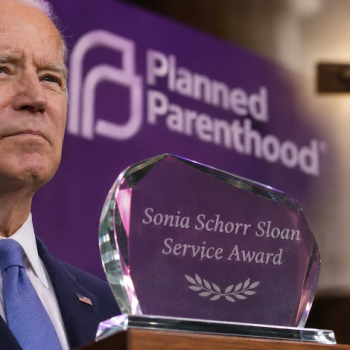
Catholic Biden Received An Abortion Award: My Thoughts
TRENDING AT PATHEOS Catholic

For many years, Catholicism has been caught up in division over the...

'Statements of Faith' never get shorter
Nothing demonstrates a conservative commitment to faith and faithfulness like a "statement...

Michele's Reviews - Future Grace by John Piper
In God's Place, at God's Pace, by Future Grace Impatience is...

Bama Gramma's Blackout Christmas: the Power of Light...
Another Christmas Skit: I have an alter ego: Bama Gramma. She shows...

Thanksgiving as a Way of Life: A Christian...
Each year, Thanksgiving brings families and friends together to share meals, stories,...

Two Women Doctors Who Went Against the Current
Women physicians who transformed healthcare for "Indians" “I shall have an advantage...
view all Catholic blogs
What Are Your Thoughts?leave a comment
Ad-Free & Subscriber Log-In Subscription Support
- About Us
- 2026 Calendar
- Videos
- Podcasts
- Library of World Religions
- Faith In Media Tracker
- Advertise With Us
- Write for Us
- Privacy Policy
- Terms of Service
- Do Not Sell My Data
- Contact Us
- Radiant Digital
- Manage Newsletter Subscriptions
- Unsubscribe From Notifications
- Sitemap
Copyright 2008-2026, Patheos, part of the Radiant Digital network of media brands. All rights reserved.
Subscription Support Ad-Free & Subscriber Log-In
Follow Patheos