
BuddhistCatholicContemplativeEvangelicalGeneral ChristianHinduJewishLatter-day SaintMuslimNew VisionsProgressive Christian
Beliefs
- Buddhist
- Catholic
- Contemplative
- Evangelical
- General Christian
- Hindu
- Jewish
- Latter-day Saint
- More Voices
- Muslim
- New Visions
- Pagan
- Progressive Christian
Topics
- Religion News
- Food and Religion
- Sports and Religion
- Religious Art
- Religious Music and Entertainment
- Religious Events
- History and Religion
- Style and Religion
- Politics and Religion
- Women in Religion
- Recreation Outdoors and Religion
- Business Finance and Religion
- Careers Workplace and Religion
- Education and Religion
- Family Parenting and Religion
- Health Fitness and Religion
- Home and Religion
- Relationships and Religion
- Technology and Religion
- Travel and Religion
Columnists
- Buddhist Columnists
- Business Finance and Religion Columnists
- Careers Workplace and Religion Columnists
- Catholic Columnists
- Contemplative Columnists
- Education and Religion Columnists
- Evangelists Columnists
- Family Parenting and Religion Columnists
- General Christian Columnists
- Health Fitness and Religion Columnists
- Hindu Columnists
- History and Religion Columnists
- Home and Religion Columnists
- Jewish Columnists
- More Voices Columnists
- Latter Day Columnists
- Muslim Columnists
- New Visions Columnists
- Nonreligious Columnists
- Pagan Columnists
- Politics and Religion Columnists
- Progressive Columnists
- Recreation Outdoors and Religion Columnists
- Relationships and Religion Columnists
- Religion News Columnists
- Religious Art Columnists
- Religious Events Columnists
- Religious Music and Entertainment Columnists
- Sports and Religion Columnists
- Style and Religion Columnists
- Technology and Religion Columnists
- Travel and Religion Columnists
- Women in Religion Columnists
Resource Library
- 2026 Calendar
- Library of World Religions
- The 100 Most Holy Places on Earth
- Patheos Answers
- Podcasts
- Videos
- Faith Leaders Database
- Anglican Episcopalian
- Bahai
- Baptist
- Buddhism
- Christianity
- Confucianism
- Eastern Orthodoxy
- Hinduism
- Holiness and Pentecostal
- ISKCON
- Islam
- Judaism
- Lutheran
- Methodist
- The Church of Jesus Christ of Latter-day Saints
- New Age
- Paganism
- Presbytarian and Reformed
- Protestantism
- Religion Behind the Scenes
- Roman Catholic
- Scientology
- Shia Islam
- Sikhism
- Sufism
- Sunni Islam
- Taoism
- Zen
- See all religions
Research Tools
 Ad-Free & Subscriber Log-In Subscription Support
Ad-Free & Subscriber Log-In Subscription Support
Follow Patheos 

- Trending:
- Forgiveness
- |
- Marriage
- |
- Consciousness
- |
- Death Penalty
- |
- Election
- |
- Halloween

- Home
- Catholic
- Relationships and Religion
- God’s Delight: Why a Perfect God Made a World
God’s Delight: Why a Perfect God Made a World
Last updated on: August 30, 2026 at 9:40 pm by Dennis Knapp
God’s Delight: Why a Perfect God Made a World 2026-08-30T21:40:04-06:00 Dennis Knapp
Patheos Explore the world's faith through different perspectives on religion and spirituality! Patheos has the views of the prevalent religions and spiritualities of the world.
God’s Delight
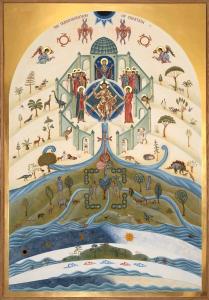
Image provided by guest writer.
Guest writer: Pilgrim.
May the LORD rejoice in his works. (Psalm 104:31)
The God Who Needs Nothing
Genesis does not open by explaining God. It opens with Him speaking, and the first thing said of what He makes is that it is good. Again and again the verdict comes. God saw that it was good. And at the end, complete. “God saw everything that he had made, and indeed, it was very good.” Before there is a doctrine of God, there is a Maker who looks at what He has made and delights in it.
The doctrine came later, worked out carefully because so much depended on getting it right. God is one, eternal, uncreated, all-powerful, all-knowing, all-loving, good beyond any goodness we can imagine. He is, in the old phrase, actus purus: no potential left unrealized, nothing in Him still waiting to become something else. Aquinas gave the classical formulation: in God, essence and existence are not two things. God is ipsum esse subsistens, subsistent Being itself. Everything else receives its being. God does not.
God does not need the world.
A creature moves because it seeks something it lacks. An animal eats because it is hungry. A plant reaches towards the light. A man builds because the rain would otherwise fall on him. Motion in a finite thing is almost always the closing of a gap. God has no gap to close. Nothing He does completes Him or diminishes Him.
So why is there anything?
I want to resist reaching for the word love too quickly. Love is where this will end up, but arriving there before the ground is laid only makes a true thing sound cheap. A being who lacks nothing has, on the face of it, no reason to make anything, unless making is not quite the right word for what He does.
The God Who Is Love
John begins his Gospel by echoing Genesis: in the beginning was the Word. Before there was a beginning for anything else, the Word already was, already with God, already God. Near the end of that same Gospel, at the Last Supper, Christ prays to the Father about a love that did not start with the world: “You loved me before the foundation of the world.” Whatever else that sentence means, it rules out one tempting answer to our question. God was not lonely before He made anything, because there was no before in which that love had not been given and received.
The doctrine of the Trinity is not a technicality added to monotheism. It is the reason the whole question of creation looks different for Christians than it does for traditions that share much else Christians believe about God.
Before there was a world, the Father eternally begets, loves and is loved by the Son. This is not a transaction across distance, unfolding in stages where something given is eventually handed back. It is the eternal giving of the whole fullness of divine life; a life the Son receives without remainder and possesses fully as His own. The Spirit is not the leftover warmth of that exchange, an atmosphere generated between two others. He proceeds eternally from that communion, as fully divine as the Father and the Son.
John’s first letter puts it plainly: God is love. Not: God became loving once there was something to love. God is love before any of that, which is why John can also say we love because He first loved us, and mean it about eternity, not just about us.
Creation, then, cannot be God filling a silence in Himself. There was no silence to fill.
The Gift of Being
This leaves the question sharper. A God who is, eternally, a communion of perfect love needs no audience, companion, or project. And yet Genesis says: let there be light. Something exists after that sentence that did not exist before it, and the difference is not that God has gained anything.
Augustine took a question that sounds childish, and it turned out to be exactly the right one. What was God doing before He made heaven and earth? There was no before, not in the sense of an empty stretch of time God let pass. Time itself is part of what was made. God does not wait through an eternity of nothing and then, one day, decide to act. God eternally wills the world’s existence, while the world He wills comes to be in time, because time itself is among the things willed.
Creation has a beginning. God does not.
Creation is God calling into existence what had no existence. That is what theologians mean by creatio ex nihilo, creation out of nothing, not God shaping some pre-existing material the way a sculptor works stone; there was, in the fullest sense, nothing there before He spoke.
And what He spoke into existence, He called good. Not useful. Not necessary. Good. The way a gift is good regardless of whether the giver needed to give it. Genesis says so seven times, the seventh without qualification: very good. The Psalmist takes the thought further than a bare verdict. May the LORD rejoice in his works, he writes, and Proverbs pictures Wisdom herself standing beside God at creation rejoicing in His world. Scripture does not ask us to infer that God delights in what He made. It tells us so, directly, before any philosopher builds an argument for why He must.
One caution. God’s delight is not like ours when we finally get something we lacked or wanted. If I delight in a garden, the garden gives me something I did not have before. God’s joy in creation adds nothing to God. The sun is not brighter for a window letting its light into a room; the room is what changes. Creation does not make God more glorious. It receives and reflects a glory that is entirely His.
God’s delight in creation is not a new feeling produced in Him by the world. He eternally knows and freely wills the goodness of what He makes.
What Creation Is For
If creation adds nothing to God, then its purpose cannot be to supply something He lacks. God is perfect and lacks nothing. Yet goodness is not something that needs to be hoarded. It gives itself. Creation is not necessary to God. It is a gift of His goodness, willed because He wills that something other than Himself should exist and share in the goodness He possesses perfectly.
God created to manifest and share His perfection.
Scripture tells us what that manifestation looks like. Creation is ordered toward God’s glory, receiving it, reflecting it, and making it visible. The heavens are telling the glory of God, says the Psalmist, and Paul will later say the same of the whole created order, that what can be known of God has been visible in what He has made since the world began. Elsewhere he compresses the whole movement into a single sentence: “For from him and through him and to him are all things.” Creation comes from God, exists through His sustaining will, and finds its fulfilment in Him.
Within that larger praise, human beings have a particular vocation. Made in God’s image, they are placed in a garden to tend it. The garden is received as gift and held as responsibility. Beyond stewardship lies something more intimate. Human beings are not spectators of God. We are made for communion with Him, to see Him face-to-face, to know and be known, to love and be loved.
Here Christianity makes a stranger claim about the Giver: the eternal Word took created human nature to Himself, remaining fully God without diminishment or division.
The World That Can Grow
To help fathom how a perfect God relates to a dynamic, unfinished world, it helps to step into a garden.
I have spent a good part of my life in gardens with soil under my fingernails, and most of my thinking about providence has happened there. I see gardening as working both with and against nature. A good gardener is never really fighting the garden. He is learning its ways.
Ivy is a simple example. It clothes bare stone and stays green through winter, but left unchecked, it smothers other life and damages the wall beneath it. You cut it back not to destroy it, but to keep its vitality from becoming destructive.
So too with a rose. You prune the bush you love because you are looking for the flower it is capable of bearing, not just the raw growth it produces. There is a quiet satisfaction in the first bloom after a hard prune. It isn’t a side effect of gardening; it is the point.
A gardener does not make ivy or a rose. He clears ground, feeds soil, and waits, sometimes for years, for something he cannot manufacture and can only encourage. Little worth having in a garden arrives ready-made. He works with a plant’s own nature, tending and pruning, rather than just against it.
This is a poor image for creation out of nothing, since a gardener always starts with soil someone else provided. It belongs to what theologians call secondary causality: the ordinary way God brings a creature to its own fulfilment through the powers He has already given it, working with and through a nature rather than overriding it. It says nothing about the deeper act by which that nature, and the ground it grows in, exist rather than not.
It is a good image for what God does with what He has made exist. He cultivates a living thing, giving it room to become what it was made to be. Watch a garden long enough, and you notice things arriving that were never quite part of the plan. Birds come because a flourishing garden becomes the kind of place life wants to inhabit. It gives more than was put into it, and no gardener minds. The surplus is the pleasure.
This helps us see one reason why God made a world with matter, time, freedom, and growth, rather than a world of finished statues. Statues cannot fail to grow, or grow crooked, or grow toward the wrong light, but neither can they receive, respond, or love. Freedom is what makes communion possible rather than mere compliance.
Freedom was given for the good, with grace enough to help the creature toward it. It was never a bare power to choose equally between good and evil. Its fullest exercise is the joyful choice of God, which is why the saints in heaven, where falling away is no longer possible, are the freest of all. Communion is the end for which He made creatures able to receive it, wanting nothing back from the sharing.
A world that can grow is also, necessarily, a world that can grow wrong. That was never a cost extracted from God, some fee He had no choice but to pay for the world He wanted. He permitted the possibility of refusal without willing the refusal itself, and what He draws from the wound is a good that we could not have imagined before the wound existed. That is not because the wound was needed, or the refusal in any sense good. Sin was never necessary, and God never willed it, only permitted it as the risk real freedom carries.
The Wound
Growth that can go right can also go wrong, and Genesis does not wait long to show us.
The man and woman in the first garden were endowed with freedom, and given the grace necessary to remain faithful, though they had not yet reached the final confirmation in holiness that belongs to glory. They used that freedom to refuse the Giver rather than trust Him.
What follows is the possibility that genuine freedom carries.
This is not the place to work out what that refusal cost, or how it was answered. It is enough here to say that the wound is real, that creation itself groans under it, in Paul’s own words, waiting to be set free, and that a God Who delighted in what He made did not, on account of the wound, stop delighting in it or walk away. He did something stranger.
The Gardener Enters His Garden
The Word through whom all things were made did not stay outside what He had made. The One who entered creation to heal what had been wounded is the same One through whom all things were made and for whom they were made. He became flesh and dwelt among us, taking created human nature to Himself.
The Creator entered the garden He tended.
What that entry cost Him, and what it accomplished, is the reason God’s original delight in creation was never a delight He later withdrew.
The Harvest
Genesis moves from creation into a garden: a tree, a river, humanity living in God’s presence. Revelation closes in a garden-city: a river, a tree bearing fruit on either bank, God dwelling among His people never to leave. Eden’s own vocabulary is carried all the way to the end and flowers into something larger. The garden does not disappear from the story. It becomes a city without ceasing to be a garden.
Genesis gives us God walking in the garden in the cool of the day. In another garden, Gethsemane, He prayed the Agony to its end. Soon after, He wore a crown of thorns. He was executed, and on the third day He rose, and again walked in a garden, where the first person to see Him mistook Him for exactly what He had always been.
She saw more truly than she knew.
We are told that the story ends with God dwelling among His people in a city that always remained a garden. The distance between Eden and the New Jerusalem is the whole of it. He rejoices in the goodness that survives the wound, and in the mercy that meets it, never in the wound itself. Not a God who needed a world, but a God Who freely willed one and has not, since the first morning, let go of His delight.
References
Catechism of the Catholic Church: CCC 1–2, 27; 293–294; 295, 317; 306; 385–412; 460; 1721.
Augustine, Confessions (XI.12–13).
Maximus the Confessor, Ambigua 7 (PG 91).
Thomas Aquinas, Summa Theologiae (I, q. 3, a. 4).
Athanasius, On the Incarnation of the Word (54.3).
Thank you!
If you liked this article, please leave your comments below. I am very interested in your opinion on this topic.
Read The Latin Right’s other writing here.
Please visit my Facebook page and IM your questions (and follow my page) or topics for articles you would like covered.
Relationships and Religion
Previous Post

August 26, 2026
Whose Vision of Human Flourishing Reflects The Common Good?
Next Post

September 1, 2026 The Suggestive Power of “Perhaps”
Recent Comments
"My honest take? I think St John Paul II was adamant that on his watch, ..."
Amoris Laetitia Deserves a Better Defence
""It's reasonable to ask what those claims mean in practice."It is. And I've laid out ..."
Amoris Laetitia Deserves a Better Defence
"I've said what I said, Peter. Read the words. If you don't have anything new ..."
Amoris Laetitia Deserves a Better Defence
"I don't expect you to decide who should be admitted to the sacraments. I'm asking ..."
Amoris Laetitia Deserves a Better Defence
Browse Our Archives
Select a Category Abortion Arius Atheists Catholic Apologetics Catholic Culture Catholic History Catholic Humor Catholic Poetry Catholic Politics Catholic Theology Dr. James White Faith Alone Joe Heschmeyer Kamala Harris Martin Luther Pope Francis Preborn Children President Biden Science and Catholicism Sola Scriptura Synod of Synodality Trinity
Select a Month October 2026 September 2026 August 2026 July 2026 June 2026 May 2026 April 2026 March 2026 February 2026 January 2026 December 2025 November 2025 October 2025 September 2025 August 2025 July 2025 June 2025 May 2025 April 2025 March 2025 February 2025 January 2025 December 2024 November 2024 October 2024 September 2024 August 2024 July 2024 June 2024 May 2024 April 2024 March 2024 February 2024 January 2024 December 2023 November 2023 October 2023 September 2023 August 2023 July 2023 June 2023 May 2023 April 2023 March 2023 February 2023 January 2023 December 2022 November 2022 October 2022 September 2022 August 2022 July 2022 June 2022 May 2022 April 2022 March 2022 February 2022 January 2022 December 2021 November 2021
Follow Us!
TAKE THE
Religious Wisdom Quiz
What does "Genesis" mean?
Select your answer to see how you score.
Poetry Wisdom Origin or Beginning Law
Related posts from The Latin Right

Amoris Laetitia Deserves a Better Defence

Rich Man, Poor Man: Altruism and Agency

The Order We Did Not Make: The World...

Is This “Culture War” Catholicism—or Evangelization?
TRENDING AT PATHEOS Catholic

The Sermon on the Mount, Part I: Matthew...
The Sermon on the Mount, Part I (Matthew 4:12-5:12) St. Matthew moves...

What's up from Crossway: Reviewing some of their latest A few weeks...

Janie Learns the Way of the Cross: A...
Teaching children about Jesus' Passion can be challenging. Many parents and educators...

Looking For Good Catholic Writing - October 2026
He alone extends the heavens, and he walks upon the waves of...

In "Irreplaceable," our book on vocation and technology, Trevor Sutton and I...

I was strolling through the top floor of the brand new Parthenon...
view all Catholic blogs
What Are Your Thoughts?leave a comment
Ad-Free & Subscriber Log-In Subscription Support
- About Us
- 2026 Calendar
- Videos
- Podcasts
- Library of World Religions
- Faith In Media Tracker
- Advertise With Us
- Write for Us
- Privacy Policy
- Terms of Service
- Do Not Sell My Data
- Contact Us
- Radiant Digital
- Manage Newsletter Subscriptions
- Unsubscribe From Notifications
- Sitemap
Copyright 2008-2026, Patheos. All rights reserved.
Subscription Support Ad-Free & Subscriber Log-In
Follow Patheos