
BuddhistCatholicContemplativeEvangelicalGeneral ChristianHinduJewishLatter-day SaintMuslimNew VisionsProgressive Christian
Beliefs
- Buddhist
- Catholic
- Contemplative
- Evangelical
- General Christian
- Hindu
- Jewish
- Latter-day Saint
- More Voices
- Muslim
- New Visions
- Pagan
- Progressive Christian
Topics
- Religion News
- Food and Religion
- Sports and Religion
- Religious Art
- Religious Music and Entertainment
- Religious Events
- History and Religion
- Style and Religion
- Politics and Religion
- Women in Religion
- Recreation Outdoors and Religion
- Business Finance and Religion
- Careers Workplace and Religion
- Education and Religion
- Family Parenting and Religion
- Health Fitness and Religion
- Home and Religion
- Relationships and Religion
- Technology and Religion
- Travel and Religion
Columnists
- Buddhist Columnists
- Business Finance and Religion Columnists
- Careers Workplace and Religion Columnists
- Catholic Columnists
- Contemplative Columnists
- Education and Religion Columnists
- Evangelists Columnists
- Family Parenting and Religion Columnists
- General Christian Columnists
- Health Fitness and Religion Columnists
- Hindu Columnists
- History and Religion Columnists
- Home and Religion Columnists
- Jewish Columnists
- More Voices Columnists
- Latter Day Columnists
- Muslim Columnists
- New Visions Columnists
- Nonreligious Columnists
- Pagan Columnists
- Politics and Religion Columnists
- Progressive Columnists
- Recreation Outdoors and Religion Columnists
- Relationships and Religion Columnists
- Religion News Columnists
- Religious Art Columnists
- Religious Events Columnists
- Religious Music and Entertainment Columnists
- Sports and Religion Columnists
- Style and Religion Columnists
- Technology and Religion Columnists
- Travel and Religion Columnists
- Women in Religion Columnists
Resource Library
- 2026 Calendar
- Library of World Religions
- The 100 Most Holy Places on Earth
- Patheos Answers
- Podcasts
- Videos
- Faith Leaders Database
- Anglican Episcopalian
- Bahai
- Baptist
- Buddhism
- Christianity
- Confucianism
- Eastern Orthodoxy
- Hinduism
- Holiness and Pentecostal
- ISKCON
- Islam
- Judaism
- Lutheran
- Methodist
- The Church of Jesus Christ of Latter-day Saints
- New Age
- Paganism
- Presbytarian and Reformed
- Protestantism
- Religion Behind the Scenes
- Roman Catholic
- Scientology
- Shia Islam
- Sikhism
- Sufism
- Sunni Islam
- Taoism
- Zen
- See all religions
Research Tools
 Ad-Free & Subscriber Log-In Subscription Support
Ad-Free & Subscriber Log-In Subscription Support
Follow Patheos 

- Trending:
- Forgiveness
- |
- Marriage
- |
- Consciousness
- |
- Death Penalty
- |
- Election
- |
- Halloween

- Home
- Catholic
- Family, Parenting and Religion
- When Pastoral Language Refuses to Answer
When Pastoral Language Refuses to Answer
Last updated on: July 3, 2026 at 12:49 pm by Dennis Knapp
When Pastoral Language Refuses to Answer 2026-07-03T12:49:49-06:00 Dennis Knapp
Patheos Explore the world's faith through different perspectives on religion and spirituality! Patheos has the views of the prevalent religions and spiritualities of the world.
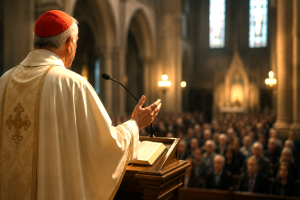
Image provided by guest author.
Guest writer: Pilgrim.
On the Rhetoric of Accompaniment
Introduction
There is an old parlour trick, beloved of diplomats and theologians alike. Ask whether the soup is too salty and receive, at generous length, a meditation on hospitality. The taste of the soup remains untouched.
Cardinal Timothy Radcliffe has elevated this into an art form. Ask him whether an act is licit, and he will tell you about friendship. He does not change the subject; he changes its register (from proposition to atmosphere) and trusts, correctly, that most of us will find the atmosphere so pleasant we forget we came in with a question.
Two documents make the case better than I could argue it cold: a homily preached in June at a Mass for two men marking fifty years together, and an essay on the Synod written for L’Osservatore Romano, in which the same manoeuvre is performed at greater length and, rather touchingly, with footnotes.
The Mass itself is worth a sentence or two, since two accounts posted on it could not agree on what kind of sentence to give it. On June 13th, at Holy Apostles Church in Pimlico, London, some hundred and fifty guests gathered for a “Mass of Thanksgiving for 50 Years of Friendship, Partnership, and Commitment in the Pursuit of Justice,” marking the golden anniversary of Julian Filochowski and Martin Pendergast; two men who met at a Catholic conference in 1976, entered a civil partnership in 2006, and were, on this occasion, formally blessed at the altar on the strength of their relationship’s anniversary.
It is worth noting that Fiducia Supplicans, the document usually cited to license such gestures, permits only spontaneous, non-liturgical blessings and excludes any blessing given in connection with a civil union’s anniversary; a distinction a scripted Mass of Thanksgiving does not obviously observe.
Cardinal Radcliffe concelebrated and preached. One outlet, sympathetic to the couple, reported the day as a triumph of pastoral tenderness over an older, harder Church. Another, reliably polemical on such matters, reported it as a scandal dressed in a chasuble. Both mistook the homily for the main event, though the homily is the more interesting because it refused to be either.
Exhibit A: The Homily That Answered Nobody’s Question
The homily is, on its own terms, lovely. Friendship, we are told, is not introverted; it is a sharing in the life of the Trinity; it anticipates the peace of God. All true, all traditional, all the kind of thing you could preach at a golden wedding, a religious profession, or the retirement of a much-loved schoolmaster, and nobody would blink.
The trouble is not what was said. The trouble is what the occasion required and never received. A few sentences would have done it. The assembled company had not gathered to celebrate the general proposition that friendship is good; a claim on which, I am reliably informed, the Church and the world are in complete agreement.
They had gathered for something rather more specific: to witness and bless the fiftieth anniversary of a named, civilly partnered same sex relationship. That is the soup. Nobody asked whether friendship as such was nourishing. The question hanging over the celebration was whether this friendship, instituted at a conference, sealed in a civil partnership, renewed at the altar with language about deepening a bond that unites, was of the kind the Church calls chaste, or the kind it does not.
The homily never acknowledges that the question exists. Instead, it performs a remarkable rhetorical substitution: the specific becomes the general; the general is treated with great eloquence; everyone leaves feeling answered although nobody has actually been told anything new. That is theology declining to inform, dressed as theology declining to speculate.
The Herbert McCabe Problem
Here is where the argument must slow down, because buried in the homily is a citation doing far more theological work than its brevity suggests, pressed into service for an argument it was never intended to support.
McCabe was answering a metaphysical question: how can God be the total cause of a creature’s existence and act without competing with that creature’s own freedom? He was not offering a theory of pastoral accompaniment.
The argument trades on a quiet equivocation. “God lets creatures be free” is a claim about metaphysics. “A Cardinal should therefore not say whether an act is sinful” is a claim about pastoral prudence, and it does not follow from the first claim any more than “God permits the rain to fall on the just and unjust” entails that a meteorologist should decline to say which way is north. McCabe was making a point about causation, not issuing a permission slip for silence.
It is a beautiful footnote in the wrong argument.
The irony is that the Church already possesses the vocabulary that would have made such honesty possible. Catholic moral theology distinguishes the moral disorder of an act from the will’s free turning from a known good. It also distinguishes both from personal culpability, which may be diminished by ignorance, fear, habit, or poor formation. A pastor can therefore name the first without pretending to judge the second or presume the third.
The homily proceeded as though those distinctions did not exist.
The pastoral dilemma was genuine. But it was also, to a considerable extent, self-created. Two bishops and a cardinal had agreed to participate in a public liturgical celebration whose very purpose invited the question the homily declined to address.
Exhibit B: The Same Trick, now with a Continent Attached
The second document is a different animal: a signed essay in the Vatican’s newspaper, written after the Synod on Synodality’s first assembly, at a moment when critics on several sides were asking loudly what, if anything, the whole three-year process had actually decided. Radcliffe’s answer, characteristically, is that the deciding was never the point; the Spirit works the way a seed does, quietly, underground, embarrassing anyone who expected a harvest by October.
It is a serious essay, ranging over friendship, clericalism, inculturation, and the Church’s reception of Aristotle, and it deserves to be read as such. It also takes up, in its central section, Fiducia Supplicans and the African bishops’ revolt against it.
The same manoeuvre appears again: the question is not answered here; it is relocated: from the register of truth to the register of process, from the moral status of an act to the pastoral texture of the conversation surrounding it. The migration is so smooth, so well-mannered, that one can read the whole essay and never notice the question left the room.
Identity itself, we are told, including sexual identity, is something the Christian must relativise, must “die to,” in favour of a deeper identity as a friend of God. It echoes St Paul: in Christ there is neither Jew nor Greek, and so on. But notice what the move accomplishes. Paul’s text relativises identities to insist that all are equally called to the same moral and sacramental life. The essay relativises identity to suggest that the moral evaluation of acts connected to that identity becomes somehow less urgent, or at least less discussable, than the shared journey of friendship in which everyone is walking.
The African bishops’ resistance to Fiducia Supplicans is handled the same way, treated almost entirely as a matter of cultural imposition and inadequate consultation, which it may well also be, while the question the bishops were actually pressing, namely whether the document was doctrinally sound, is allowed to recede into procedure.
Process becomes the answer to a question about truth. It is the soup and the hospitality, played out this time across a continent.
The Word “Development,” Doing Its Usual Work
The pattern appears again in the essay’s treatment of development. To be fair to the Cardinal, he does not claim the Church cannot change its mind about anything. Quite the opposite: the essay’s third movement is an explicit defence of doctrinal development, complete with Aquinas rediscovering Aristotle and the Church “dying” to inadequate understandings to enter more deeply into the mystery she has always professed. This is real Newman territory, and Newman is not an author a Catholic can dismiss lightly.
Doctrine develops. Newman insisted upon it. But development is not simply change; it is change continuous with what came before, corrigible against it, never simply its reversal. The essay invokes “development” warmly while giving us almost no criterion for recognising it. We are told the Church must be willing to abandon old ways of understanding, but not which understandings are historical and which are constitutive.
Applied to Aquinas rediscovering Aristotle, the word does real work. Applied, by implication, to whether the Church might one day bless what she has always called disordered, it is asked to do the same work on a case that has not remotely been shown to belong to the same family. Invoke development often enough, in contexts general enough, and it stops functioning as a criterion and starts functioning as a mood, exactly the issue this essay has been describing.
The trouble with an argument built this way is not that it is dishonest. It’s that it has the consistency of freshly made jelly: handsome on the plate, impossible to pin to the wall. Press on where, precisely, the boundary of legitimate development lies, and the shape dissolves and reforms somewhere else, still handsome, still unpinned.
Conclusion: A Style, not a Man
I raise all this not to convict a Cardinal of malice. I do not think he is lying, any more than the man discoursing on hospitality is lying about the soup. But because the pattern is not confined to Cardinals, or to this particular controversy, or even to progressives, whatever the comment-thread taxonomies suggest.
I have had this exact conversation, nearly word for word, with correspondents of impeccably orthodox self-description who, asked a plain question about church doctrine, culpability or grace, retreat into “lived experience,” “complexity,” or “imagination,” with the same fluency Radcliffe retreats into “friendship.”
The tell is always the same: a direct yes-or-no question is met with an unfalsifiable answer, moving, and about something slightly to the left of what was asked.
It is possible to build an entire theological style out of never quite being wrong, by the simple expedient of never quite answering.
The remedy isn’t harshness (not calling the man heterodox, or the Mass sacrilegious, or reaching for the nearest available saint’s feast day as an ironic cudgel); that is simply hospitality’s opposite number, equally allergic to the plain question, just louder about it.
The remedy is smaller, and I suspect more annoying to everyone involved: to notice, gently and repeatedly, when the soup has gone unaddressed, and to keep asking about the soup.
Somewhere underneath all our processes and our beautifully theorised accompaniment, there remains a very old and very unfashionable Catholic conviction that some questions have answers, that the answers are occasionally yes or no, and that a Church which has forgotten how to say either has not thereby become more merciful. It has only become better at accompaniment than at witness.
References
New Ways Ministry, Gay Men’s 50 Years of Partnership Celebrated with Catholic Mass (1st July 2026)
L’Osservatore Romano, Lo spirito del Sinodo e l’ecclesiologia dei cappelli (12 October, 2024)
Thank you!
If you liked this article, please leave your comments below. I am very interested in your opinion on this topic.
Read The Latin Right’s other writing here.
Please visit my Facebook page and IM your questions (and follow my page) or topics for articles you would like covered.
Progressive Christian
Family, Parenting and Religion
Previous Post

June 30, 2026
Don't Misinterpret the Bereans: Berean Principle Reexamined
Next Post

July 5, 2026 Accompanying the Greedy: A Pastoral Reflection
Recent Comments
""It's reasonable to ask what those claims mean in practice."It is. And I've laid out ..."
Amoris Laetitia Deserves a Better Defence
"I've said what I said, Peter. Read the words. If you don't have anything new ..."
Amoris Laetitia Deserves a Better Defence
"I don't expect you to decide who should be admitted to the sacraments. I'm asking ..."
Amoris Laetitia Deserves a Better Defence
"But is that how you see it, Todd? You initially offered “salvation is more important ..."
Amoris Laetitia Deserves a Better Defence
Browse Our Archives
Select a Category Abortion Arius Atheists Catholic Apologetics Catholic Culture Catholic History Catholic Humor Catholic Poetry Catholic Politics Catholic Theology Dr. James White Faith Alone Joe Heschmeyer Kamala Harris Martin Luther Pope Francis Preborn Children President Biden Science and Catholicism Sola Scriptura Synod of Synodality Trinity
Select a Month October 2026 September 2026 August 2026 July 2026 June 2026 May 2026 April 2026 March 2026 February 2026 January 2026 December 2025 November 2025 October 2025 September 2025 August 2025 July 2025 June 2025 May 2025 April 2025 March 2025 February 2025 January 2025 December 2024 November 2024 October 2024 September 2024 August 2024 July 2024 June 2024 May 2024 April 2024 March 2024 February 2024 January 2024 December 2023 November 2023 October 2023 September 2023 August 2023 July 2023 June 2023 May 2023 April 2023 March 2023 February 2023 January 2023 December 2022 November 2022 October 2022 September 2022 August 2022 July 2022 June 2022 May 2022 April 2022 March 2022 February 2022 January 2022 December 2021 November 2021
Follow Us!
TAKE THE
Religious Wisdom Quiz
I am twelve stones taken from a riverbed and set up as a memorial to a miraculous crossing. What am I?
Select your answer to see how you score.
The Stones of remembrance Bethel Altar stones The memorial stones
Related posts from The Latin Right

Amoris Laetitia Deserves a Better Defence

Rich Man, Poor Man: Altruism and Agency

The Order We Did Not Make: The World...

The Poor Have Rights—and Responsibilities
TRENDING AT PATHEOS Catholic

In "Irreplaceable," our book on vocation and technology, Trevor Sutton and I...

I was strolling through the top floor of the brand new Parthenon...

What Does Gêvâh Mean For Kimberley Guifoyle &...
This week, a lot of the news is focused on Kimberly Guilfoyle....

INNER CIRCLE: Profound Mystery (Of Christ In All...
Ephesians 5:31-32 “For this reason, a man will leave his father and...

Do Not Rejoice When Your Enemy Falls: The...
Turning an execution into a public spectacle is a disturbing expression of...

'The Chosen' S6 Trailer: The Passion Gets Very...
Not many watching 'The Chosen' worry about spoilers, but just because they...
view all Catholic blogs
What Are Your Thoughts?leave a comment
Ad-Free & Subscriber Log-In Subscription Support
- About Us
- 2026 Calendar
- Videos
- Podcasts
- Library of World Religions
- Faith In Media Tracker
- Advertise With Us
- Write for Us
- Privacy Policy
- Terms of Service
- Do Not Sell My Data
- Contact Us
- Radiant Digital
- Manage Newsletter Subscriptions
- Unsubscribe From Notifications
- Sitemap
Copyright 2008-2026, Patheos. All rights reserved.
Subscription Support Ad-Free & Subscriber Log-In
Follow Patheos