
BuddhistCatholicContemplativeEvangelicalGeneral ChristianHinduJewishLatter-day SaintMuslimNew VisionsProgressive Christian
Beliefs
- Buddhist
- Catholic
- Contemplative
- Evangelical
- General Christian
- Hindu
- Jewish
- Latter-day Saint
- More Voices
- Muslim
- New Visions
- Pagan
- Progressive Christian
Topics
- Religion News
- Food and Religion
- Sports and Religion
- Religious Art
- Religious Music and Entertainment
- Religious Events
- History and Religion
- Style and Religion
- Politics and Religion
- Women in Religion
- Recreation Outdoors and Religion
- Business Finance and Religion
- Careers Workplace and Religion
- Education and Religion
- Family Parenting and Religion
- Health Fitness and Religion
- Home and Religion
- Relationships and Religion
- Technology and Religion
- Travel and Religion
Columnists
- Buddhist Columnists
- Business Finance and Religion Columnists
- Careers Workplace and Religion Columnists
- Catholic Columnists
- Contemplative Columnists
- Education and Religion Columnists
- Evangelists Columnists
- Family Parenting and Religion Columnists
- General Christian Columnists
- Health Fitness and Religion Columnists
- Hindu Columnists
- History and Religion Columnists
- Home and Religion Columnists
- Jewish Columnists
- More Voices Columnists
- Latter Day Columnists
- Muslim Columnists
- New Visions Columnists
- Nonreligious Columnists
- Pagan Columnists
- Politics and Religion Columnists
- Progressive Columnists
- Recreation Outdoors and Religion Columnists
- Relationships and Religion Columnists
- Religion News Columnists
- Religious Art Columnists
- Religious Events Columnists
- Religious Music and Entertainment Columnists
- Sports and Religion Columnists
- Style and Religion Columnists
- Technology and Religion Columnists
- Travel and Religion Columnists
- Women in Religion Columnists
Resource Library
- 2026 Calendar
- Library of World Religions
- The 100 Most Holy Places on Earth
- Patheos Answers
- Podcasts
- Videos
- Faith Leaders Database
- Anglican Episcopalian
- Bahai
- Baptist
- Buddhism
- Christianity
- Confucianism
- Eastern Orthodoxy
- Hinduism
- Holiness and Pentecostal
- ISKCON
- Islam
- Judaism
- Lutheran
- Methodist
- The Church of Jesus Christ of Latter-day Saints
- New Age
- Paganism
- Presbytarian and Reformed
- Protestantism
- Religion Behind the Scenes
- Roman Catholic
- Scientology
- Shia Islam
- Sikhism
- Sufism
- Sunni Islam
- Taoism
- Zen
- See all religions
Research Tools
 Ad-Free & Subscriber Log-In Subscription Support
Follow Patheos 

- Trending:
- Advent
- |
- Forgiveness
- |
- Thanksgiving
- |
- Election
- |
- Seasonal Holidays
- |
- Marriage

- Home
- Catholic
- History and Religion
- A Christian Theodicy: The Wound and the Crown
A Christian Theodicy: The Wound and the Crown
Last updated on: July 31, 2026 at 7:08 am by Dennis Knapp
A Christian Theodicy: The Wound and the Crown 2026-07-31T07:08:32-06:00 Dennis Knapp
Patheos Explore the world's faith through different perspectives on religion and spirituality! Patheos has the views of the prevalent religions and spiritualities of the world.
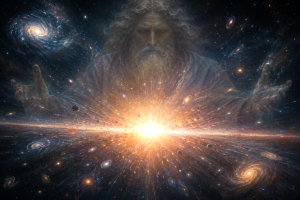
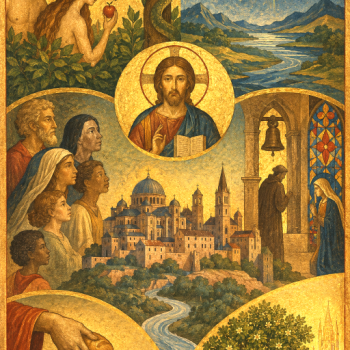
Image provided by guest author.
Guest writer: Pilgrim.
Preface
This is the first of two essays that are not an attempt to explain evil away, or to reduce providence to a formula that removes the mystery from it. They are an invitation to consider how a good God can create a world with a genuine wound in it, and govern that world without either overriding its freedom or abandoning it to itself.
Opening: The Wrong Question
Ask many people why a good God permits evil, and they will answer as though the question had only one possible form. God could have made a perfect world. This world is not perfect, so something has gone wrong.
That assumption needs to be examined before we accept it. It suggests an answer to a prior question none of us voiced: what sort of creation would a good God make in the first place? A finished world that later broke? Or a world still on its way to the glory for which it was made?
We should admit, before going further, that not every “why” receives an answer. Job asked this question in its oldest form and was answered with a whirlwind, a vision of things too vast and too strange for him to understand. We inherit the same limit. What follows offers a shape and a direction, though the mystery itself remains standing.
Within the Christian tradition, two great ways of imagining creation have developed. Their long conversation has more to teach us than either account taken alone. A later synthesis suggests these two visions need not be rivals.
Before asking why evil exists, we must first ask what sort of world God was creating.
Two Kinds of Lack
We start with a distinction more basic than any theology: not all absence is the same kind of absence.
An acorn, planted, lacks branches, bark, height, and the whole architecture of an oak. Nothing has gone wrong. It is exactly what an acorn is meant to be at this stage. Its lack is the shape of its becoming.
A branch snapped by a storm lacks the wholeness proper to a living oak. Here the lack is not a stage but a failure. The tree is now less than the kind of tree it should be, not on its way to becoming more.
Call the first kind “incompleteness”, and the second “woundedness”. They are not the same thing. An acorn is not a damaged oak. A wounded oak is not simply an oak that has not finished growing.
Confusing them creates a double error, and Christian thought has fallen into both. Treat every lack as woundedness, and growth itself starts to look like failure; a fall built into creation from its first page. Treat every lack as incompleteness, and real failure starts to look like just another stage on the way to something better, which is cold comfort to anyone standing within the wound. Keep the distinction, and each lack can be named for what it is, rather than flattened into whichever category happens to be theologically convenient.
The distinction, though, is conceptual rather than chronological. In the world we now inhabit, incompleteness and woundedness are already intertwined, and by the end of our enquiry we will return to this distinction and find that completion and healing finally belong together.
Two Great Christian Visions
Augustine and Irenaeus are usually presented as rivals. They are better understood as two witnesses answering different concerns. One of the richest expressions of their complementarity appears centuries later in Maximus the Confessor, whose vision of humanity’s vocation in Christ informs much of what follows.
Augustine asks why humanity is wounded. His answer runs through privation. Evil is not a thing in its own right but a corruption of some created good, a wound in something that was once whole. Adam’s fall wounds a creation already good, though not yet complete, and history becomes the long labour of restoring what was lost. Augustine’s gift to the tradition is his refusal to soften the wound into a mere stage. Evil is genuinely evil.
Irenaeus asks why creation is unfinished. His answer runs through growth. Adam was created not defective but capable of growth into the destiny prepared for him. From the beginning, both he and creation were called to full communion with God. History instead becomes the long labour of creation growing into that destiny. Irenaeus’s gift to Christianity is his refusal to treat creation’s becoming as a defect. Creation, on his account, was never intended to arrive complete on the first day. Paradise marked the beginning of humanity’s vocation. Our communion with God always lay beyond Eden’s innocence.
Irenaeus’s own argument, though, is more modest than the theodicy sometimes built on his name: a later, more systematic claim that suffering itself is necessary to forge virtue, without which souls remain shallow. Our debt is to the older, more modest Irenaeus: growth through communion, not suffering as a necessary curriculum; a travail to be redeemed, not a lesson to be learned.
Neither account, taken alone, covers all the evidence. Augustine’s account leaves difficult questions once suffering is recognised as preceding humanity itself, something we return to when evolution enters the picture. Irenaeus, taken alone, can drift toward treating tragedy as only an unfinished chapter, which is cold comfort at a graveside or hospital bed. Together they illuminate different dimensions of the same mystery.
Creation’s destiny was always glory. The wound belongs to the road, not the destination. The Christian tradition has often pictured that destiny as coronation, the fulfilment of what creation was always meant to become.
Development and Vocation
The harder question is why humanity’s incompleteness should differ from the acorn’s at all. An acorn cannot refuse to become an oak. Its becoming is written into it; it has no other way to go. Why should Adam’s incompleteness have been any different?
Adam’s becoming was not only developmental. It was vocational.
A vocation is a calling. It can be answered or refused. It does not exist because something is defective, but because something already good has been invited toward a greater good. Adam’s incompleteness was never a flaw awaiting correction. He was created good. It was a beginning awaiting an answer.
Answering, or refusing, requires a kind of creature the acorn is not: one that reasons and is free. This is what the language of the image of God was reaching for. Not just reason as a tool for survival, but reason and freedom together: the capacity to recognise a good and to choose it, or refuse.
The same conviction runs through later Catholic reflection on the human person as gift, called to give himself or herself freely rather than only to function. A creature’s dignity lies precisely in being able to answer a call rather than blindly execute a nature. The capacity to answer a vocation is not the same as its exercise. An infant, or a mind dimmed by age or disability, does not cease to bear the image of God because it cannot, for the moment, answer. The dignity lies in being addressable at all, not in the moment of the answer.
Every other creature develops. Only a rational creature can be summoned, and only a summoned creature can assent or refuse. That is the line dividing Adam’s incompleteness from the acorn’s, and from every other creature. The Fall is best named as a refused vocation, humanity turning down a calling it might have kept.
This should not be understood as though the refusal were somehow scripted, a stage God’s plan required. Nothing about calling something a vocation makes its failure inevitable. The refusal was a real possibility, and it was genuinely taken. That is what makes it a fall rather than a stage, and Adam a creature rather than a mechanism.
Evolution and the Problem of Natural Evil
Evolution did not create the problem of natural evil. It exposed a hidden assumption in one particular way of telling the Christian story. That story assumes every natural process capable of causing suffering must trace back to a human crime that set it in motion. Yet, predation, disease, and extinction all precede any creature capable of committing that crime. Whatever explains them cannot simply be human guilt, since there was no human guilt yet to explain them.
Here Augustine is primarily answering the woundedness question, and natural evil, for the most part, is not that question. A world of change is, by its nature, a world of decay; a world with real causes of its own is one in which some of those causes will fail, collide, and consume one another. Aquinas saw something important here: a universe of genuine secondary causes is one where things truly act and are acted upon rather than puppets moved directly by the divine hand. Such a universe more fully reflects the richness of creation, even though individual creatures within it will suffer and perish as a result.
A world with real weather has storms. A world with real causality has causes that fail.
Honesty requires marking the limit of this argument. That a world of real causes will include suffering is one claim; that it must include suffering of this severity is another. The first does not establish the second; a parasite that slowly consumes a living host from within seems built to fail cruelly. That gap is real. A fawn burned alive in a forest fire never had Adam’s vocation to betray.
This groaning, then, is not something the Fall caused, but neither is it something the Fall leaves untouched. Human refusal does not originate creation’s decay; that decay was already real, the shadow side of a world of genuine causes, before any human stood to refuse anything. But refusal adds its own grief, a further and distinct sorrow layered upon the world’s original suffering. The two griefs are related but not identical, and Augustine and Irenaeus answer to each in turn: Irenaeus to the groaning that was always there, Augustine to the grief human refusal has since added. In lived experience, though, the two are rarely so easily distinguished. The storm that destroys a home and the neighbour who refuses to help are felt as one weight, not two.
That does not require natural processes to be a punishment, only that they remain incomplete, not yet arrived, groaning rather than guilty.
None of this, though, makes the suffering weigh less. Removing guilt from predation and disease does not make them easier to bear, and nothing here claims that it does. Incompleteness explains why such pain exists in a world made by a good God without making God the author of evil or the accuser of its victims. It does not, on its own, make the agony good. That is exactly why Paul does not end with an explanation. He ends with a groan, and with the hope of being set free.
Romans 8 no longer needs to sound like collateral damage from a human crime. It can now be read as Paul presents it: creation awaiting its liberation.
Job asks the hardest question directly, and receives nothing like the explanation he sought. He receives a whirlwind, and page after page of creatures that seem to have no obvious bearing on his torment, but a vision of a world larger than the question he had brought to it. God asks where Job was when the foundations of the earth were laid, and Job discovers not that his question was wrong, but that it could not be answered from where he stood. God does not explain away the suffering; He leaves the mystery standing, and the Book of Job ends without resolving it.
Christian hope, however, does not end where Job ends. Paul’s groaning creation is no more explained than Job’s pain. But the New Testament refuses to leave the groan in the whirlwind. It gives it a direction.
One question remains. If natural suffering predates humanity and owes nothing to human sin, why does Paul say creation waits on humanity at all, rather than simply on its own unfolding?
Christ and Recapitulation
Paul calls Christ the “last Adam”. Where the first Adam was called and refused, the last Adam was called and answered, all the way, including when the calling cost Him everything.
The refusal in the Garden was never simply the breaking of a rule, as though Adam’s sin were a technical infraction requiring a technical remedy. It was the failure of humanity to become what it had been called to become: to trust rather than grasp, to answer a gift with a gift rather than with suspicion. Christ’s obedience then, embraced in another Garden, is not just compensation offered to balance an account. It is humanity finally reaching, in Him, the vocation it had been offered from the beginning and had failed to fulfil.
This obedience is not offered from outside suffering. Christ does not complete the vocation Adam left unanswered from a safe distance above it; He completes it from within the very condition Adam’s refusal left behind: subject to decay, to abandonment, and to a death He did not deserve. The cry from the cross, “Why have you forsaken me?”, is not staged. It is asked from the heart of the very darkness creation has been groaning under since before Adam existed. God does not survey the groan and pronounce it finished. In the human nature He assumed, God enters it and is forsaken within it, so that the cry is no longer creation’s alone to carry. This is solidarity. The Word does not cease to be God in taking up a nature that can suffer. He does suffer. He is forsaken.
But solidarity alone would be companionship in the wound, not its healing. Something more than presence has to be true of this suffering if it is to close the gap Adam left open.
The wound heals not through a separate act of reparation, but because humanity’s calling is at last realised in Christ. The wound exists because that vocation remained unanswered. In Him, all things are brought together, and humanity is restored to what it was meant to become. In Christ, healing finds its completion.
Here our opening distinction finally resolves: healing and completion prove to be a single act, not two.
The shape of the refusal and the shape of the answer are mirror images of one another, and Paul draws the mirror himself. The serpent promised that eating the fruit would make Adam and Eve like God: godhood seized on their own terms, grasped at rather than given. Paul’s hymn in Philippians says the opposite about Christ. Though He was in the form of God, He did not count equality with God something to be grasped, but emptied Himself and became obedient.
Adam, already given likeness to God as a gift, reached to seize it as possession. Christ, already possessing the equality Adam reached for, received His mission as gift, even to death. One is the story of a hand closing around a gift as though it were a possession. The other is the story of a hand opening to receive what can only ever be given. Christ’s obedience does more than cancel Adam’s disobedience. It fulfils Adam’s vocation. Reception. Gift met with gift.
Adam’s calling, though, was never simply individual. Humanity stood within creation as its representative, not because creation was otherwise silent. The Psalms already summon sun and moon, mountains and seas to praise their Maker. Only a creature endowed with reason and freedom could knowingly receive creation as gift and return it in thanksgiving. The rest of creation glorifies God by being what it is; humanity alone can consciously offer creation back to its Creator in praise.
For this reason, a strand of Christian thought, running through the Greek Fathers, and above all Maximus the Confessor, speaks of Adam as priest before he is ruler, gathering creation, consciously and freely, into the praise its Maker is owed; the first labour of a City not yet built.
Creation’s waiting was never itself blameworthy. What Adam’s refusal left missing was the voice by which creation was to answer; the voice creation had been waiting to hear.
And because Adam’s calling was never only personal, neither is Christ’s answering of it. Paul does not stop at the redemption of persons. He goes on to creation itself, waiting, yearning, and now to be set free. Creation’s liberation belongs to the same recapitulating act by which humanity reaches its vocation. The one redemption unfolds at different scales. Humanity reaches what it was called to be. Creation, carried by humanity’s vocation from the beginning, reaches what it was always moving towards.
Augustine illuminates the wound. Irenaeus illuminates creation’s growth. The Cross reveals God’s solidarity within suffering, and the Resurrection opens creation’s hope. Together they form successive chapters in one drama, each answering a different question about the same mystery.
The mystery of evil is not resolved, nor does Christianity pretend that every “why” has been answered. What it claims instead is that the shape of redemption has been revealed, and that its ending allows the earlier chapters to be read aright.
The Christian answer to evil is therefore not a single explanation but a story whose parts become fully intelligible only when read together.
Conclusion: The Wound and the Crown
Return to the question we opened with: would a good God make a perfect world, or a world still becoming?
Christianity refuses the choice. Creation was truly unfinished. It was always moving towards its fulfilment. Humanity’s refusal introduced a genuine wound into that history, and Christ recapitulated what Adam left undone in the very act that completed humanity’s vocation.
God permits evil because He chose to create a world capable of genuine becoming and genuine freedom, not because evil is good, nor because any particular grief was ever willed for its own sake. Having freely chosen this world, with its own order and history, divine wisdom orders that history not by necessity but by what is fitting. God does not abandon it when evil enters; He redeems it from within, remaining faithful to the work of His own hands.
The Crown is the fulfilment for which creation was always destined. It does not erase the wound. It transfigures it, not because the wound was ever necessary, but because redemption perfects history rather than abolishing it.
Scripture is precise about the difference. The risen Christ does not appear scar-free. He shows Thomas His hands and His side, and invites a finger into the wound itself. The wounds are not hidden as an embarrassment to glory; they are carried into glory as its most eloquent witnesses. That is what it means for the Crown to transfigure the wound rather than erase it: not a glory that pretends the wound never happened, but a glory great enough to hold the wound within itself and still be glory.
It is the destiny towards which creation was always ordered, reached at last through a refusal answered by obedience: a creation wounded by grasping, restored through receiving, and brought in Christ to the glory for which it was made.
Scripture itself preserves that pattern. It begins in a Garden where a gift was seized like a possession and ends in a City where every gift is finally received in thanksgiving, and God is all in all.
Sources and Further Reading
Scripture: Genesis 1–3; Job 38–42; Romans 5 and 8; Philippians 2; Colossians 1; John 20.
Augustine, Enchiridion on Faith, Hope, and Charity (especially on evil as privation).
Thomas Aquinas, Summa Theologiae, Part I, questions 47–48 (on creation and the nature of evil).
Thank you!
If you liked this article, please leave your comments below. I am very interested in your opinion on this topic.
Read The Latin Right’s other writing here.
Please visit my Facebook page and IM your questions (and follow my page) or topics for articles you would like covered.
History and Religion
Previous Post

July 28, 2026
Can You Pass the $10 Test for the Common Good?
Next Post
August 3, 2026 If God Is Good, Why Evil? A Composer and His Score
Recent Comments
"You sort of reference it above, but Christianity is a relatively flexible religion, able to ..."
The West’s Christian Moral Inheritance: A ..."
""In a book called The Ancient Civilizations of Peru you read that 'The Inca state ..."
The West’s Christian Moral Inheritance: A ..."
""Do the things other people want to do with your body. Don't make your own ..."
Why Is Abortion a Lost Cause ..."
"Actually there is a perfectly pure solution. Don’t kill your children. Don’t engage in procreative ..."
Why Is Abortion a Lost Cause ..."
Browse Our Archives
Select a Category Abortion Arius Atheists Catholic Apologetics Catholic Culture Catholic History Catholic Humor Catholic Poetry Catholic Politics Catholic Theology Dr. James White Faith Alone Joe Heschmeyer Kamala Harris Martin Luther Pope Francis Preborn Children President Biden Science and Catholicism Sola Scriptura Synod of Synodality Trinity
Select a Month November 2026 October 2026 September 2026 August 2026 July 2026 June 2026 May 2026 April 2026 March 2026 February 2026 January 2026 December 2025 November 2025 October 2025 September 2025 August 2025 July 2025 June 2025 May 2025 April 2025 March 2025 February 2025 January 2025 December 2024 November 2024 October 2024 September 2024 August 2024 July 2024 June 2024 May 2024 April 2024 March 2024 February 2024 January 2024 December 2023 November 2023 October 2023 September 2023 August 2023 July 2023 June 2023 May 2023 April 2023 March 2023 February 2023 January 2023 December 2022 November 2022 October 2022 September 2022 August 2022 July 2022 June 2022 May 2022 April 2022 March 2022 February 2022 January 2022 December 2021 November 2021
Follow Us!
TAKE THE
Religious Wisdom Quiz
What did the angel tell Mary she would name her son?
Select your answer to see how you score.
John Immanuel Jesus Peter
Related posts from The Latin Right
The West's Christian Moral Inheritance: A Legacy Denied
Pope Leo in Lima: The Speech That Inconveniences...
Will God Raise Us as We Are or...
TRENDING AT PATHEOS Catholic

For many years, Catholicism has been caught up in division over the...

'Statements of Faith' never get shorter
Nothing demonstrates a conservative commitment to faith and faithfulness like a "statement...

Michele's Reviews - Future Grace by John Piper
In God's Place, at God's Pace, by Future Grace Impatience is...

Bama Gramma's Blackout Christmas: the Power of Light...
Another Christmas Skit: I have an alter ego: Bama Gramma. She shows...

Thanksgiving as a Way of Life: A Christian...
Each year, Thanksgiving brings families and friends together to share meals, stories,...

Two Women Doctors Who Went Against the Current
Women physicians who transformed healthcare for "Indians" “I shall have an advantage...
view all Catholic blogs
What Are Your Thoughts?leave a comment
Ad-Free & Subscriber Log-In Subscription Support
- About Us
- 2026 Calendar
- Videos
- Podcasts
- Library of World Religions
- Faith In Media Tracker
- Advertise With Us
- Write for Us
- Privacy Policy
- Terms of Service
- Do Not Sell My Data
- Contact Us
- Radiant Digital
- Manage Newsletter Subscriptions
- Unsubscribe From Notifications
- Sitemap
Copyright 2008-2026, Patheos, part of the Radiant Digital network of media brands. All rights reserved.
Subscription Support Ad-Free & Subscriber Log-In
Follow Patheos