
BuddhistCatholicContemplativeEvangelicalGeneral ChristianHinduJewishLatter-day SaintMuslimNew VisionsProgressive Christian
Beliefs
- Buddhist
- Catholic
- Contemplative
- Evangelical
- General Christian
- Hindu
- Jewish
- Latter-day Saint
- More Voices
- Muslim
- New Visions
- Pagan
- Progressive Christian
Topics
- Religion News
- Food and Religion
- Sports and Religion
- Religious Art
- Religious Music and Entertainment
- Religious Events
- History and Religion
- Style and Religion
- Politics and Religion
- Women in Religion
- Recreation Outdoors and Religion
- Business Finance and Religion
- Careers Workplace and Religion
- Education and Religion
- Family Parenting and Religion
- Health Fitness and Religion
- Home and Religion
- Relationships and Religion
- Technology and Religion
- Travel and Religion
Columnists
- Buddhist Columnists
- Business Finance and Religion Columnists
- Careers Workplace and Religion Columnists
- Catholic Columnists
- Contemplative Columnists
- Education and Religion Columnists
- Evangelists Columnists
- Family Parenting and Religion Columnists
- General Christian Columnists
- Health Fitness and Religion Columnists
- Hindu Columnists
- History and Religion Columnists
- Home and Religion Columnists
- Jewish Columnists
- More Voices Columnists
- Latter Day Columnists
- Muslim Columnists
- New Visions Columnists
- Nonreligious Columnists
- Pagan Columnists
- Politics and Religion Columnists
- Progressive Columnists
- Recreation Outdoors and Religion Columnists
- Relationships and Religion Columnists
- Religion News Columnists
- Religious Art Columnists
- Religious Events Columnists
- Religious Music and Entertainment Columnists
- Sports and Religion Columnists
- Style and Religion Columnists
- Technology and Religion Columnists
- Travel and Religion Columnists
- Women in Religion Columnists
Resource Library
- 2026 Calendar
- Library of World Religions
- The 100 Most Holy Places on Earth
- Patheos Answers
- Podcasts
- Videos
- Faith Leaders Database
- Anglican Episcopalian
- Bahai
- Baptist
- Buddhism
- Christianity
- Confucianism
- Eastern Orthodoxy
- Hinduism
- Holiness and Pentecostal
- ISKCON
- Islam
- Judaism
- Lutheran
- Methodist
- The Church of Jesus Christ of Latter-day Saints
- New Age
- Paganism
- Presbytarian and Reformed
- Protestantism
- Religion Behind the Scenes
- Roman Catholic
- Scientology
- Shia Islam
- Sikhism
- Sufism
- Sunni Islam
- Taoism
- Zen
- See all religions
Research Tools
 Ad-Free & Subscriber Log-In Subscription Support
Ad-Free & Subscriber Log-In Subscription Support
Follow Patheos 

- Trending:
- Forgiveness
- |
- Marriage
- |
- Consciousness
- |
- Death Penalty
- |
- Election
- |
- Halloween

- Home
- Catholic
- History and Religion
- The One Who Hears You Hears Me: First, Identify the Church
The One Who Hears You Hears Me: First, Identify the Church
Last updated on: June 17, 2026 at 2:11 pm by Dennis Knapp
The One Who Hears You Hears Me: First, Identify the Church 2026-06-17T14:11:16-06:00 Dennis Knapp
Patheos Explore the world's faith through different perspectives on religion and spirituality! Patheos has the views of the prevalent religions and spiritualities of the world.
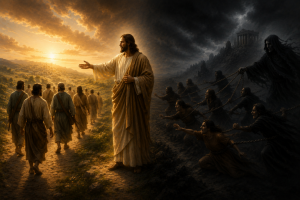
AI image created by author.
The one who hears you hears me, and the one who rejects you rejects me, and the one who rejects me rejects him who sent me. Luke 10:16
If a Christian friend and I disagree about the faith, why should I listen to him? Good intentions? Friendship? My friend may possess knowledge, training, or experience that makes him worthy of consideration. But should I wager my eternal soul on his expertise?
How do I know whether I hear Christ or reject Him? What about those I do not know personally? What about teachers who lived hundreds—or even thousands—of years ago? Why should I trust one voice over another?
St. Paul raises a similar question in his Letter to the Romans. He writes that people cannot believe unless they hear, cannot hear unless someone preaches, and cannot preach unless someone is sent (Romans 10:14–15). I want to hear and believe. But how do I know who is truly sent? How do I distinguish the messenger Christ commissions from the one who merely claims His authority?
Before I can answer questions about baptism, salvation, the Eucharist, or any other doctrine, I must answer a more fundamental question:
Who speaks for Christ?
To answer that question, I must first identify His Church.
Three Different Questions
Many debates about this topic confuse three distinct questions.
The Historical Question
- What did Christ establish?
- Did He found a visible Church?
- Did He leave behind a continuing authority?
The Epistemological Question
- How do I identify that authority today?
- How do I distinguish authentic apostolic teaching from competing claims?
The Theological Question
- What does Christianity teach about baptism, salvation, the Eucharist, authority, and morality?
These questions relate to one another, but they answer different problems. The historical and epistemological questions come first. Before I can ask what Christ’s Church teaches, I must first determine where Christ’s Church is. Before I can hear the witness, I must identify the witness.
Christ Established a Church Before He Left a New Testament
As previously noted, the biblical pattern begins with Christ, continues through His sent messengers, extends to the Church, and finally reaches believers. Christ established a visible Church and entrusted it to the apostles. He gave them a teaching mission, authority to govern, and the sacraments through which the faithful would receive His grace.
Notably, Christ did not leave behind a completed New Testament. Instead, He commissioned apostles to preach, teach, baptize, and make disciples of all nations. The New Testament would emerge from the life of the Church over the following decades as the apostles and their associates recorded Christ’s teachings and addressed the needs of the growing Christian communities.
For decades after the Ascension, Christians lived the faith without a completed New Testament canon. During this period, they baptized, celebrated the Eucharist, ordained clergy, settled disputes, and preserved the deposit of faith. Christians learned the faith through apostolic preaching and the life of the Church long before they possessed a universally recognized New Testament.
Historically speaking, the Church precedes the New Testament. Christ founded the Church first. The Church then proclaimed the Gospel, produced the New Testament writings, and eventually recognized the canon.
The Church as Guardian of Truth
Scripture presents the Church as far more than a mere collection of individual believers. Jesus meant what He said when He told His disciples, “He who hears you hears me” (Luke 10:16). Those whom Christ sends do not speak on their own authority; they speak in His name. Christ identifies His voice with the voice of those He commissions. He also assumes the existence of a visible authority capable of rendering judgment when disputes arise (Matthew 18:17).
One of the strongest passages supporting this understanding appears in 1 Timothy 3:15. There, St. Paul describes the Church as “the pillar and bulwark of the truth.” Some translations render the phrase “pillar and foundation of the truth,” but the point remains the same. The Church does not create truth. Rather, it preserves, protects, and proclaims the truth entrusted to it.
This verse directly supports my thesis. If the Church serves as the pillar and bulwark of the truth, then identifying that Church becomes essential. Before I can know what the Church teaches, I must first know which Church Paul describes. Before I can hear the witness, I must identify the witness.
Significantly, Paul does not describe individual Christians as the pillar and bulwark of the truth. He applies that role to the Church itself. If Christ entrusted His truth to the Church, then identifying that Church is not a distraction from the search for truth—it is an essential part of it.
The A.D. 180 Thought Experiment
Imagine you arrive in A.D. 180 through some strange twist of time. Fortunately, your study of the classics in college allows you to read and speak both Greek and Latin.
You travel throughout the Roman Empire and encounter various groups claiming to possess revealed Christian truth. You meet Gnostics, Marcionites, Montanists, and a host of other sectarian movements. You also encounter Christians who claim apostolic origin.
What is your first question?
It is not:
What does the Church teach?
You cannot ask that question yet because you do not know which group constitutes the Church.
Instead, you ask:
Which community preserves the apostolic faith?
Or:
Where is the Church founded by the apostles?
Only after you identify the apostolic Church can you ask what that Church teaches.
The order matters.
Before you evaluate the witness, you must identify the witness. Before you ask what the Church teaches, you must determine where the Church is.
Church first. Doctrine second.
The significance of Irenaeus’ argument lies not merely in apostolic doctrine but in apostolic continuity. He did not tell Christians to identify the true Church by comparing private interpretations of Scripture. He directed them to the churches founded by the apostles and to the bishops who succeeded them. In other words, he identified the Church historically before he defended it theologically.
The Early Church Used This Method
This method has historical precedent. St. Irenaeus (d. 191), bishop of Lyons in modern-day France, confronted the Gnostics using precisely this approach. Rather than beginning with a point-by-point refutation of Gnostic doctrine, he asked a more fundamental question: Which churches trace their teaching and bishops back to the apostles?
His argument was historical before it was theological. In Against Heresies, he presented his case as follows:
- Christ entrusted His teaching to the apostles.
- The apostles entrusted that teaching to their successors.
- The apostolic churches still exist.
- Therefore, those churches preserve apostolic doctrine.
St. Augustine employed a similar approach when confronting rival claimants to Christian truth. Rather than treating every competing group as equally credible, he pointed to the public, continuous, and universal character of the Catholic Church. In Against the Fundamental Epistle of Manichaeus, he writes:
And so, lastly, does the name itself of Catholic, which, not without reason, amid so many heresies, the Church has thus retained; so that, though all heretics wish to be called Catholics, yet when a stranger asks where the Catholic Church meets, no heretic will venture to point to his own chapel or house.
Augustine’s point is striking. When confronted with competing claimants, he first asks where the Catholic Church is. Only after identifying the Church does he address the claims of its rivals.
The early Church followed the same pattern. Christians first identified the apostolic Church and then received apostolic doctrine from it. They did not begin by assuming every claimant taught the truth and then compare doctrines in isolation. They first asked: Where is the Church founded by the apostles?
Final Thoughts… The Foundational Question
Just as in the days of St. Irenaeus and St. Augustine, the issue before us does not primarily concern what individual Christians believe. The issue concerns which Christians speak for Christ.
Whether in A.D. 40, A.D. 180, or A.D. 2026, the foundational question remains the same:
Who speaks for Christ?
That question is not primarily theological. It is historical and epistemological. Before I can determine what Christianity teaches, I must first determine who possesses the authority to teach it. Only after answering that question can I hope to resolve theological disputes.
Christ did not tell His followers, “He who hears himself hears Me.” He said:
“He who hears you hears Me.”
Before I can know whether I hear Christ, I must first identify the “you.”
Therefore, identifying Christ’s Church is not the end of the inquiry.
It is the beginning of it.
Thank you!
If you liked this article, please leave your comments below. I am very interested in your opinion on this topic.
Read The Latin Right’s other writing here.
Please visit my Facebook page and IM your questions (and follow my page) or topics for articles you would like covered.
Evangelical
History and Religion
Previous Post
June 15, 2026
The Grammar the Body Speaks
Next Post
June 18, 2026 The Grammar and the Wound: Truth and Pastoral Reckoning
Recent Comments
""It's reasonable to ask what those claims mean in practice."It is. And I've laid out ..."
Amoris Laetitia Deserves a Better Defence
"I've said what I said, Peter. Read the words. If you don't have anything new ..."
Amoris Laetitia Deserves a Better Defence
"I don't expect you to decide who should be admitted to the sacraments. I'm asking ..."
Amoris Laetitia Deserves a Better Defence
"But is that how you see it, Todd? You initially offered “salvation is more important ..."
Amoris Laetitia Deserves a Better Defence
Browse Our Archives
Select a Category Abortion Arius Atheists Catholic Apologetics Catholic Culture Catholic History Catholic Humor Catholic Poetry Catholic Politics Catholic Theology Dr. James White Faith Alone Joe Heschmeyer Kamala Harris Martin Luther Pope Francis Preborn Children President Biden Science and Catholicism Sola Scriptura Synod of Synodality Trinity
Select a Month October 2026 September 2026 August 2026 July 2026 June 2026 May 2026 April 2026 March 2026 February 2026 January 2026 December 2025 November 2025 October 2025 September 2025 August 2025 July 2025 June 2025 May 2025 April 2025 March 2025 February 2025 January 2025 December 2024 November 2024 October 2024 September 2024 August 2024 July 2024 June 2024 May 2024 April 2024 March 2024 February 2024 January 2024 December 2023 November 2023 October 2023 September 2023 August 2023 July 2023 June 2023 May 2023 April 2023 March 2023 February 2023 January 2023 December 2022 November 2022 October 2022 September 2022 August 2022 July 2022 June 2022 May 2022 April 2022 March 2022 February 2022 January 2022 December 2021 November 2021
Follow Us!
TAKE THE
Religious Wisdom Quiz
True or False: In Revelation, Satan is bound in the Abyss for 500 years.
Select your answer to see how you score.
TRUE FALSE
Related posts from The Latin Right

Amoris Laetitia Deserves a Better Defence

Rich Man, Poor Man: Altruism and Agency

The Order We Did Not Make: The World...

Is This “Culture War” Catholicism—or Evangelization?
TRENDING AT PATHEOS Catholic

In "Irreplaceable," our book on vocation and technology, Trevor Sutton and I...

I was strolling through the top floor of the brand new Parthenon...

What Does Gêvâh Mean For Kimberley Guifoyle &...
This week, a lot of the news is focused on Kimberly Guilfoyle....

INNER CIRCLE: Profound Mystery (Of Christ In All...
Ephesians 5:31-32 “For this reason, a man will leave his father and...

Do Not Rejoice When Your Enemy Falls: The...
Turning an execution into a public spectacle is a disturbing expression of...

'The Chosen' S6 Trailer: The Passion Gets Very...
Not many watching 'The Chosen' worry about spoilers, but just because they...
view all Catholic blogs
What Are Your Thoughts?leave a comment
Ad-Free & Subscriber Log-In Subscription Support
- About Us
- 2026 Calendar
- Videos
- Podcasts
- Library of World Religions
- Faith In Media Tracker
- Advertise With Us
- Write for Us
- Privacy Policy
- Terms of Service
- Do Not Sell My Data
- Contact Us
- Radiant Digital
- Manage Newsletter Subscriptions
- Unsubscribe From Notifications
- Sitemap
Copyright 2008-2026, Patheos. All rights reserved.
Subscription Support Ad-Free & Subscriber Log-In
Follow Patheos