
BuddhistCatholicContemplativeEvangelicalGeneral ChristianHinduJewishLatter-day SaintMuslimNew VisionsProgressive Christian
Beliefs
- Buddhist
- Catholic
- Contemplative
- Evangelical
- General Christian
- Hindu
- Jewish
- Latter-day Saint
- More Voices
- Muslim
- New Visions
- Pagan
- Progressive Christian
Topics
- Religion News
- Food and Religion
- Sports and Religion
- Religious Art
- Religious Music and Entertainment
- Religious Events
- History and Religion
- Style and Religion
- Politics and Religion
- Women in Religion
- Recreation Outdoors and Religion
- Business Finance and Religion
- Careers Workplace and Religion
- Education and Religion
- Family Parenting and Religion
- Health Fitness and Religion
- Home and Religion
- Relationships and Religion
- Technology and Religion
- Travel and Religion
Columnists
- Buddhist Columnists
- Business Finance and Religion Columnists
- Careers Workplace and Religion Columnists
- Catholic Columnists
- Contemplative Columnists
- Education and Religion Columnists
- Evangelists Columnists
- Family Parenting and Religion Columnists
- General Christian Columnists
- Health Fitness and Religion Columnists
- Hindu Columnists
- History and Religion Columnists
- Home and Religion Columnists
- Jewish Columnists
- More Voices Columnists
- Latter Day Columnists
- Muslim Columnists
- New Visions Columnists
- Nonreligious Columnists
- Pagan Columnists
- Politics and Religion Columnists
- Progressive Columnists
- Recreation Outdoors and Religion Columnists
- Relationships and Religion Columnists
- Religion News Columnists
- Religious Art Columnists
- Religious Events Columnists
- Religious Music and Entertainment Columnists
- Sports and Religion Columnists
- Style and Religion Columnists
- Technology and Religion Columnists
- Travel and Religion Columnists
- Women in Religion Columnists
Resource Library
- 2026 Calendar
- Library of World Religions
- The 100 Most Holy Places on Earth
- Patheos Answers
- Podcasts
- Videos
- Faith Leaders Database
- Anglican Episcopalian
- Bahai
- Baptist
- Buddhism
- Christianity
- Confucianism
- Eastern Orthodoxy
- Hinduism
- Holiness and Pentecostal
- ISKCON
- Islam
- Judaism
- Lutheran
- Methodist
- The Church of Jesus Christ of Latter-day Saints
- New Age
- Paganism
- Presbytarian and Reformed
- Protestantism
- Religion Behind the Scenes
- Roman Catholic
- Scientology
- Shia Islam
- Sikhism
- Sufism
- Sunni Islam
- Taoism
- Zen
- See all religions
Research Tools
 Ad-Free & Subscriber Log-In Subscription Support
Ad-Free & Subscriber Log-In Subscription Support
Follow Patheos 

- Trending:
- Forgiveness
- |
- Marriage
- |
- Consciousness
- |
- Death Penalty
- |
- Election
- |
- Halloween

- Home
- Catholic
- Relationships and Religion
- The Grammar the Body Speaks
The Grammar the Body Speaks
Last updated on: June 22, 2026 at 9:34 am by Dennis Knapp
The Grammar the Body Speaks 2026-06-22T09:34:47-06:00 Dennis Knapp
Patheos Explore the world's faith through different perspectives on religion and spirituality! Patheos has the views of the prevalent religions and spiritualities of the world.
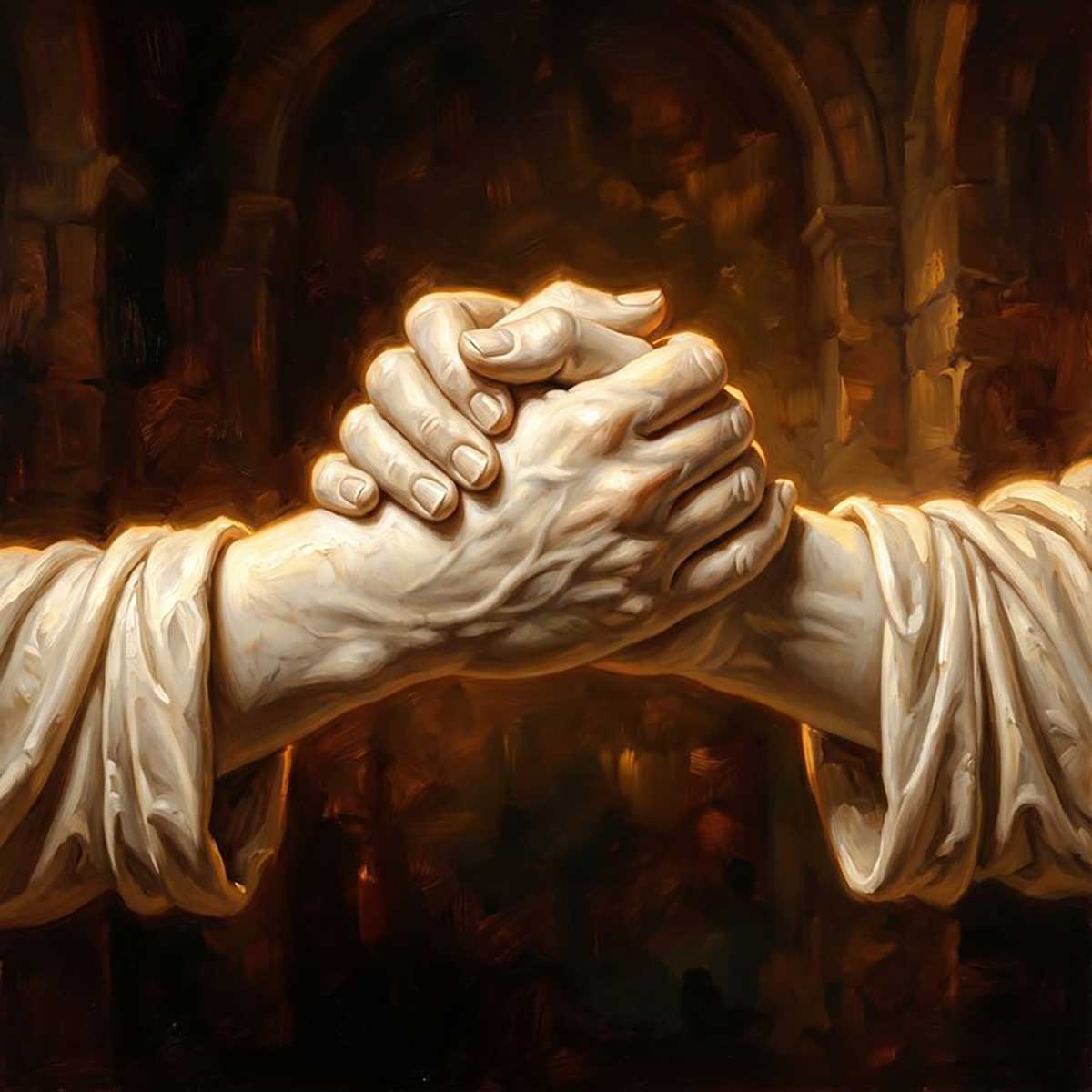
It is to say that those entrusted with handing on the grammar sometimes failed in their pastoral obligations, and that those failures are part of the story the Church must tell honestly if it is to be believed. | Image created in Gemini for Patheos.
Scripture, Experience, and the Flesh
Introduction: The Question That Was Always There
There is a question underneath all the arguments about sexual ethics that the arguments themselves rarely reach. It is not about which acts are permissible, or whether circumstances alter moral judgment, or where the boundaries of conscience run in intimate life. These are not trivial questions, but they are downstream of a prior one that the twentieth century quietly stopped asking.
A Note from The Latin Right
Note: This is the second of three essays exploring different aspects of sexual morality and pastoral/sacramental recovery.
Guest writer: Pilgrim.
Read the First article in this series:
The Question That Quietly Disappeared About Contraception.
Read the third article in this series:
The Grammar and the Wound: Truth and Pastoral Reckoning
The prior question is this: what is a sexual act? Not what feelings accompany it, or what identities it expresses, but what kind of human act it actually is, what it means before anyone decides what to do with it.
This essay attempts to answer that question directly, beginning not with doctrine but with experience, not with rules but with the reality the rules were always trying to name, though answering the question is not yet the same as being able to live within it.
What the Body Already Says
The body has not forgotten what the mind has been persuaded to ignore. Before any tradition named it, before any revelation confirmed it, before any theology articulated it, the meaning was already there, registered in the structure of human experience with a persistence that no cultural pressure has managed to extinguish. The evidence is not theological. It is simply human.
Sex is not like other things. Most people sense this, including cultures that have never heard of covenant or sacrament, and including people who have rejected every tradition that claims to name what they are sensing. The evidence accumulates in experiences that were not expected to last. The way a song from three relationships ago still carries a specific weight. The way certain rooms or cities belong to someone who is no longer there. The way a subsequent relationship sometimes finds the previous one quietly occupying space that should by now be empty. Nobody says “I find you statistically compatible.” They say “forever.” They say “always.” They say “you are the only one.”
Consider jealousy. It is among the most universal and most violent of human emotions, and its existence is philosophically interesting. If sex were simply recreational, a pleasurable activity two people choose to share carrying no more inherent significance than tennis, jealousy would be as irrational as resenting a partner for playing tennis with someone else. But nobody experiences it that way. Jealousy operates as though something has been violated, something to which one had a claim deeper than preference. That sense of violation appears across cultures, across centuries, in people who have never heard a word about covenant or sacrament. It reveals, or at least strongly suggests at the level of lived experience, that human beings spontaneously experience sexual union as involving claims that go deeper than recreation, that even in cultures which officially deny objective meaning in sex, the emotional presupposition of that meaning persists. The body is registering what the culture has decided to ignore.
Consider heartbreak and the aspiration to permanence. When a serious sexual relationship ends, something specific happens that does not happen when other close relationships end, even ones involving comparable time, shared history, and genuine affection. The grief has a different texture, longer, less consolable, oriented toward a particular absence rather than loss in general. Friends are mourned; lovers leave a shape. That shape is the trace of a self-gift that strained toward permanence even when it did not achieve it, whose failure is experienced not as disappointment but as fracture. Something that was supposed to hold did not hold. The lover who says “forever” is not simply making a promise about future behaviour. They are making a claim about the nature of what is happening now, that the self-gift is total, that the beloved is not interchangeable with another equally suitable person. Eros naturally strains toward eternity, hence tragedy, hence the whole of poetic literature, art, and music about love.
Consider parenthood. Children transform the relationship to time, responsibility, and the future in a way elective consequences do not. They make the couple into something they were not, a family, a link in a chain, a place in a network of dependence extending backwards and forward through time. Even couples who do not have children carry this orientation in the structure of their union, an openness to a future that exceeds their own intentions, the recognition that their love is not sealed within itself but pointed outward toward what it might become. Love tends not only toward permanence but toward fruitfulness.
This grammar does not depend on modern romantic courtship. Whether couples arrive at union through romantic choice or family arrangement, the same patterns emerge, the same jealousy at betrayal, the same grief at loss, the same aspiration toward permanence and fruitfulness. Romantic love is one register of the grammar, not its source. The grammar is written into the structure of the act itself, which is why it persists across every culture that has tried to erase it, and why it announces itself in every generation that has tried to forget it.
The grammar applies to everyone, and its cost is unequally distributed. For those outside the one-flesh union, whether young, widowed, divorced, or single by circumstance, or those whose desires are not ordered toward that union, the tradition asks chastity: the integration of desire within a life ordered toward self-gift that is not genital. This is not a consolation prize. Celibacy, lived well, is a complete vocation, a form of total self-gift that images the Kingdom where there is no giving in marriage. Some of the most honest witnesses to what the tradition asks are people for whom it asks the most, not because the grammar targets them, but because their fidelity reveals what chastity means when it is not a temporary stage en route to something else.
Emotions are not the source of this meaning. They are its trace, the way embodied persons register something they have not chosen and cannot simply dismiss. The great traditions did not impose meaning on sex from outside. They noticed meaning that was already there, written into the body before the first word of scripture was spoken, legible in human experience before God called Abraham or gave the law to Moses. What revelation did was not invent the grammar but restore the capacity to read it clearly, to name what the body had never stopped saying, in a world that had largely stopped listening. But seeing this grammar is not yet the same as learning to live within it.
Scripture does not invent this grammar. It names what human experience had never stopped registering, and in naming it, restores the capacity to read it clearly.
In the Beginning: The Grammar Given
The opening chapters of Genesis are a theological reading of reality, an answer to the question of what kind of world this is and what kind of creatures inhabit it.
“In the image of God he created them; male and female he created them” (Genesis 1:27). The image of God is not exhausted by the isolated individual. Male and female together reveal something about the relational character of the image in a way that neither does alone. Sexual difference is not incidental to humanity. It is built into the structure of the imago Dei. The mandate follows immediately, “be fruitful and multiply” (Genesis 1:28). Fruitfulness is not an optional consequence of the union but part of what the image of God in the flesh is ordered toward: the couple’s participation in the ongoing act of creation, their love becoming generative in the world.
The second account moves from the structural to the relational. The man names the woman with the first human poetry in scripture, “bone of my bones, flesh of my flesh.” The narrative moves immediately to its theological interpretation, “therefore a man leaves his father and mother and cleaves to his wife, and they become one flesh” (Genesis 2:24). Sexual difference is ordered toward fruitful union; from that union the human story begins.
“They were both naked, and were not ashamed” (Genesis 2:25). This is not naivety. It is integrity, the condition in which the body’s meaning and the person’s meaning are fully aligned, in which the self-gift is genuinely total because nothing is held back or distorted. It is the condition of a love that has not yet learned to lie.
John Paul II called this the “nuptial meaning of the body.” The body, in its sexual differentiation, is ordered toward self-gift. Men and women do not simply complement each other biologically. They signify a communion. The body says: “I am made for you.” To see this is one thing; to have one’s desires and habits conformed to it is another.
Its deepest ground is not biology but theology. We are made in the image of the Trinitarian God, Father, Son, and Spirit, not a solitary self but a community of gift whose love overflows into life. The union of husband and wife, differentiated, complementary, open to life, images that Trinitarian reality in the flesh. This is why the two meanings of the sexual act, unitive and procreative, cannot be separated. Separate them, and the act no longer images what it was made to image, not just something about human love, but the God whose image human love reflects.
The Fall does not destroy this grammar. It disorders the reading of it. Shame enters not because the body becomes bad but because its meaning becomes obscured. Augustine called it curvatus in se, the soul curved inward on itself. The open, giving hand closes. And this is not only an error of perception but a deformation of desire itself, requiring more than correction to heal. Lust enters as the distortion of eros, not its replacement, the same energy, misdirected.
Shadow, Song, and Law: The Old Testament’s Sexual Imagination
The Old Testament does not leave the meaning of Genesis as an abstract principle. It shows what it looks like when lived, and what it becomes when refused.
The Song of Songs is in the canon not despite its frank eroticism but because of it. It does not mention marriage. It does not mention children. It does not argue for anything. It simply sings, desire as delight in the beloved person, ardent and exclusive, the lover longing for the one who cannot be replaced by any other. The Song presupposes what Genesis 2 names, that eros, when it is truly itself, tends toward exclusivity and permanence rather than variety and consumption. The allegorical reading, Israel and God, Christ and the Church, depends on the literal one. The image works only if the thing it images is real and good. Eros here is neither trivialised nor idolised. It is Genesis set to music.
The counter-images scattered through the Old Testament tell the same story in another key. The sexual failures are never only sexual. They are manifestations of a deeper pattern, the transformation of gift into possession, communion into consumption, the open hand into the closed fist. Again and again, desire becomes acquisitive rather than self-giving. David takes what is not his. Solomon multiplies wives as he multiplies horses and gold. The men of Sodom reduce persons to objects for appetite’s use. And the consequences are never private. Disorder in love becomes disorder in the household, the kingdom, and eventually the nation. Eros without form acquires civilisational weight.
The prophets name this with unusual clarity. Hosea does not simply compare covenant to marriage. God commands him to live the comparison, to marry a faithless wife and remain faithful to her, so that Israel might understand what their idolatry costs the God who chose them. Israel is the bride who has gone after other lovers, and what the prophets keep pressing is whether she will return to the one who first called her; yet recognition of that pattern does not itself restore fidelity to it.
Leviticus 18 presents the sexual laws as the definition of what Israel is not to be, what the surrounding nations did, and why the land vomited them out. Israel’s sexual discipline was covenantal pedagogy enacted in the body, shaping a people capable of carrying the image of God into a world that had forgotten what that image looks like.
From the Beginning: Christ and the Restoration
The Pharisees’ question about divorce is a test, and Christ’s answer refuses the terms of the test. They ask about the limits of Mosaic permission. He reaches behind Moses. “From the beginning it was not so” (Matthew 19:8). The standard is the creation order, the one-flesh union of Genesis 2:24, which Christ quotes directly. What God has joined together, human choice cannot undo, because it was not human choice that joined it.
The Kingdom restores the possibility of living the created order, not by relaxing its demands but by supplying what the hardness of heart had made impossible. The standard was never just to avoid adultery. It was the undivided heart; desire itself ordered toward its proper end.
Christ speaks about sexual integrity the way a physician speaks about sight to people who have gradually forgotten what clear vision looks like. His severity is not contempt for desire but confidence that desire was made for more than appetite. The commands are not new impositions. They are the language becoming legible again to those who had forgotten they ever spoke it.
“Neither do I condemn you; go and sin no more” (John 8:11) holds both movements together, the refusal to reduce the person to what they have done, and the refusal to reduce the moral order to what they have settled for. The open hand extended, not to excuse the grasping, but to make the gift possible again.
Both marriage and celibacy are complete responses to the human telos, not competing vocations but complementary ones. Marriage images the covenant love of Christ and the Church across time, faithful, fruitful, and permanent. Celibacy images the Kingdom toward which that love tends, the final union beyond which there is no giving in marriage. Both require the same conviction, that the body has a meaning, that desire has a direction, and that human flourishing consists in moving toward that direction rather than away from it.
The Body and the Word: Paul’s Synthesis
Romans 1 is the most contested passage in the New Testament’s treatment of sexuality, and the most frequently misread. It is not primarily a catalogue of prohibited acts. It is a cosmological argument.
Paul’s account moves in a single sweep. The knowledge of God is available in creation, “his eternal power and divine nature visible in the things he has made” (Romans 1:20). The suppression of that knowledge leads to idolatry, the creature worshipped in place of the Creator. Idolatry leads to the disordering of desire, “God gave them up to dishonourable passions” (1:26). The same-sex acts Paul describes appear not as the worst sin but as the diagnostic one, the clearest sign that the body’s natural meaning has been abandoned. Para phusin, against nature, is not a cultural observation about first-century Roman mores. It is a teleological claim. The body and desire have a nature that can be embodied or refused.
Romans 2 supplies the premise that the passage’s critics most consistently ignore. The Gentiles, who have no Torah, nonetheless do by nature what the law requires, “because the law is written on their hearts, their conscience bearing witness” (Romans 2:14-15). The moral structure of creation is legible by reason, inscribed in human nature, accessible without special revelation. This is the natural law argument, appearing not in Augustine or Aquinas first but here, in the apostle most beloved by those suspicious of philosophical reasoning in ethics. To read Romans 1 without Romans 2 is to be left with a conclusion without its premises, a prohibition without a reason, which is exactly the form in which the passage is most frequently dismissed.
Ephesians 5 is where the teleology reaches its fullest expression. The one-flesh union of Genesis 2, restated and restored by Christ in Matthew 19, is now revealed as icon. “This mystery is profound, and I am saying that it refers to Christ and the Church” (Ephesians 5:32). The sexual union within marriage images the divine self-giving that is the structure of love itself, the Trinitarian communion made visible in the flesh. This is why the act’s counterfeits matter, not because God is easily offended, but because distorted images corrupt the imagination through which we understand who God is and what love means. An act that withholds fertility speaks the language of total self-gift while reserving something. An act that cannot instantiate the complementary union of male and female cannot embody what Ephesians 5 says the act is imaging. Two instances of the same failure to speak truthfully with the body.
First Corinthians 6 adds the ontological dimension. “The body is not meant for sexual immorality, but for the Lord, and the Lord for the body” (1 Corinthians 6:13). Sexual sin is against one’s own body, “the temple of the Holy Spirit, a member of Christ” (6:19). To use it against its own meaning is not self-expression. It is self-contradiction.
Romans 3:8 supplies the ethical implication directly: why not do evil that good may come? Some acts are wrong in themselves, and an ethics incapable of saying so has ceased to be ethics in any coherent sense.
The body speaks because it was made by the Word. “All things were made through him, and without him was not anything made that was made” (John 1:3). The meaning inscribed in the body, union and fruitfulness, self-gift and permanence, is not a human convention or a cultural overlay. It is the Word’s own logic, embedded in flesh. And the Word made flesh gave Himself completely, holding nothing back. “This is my body, given for you.” Not taken. Not grasped. Given. The body speaks the language of the Logos, because the Logos made it, became flesh Himself, and gave it away.
Preserving the Grammar
The grammar the tradition preserved is older than the traditions that preserved it. Nowhere is this more visible than in what they do with marriage itself.
The Western churches take vows. The contractual form, the promise made before witnesses, the will binding itself to the future. The Eastern rite exchanges no vows at all. Instead, the priest places crowns on the heads of the couple, crowns of the kind given to martyrs rather than conquerors, and leads them three times around the altar, following him into the divine life. Not a declaration but a journey. Not a contract signed but a path entered. The crowns are not symbols of triumph. They are given to those who have chosen a love that will cost them everything, and given themselves to it anyway.
The West reaches for the promise. The East the path. Both are trying to speak the same grammar in the flesh, the grammar of Genesis enacted liturgically, the body’s meaning given form in gesture and word and the slow movement of two people following the priest around the altar into a life they cannot yet see — and which must therefore be learned over time rather than grasped at once.
Conclusion: What the Grammar Makes Possible
The traditions did not surround sex with moral seriousness because they were embarrassed by it. They surrounded it with moral seriousness because they knew it was serious, because they had listened to what human experience and divine revelation were already saying and tried to articulate it.
What that experience says, in jealousy and heartbreak and the longing that love tends toward life, is that this act is not like other acts. It involves the whole person. It creates bonds that are not simply chosen and cannot simply be unchosen. It opens onto a future that exceeds the couple’s intentions. It is oriented, by its nature, toward union and toward life, and those two orientations cannot be separated without the act saying something false with the body.
The modern reader tends to assume that the grammar is anti-romantic, that form constrains desire, that teleology is the enemy of eros. The opposite is true. Eros without form collapses. The aspiration to permanence that rises from within desire, the sense that the beloved is irreplaceable, the lover’s instinct to give everything and hold nothing back, these are not obstacles the grammar must navigate around. They are the grammar already at work in the heart.
What the liturgical traditions show is that the grammar is not primarily a constraint. It is a form, and forms are what make expression possible. The couple exchanging vows or receiving crowns are not being told what they cannot do. They are being given a shape in which what they already want to give can be given fully, permanently, and truthfully.
The freedom most worth having is not the freedom to assign meaning to acts that are already meaningful. It is the freedom to act in accordance with what one actually is, to give permanence to what already aspires to permanence, to welcome the life that love already tends toward.
The grammar is real. It is written into experience; it is confirmed by scripture; and it is preserved by the liturgical traditions by which marriage is solemnised. Yet a person can follow every step of the argument and still find, at the level of desire and habit and daily choice, that they are somewhere else entirely. The grammar is learned before it is fully inhabited, and inhabited only by a formation the argument cannot supply.
That is not a prison. It is a grammar which, unlike rules, does not restrict what can be said; it makes it possible to say anything true at all.
References
- Augustine of Hippo, Confessions and On the Good of Marriage
- Thomas Aquinas, Summa Theologiae.
- Pope Pius XI, Casti Connubii (31 December 1930).
- Pope Paul VI, Humanae Vitae (25 July 1968).
- Pope John Paul II, Veritatis Splendor (6 August 1993).
- John Paul II Theology of the Body Audiences
- Joseph Ratzinger, Faith and the Future
Thank you!
If you liked this article, please leave your comments below. I am very interested in your opinion on this topic.
Read The Latin Right’s other writing here.
Please visit my Facebook page and IM your questions (and follow my page) or topics for articles you would like covered.
Relationships and Religion
Family, Parenting and Religion
Previous Post
June 12, 2026
The Question That Quietly Disappeared About Contraception
Next Post
June 16, 2026 The One Who Hears You Hears Me: First, Identify the Church
Recent Comments
""It's reasonable to ask what those claims mean in practice."It is. And I've laid out ..."
Amoris Laetitia Deserves a Better Defence
"I've said what I said, Peter. Read the words. If you don't have anything new ..."
Amoris Laetitia Deserves a Better Defence
"I don't expect you to decide who should be admitted to the sacraments. I'm asking ..."
Amoris Laetitia Deserves a Better Defence
"But is that how you see it, Todd? You initially offered “salvation is more important ..."
Amoris Laetitia Deserves a Better Defence
Browse Our Archives
Select a Category Abortion Arius Atheists Catholic Apologetics Catholic Culture Catholic History Catholic Humor Catholic Poetry Catholic Politics Catholic Theology Dr. James White Faith Alone Joe Heschmeyer Kamala Harris Martin Luther Pope Francis Preborn Children President Biden Science and Catholicism Sola Scriptura Synod of Synodality Trinity
Select a Month October 2026 September 2026 August 2026 July 2026 June 2026 May 2026 April 2026 March 2026 February 2026 January 2026 December 2025 November 2025 October 2025 September 2025 August 2025 July 2025 June 2025 May 2025 April 2025 March 2025 February 2025 January 2025 December 2024 November 2024 October 2024 September 2024 August 2024 July 2024 June 2024 May 2024 April 2024 March 2024 February 2024 January 2024 December 2023 November 2023 October 2023 September 2023 August 2023 July 2023 June 2023 May 2023 April 2023 March 2023 February 2023 January 2023 December 2022 November 2022 October 2022 September 2022 August 2022 July 2022 June 2022 May 2022 April 2022 March 2022 February 2022 January 2022 December 2021 November 2021
Follow Us!
TAKE THE
Religious Wisdom Quiz
Why did Jesus wash His disciples' feet?
Select your answer to see how you score.
To show humble service Tradition only They asked Him to To clean them for eating
Related posts from The Latin Right

Amoris Laetitia Deserves a Better Defence

Rich Man, Poor Man: Altruism and Agency

The Order We Did Not Make: The World...

Is This “Culture War” Catholicism—or Evangelization?
TRENDING AT PATHEOS Catholic

In "Irreplaceable," our book on vocation and technology, Trevor Sutton and I...

I was strolling through the top floor of the brand new Parthenon...

What Does Gêvâh Mean For Kimberley Guifoyle &...
This week, a lot of the news is focused on Kimberly Guilfoyle....

INNER CIRCLE: Profound Mystery (Of Christ In All...
Ephesians 5:31-32 “For this reason, a man will leave his father and...

Do Not Rejoice When Your Enemy Falls: The...
Turning an execution into a public spectacle is a disturbing expression of...

'The Chosen' S6 Trailer: The Passion Gets Very...
Not many watching 'The Chosen' worry about spoilers, but just because they...
view all Catholic blogs
What Are Your Thoughts?leave a comment
Ad-Free & Subscriber Log-In Subscription Support
- About Us
- 2026 Calendar
- Videos
- Podcasts
- Library of World Religions
- Faith In Media Tracker
- Advertise With Us
- Write for Us
- Privacy Policy
- Terms of Service
- Do Not Sell My Data
- Contact Us
- Radiant Digital
- Manage Newsletter Subscriptions
- Unsubscribe From Notifications
- Sitemap
Copyright 2008-2026, Patheos. All rights reserved.
Subscription Support Ad-Free & Subscriber Log-In
Follow Patheos