
BuddhistCatholicContemplativeEvangelicalGeneral ChristianHinduJewishLatter-day SaintMuslimNew VisionsProgressive Christian
Beliefs
- Buddhist
- Catholic
- Contemplative
- Evangelical
- General Christian
- Hindu
- Jewish
- Latter-day Saint
- More Voices
- Muslim
- New Visions
- Pagan
- Progressive Christian
Topics
- Religion News
- Food and Religion
- Sports and Religion
- Religious Art
- Religious Music and Entertainment
- Religious Events
- History and Religion
- Style and Religion
- Politics and Religion
- Women in Religion
- Recreation Outdoors and Religion
- Business Finance and Religion
- Careers Workplace and Religion
- Education and Religion
- Family Parenting and Religion
- Health Fitness and Religion
- Home and Religion
- Relationships and Religion
- Technology and Religion
- Travel and Religion
Columnists
- Buddhist Columnists
- Business Finance and Religion Columnists
- Careers Workplace and Religion Columnists
- Catholic Columnists
- Contemplative Columnists
- Education and Religion Columnists
- Evangelists Columnists
- Family Parenting and Religion Columnists
- General Christian Columnists
- Health Fitness and Religion Columnists
- Hindu Columnists
- History and Religion Columnists
- Home and Religion Columnists
- Jewish Columnists
- More Voices Columnists
- Latter Day Columnists
- Muslim Columnists
- New Visions Columnists
- Nonreligious Columnists
- Pagan Columnists
- Politics and Religion Columnists
- Progressive Columnists
- Recreation Outdoors and Religion Columnists
- Relationships and Religion Columnists
- Religion News Columnists
- Religious Art Columnists
- Religious Events Columnists
- Religious Music and Entertainment Columnists
- Sports and Religion Columnists
- Style and Religion Columnists
- Technology and Religion Columnists
- Travel and Religion Columnists
- Women in Religion Columnists
Resource Library
- 2026 Calendar
- Library of World Religions
- The 100 Most Holy Places on Earth
- Patheos Answers
- Podcasts
- Videos
- Faith Leaders Database
- Anglican Episcopalian
- Bahai
- Baptist
- Buddhism
- Christianity
- Confucianism
- Eastern Orthodoxy
- Hinduism
- Holiness and Pentecostal
- ISKCON
- Islam
- Judaism
- Lutheran
- Methodist
- The Church of Jesus Christ of Latter-day Saints
- New Age
- Paganism
- Presbytarian and Reformed
- Protestantism
- Religion Behind the Scenes
- Roman Catholic
- Scientology
- Shia Islam
- Sikhism
- Sufism
- Sunni Islam
- Taoism
- Zen
- See all religions
Research Tools
 Ad-Free & Subscriber Log-In Subscription Support
Ad-Free & Subscriber Log-In Subscription Support
Follow Patheos 

- Trending:
- Forgiveness
- |
- Marriage
- |
- Consciousness
- |
- Death Penalty
- |
- Election
- |
- Halloween

- Home
- Catholic
- Family, Parenting and Religion
- The Grammar and the Wound: Truth and Pastoral Reckoning
The Grammar and the Wound: Truth and Pastoral Reckoning
Last updated on: June 22, 2026 at 9:35 am by Dennis Knapp
The Grammar and the Wound: Truth and Pastoral Reckoning 2026-06-22T09:35:12-06:00 Dennis Knapp
Patheos Explore the world's faith through different perspectives on religion and spirituality! Patheos has the views of the prevalent religions and spiritualities of the world.
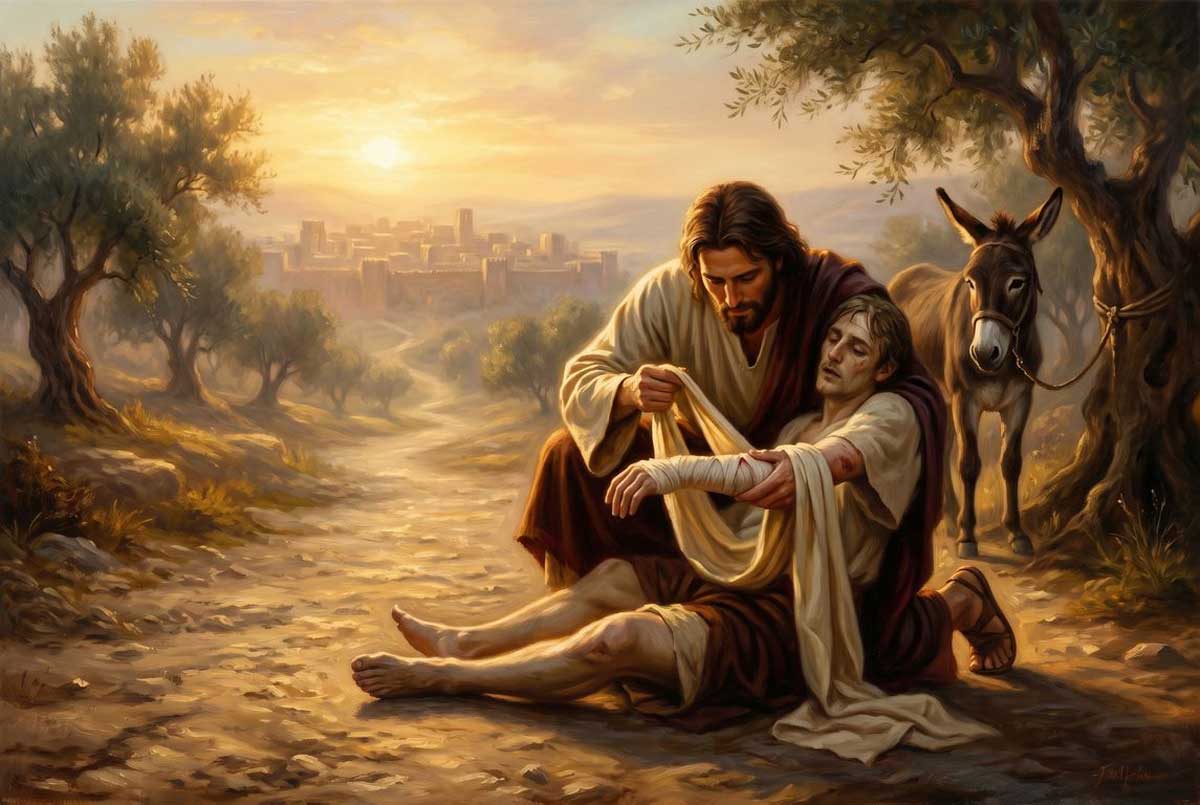
The Good Samaritan binding a traveler’s wounds — pastoral care, the wound, and “reckoning.” | Image created in Gemini for Patheos.
Introduction: The Reckoning of the Grammar Requires
The Christian tradition proposes that the sexual act carries an objective meaning inscribed in its nature, not invented by the persons performing it, not negotiable by their intentions; a meaning given with the act itself.
That meaning is double and inseparable: the union of the spouses and their openness to life.
A Note from The Latin Right
Note: This is the final of three essays exploring different aspects of sexual morality and pastoral/sacramental recovery.
Guest writer: Pilgrim.
Read the First article in this series:
The Question That Quietly Disappeared About Contraception.
Read the Second article in this series:
The Grammar the Body Speaks.
This is the grammar of the body. It is not a metaphor for a rule. It is a claim that the body speaks, that sexual union is a language, and that like any language it can be spoken truly or falsely. Not well or badly, but honestly or dishonestly at the level of what the act itself says. Marriage, in that account, is not primarily a legal arrangement or an emotional bond, though it is both of those things; it is the covenantal form in which the grammar of total self-gift can be spoken truthfully, imaging the differentiated, faithful, fruitful love of God in whose image we are made.
Accepting this as true generates specific and demanding consequences for how the Church accompanies the people it is called to serve. Not abstractly, but in the confessional and in the rectory study when someone comes to the door who does not know how to begin.
The truth of the grammar does not make the pastoral task easier. It makes it harder. A Church that has lost the grammar can offer sympathy and a listening ear. A Church that holds it must offer something more demanding: an honest account of what the body means, spoken with the confidence that comes from knowing it is true, and the patience that comes from knowing how far most people are from inhabiting it. That combination, speaking plainly about the truth while refusing to abandon the person, is what this essay attempts to describe.
The grammar has carried real costs: maternal mortality, the physical exhaustion of repeated childbearing, the economic precarity of large families. These were not abstractions. The people who sought relief were often bearing genuine suffering. To acknowledge this is not to concede the moral argument. It is to say that those entrusted with handing on the grammar sometimes failed in their pastoral obligations, and that those failures are part of the story the Church must tell honestly if it is to be believed.
The Grammar and the Wound
Once the act has a grammar, failure becomes possible. However, not all failures are identical, and conflating distinct moral categories is a deep source of both pastoral cruelty and pastoral indulgence. Precision here is not scholastic pedantry. It is the condition of genuine care.
Disorder, sin, and culpability are not the same thing.
Disorder is a property of the act considered in itself: the misalignment of the act with its own ends, the body speaking falsely. Sin includes the will: the free turning away from what one knows to be good. Culpability is the measure of the person’s responsibility, diminished by ignorance, not wilful ignorance but genuine inability to perceive what the order requires. In a culture that has largely lost the grammar, that inability is widespread and often invincible. It is diminished further by the internal compulsion of disordered desire that habit has made close to second nature, and, separately, by the damage done to the person’s capacity for ordered love by neglect, abuse, or the systematic formation of disordered expectations.
These distinctions allow the pastor to speak honestly without being cruel, to name disorder without pronouncing on guilt, and to accompany the person without pretending that nothing is amiss.
John Paul II named the governing principle in Veritatis Splendor. It is the difference between the gradualness of the law and the law of gradualness. The destination is fixed. What varies is the person’s proximity to it and the conditions under which they are travelling. What is graduated is not the standard but the person’s appropriation of it. To forget this is to confuse pastoral realism with doctrinal revision and, in practice, to abandon the person. A physician who moves the goalposts has not made health easier to reach. He has made it impossible to find.
Consider the young woman who has grown up in a culture that treats contraception as straightforwardly responsible. Nobody told her otherwise. She uses contraception within a faithful, loving relationship. The act is objectively disordered. Her culpability may be considerably less than the objective disorder of the act would suggest and is not something the confessor can presume. But neither is she helped by being told there is nothing to reconsider. What she needs is neither condemnation nor false reassurance, but someone who can help her understand, with patience, what the body is saying and why it matters. Someone willing to begin that conversation knowing it may take years to complete.
Consider the man who walks into a confessional after fifteen years away from the Church. He is somewhere in his late thirties, having lived an ordinary life by the standards of his culture: relationships, compromises, and the slow accumulation of habits he never examined because nobody suggested they needed examining. He is a person formed outside the grammar, returning to a language he never learned to speak. The pastoral question is not primarily one of absolution for catalogued offences but of formation. Where does the journey toward the grammar begin for someone who has never known it as home? He needs a confessor who understands that the first conversation is not the last, who can receive him fully without pretending that reception is the same as arrival, and who has the patience to accompany a journey whose length neither of them can predict.
Then there are harder cases still. The woman for whom another pregnancy carries serious risk of death understands the grammar. She may hold it with full conviction. She is navigating a genuine conflict between goods that the tradition’s own principles recognise as real. The tradition has resources here, but they require honest engagement rather than formulaic application. A checklist cannot do justice to a situation like this. The situation requires a more serious pastoral judgment.
Modernity makes all of this harder by collapsing person and desire into identity. The older Christian grammar distinguished between the person, who possesses inviolable dignity, and desires or acts, which may be ordered or disordered. Once identity and desire fuse, moral disagreement becomes existential negation: not “this act is disordered” but “your self is illegitimate.” Separating the person from the act is not a rhetorical softening. It is the condition of speaking truthfully about both, and of being heard at all.
The Church’s own pastoral practice has not always honoured these distinctions. Precision without accompaniment curdles into something else: abdication dressed up as fidelity.
The proportionalist response to Humanae Vitae did not resolve the pastoral difficulties that followed its widespread rejection. It compounded them, replacing the act’s intrinsic character with the agent’s reasons as the governing moral consideration. The doctrine was never the whole problem. The greater difficulty lay in the gap between the teaching and the accompaniment that should have made it intelligible and liveable. What proportionalism offered was not a solution to that gap. It offered a way of ceasing to notice it.
The grammar is not finally a philosophical construct or an ecclesiastical regulation. It is inscribed in creation by the Logos through whom all things were made. Christ does not abolish the grammar. He reveals what it was always pointing toward: love as total self-gift, the body as the place where that gift becomes visible, and desire as the energy that love redeems rather than suppresses. The Church that hands on the grammar without the love it describes has not understood what it is handing on.
The Grammar and the Lovers
The objection arrives, as genuine objections do, with something true in it.
A husband and wife, married twenty years. They have built a life together: children, shared labour, and the accumulated fidelity of ordinary days. They know what it is to stay when staying was costly and to choose each other again across the small attritions of a shared life. They use contraception because another pregnancy would place serious strain on a family already stretched. They have not made this decision lightly.
To tell them that what they are doing makes the body lie, that they speak the grammar of total self-gift while withholding what the grammar requires, can feel not only harsh but categorically wrong. They are trying to act responsibly amid genuine constraints.
The Church’s objection is not directed against their love. It is directed against the deliberate separation of meanings that belong together in the act’s nature, ordered both to the union of the persons and to the transmission of life, two dimensions of a single reality that the spouses did not invent. To use the gift of married love while deliberately depriving it of its procreative meaning is, as Paul VI put it, to act as master of the sources of life rather than minister of the design established by the Creator.
The claim is not that contraception destroys love, but that it deliberately separates meanings that belong together in the act’s nature, causing the body to speak a language of total self-gift while withholding one dimension of the gift that the act is structured to express.
The love is real. So is the disorder. The two judgments are not directed at the same thing. One concerns the persons, the other the act itself. They do not cancel each other. They coexist, and the tension between them doesn’t get resolved; it Is inhabited. None of that changes what the act is.
The Church’s answer to that objection is completion, not rebuttal. The grammar does not suppress eros. It names what eros itself tends toward when it is not frustrated: permanence, exclusivity, fruitfulness, and the total self-gift that the Trinitarian theology of Genesis names. Teleology does not constrain desire. Underlying this is the claim that eros without form collapses; permanence and fruitfulness aren’t limits placed on desire from outside; they’re what desire was reaching for all along. The Church takes love seriously enough to say what love is for.
The couple whose love has lasted twenty years already know something of this. The grammar names the logic of what they have lived and asks whether they are willing to follow it to its end.
The pastoral task is not to pronounce on their guilt but to accompany them toward the health they are already, in their best moments, reaching for.
The Grammar and the Journey
The grammar is not self-implementing. It does not travel from one generation to the next by being stated correctly. It travels by being inhabited, by persons who have taken it into their bodies and their habits and their daily choices and found that it is liveable, at whatever cost, and that the cost has been worth paying. Without those persons, the grammar is a set of propositions. With them, it is a life.
But formation alone cannot bear the weight the grammar places upon it. The Christian tradition has never claimed that human beings can educate themselves into holiness. The wound runs deeper than ignorance.
The tradition traces it not just to personal failure but to original sin itself: a disorder introduced into human nature that clouds reason, yet leaves reason capable of recognising the good while weakening the will in its pursuit. Paul describes the consequence with painful clarity: “I do not understand my own actions. For I do not do what I want, but I do the very thing I hate. I can will what is right, but I cannot do it” (Romans 7:15-18). Knowledge of the disorder does not heal the will. What formation prepares for, grace makes possible. The sacraments are not rewards for those who have successfully inhabited the grammar. They are among the principal means by which fallen people are gradually made capable of doing so.
Grace restores and strengthens the will, slowly, so that what seemed impossible from the outside gradually becomes possible from within, ordinarily through habits patiently shaped and people who accompany us, though neither can substitute for Christ himself, the source of what they convey.
This is what makes confession more than a counselling relationship and the Eucharist more than a symbol. In confession, the person does not simply receive advice about how to live the grammar more effectively. They receive absolution, the actual restoration of the relationship with God that sin has damaged, and with it the grace to begin again. In the Eucharist, the body of believers does not just commemorate Christ’s self-gift. It participates in it. It is the source from which the capacity to live the grammar flows.
What formation looks like in practice is less dramatic than its theological description. It looks like a confessor who meets the same person regularly over the years, knows their name and history, and does not start each encounter from the beginning. It looks like a couple prepared for marriage not in a weekend but across months of honest conversation with people whose own marriage has cost them something and given them more. It looks like a community in which desire is spoken of frankly enough that a young person does not encounter the grammar for the first time in a moment of failure. Doctrine handed on without that formation produces compliance at best and rebellion at worst. Carried within a community whose life makes the grammar visible and attractive, and sustained by the grace that flows from its sacramental life, it becomes something the tradition has long promised and rarely delivered.
The witnesses such a community requires are people whose experience of living within the grammar, across its difficulties, its costs, and the ordinary fidelities of a shared life, has led them not to constriction but to a recognisable wholeness. Their lives are evidence not only of human effort but of divine assistance. Among them are those for whom the grammar has worked at the highest cost: the same-sex attracted person who holds the tradition’s account not because desire has been dissolved but because the grammar has been inhabited across the full weight of what it asks. The tradition holds that celibacy is a complete vocation rather than a consolation, that total self-gift can be lived in the body without genital expression. That claim is strong enough to carry the weight the grammar places upon such a person. But it carries it only if the cost is named honestly, not evaded by calling it a gift without saying what is given up. A church that cannot accompany what the grammar asymmetrically requires of people ends up presenting the tradition as a demand rather than a way of life.
These witnesses are not arguments. They are evidence of a different kind, the kind that only a life can supply. When the surrounding culture eventually finds itself asking again what the body means, these are the people with something to show.
The Reckoning
The Church’s failure to transmit the grammar in the decades after Humanae Vitae cannot be explained by any single cause. The late 1960s and 1970s brought immense upheaval: the sexual revolution, the rise of expressive individualism, widespread dissent from Humanae Vitae, theological experimentation, liturgical disruption, and the slow dissolution of the ordinary associations through which Catholic life had previously been handed on.
The deeper problem was that the grammar had never needed defending before.
Many priests found themselves caught between a teaching they were bound to transmit and a theological culture that had begun to question it. The language had been there, in the schools, the catechism, the natural law tradition, but it had been handed on as formula rather than as the living depth it expressed.
The grammar became increasingly difficult to hear not because the teaching changed, but because the communities capable of making it intelligible, and the sacramental life that sustained them, steadily weakened. The lived world in which the grammar once seemed plausible started to disappear. What those debates over proportionalism, dissent, and authority often obscured is a simpler diagnosis: what most Catholics received was the prohibition without the grammar that makes it intelligible, without the accompaniment that makes it liveable, and without the sacramental life that supplies the grace to live it.
The problem lay less in the doctrine itself than in the breakdown of apprenticeship: the slow, costly, irreplaceable process by which a moral vision passes from one generation to the next, not as a set of rules but as a way of seeing, sustained by the grace that alone makes such seeing possible.
A generation of young Catholics lost their footing in those years, not through malice or apostasy but through the ordinary vulnerabilities of youth meeting an extraordinary cultural moment. They had received the formulas without the depth, and when the wider culture offered what felt like freedom, authenticity, and justice all at once, the formulas alone could not hold them. Many never found their way back. That loss is not a statistic. It is the human cost of the formation crisis, and the Church that seeks recovery must reckon with it honestly; not with guilt, but with grief.
What is needed is less a programme than a conversion of pastoral imagination: from transmitting doctrine as information to forming persons capable of inhabiting it, within communities sustained by the sacramental life formation alone cannot generate. Recovery will come not through better arguments but through communities embodying the grammar convincingly enough that it becomes visible again as a life worth living.
Such communities will likely be smaller than the Church once imagined possible. They may possess fewer institutions, fewer privileges, and less cultural influence. Yet the loss of influence is not necessarily the loss of mission. A faith carried by conviction rather than inheritance, sustained by sacramental life rather than social expectation, may prove capable of speaking to forms of loneliness and fragmentation that the modern world increasingly struggles to heal. The Church may not recover its former position; it can become the kind of community in which the body’s meaning is visible, and therefore believable.
That work is slow. It asks the Church to take seriously what it has always professed: that people first encounter the truth in lives they trust long before they grasp the arguments for it.
Conclusion: Healed Into Reality
The world accuses the Church of being obsessed with sex. The deeper failure has often been the opposite: a reluctance to speak clearly about what the body means, to accompany honestly what the grammar costs, to hand on with confidence what it has been given to preserve. When the grammar is spoken quietly enough for long enough, it ceases to be heard at all. The grammar is not the problem. The silence has been.
The Church that hands on only the grammar hands on a demand. The Church that draws people to Christ draws them to the one in whom the demand becomes gift, and gives the grace to live what the grammar requires. That is why the Gospel is not simply a set of instructions but an offer.
The Word became flesh. He inhabited it, honoured it, suffered in it, and gave it completely. “This is my body, given for you.” Not taken. Given. The grammar of total self-gift was not a rule He imposed. It was a life He lived, and more than a life, because what He gave did not end with the giving. The Eucharist does not just teach the grammar of self-gift. It is the grammar fulfilled. The body whose meaning creation revealed, whose significance scripture named, whose beauty the tradition laboured to hand on. That body is the same body Christ gives for the life of the world. In the Eucharist, the arc from creation through Fall through redemption reaches its proper end: the open hand of God extended to the uttermost, the wound met by the one medicine strong enough to heal it.
Because the wound runs deeper than ignorance, He does not leave His people with an ideal and the instruction to try harder. He gives them Himself, in word, sacrament, and communion, so that what seems impossible from the outside may gradually become possible from within.
References
- Casti Connubii (Pius XI, 1930)
- Humanae Vitae (Paul VI, 1968)
- Veritatis Splendor (John Paul II, 1993)
- Pope Benedict XVI, in Deus Caritas Est (2005)
- John Paul II Theology of the Body Audiences
- Joseph Ratzinger, Faith and the Future
Thank you!
If you liked this article, please leave your comments below. I am very interested in your opinion on this topic.
Read The Latin Right’s other writing here.
Please visit my Facebook page and IM your questions (and follow my page) or topics for articles you would like covered.
Family, Parenting and Religion
Previous Post

June 16, 2026
The One Who Hears You Hears Me: First, Identify the Church
Next Post

June 22, 2026 The Soft Bigotry of Low Saintly Expectations
Recent Comments
""It's reasonable to ask what those claims mean in practice."It is. And I've laid out ..."
Amoris Laetitia Deserves a Better Defence
"I've said what I said, Peter. Read the words. If you don't have anything new ..."
Amoris Laetitia Deserves a Better Defence
"I don't expect you to decide who should be admitted to the sacraments. I'm asking ..."
Amoris Laetitia Deserves a Better Defence
"But is that how you see it, Todd? You initially offered “salvation is more important ..."
Amoris Laetitia Deserves a Better Defence
Browse Our Archives
Select a Category Abortion Arius Atheists Catholic Apologetics Catholic Culture Catholic History Catholic Humor Catholic Poetry Catholic Politics Catholic Theology Dr. James White Faith Alone Joe Heschmeyer Kamala Harris Martin Luther Pope Francis Preborn Children President Biden Science and Catholicism Sola Scriptura Synod of Synodality Trinity
Select a Month October 2026 September 2026 August 2026 July 2026 June 2026 May 2026 April 2026 March 2026 February 2026 January 2026 December 2025 November 2025 October 2025 September 2025 August 2025 July 2025 June 2025 May 2025 April 2025 March 2025 February 2025 January 2025 December 2024 November 2024 October 2024 September 2024 August 2024 July 2024 June 2024 May 2024 April 2024 March 2024 February 2024 January 2024 December 2023 November 2023 October 2023 September 2023 August 2023 July 2023 June 2023 May 2023 April 2023 March 2023 February 2023 January 2023 December 2022 November 2022 October 2022 September 2022 August 2022 July 2022 June 2022 May 2022 April 2022 March 2022 February 2022 January 2022 December 2021 November 2021
Follow Us!
TAKE THE
Religious Wisdom Quiz
True or False: In Revelation, Satan is bound in the Abyss for 500 years.
Select your answer to see how you score.
TRUE FALSE
Related posts from The Latin Right

Amoris Laetitia Deserves a Better Defence

Rich Man, Poor Man: Altruism and Agency

The Order We Did Not Make: The World...

The Poor Have Rights—and Responsibilities
TRENDING AT PATHEOS Catholic

In "Irreplaceable," our book on vocation and technology, Trevor Sutton and I...

I was strolling through the top floor of the brand new Parthenon...

What Does Gêvâh Mean For Kimberley Guifoyle &...
This week, a lot of the news is focused on Kimberly Guilfoyle....

INNER CIRCLE: Profound Mystery (Of Christ In All...
Ephesians 5:31-32 “For this reason, a man will leave his father and...

Do Not Rejoice When Your Enemy Falls: The...
Turning an execution into a public spectacle is a disturbing expression of...

'The Chosen' S6 Trailer: The Passion Gets Very...
Not many watching 'The Chosen' worry about spoilers, but just because they...
view all Catholic blogs
What Are Your Thoughts?leave a comment
Ad-Free & Subscriber Log-In Subscription Support
- About Us
- 2026 Calendar
- Videos
- Podcasts
- Library of World Religions
- Faith In Media Tracker
- Advertise With Us
- Write for Us
- Privacy Policy
- Terms of Service
- Do Not Sell My Data
- Contact Us
- Radiant Digital
- Manage Newsletter Subscriptions
- Unsubscribe From Notifications
- Sitemap
Copyright 2008-2026, Patheos. All rights reserved.
Subscription Support Ad-Free & Subscriber Log-In
Follow Patheos