
BuddhistCatholicContemplativeEvangelicalGeneral ChristianHinduJewishLatter-day SaintMuslimNew VisionsProgressive Christian
Beliefs
- Buddhist
- Catholic
- Contemplative
- Evangelical
- General Christian
- Hindu
- Jewish
- Latter-day Saint
- More Voices
- Muslim
- New Visions
- Pagan
- Progressive Christian
Topics
- Religion News
- Food and Religion
- Sports and Religion
- Religious Art
- Religious Music and Entertainment
- Religious Events
- History and Religion
- Style and Religion
- Politics and Religion
- Women in Religion
- Recreation Outdoors and Religion
- Business Finance and Religion
- Careers Workplace and Religion
- Education and Religion
- Family Parenting and Religion
- Health Fitness and Religion
- Home and Religion
- Relationships and Religion
- Technology and Religion
- Travel and Religion
Columnists
- Buddhist Columnists
- Business Finance and Religion Columnists
- Careers Workplace and Religion Columnists
- Catholic Columnists
- Contemplative Columnists
- Education and Religion Columnists
- Evangelists Columnists
- Family Parenting and Religion Columnists
- General Christian Columnists
- Health Fitness and Religion Columnists
- Hindu Columnists
- History and Religion Columnists
- Home and Religion Columnists
- Jewish Columnists
- More Voices Columnists
- Latter Day Columnists
- Muslim Columnists
- New Visions Columnists
- Nonreligious Columnists
- Pagan Columnists
- Politics and Religion Columnists
- Progressive Columnists
- Recreation Outdoors and Religion Columnists
- Relationships and Religion Columnists
- Religion News Columnists
- Religious Art Columnists
- Religious Events Columnists
- Religious Music and Entertainment Columnists
- Sports and Religion Columnists
- Style and Religion Columnists
- Technology and Religion Columnists
- Travel and Religion Columnists
- Women in Religion Columnists
Resource Library
- 2026 Calendar
- Library of World Religions
- The 100 Most Holy Places on Earth
- Patheos Answers
- Podcasts
- Videos
- Faith Leaders Database
- Anglican Episcopalian
- Bahai
- Baptist
- Buddhism
- Christianity
- Confucianism
- Eastern Orthodoxy
- Hinduism
- Holiness and Pentecostal
- ISKCON
- Islam
- Judaism
- Lutheran
- Methodist
- The Church of Jesus Christ of Latter-day Saints
- New Age
- Paganism
- Presbytarian and Reformed
- Protestantism
- Religion Behind the Scenes
- Roman Catholic
- Scientology
- Shia Islam
- Sikhism
- Sufism
- Sunni Islam
- Taoism
- Zen
- See all religions
Research Tools
 Ad-Free & Subscriber Log-In Subscription Support
Follow Patheos 

- Trending:
- Advent
- |
- Forgiveness
- |
- Thanksgiving
- |
- Election
- |
- Seasonal Holidays
- |
- Marriage

- Home
- Catholic
- Religious Art
- One Reason Why I Cannot Be a Progressive Catholic: Beauty
One Reason Why I Cannot Be a Progressive Catholic: Beauty
Last updated on: June 2, 2026 at 4:55 pm by Dennis Knapp
One Reason Why I Cannot Be a Progressive Catholic: Beauty 2026-06-02T16:55:06-06:00 Dennis Knapp
Patheos Explore the world's faith through different perspectives on religion and spirituality! Patheos has the views of the prevalent religions and spiritualities of the world.
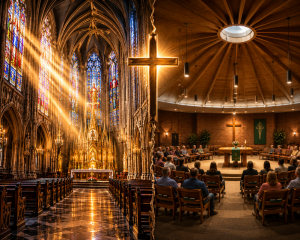
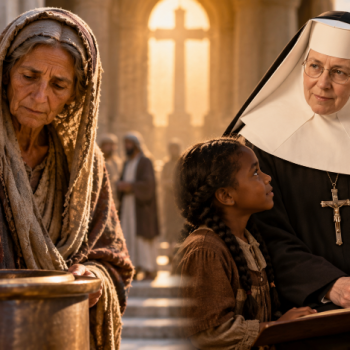
AI image created by author.
One of my favorite works of art—whether visual, musical, or otherwise—is Mozart’s Requiem. Its beauty reflects something far beyond the mundane, lifting the listener toward unimaginable spiritual heights. When I listen to it, I often experience a mixture of awe and sadness: awe at the God-given genius required to compose such a masterpiece, and sadness for its composer, Wolfgang Amadeus Mozart, whose personal life seems to have lacked the deep piety one might expect from someone used by God in so extraordinary a way.
The awe I experience before works such as the Requiem stands in stark contrast to what I feel when confronted with religious art, architecture, and music shaped by the horizontal vision of progressive Christianity. This vision often reduces Christianity to service of others—especially the poor—and treats that service as the center of the Gospel rather than the fruit of something greater: the worship of God and the salvation of souls.
We can see this emphasis in much contemporary sacred music, particularly the work of Dan Schutte, including Table of Plenty. We can also see it in the church architecture that emerged during the 1970s and 1980s. Both reflect a broader shift in focus—from God to man, from transcendence to utility, and from worship to community. That shift helps explain why I cannot be a progressive Catholic.
The Horizontal Turn
Anyone familiar with the music of Dan Schutte will understand my reaction. His catalog includes:
These songs repeatedly emphasize gathering, mission, community, inclusion, and service. All of these themes reflect legitimate Christian concerns. The question is whether they constitute the whole of Christian life.
What of sin, repentance, judgment, sacrifice, holiness, and salvation? What of the Cross and the eternal destiny of the soul?
When sacred music consistently emphasizes the horizontal dimensions of Christianity while giving comparatively little attention to its vertical dimensions, it inevitably shapes how people understand the faith itself. Over time, the Church begins to look less like an ark of salvation and more like a religiously inspired social movement. The mission shifts subtly but significantly—from reconciling man to God to improving man’s relationship with his neighbor.
Christianity certainly calls us to love and serve others. Yet love of neighbor flows from love of God, not the other way around. When the vertical dimension fades from view, the horizontal eventually loses its foundation as well.
From Altar to Table
For Catholics, the Mass is far more than a communal meal. In the Eucharist, Christ presents His sacrifice to the faithful. The altar is not merely a table; it is Calvary in sacramental form.
This distinction reveals one of the deepest differences between progressive Catholicism and historic Catholicism. Progressive Catholics often begin with the meal and work backward toward sacrifice. Historic Catholicism begins with sacrifice and understands the meal through it.
The difference matters. A meal emphasizes fellowship, community, and inclusion. A sacrifice emphasizes sin, redemption, worship, and the need for reconciliation with God. Both belong to the Mass, but the order matters.
When Catholics place fellowship above sacrifice, the Mass begins to resemble a gathering of believers rather than the worship of God. The Church teaches that the Eucharist is both sacrifice and sacred banquet. The banquet draws its meaning from the sacrifice, not the other way around. Remove Calvary from the altar, and the table loses its deepest significance.
The Churches We Built
Churches reveal what people believe. For centuries, Christians designed churches to inspire awe and direct the soul toward God. Architects drew the eye upward with towers, spires, and domes. Sunlight filtered through stained-glass windows. Sacred images adorned the walls, and high altars dominated the sanctuary.
Now compare those churches with many built during the 1970s and 1980s. Fan-shaped seating, circular layouts, low ceilings, and minimal ornamentation created a more pragmatic, auditorium-like aesthetic. Rather than emphasizing transcendence, these designs often emphasized accessibility, participation, and community.
The same theological instincts that shaped contemporary hymnody seem to have shaped contemporary architecture as well—or perhaps the influence flowed in the opposite direction. Either way, the result was the same. The focus shifted subtly but significantly from “God is here” to “we are gathered here.”
That shift matters. A church building teaches long before a priest preaches a homily. It forms expectations about what worship is and whom worship is for. The architecture of a cathedral lifts the mind toward heaven. The architecture of an auditorium keeps the focus on the assembly.
Why Beauty Matters
Why do Christians build cathedrals or compose masterpieces such as Mozart’s Requiem? Cathedrals such as Chartres Cathedral, Notre-Dame de Paris, and St. Peter’s Basilica were neither practical nor efficient. They were acts of worship. In many cases, generations of craftsmen devoted their lives to these projects because they sought to glorify God through beauty.
The same principle guided the creation of other masterpieces. Christians did not ask how to maximize accessibility or community participation. They asked how they could offer God their very best.
Beauty teaches. Beauty elevates. It draws the soul beyond the ordinary and toward the transcendent. It reminds us that we were made for more than comfort, utility, or material prosperity. We were made for God.
That is why beauty matters. It does not distract from worship; it flows from worship. A civilization centered on God naturally produces cathedrals, sacred art, and great sacred music because worship inspires men to create things worthy of the One they adore.
Final Thoughts: Why I Am Not a Progressive Catholic
The issue I have addressed in this essay concerns orientation, not politics. Progressive Catholicism often begins with man and moves from there toward God. Historic Catholicism begins with God and, in light of that reality, understands the human person correctly.
That orientation shaped Christian civilization. It inspired Christians to build cathedrals, compose requiems, and create sacred art. It led craftsmen to devote decades of their lives to works they would never see completed. It led artists to create masterpieces not for their own glory, but for God’s.
This is one reason progressive Catholicism does not appeal to me. Not because I care too little about the world, but because I believe the Church exists for something greater than the world. Christ founded the Church to worship God and lead souls to eternal life.
Beauty serves that mission. A cathedral lifts the eyes toward heaven. Sacred music stirs the soul toward God. Great religious art reminds us that we were made for more than comfort, utility, and material concerns.
The Church’s highest purpose is not to help us feel at home in this world. It is to prepare us for the next. One of the ways she accomplishes that task is through beauty.
Thank you!
If you liked this article, please leave your comments below. I am very interested in your opinion on this topic.
Read The Latin Right’s other writing here.
Please visit my Facebook page and IM your questions (and follow my page) or topics for articles you would like covered.
Progressive Christian
Religious Art
Previous Post
May 29, 2026
The Foundation Stone Beneath the Ruin
Next Post

June 6, 2026 Extinction Through Compassion: Down Syndrome's Disappearance
Recent Comments
"Saying "she has no reason to feel guilty" is a legalistic, out of touch response. ..."
Pope Leo in Lima: The Speech ..."
"You're right about one thing: there is evidence that average female sexual desire increases around ..."
Pope Leo in Lima: The Speech ..."
"If you really believe that the purpose of sex is procreation, you can't deny that ..."
Pope Leo in Lima: The Speech ..."
"Several things are being conflated here. I think your imaginary Eileen illustrates the problem with ..."
Pope Leo in Lima: The Speech ..."
Browse Our Archives
Select a Category Abortion Arius Atheists Catholic Apologetics Catholic Culture Catholic History Catholic Humor Catholic Poetry Catholic Politics Catholic Theology Dr. James White Faith Alone Joe Heschmeyer Kamala Harris Martin Luther Pope Francis Preborn Children President Biden Science and Catholicism Sola Scriptura Synod of Synodality Trinity
Select a Month November 2026 October 2026 September 2026 August 2026 July 2026 June 2026 May 2026 April 2026 March 2026 February 2026 January 2026 December 2025 November 2025 October 2025 September 2025 August 2025 July 2025 June 2025 May 2025 April 2025 March 2025 February 2025 January 2025 December 2024 November 2024 October 2024 September 2024 August 2024 July 2024 June 2024 May 2024 April 2024 March 2024 February 2024 January 2024 December 2023 November 2023 October 2023 September 2023 August 2023 July 2023 June 2023 May 2023 April 2023 March 2023 February 2023 January 2023 December 2022 November 2022 October 2022 September 2022 August 2022 July 2022 June 2022 May 2022 April 2022 March 2022 February 2022 January 2022 December 2021 November 2021
Follow Us!
TAKE THE
Religious Wisdom Quiz
What animal tricked Eve into eating the forbidden fruit?
Select your answer to see how you score.
Serpent Eagle Lion Bear
Related posts from The Latin Right

Catholic Biden Received An Abortion Award: My Thoughts
Will God Raise Us as We Are or...
Rich Man, Poor Man: Altruism and Agency
TRENDING AT PATHEOS Catholic

An Advent Calendar, and a Tree full of...
I've spent the weekend deeply invested in internet drama about a $150...

How to Have Financial Transparency in Marriage
Despite the fact that financial issues and money problems are the number...
The Healing Power of Forgiveness in Marriage
Learning how to give and accept apologies are essential ingredients of a...

The West's Christian Moral Inheritance: A Legacy Denied
Whether we like it or not, our environment matters, shaping us both...

How Does Tôḏâ Connect Florida & Thanksgiving?
The big news this weekend has been about the continued flooding on...
Were Early Christians Drinking Psychedelic Wine?
The Secret Sacrament the Church Took Away The early Christian church was...
view all Catholic blogs
What Are Your Thoughts?leave a comment
Ad-Free & Subscriber Log-In Subscription Support
- About Us
- 2026 Calendar
- Videos
- Podcasts
- Library of World Religions
- Faith In Media Tracker
- Advertise With Us
- Write for Us
- Privacy Policy
- Terms of Service
- Do Not Sell My Data
- Contact Us
- Radiant Digital
- Manage Newsletter Subscriptions
- Unsubscribe From Notifications
- Sitemap
Copyright 2008-2026, Patheos. All rights reserved.
Subscription Support Ad-Free & Subscriber Log-In
Follow Patheos