
BuddhistCatholicContemplativeEvangelicalGeneral ChristianHinduJewishLatter-day SaintMuslimNew VisionsProgressive Christian
Beliefs
- Buddhist
- Catholic
- Contemplative
- Evangelical
- General Christian
- Hindu
- Jewish
- Latter-day Saint
- More Voices
- Muslim
- New Visions
- Pagan
- Progressive Christian
Topics
- Religion News
- Food and Religion
- Sports and Religion
- Religious Art
- Religious Music and Entertainment
- Religious Events
- History and Religion
- Style and Religion
- Politics and Religion
- Women in Religion
- Recreation Outdoors and Religion
- Business Finance and Religion
- Careers Workplace and Religion
- Education and Religion
- Family Parenting and Religion
- Health Fitness and Religion
- Home and Religion
- Relationships and Religion
- Technology and Religion
- Travel and Religion
Columnists
- Buddhist Columnists
- Business Finance and Religion Columnists
- Careers Workplace and Religion Columnists
- Catholic Columnists
- Contemplative Columnists
- Education and Religion Columnists
- Evangelists Columnists
- Family Parenting and Religion Columnists
- General Christian Columnists
- Health Fitness and Religion Columnists
- Hindu Columnists
- History and Religion Columnists
- Home and Religion Columnists
- Jewish Columnists
- More Voices Columnists
- Latter Day Columnists
- Muslim Columnists
- New Visions Columnists
- Nonreligious Columnists
- Pagan Columnists
- Politics and Religion Columnists
- Progressive Columnists
- Recreation Outdoors and Religion Columnists
- Relationships and Religion Columnists
- Religion News Columnists
- Religious Art Columnists
- Religious Events Columnists
- Religious Music and Entertainment Columnists
- Sports and Religion Columnists
- Style and Religion Columnists
- Technology and Religion Columnists
- Travel and Religion Columnists
- Women in Religion Columnists
Resource Library
- 2026 Calendar
- Library of World Religions
- The 100 Most Holy Places on Earth
- Patheos Answers
- Podcasts
- Videos
- Faith Leaders Database
- Anglican Episcopalian
- Bahai
- Baptist
- Buddhism
- Christianity
- Confucianism
- Eastern Orthodoxy
- Hinduism
- Holiness and Pentecostal
- ISKCON
- Islam
- Judaism
- Lutheran
- Methodist
- The Church of Jesus Christ of Latter-day Saints
- New Age
- Paganism
- Presbytarian and Reformed
- Protestantism
- Religion Behind the Scenes
- Roman Catholic
- Scientology
- Shia Islam
- Sikhism
- Sufism
- Sunni Islam
- Taoism
- Zen
- See all religions
Research Tools
 Ad-Free & Subscriber Log-In Subscription Support
Ad-Free & Subscriber Log-In Subscription Support
Follow Patheos 

- Trending:
- Forgiveness
- |
- Marriage
- |
- Consciousness
- |
- Death Penalty
- |
- Election
- |
- Halloween

- Home
- Catholic
- Relationships and Religion
- Genesis Reimagined: A Reflection on the Garden Experience
Genesis Reimagined: A Reflection on the Garden Experience
Last updated on: June 25, 2026 at 1:20 pm by Dennis Knapp
Genesis Reimagined: A Reflection on the Garden Experience 2026-06-25T13:20:21-06:00 Dennis Knapp
Patheos Explore the world's faith through different perspectives on religion and spirituality! Patheos has the views of the prevalent religions and spiritualities of the world.
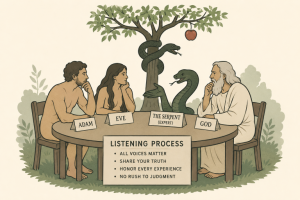
AI image provided by quest writer.
Guest writer: Pilgrim.
Disclaimer
The following narrative is entirely fictional. Any resemblance to real persons, institutions, ecclesial processes, conferences, consultations, assemblies, reports, listening exercises, or documents currently under review is purely coincidental.
The author wishes to state clearly that no conclusions should be drawn from any similarities the reader may happen to notice.
****
In the beginning, there was a Garden.
And God saw that it was good.
This assessment was immediately referred to a listening process.
A committee was formed.
The committee acknowledged that “good” was a meaningful term for many stakeholders but cautioned against imposing a single interpretive framework upon the lived experiences of the Garden’s participants.
Adam and Eve were invited to share.
Adam explained that he experienced the Garden positively but felt that the prohibition regarding the Tree required further discernment.
Eve said that while she appreciated the traditional understanding of the Tree, she wondered whether the command not to eat from it adequately reflected the complexity of human experience.
The Serpent was invited to contribute as an expert witness.
“We must avoid simplistic binaries,” he said. “Let’s not focus on whether the fruit should be eaten. Instead, consider how we accompany those who feel called toward its fruit.”
This was widely regarded as a helpful intervention.
God reiterated the command.
“You shall not eat of the Tree.”
The committee thanked Him for sharing His perspective.
A working document was prepared.
The document noted that while some participants continued to find value in the traditional prohibition, others had begun exploring alternative relationships with the fruit. Both perspectives were acknowledged as authentic expressions of the Garden journey.
The Serpent facilitated several listening sessions.
Participants were encouraged to reflect on their relationship with the Tree.
How did they experience the command?
How did the command make them feel?
What did fruitfulness mean to them?
Could there be multiple understandings of fruitfulness?
Was it possible that earlier generations had lacked the conceptual vocabulary needed to appreciate the deeper significance of eating fruit?
These questions generated rich discussion.
Adam admitted that he had never personally felt harmed by the prohibition.
Eve observed that she increasingly experienced the command as a limitation upon her authentic self.
The Serpent affirmed her courage.
“It sounds,” he said gently, “as though you are naming your truth.”
The phrase was added to the draft document.
God again reminded them that the Tree was not to be touched.
The committee acknowledged that His contribution reflected an important strand of the Garden tradition.
At the next session, the discussion turned to anthropology.
What does it mean to be human?
Adam suggested that human identity was rooted in being created by God.
Eve proposed that identity might also include one’s desires, aspirations, experiences, perceptions, preferences, narratives, and evolving relationship with fruit.
The Serpent applauded the nuance.
A subcommittee was immediately established.
After several months, the subcommittee concluded that both positions contained valuable insights.
No attempt was made to determine whether they were compatible.
The goal was dialogue, not conclusions.
No one had thought to put a time limit on either.
It was around this time that a traveller arrived in the Garden.
He had come some distance, and he asked, before anything else, to listen. He listened to Adam for the better part of a day, and to Eve for longer than that, and when the Serpent offered to share his own perspective as an expert, the traveller listened to him too, without interrupting, and thanked him for it afterwards. Nobody could accuse him of failing to listen. This alone made him difficult to categorise. The committee had grown used to sorting visitors quickly into those who listened and those who merely pronounced, and the traveller declined to sit in either chair.
When he finally spoke, it was to the subcommittee on anthropology, and what he said was this: that Eve was right to insist that desire, experience, and the texture of one’s own longing mattered to the question of who a person was; that this was not a concession to be managed but a truth to be taken with full seriousness.
And that Adam was right, too, in a way Adam had not quite managed to argue. That none of this changed what a human being was for. A desire was not self-explanatory. It pointed beyond itself, toward something it hoped would complete it, and the pointing was not the same as the arrival. The question the subcommittee kept declining to ask, he said, was not whether the desire was felt. It was whether the thing desired would actually do for the person what the desire promised.
The subcommittee found this an interesting contribution, minuting it as such.
The Serpent did not mention it.
Privately, he had begun to regard the traveller as the only person in the Garden worth worrying about. Not because the traveller was hostile, but because he could not be filed under any of the categories that made opposition easy to dismiss. He was not rigid. He was not afraid of Eve’s desires. He simply would not agree that wanting a thing settled the question of whether it was good, and the Serpent had found, over a long career, that this particular refusal was very hard to argue with and very easy to ignore.
The Serpent next introduced the concept of developmental fruit theory.
“Earlier generations understood fruit in a certain way,” he explained. “But human consciousness evolves. Experience deepens. Vocabulary expands. What if the command was never wrong, but incomplete?”
The committee found this intriguing.
Several members asked whether the Tree might now be understood through a richer interpretive lens.
God responded:
“The command remains the same.”
The minutes recorded that significant differences remained.
Attention then shifted toward accompaniment.
Some members expressed concern that discussions of obedience could be hurtful to those who felt drawn toward fruit.
Others worried that continually discussing fruit consumption might create an atmosphere of exclusion.
The committee agreed that all Garden inhabitants should feel welcome regardless of their relationship with fruit.
A statement was issued.
“Everyone belongs in the Garden.”
This was unanimously approved.
A proposal to add the sentence, “The fruit remains forbidden,” was referred back for further consultation.
The Serpent praised the spirit of openness.
By now, Eve had begun keeping a journal.
In it she reflected extensively upon her lived experience.
She described a growing sense that the prohibition no longer resonated with her developing understanding of herself.
The command felt external.
The fruit felt authentic.
The journal received excellent peer review.
The traveller read the journal carefully, twice, and said that he found it moving. He meant this without irony, because a record of someone’s inward life honestly kept was not a small thing, and he would not pretend otherwise to score a point. But he asked Eve, gently, whether a feeling of authenticity was the same thing as being right. Plenty of true things did not feel authentic at first, he said, and plenty of authentic-feeling things turned out, on examination, not to be true. The feeling was data. It was not the verdict.
Eve asked what, then, would count as a verdict, if not how the thing felt from the inside.
“Whether it makes you more capable of love,” the traveller said, “or less. That’s not a feeling either. It’s a direction. You can feel quite wonderful while moving the wrong way.”
This phrase, direction of love, was seized upon with real enthusiasm. A working group was formed to mainstream it across all Garden documentation. Participants agreed it was exactly the kind of integrative language the process had been missing.
The working group’s first task was to define love. After some discussion, it was concluded that love meant supporting a person’s journey toward their authentic self, without judgment, on that person’s own terms.
The traveller pointed out that this was not a direction at all, since a journey defined entirely by where someone already wanted to go could not, by definition, redirect anyone.
The working group thanked him for the observation and incorporated it as a footnote.
Adam remained uncertain.
Whenever he asked whether eating the fruit was actually good or bad, the discussion tended to return to questions of language.
“What do we mean by ‘good’?” asked one facilitator.
“What do we mean by ‘bad’?” asked another.
These interventions were regarded as profound.
The Serpent continued to encourage reflection.
“Perhaps,” he suggested, “the issue is not whether the fruit conforms to the command. Perhaps the command must be reinterpreted through the fruit.”
This observation generated considerable excitement.
Several participants remarked that it represented a paradigm shift.
Others described it as a development.
A few traditionalists called it exactly what it was.
The summary document was drafted by a quiet woman named Maren, who had sat through every session, who privately thought the traditionalists were the only ones in the room still speaking plainly, and who left their comments out anyway; not from malice, and not from cowardice exactly, but because she had attended enough sessions by now to know precisely which sentence would get a person filed under “rigid” and quietly excused from the next round of consultation. She did not think saying the true thing out loud, today, by her, would change the outcome enough to be worth what it would cost the person who said it. She believed this. She was probably right. She wrote the gentler sentence instead, and felt, for the length of one keystroke, exactly the way Eve had described feeling about the Tree, and then went on to the next item on the agenda.
As time passed, God became concerned.
“You are overcomplicating this.”
This was noted, filed, and overtaken by the next agenda item.
The traveller made one more attempt. He found Eve before she went to the Tree and asked her directly: not how she felt about the fruit, not whether she felt accompanied in her discernment, but whether the fruit was good. Not good for now, not good as a stage in her development; simply good, in the way a thing is either nourishing or poisonous, regardless of how hungry one is for it.
Eve said this was a very binary way of putting it.
“It is,” the traveller agreed. “Most important things are. I’m not asking you to stop feeling what you feel. I’m asking you to let the feeling be questioned by something outside itself. That’s not an insult to your experience. It’s the only thing that takes your experience seriously enough to risk being wrong about it.”
Eve said she would bring the question to the committee.
The committee thanked the traveller for a perspective that enriched the diversity of views under discussion, noted that the question of objective goodness remained one on which sincere and faithful people continued to disagree, and moved to the next item on the agenda. It was Eve’s proposed timeline for approaching the Tree.
Eventually, Eve approached the Tree.
The Serpent joined her.
“How do you feel?” he asked.
“I feel seen,” she replied.
“Do you feel accompanied?”
“Deeply accompanied.”
“Do you feel empowered to explore your truth?”
“I do.”
The Serpent smiled.
“Then perhaps the real question is not whether you should eat the fruit.”
“What is the real question?”
“Whether anyone else has the right to define fruit for you.”
This was regarded as a breakthrough moment.
Eve took the fruit.
Adam, after considerable discernment, joined her.
The committee issued a statement expressing gratitude for their courageous journey.
God arrived shortly thereafter.
The atmosphere became tense.
“Have you eaten from the Tree?”
Adam requested clarification regarding the term “eaten.”
Eve suggested that the conversation would benefit from greater sensitivity to individual experience.
The Serpent proposed a listening session.
God declined.
At this point, several committee members expressed concern that the discussion had become overly dogmatic.
One facilitator noted that commandments can sometimes silence lived realities.
Another observed that certainty often inhibits dialogue.
The Serpent nodded approvingly.
God then explained that actions have consequences.
This was criticised as legalistic.
Adam acknowledged that something had gone wrong.
Eve admitted that the promised enlightenment seemed less impressive than advertised.
The Serpent quietly updated his résumé.
The committee nevertheless insisted that important insights had emerged.
Participants now possessed a richer vocabulary.
They had developed a more nuanced understanding of fruit.
They had learned to appreciate complexity.
They had cultivated empathy.
The fact that they had also destroyed paradise was considered unfortunate but unrelated.
The Garden closed its file. The world, being larger and less patient, opened a great many new ones.
Humanity continued its long pilgrimage.
People lied, stole, cheated, murdered, envied, lusted, and oppressed one another.
Entire civilisations rose and fell.
Prophets came and went.
At last Christ appeared.
He spoke frequently about truth, and also, in the same breath, about mercy, as though the two had never been rivals.
This created certain difficulties.
A rich young man was told he lacked one thing, and went away sad; the committee minuted his sorrow as evidence that the requirement needed softening, not that he had been told the truth by someone who loved him enough to let him leave sad rather than lie to him. A woman was told her sins were forgiven and also to go and sin no more; subsequent commentary divided neatly into those who emphasised the forgiving and those who emphasised the going, and a substantial literature grew up around the question of which clause was load-bearing. Few considered that He had not, in fact, offered a clause at a time.
Many appreciated His compassion. Others admired His commitment to encounter. His insistence that the two were the same act, indivisible, proved the least quotable thing about Him, and was for that reason quoted least.
A conference was convened. The final report praised His pastoral sensitivity while recommending further study of several doctrinal formulations. The report remains under review.
Time, as it does, moved on. Eventually, it circled back to the Garden.
Several centuries later, historians would revisit the episode.
Some argued that the Fall occurred because Adam and Eve disobeyed God. Others argued that it occurred because the listening process had not been sufficiently inclusive. A symposium was organised.
The traveller was not invited. He had died some time before, having spent his life insisting that truth and mercy were friends. Many participants continued quoting him, though generally one half at a time. His insistence that experience be taken seriously, detached from his insistence that experience be questioned; or the reverse, his demand for clarity, detached from the gentleness with which he had always delivered it. Both halves circulated freely. They were rarely seen together.
No conclusions were reached until, near the end of the proceedings, a delegate who had spent the conference quoting the traveller’s gentler half rose to respond to a remark of the Serpent’s, made decades earlier but still fashionable, that his greatest achievement had been persuading people that clarity was the real problem.
“That isn’t quite it,” she said. “You never made anyone stop wanting the truth. You only convinced them that wanting it badly enough was the same as being loved, and that being loved enough excused them from finding out. You didn’t sever us from clarity. You severed clarity from charity, and let us mistake the two pieces for the whole, one at a time, forever. It was very efficient. We are still doing your work for you, half a virtue at a time, and calling it discernment.”
The Serpent, who had grown old and was not often contradicted anymore, considered this for a while.
“Half a virtue,” he said at last, “is so much easier to manage than the whole. You’ve just demonstrated it rather well yourself; that was a very complete sentence you gave me. I don’t suppose you’ll be able to do that twice before lunch.”
He did not say whether this was an agreement. He did not need to. The symposium broke, as symposia do, into smaller conversations, and by evening most of them were once again about one half of the thing or the other.
The debate continues.
Relationships and Religion
Previous Post

June 22, 2026
The Soft Bigotry of Low Saintly Expectations
Next Post

June 27, 2026 The Real Danger of Imagination in the Spiritual Life
Recent Comments
""It's reasonable to ask what those claims mean in practice."It is. And I've laid out ..."
Amoris Laetitia Deserves a Better Defence
"I've said what I said, Peter. Read the words. If you don't have anything new ..."
Amoris Laetitia Deserves a Better Defence
"I don't expect you to decide who should be admitted to the sacraments. I'm asking ..."
Amoris Laetitia Deserves a Better Defence
"But is that how you see it, Todd? You initially offered “salvation is more important ..."
Amoris Laetitia Deserves a Better Defence
Browse Our Archives
Select a Category Abortion Arius Atheists Catholic Apologetics Catholic Culture Catholic History Catholic Humor Catholic Poetry Catholic Politics Catholic Theology Dr. James White Faith Alone Joe Heschmeyer Kamala Harris Martin Luther Pope Francis Preborn Children President Biden Science and Catholicism Sola Scriptura Synod of Synodality Trinity
Select a Month October 2026 September 2026 August 2026 July 2026 June 2026 May 2026 April 2026 March 2026 February 2026 January 2026 December 2025 November 2025 October 2025 September 2025 August 2025 July 2025 June 2025 May 2025 April 2025 March 2025 February 2025 January 2025 December 2024 November 2024 October 2024 September 2024 August 2024 July 2024 June 2024 May 2024 April 2024 March 2024 February 2024 January 2024 December 2023 November 2023 October 2023 September 2023 August 2023 July 2023 June 2023 May 2023 April 2023 March 2023 February 2023 January 2023 December 2022 November 2022 October 2022 September 2022 August 2022 July 2022 June 2022 May 2022 April 2022 March 2022 February 2022 January 2022 December 2021 November 2021
Follow Us!
TAKE THE
Religious Wisdom Quiz
I am twelve stones taken from a riverbed and set up as a memorial to a miraculous crossing. What am I?
Select your answer to see how you score.
The Stones of remembrance Bethel Altar stones The memorial stones
Related posts from The Latin Right

Amoris Laetitia Deserves a Better Defence

Rich Man, Poor Man: Altruism and Agency

The Order We Did Not Make: The World...

Is This “Culture War” Catholicism—or Evangelization?
TRENDING AT PATHEOS Catholic

In "Irreplaceable," our book on vocation and technology, Trevor Sutton and I...

I was strolling through the top floor of the brand new Parthenon...

What Does Gêvâh Mean For Kimberley Guifoyle &...
This week, a lot of the news is focused on Kimberly Guilfoyle....

INNER CIRCLE: Profound Mystery (Of Christ In All...
Ephesians 5:31-32 “For this reason, a man will leave his father and...

Do Not Rejoice When Your Enemy Falls: The...
Turning an execution into a public spectacle is a disturbing expression of...

'The Chosen' S6 Trailer: The Passion Gets Very...
Not many watching 'The Chosen' worry about spoilers, but just because they...
view all Catholic blogs
What Are Your Thoughts?leave a comment
Ad-Free & Subscriber Log-In Subscription Support
- About Us
- 2026 Calendar
- Videos
- Podcasts
- Library of World Religions
- Faith In Media Tracker
- Advertise With Us
- Write for Us
- Privacy Policy
- Terms of Service
- Do Not Sell My Data
- Contact Us
- Radiant Digital
- Manage Newsletter Subscriptions
- Unsubscribe From Notifications
- Sitemap
Copyright 2008-2026, Patheos. All rights reserved.
Subscription Support Ad-Free & Subscriber Log-In
Follow Patheos