
BuddhistCatholicContemplativeEvangelicalGeneral ChristianHinduJewishLatter-day SaintMuslimNew VisionsProgressive Christian
Beliefs
- Buddhist
- Catholic
- Contemplative
- Evangelical
- General Christian
- Hindu
- Jewish
- Latter-day Saint
- More Voices
- Muslim
- New Visions
- Pagan
- Progressive Christian
Topics
- Religion News
- Food and Religion
- Sports and Religion
- Religious Art
- Religious Music and Entertainment
- Religious Events
- History and Religion
- Style and Religion
- Politics and Religion
- Women in Religion
- Recreation Outdoors and Religion
- Business Finance and Religion
- Careers Workplace and Religion
- Education and Religion
- Family Parenting and Religion
- Health Fitness and Religion
- Home and Religion
- Relationships and Religion
- Technology and Religion
- Travel and Religion
Columnists
- Buddhist Columnists
- Business Finance and Religion Columnists
- Careers Workplace and Religion Columnists
- Catholic Columnists
- Contemplative Columnists
- Education and Religion Columnists
- Evangelists Columnists
- Family Parenting and Religion Columnists
- General Christian Columnists
- Health Fitness and Religion Columnists
- Hindu Columnists
- History and Religion Columnists
- Home and Religion Columnists
- Jewish Columnists
- More Voices Columnists
- Latter Day Columnists
- Muslim Columnists
- New Visions Columnists
- Nonreligious Columnists
- Pagan Columnists
- Politics and Religion Columnists
- Progressive Columnists
- Recreation Outdoors and Religion Columnists
- Relationships and Religion Columnists
- Religion News Columnists
- Religious Art Columnists
- Religious Events Columnists
- Religious Music and Entertainment Columnists
- Sports and Religion Columnists
- Style and Religion Columnists
- Technology and Religion Columnists
- Travel and Religion Columnists
- Women in Religion Columnists
Resource Library
- 2026 Calendar
- Library of World Religions
- The 100 Most Holy Places on Earth
- Patheos Answers
- Podcasts
- Videos
- Faith Leaders Database
- Anglican Episcopalian
- Bahai
- Baptist
- Buddhism
- Christianity
- Confucianism
- Eastern Orthodoxy
- Hinduism
- Holiness and Pentecostal
- ISKCON
- Islam
- Judaism
- Lutheran
- Methodist
- The Church of Jesus Christ of Latter-day Saints
- New Age
- Paganism
- Presbytarian and Reformed
- Protestantism
- Religion Behind the Scenes
- Roman Catholic
- Scientology
- Shia Islam
- Sikhism
- Sufism
- Sunni Islam
- Taoism
- Zen
- See all religions
Research Tools
 Ad-Free & Subscriber Log-In Subscription Support
Follow Patheos 

- Trending:
- Advent
- |
- Forgiveness
- |
- Thanksgiving
- |
- Election
- |
- Seasonal Holidays
- |
- Marriage

- Home
- Catholic
- History and Religion
- Did Christ Give Church Authority an Expiration Date?
Did Christ Give Church Authority an Expiration Date?
Last updated on: June 10, 2026 at 9:04 pm by Dennis Knapp
Did Christ Give Church Authority an Expiration Date? 2026-06-10T21:04:08-06:00 Dennis Knapp
Patheos Explore the world's faith through different perspectives on religion and spirituality! Patheos has the views of the prevalent religions and spiritualities of the world.
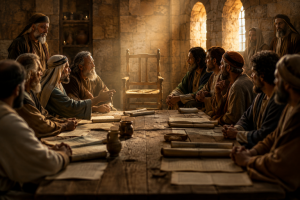
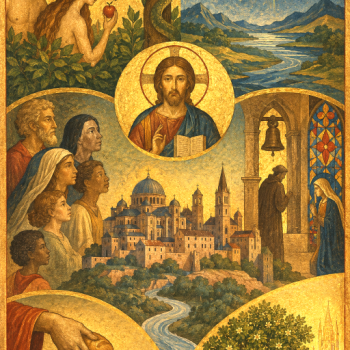
AI image created by author.
Any Catholic interested in theology who has Protestant friends knows the drill. Catholics appeal to the Church, including the papacy, as an authority for resolving doctrinal questions, while Protestants appeal to Scripture alone. Yet these debates often overlook a more fundamental issue: the nature of biblical authority itself.
Regardless of whether one views the papacy as a legitimate development or an illegitimate innovation, a prior question remains: Did Christ establish a Church capable of authoritatively resolving doctrinal disputes? If He did, was that authority temporary or permanent?
Catholics and Protestants generally agree on several basic biblical truths:
- Jesus established one Church (Matthew 16:18).
- This Church exercised authority (Acts 15).
- This Church is one and should remain so (1 Corinthians 1:10–17).
- Jesus commands believers to bring disputes before the Church (Matthew 18:15–17).
The New Testament presents a visible Church that exercised real authority. It settled disputes, preserved unity, and issued binding judgments. Most Christians acknowledge that such authority existed during the apostolic age. The real question is whether Christ intended that authority to expire with the death of the apostles.
Scripture never explicitly says that it did.
Christ Did Not Leave His Followers as Isolated Interpreters
At least in the New Testament, Christ did not leave His followers to operate as isolated interpreters of doctrine and discipline. In Matthew 18:15–17, Jesus instructs believers to bring unresolved disputes before the Church for resolution:
If your brother sins against you, go and tell him his fault, between you and him alone. If he listens to you, you have gained your brother. But if he does not listen, take one or two others along with you, that every charge may be established by the evidence of two or three witnesses. If he refuses to listen to them, tell it to the church. And if he refuses to listen even to the church, let him be to you as a Gentile and a tax collector.
Notice what Jesus does not say. He does not tell believers to consult their private interpretation of Scripture. He does not instruct them to gather competing opinions and decide for themselves. Nor does He suggest that those involved in the dispute simply separate and form another congregation.
Instead, Christ points them to the Church. More importantly, the Church’s judgment carries consequences. A person who refuses to listen even to the Church places himself outside the community of believers.
One must ask: when did this change? If Christ intended the Church to settle disputes among believers, when did that authority expire? And what Church, if any, still fulfills that role today?
The Apostolic Church Exercised Real Authority
Some Protestants may object that Matthew 18:15–17 concerns sin and church discipline rather than doctrinal disputes. Fair enough. But what about the question of circumcision for Gentile believers—the Church’s first major theological controversy?
Acts 15 records a dispute between Paul and Barnabas and certain Jewish Christians, often called Judaizers, who insisted that Gentile converts must be circumcised and observe the Mosaic Law. The issue was not merely practical. It concerned salvation itself. Were Gentile Christians required to submit to circumcision, or not?
Rather than allowing each congregation to reach its own conclusion, the parties brought the dispute before the apostles and elders in Jerusalem. There, the leaders of the Church considered the matter and rendered a decision. They ultimately concluded that Gentile Christians were not required to be circumcised and communicated that judgment to the churches in a formal letter.
The Judaizers did not lack biblical support for their position. Genesis 17:13 describes circumcision as an “everlasting covenant,” and numerous Old Testament passages reinforced its importance. Yet the apostles concluded that these texts no longer bound Gentile converts under the New Covenant.
Notice what did not happen. No one retreated into private study until a consensus emerged. Local churches did not decide the issue independently. Competing interpretations did not coexist indefinitely.
Instead, the leaders of the Church gathered, debated, and issued a binding judgment.
Does that paradigm seem familiar?
The Protestant Answer: Authority Expired with the Apostles
Most Protestants would agree with everything discussed thus far because these events occur within the pages of Scripture. “Of course,” they might respond, “the apostles received real authority from Christ and exercised it.”
Many Protestants further argue that this authority belonged uniquely to the apostles. With the death of the last apostle, public revelation ceased, and the only infallible witness to that apostolic authority remained in the writings they left behind. According to this view, Scripture alone now serves as the Church’s final authority in matters of faith and morals.
This position explains why Christians do not expect new public revelation and why the apostolic office occupies a unique place in salvation history.
Yet several questions remain:
- Where does Scripture teach that the Church’s authority would expire with the apostles?
- Why does Matthew 18 contain no indication that the Church’s authority would end?
- Why does Acts 15 appear to establish a pattern for resolving disputes rather than a temporary exception?
- If Christ intended the Church’s authority to expire, when and how was that transition communicated to believers?
These questions do not disprove the Protestant position. They do, however, expose an assumption that Scripture itself never explicitly states.
The Canon and Nicaea Problem
Scripture never declares its own contents. Christ never commanded His followers to write a New Testament, nor did He provide a list of books that would eventually belong to it. The Bible therefore owes its material existence, as well as its table of contents, to the Church.
Protestants often respond that the Church did not create the canon but merely recognized it. Catholics readily agree. The question, however, remains: by what authority did the Church recognize the canon correctly? If the Church was guided reliably enough to identify the inspired books of Scripture, why could it not also define doctrine reliably?
A similar challenge arises with the Council of Nicaea. Most Christians affirm Christ’s full divinity and accept the Nicene Creed as an authentic expression of Christian orthodoxy. Yet Nicaea took place nearly three centuries after the death of the last apostle.
Protestants typically answer that they accept Nicaea because the council fathers interpreted Scripture correctly. But who authoritatively determined that their interpretation was correct? Arius, who denied Christ’s full divinity, also appealed to Scripture in defense of his position.
The dispute, therefore, was not Scripture versus no Scripture. It was one interpretation of Scripture against another. The Church gathered, examined the controversy, and rendered a judgment.
That pattern should sound familiar.
It is precisely what occurred in Acts 15.
Did Christ Ever Revoke the Church’s Authority?
I invite Protestants reading this to search the Scriptures for any passage in which Christ teaches that the Church would cease to settle disputes, lose its teaching authority, or give way to private interpretation as the means for resolving theological disagreements. No such passage exists.
Instead, we find Christ promising to remain with His Church (Matthew 28:20), Paul describing the Church as the “pillar and foundation of the truth” (1 Timothy 3:15), and the author of Hebrews commanding believers to obey their leaders (Hebrews 13:17).
If Christ intended the Church’s authority to expire, why is there no indication of that expiration?
In fact, both Scripture and the early Church reflect the Catholic understanding of authority. Christ established a visible Church and entrusted it with authority. The apostles appointed successors, and the Holy Spirit continued to guide the Church. Councils continued the pattern established in Acts 15, addressing disputes and clarifying doctrine. Dogma did not add new revelation; it clarified and defended the revelation already entrusted to the Church.
Viewed in this light, Acts 15 stands not as an exception but as the model. The Church gathered, deliberated, and rendered judgment under the guidance of the Holy Spirit. The early councils followed the same pattern.
Final Thoughts… The Question Every Christian Must Answer
Christians should not begin by asking whether the papacy is biblical. They should first ask a more fundamental question: Did Christ establish a Church capable of rendering binding doctrinal judgments?
If the answer is no, then Acts 15 becomes difficult to explain. If the answer is yes, then another question immediately follows: Did Christ ever give that authority an expiration date?
If no such expiration date exists, then Christians must ask where that authority exists today. That question naturally leads to the larger debate about apostolic succession, councils, and ultimately the Catholic Church.
The discussion should begin there, not with the papacy. Before one can ask who possesses authority, one must first determine whether Christ intended His Church to retain it at all.
That is the question every Christian must answer.
Thank you!
If you liked this article, please leave your comments below. I am very interested in your opinion on this topic.
Read The Latin Right’s other writing here.
Please visit my Facebook page and IM your questions (and follow my page) or topics for articles you would like covered.
Evangelical
History and Religion
Previous Post
June 9, 2026
"The Committee" Evaluates Moses and Jesus... The Results
Next Post
June 12, 2026 The Question That Quietly Disappeared About Contraception
Recent Comments
"I once had an discussion with someone who was adamant that immigrants to the U.S. ..."
The West’s Christian Moral Inheritance: A ..."
""If some things were different, other things would be otherwise," said the Griffin to the ..."
The West’s Christian Moral Inheritance: A ..."
"Can we look forward to the orans decision in the Portland, Oregan diocese continuing "Christianity's ..."
The West’s Christian Moral Inheritance: A ..."
"And again, your attempt to be clever reveals your denial of the humanity of the ..."
Why Is Abortion a Lost Cause ..."
Browse Our Archives
Select a Category Abortion Arius Atheists Catholic Apologetics Catholic Culture Catholic History Catholic Humor Catholic Poetry Catholic Politics Catholic Theology Dr. James White Faith Alone Joe Heschmeyer Kamala Harris Martin Luther Pope Francis Preborn Children President Biden Science and Catholicism Sola Scriptura Synod of Synodality Trinity
Select a Month November 2026 October 2026 September 2026 August 2026 July 2026 June 2026 May 2026 April 2026 March 2026 February 2026 January 2026 December 2025 November 2025 October 2025 September 2025 August 2025 July 2025 June 2025 May 2025 April 2025 March 2025 February 2025 January 2025 December 2024 November 2024 October 2024 September 2024 August 2024 July 2024 June 2024 May 2024 April 2024 March 2024 February 2024 January 2024 December 2023 November 2023 October 2023 September 2023 August 2023 July 2023 June 2023 May 2023 April 2023 March 2023 February 2023 January 2023 December 2022 November 2022 October 2022 September 2022 August 2022 July 2022 June 2022 May 2022 April 2022 March 2022 February 2022 January 2022 December 2021 November 2021
Follow Us!
TAKE THE
Religious Wisdom Quiz
Which city did David conquer and make his capital?
Select your answer to see how you score.
Jerusalem Gibeon Hebron Bethel
Related posts from The Latin Right
The West's Christian Moral Inheritance: A Legacy Denied
Pope Leo in Lima: The Speech That Inconveniences...

Will God Raise Us as We Are or...
TRENDING AT PATHEOS Catholic

Blue Christmas: Making Room for Grief at Church
A Blue Christmas service makes room for grief, remembrance, and hope. Explore...

We Can Trust That God Will Use Our...
A Jesus-loving young friend who is going through deep suffering sent me...

Everything is worship for Quakers. The Quakers emphasize contemplation, equality, pacifism and...

Happy Thanksgiving! I published this Thanksgiving column back in 2017 in...

More Than a Meal: A Messianic Thanksgiving
A Messianic Thanksgiving What if Thanksgiving became more than a meal to...

The Darkening of the Sun, Moon, and Stars
The darkening of the sun and moon and the falling of stars...
view all Catholic blogs
What Are Your Thoughts?leave a comment
Ad-Free & Subscriber Log-In Subscription Support
- About Us
- 2026 Calendar
- Videos
- Podcasts
- Library of World Religions
- Faith In Media Tracker
- Advertise With Us
- Write for Us
- Privacy Policy
- Terms of Service
- Do Not Sell My Data
- Contact Us
- Radiant Digital
- Manage Newsletter Subscriptions
- Unsubscribe From Notifications
- Sitemap
Copyright 2008-2026, Patheos, part of the Radiant Digital network of media brands. All rights reserved.
Subscription Support Ad-Free & Subscriber Log-In
Follow Patheos