
BuddhistCatholicContemplativeEvangelicalGeneral ChristianHinduJewishLatter-day SaintMuslimNew VisionsProgressive Christian
Beliefs
- Buddhist
- Catholic
- Contemplative
- Evangelical
- General Christian
- Hindu
- Jewish
- Latter-day Saint
- More Voices
- Muslim
- New Visions
- Pagan
- Progressive Christian
Topics
- Religion News
- Food and Religion
- Sports and Religion
- Religious Art
- Religious Music and Entertainment
- Religious Events
- History and Religion
- Style and Religion
- Politics and Religion
- Women in Religion
- Recreation Outdoors and Religion
- Business Finance and Religion
- Careers Workplace and Religion
- Education and Religion
- Family Parenting and Religion
- Health Fitness and Religion
- Home and Religion
- Relationships and Religion
- Technology and Religion
- Travel and Religion
Columnists
- Buddhist Columnists
- Business Finance and Religion Columnists
- Careers Workplace and Religion Columnists
- Catholic Columnists
- Contemplative Columnists
- Education and Religion Columnists
- Evangelists Columnists
- Family Parenting and Religion Columnists
- General Christian Columnists
- Health Fitness and Religion Columnists
- Hindu Columnists
- History and Religion Columnists
- Home and Religion Columnists
- Jewish Columnists
- More Voices Columnists
- Latter Day Columnists
- Muslim Columnists
- New Visions Columnists
- Nonreligious Columnists
- Pagan Columnists
- Politics and Religion Columnists
- Progressive Columnists
- Recreation Outdoors and Religion Columnists
- Relationships and Religion Columnists
- Religion News Columnists
- Religious Art Columnists
- Religious Events Columnists
- Religious Music and Entertainment Columnists
- Sports and Religion Columnists
- Style and Religion Columnists
- Technology and Religion Columnists
- Travel and Religion Columnists
- Women in Religion Columnists
Resource Library
- 2026 Calendar
- Library of World Religions
- The 100 Most Holy Places on Earth
- Patheos Answers
- Podcasts
- Videos
- Faith Leaders Database
- Anglican Episcopalian
- Bahai
- Baptist
- Buddhism
- Christianity
- Confucianism
- Eastern Orthodoxy
- Hinduism
- Holiness and Pentecostal
- ISKCON
- Islam
- Judaism
- Lutheran
- Methodist
- The Church of Jesus Christ of Latter-day Saints
- New Age
- Paganism
- Presbytarian and Reformed
- Protestantism
- Religion Behind the Scenes
- Roman Catholic
- Scientology
- Shia Islam
- Sikhism
- Sufism
- Sunni Islam
- Taoism
- Zen
- See all religions
Research Tools
 Ad-Free & Subscriber Log-In Subscription Support
Ad-Free & Subscriber Log-In Subscription Support
Follow Patheos 

- Trending:
- Forgiveness
- |
- Marriage
- |
- Consciousness
- |
- Death Penalty
- |
- Election
- |
- Halloween

- Home
- Catholic
- History and Religion
- If Scripture Alone, Then Who Decides?
If Scripture Alone, Then Who Decides?
Last updated on: March 28, 2026 at 4:02 pm by Dennis Knapp
If Scripture Alone, Then Who Decides? 2026-03-28T16:02:54-06:00 Dennis Knapp
Patheos Explore the world's faith through different perspectives on religion and spirituality! Patheos has the views of the prevalent religions and spiritualities of the world.
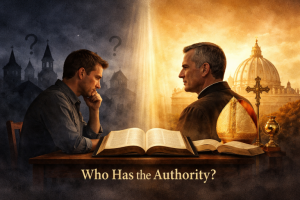
AI image created by author.
Once upon a time, two committed Christians opened the Bible to answer the same question that troubled them both: Does baptism merely symbolize salvation, or does it bring about new birth?
This question did not arise from idle curiosity. It reached far beyond academic speculation. It concerned salvation itself. With such high stakes, both men wanted more than a formed opinion—they wanted the truth. God’s truth.
Yet truth has a fixed nature. If these two men reached contradictory conclusions, both could not be right at the same time and in the same sense. Of the two, only one possessed the means to answer the question in a meaningful and definitive way.
Anthony, the first Christian, was a committed Protestant. He believed in the perspicuity of Scripture—that the Bible clearly teaches what is necessary for salvation:
In other words, Anthony adhered to sola scriptura, Protestantism’s foundational doctrine.
“Surely,” he thought as he opened his New King James Version Bible, “God’s Word will clearly teach me—or correct me—regarding the true nature of baptism.”
Now consider Douglas. Unlike Anthony, Douglas was a committed and faithful Catholic. He trusted the Magisterium and believed that one must interpret Scripture within the Church.
“The Church has not left this unanswered,” Douglas thought. “I do not stand alone—I receive what has already been handed down.”
Anthony and Douglas shared much in common. Both loved Christ. Both believed the Bible was inspired by God. Both prayed for the guidance of the Holy Spirit when they read Scripture. They differed not in sincerity, but in their understanding of authority.
The difference between them would not lie in the text—but in who had the authority to say what it meant.
The Question: What Does Baptism Do?
The question before Anthony and Douglas concerned the nature of baptism. Some Christians view baptism as merely symbolic, an act of obedience to Christ’s command. Others—including Douglas—understand baptism as salvific: the moment when God imparts grace, forgives sins (both original and actual), and initiates the believer into the life of salvation.
Several key texts stood at the center of their inquiry:
Jesus answered, “Truly, truly, I say to you, unless one is born of water and the Spirit, he cannot enter the kingdom of God.”
And Peter said to them, “Repent and be baptized every one of you in the name of Jesus Christ for the forgiveness of your sins, and you will receive the gift of the Holy Spirit.”
Baptism, which corresponds to this, now saves you—not as a removal of dirt from the body but as an appeal to God for a good conscience, through the resurrection of Jesus Christ.
Both men approached these passages with seriousness. They prayed, consulted study tools, and examined the witness of Christian history.
Anthony’s Journey: The Weight of Interpretation
After a period of careful study, Anthony finally reached a conclusion: baptism did not affect salvation—though it closely accompanied it in a secondary sense—but instead served as a sign and seal of the New Covenant. He further concluded that baptism, while sacramental, does not regenerate.
Anthony interpreted “water and Spirit” in John 3:5 in a spiritual or metaphorical sense. Likewise, in Acts 2:38, he saw baptism as closely tied to forgiveness but not its cause. Finally, he understood “baptism now saves you” in 1 Peter 3:21 as referring not to the physical act itself, but to the inward reality it signifies.
At first, Anthony felt intellectually justified. He saw coherence in his system, which preserved salvation by grace and the priority of faith. “Scripture speaks in a sacramental way,” he reasoned, “but it does not teach that water itself regenerates.”
Over time, however, he encountered pushback—not from Catholics like Douglas, but from other Protestants who used the same texts and methods. The earliest Protestants, the Lutherans, affirmed baptismal regeneration. Baptists, by contrast, denied it vigorously, while Anglicans held a range of positions. The same texts, the same methods—yet different conclusions.
This realization forced Anthony to pause. Why did others, using the same Bible and the same interpretive approach, arrive at different conclusions? Had they misread Scripture? Or had he? Should he revise his position, or stand firm?
Anthony remained confident, but he could not resolve the disagreement. He had reached a conclusion. What he had not found was a way to make it binding.
Douglas’s Journey: Receiving What Has Been Handed Down
At first, Douglas followed a path similar to Anthony’s. He approached the texts carefully and prayerfully. He consulted Scripture and reflected on its meaning. However, as a Catholic, he also considered how Christians before him had understood these passages. He read Scripture within the life of the Church.
In doing so, he discovered a consistent witness: the Church had long affirmed baptism not merely as a symbol, but as the means by which God grants new birth, forgives sins, and incorporates believers into Christ. This understanding did not arise from isolated interpretations, but from the Church’s continuous teaching through the Magisterium.
Douglas did not set aside the force of Scripture; he received it within that same tradition. The words “born of water and the Spirit,” “for the forgiveness of your sins,” and “baptism now saves you” did not stand alone as texts to be debated endlessly. The Church had already given them a definitive meaning.
This did not eliminate the need for study or reflection. Douglas still wrestled with Scripture, sought deeper understanding, and grew in his appreciation of its richness. But when questions arose, he did not face them alone.
Where Anthony encountered competing interpretations, Douglas encountered a settled teaching. Where Anthony had to decide, Douglas could receive.
“The Church has not left this unanswered,” he thought. “I do not stand alone—I receive what has already been handed down.”
Douglas, like Anthony, reached a conclusion. But unlike Anthony, he did not bear the weight of making it binding.
Two Ways of Knowing
Both Anthony and Douglas sought to know the truth about baptism by studying the Scriptures. However, their different sources of authority led them down divergent paths. Anthony, relying on sola scriptura, ultimately depended on his own interpretation to determine what Scripture teaches. Douglas, by contrast, received and submitted to what the Church teaches.
For Anthony, no final court of appeal exists. For Douglas, one does—the Church. For Anthony, unity depends on agreement with his conclusions, if such agreement can be found at all. For Douglas, unity rests on a shared authority that precedes individual interpretation.
Both read Scripture. Only one had a way to settle what it meant.
The Objection: “But Anthony Has Authorities Too”
Some on Anthony’s side will object: “But Anthony has authorities too. During his study of baptism, he consulted Church history, scholars, creeds, and pastors. He is not alone, nor is he careless.”
This is true—but with an important qualification.
Anthony accepts creeds only insofar as they align with his interpretation of Scripture. He respects the Church Fathers, but he regards them as corrigible. Confessions bind him only so long as he agrees with them. In each case, the pattern remains the same: every authority speaks—but only after Anthony permits it.
Yet an authority that must first be approved is not truly an authority—it is an educated opinion. Anthony must choose between competing authorities and judge which ones interpret Scripture correctly. In doing so, he places himself above them all.
Therefore, the final authority is not the expert, the creed, or history—but Anthony himself.
At This Point…
At this point, someone might object: “But your claim—that Christ established a Church with authority—is itself an interpretation of Scripture.”
That is true. But this does not solve the problem—it restates it.
The question is not whether interpretation is involved. Every Christian must interpret Scripture. The question is what happens when interpretations conflict.
When Anthony and Douglas disagree, both appeal to Scripture. Both claim fidelity to its meaning. Both offer interpretations. But which interpretation prevails—and why?
If no authority exists to resolve the dispute, then the disagreement remains permanent. If an authority does exist, then the question becomes whether Christ established it.
Interpretation is unavoidable. The real issue is whether it is finalized.
Final Thoughts… The Question That Remains
Anthony and Douglas began with the same Bible. They approached it with the same sincerity, the same desire for truth, and the same reliance on God’s guidance. Yet they arrived at different conclusions about a question that touches salvation itself.
The difference did not lie in the text.
It lay in who had the authority to say what the text means. Scripture does not interpret itself. Someone must read it, understand it, and determine its meaning. When disagreements arise—as they did for Anthony and countless others—an interpretation must prevail. But who decides which interpretation is correct?
So, the question remains:
When two sincere Christians disagree about what Scripture teaches regarding salvation—who has the authority to decide?
If the answer is “the individual,” then the final authority rests not in Scripture alone, but in the one who interprets it.
If the answer is something more—something visible, historical, and binding—then the question is no longer whether authority exists, but where Christ placed it.
Thank you!
If you liked this article, please leave your comments below. I am very interested in your opinion on this topic.
Read The Latin Right’s other writing here.
Please visit my Facebook page and IM your questions (and follow my page) or topics for articles you would like covered.
…despite the undeniable influence of the church fathers (especially some aspects of the later Augustine) on the magisterial Protestant reformers, and notwithstanding their acceptance of early conciliar decrees, the magisterial reformers rejected patristic theological claims and interpretations of scripture, just as they rejected medieval exegesis, papal decrees, canon law, conciliar decrees, and ecclesiastical practices, precisely wherever any of these contradicted their own interpretations of the Bible. In no sense therefore was “tradition” for magisterial Protestant reformers an authority to which they deferred relative to their respective readings of scripture, as it was for their Catholic counterparts. This was the whole point and part of the power of “scripture alone.”
Neither magisterial nor radical Protestant reformers modified their hermeneutical judgments when these were at odds with traditional authorities; instead, they rejected the latter at each point of disagreement. – Brad Gregory, The Unintended Reformation: How a Religious Revolution Secularized Society
Evangelical
History and Religion
Previous Post
March 25, 2026
Non Serviam: The Mystery of the First Refusal
Next Post

March 31, 2026 Nietzsche, Orwell, Modern Grievance Politics & "No Kings"
Recent Comments
"My honest take? I think St John Paul II was adamant that on his watch, ..."
Amoris Laetitia Deserves a Better Defence
""It's reasonable to ask what those claims mean in practice."It is. And I've laid out ..."
Amoris Laetitia Deserves a Better Defence
"I've said what I said, Peter. Read the words. If you don't have anything new ..."
Amoris Laetitia Deserves a Better Defence
"I don't expect you to decide who should be admitted to the sacraments. I'm asking ..."
Amoris Laetitia Deserves a Better Defence
Browse Our Archives
Select a Category Abortion Arius Atheists Catholic Apologetics Catholic Culture Catholic History Catholic Humor Catholic Poetry Catholic Politics Catholic Theology Dr. James White Faith Alone Joe Heschmeyer Kamala Harris Martin Luther Pope Francis Preborn Children President Biden Science and Catholicism Sola Scriptura Synod of Synodality Trinity
Select a Month October 2026 September 2026 August 2026 July 2026 June 2026 May 2026 April 2026 March 2026 February 2026 January 2026 December 2025 November 2025 October 2025 September 2025 August 2025 July 2025 June 2025 May 2025 April 2025 March 2025 February 2025 January 2025 December 2024 November 2024 October 2024 September 2024 August 2024 July 2024 June 2024 May 2024 April 2024 March 2024 February 2024 January 2024 December 2023 November 2023 October 2023 September 2023 August 2023 July 2023 June 2023 May 2023 April 2023 March 2023 February 2023 January 2023 December 2022 November 2022 October 2022 September 2022 August 2022 July 2022 June 2022 May 2022 April 2022 March 2022 February 2022 January 2022 December 2021 November 2021
Follow Us!
TAKE THE
Religious Wisdom Quiz
How was the crossing of the Jordan similar to the crossing of the Red Sea?
Select your answer to see how you score.
A great wind caused the event It happened at night The people walked on stones The waters were parted
Related posts from The Latin Right

Amoris Laetitia Deserves a Better Defence

Rich Man, Poor Man: Altruism and Agency

The Order We Did Not Make: The World...

Is This “Culture War” Catholicism—or Evangelization?
TRENDING AT PATHEOS Catholic

Janie Learns the Way of the Cross: A...
Teaching children about Jesus' Passion can be challenging. Many parents and educators...

Looking For Good Catholic Writing - October 2026
He alone extends the heavens, and he walks upon the waves of...

In "Irreplaceable," our book on vocation and technology, Trevor Sutton and I...

I was strolling through the top floor of the brand new Parthenon...

What Does Gêvâh Mean For Kimberley Guifoyle &...
This week, a lot of the news is focused on Kimberly Guilfoyle....

INNER CIRCLE: Profound Mystery (Of Christ In All...
Ephesians 5:31-32 “For this reason, a man will leave his father and...
view all Catholic blogs
What Are Your Thoughts?leave a comment
Ad-Free & Subscriber Log-In Subscription Support
- About Us
- 2026 Calendar
- Videos
- Podcasts
- Library of World Religions
- Faith In Media Tracker
- Advertise With Us
- Write for Us
- Privacy Policy
- Terms of Service
- Do Not Sell My Data
- Contact Us
- Radiant Digital
- Manage Newsletter Subscriptions
- Unsubscribe From Notifications
- Sitemap
Copyright 2008-2026, Patheos. All rights reserved.
Subscription Support Ad-Free & Subscriber Log-In
Follow Patheos