
BuddhistCatholicContemplativeEvangelicalGeneral ChristianHinduJewishLatter-day SaintMuslimNew VisionsProgressive Christian
Beliefs
- Buddhist
- Catholic
- Contemplative
- Evangelical
- General Christian
- Hindu
- Jewish
- Latter-day Saint
- More Voices
- Muslim
- New Visions
- Pagan
- Progressive Christian
Topics
- Religion News
- Food and Religion
- Sports and Religion
- Religious Art
- Religious Music and Entertainment
- Religious Events
- History and Religion
- Style and Religion
- Politics and Religion
- Women in Religion
- Recreation Outdoors and Religion
- Business Finance and Religion
- Careers Workplace and Religion
- Education and Religion
- Family Parenting and Religion
- Health Fitness and Religion
- Home and Religion
- Relationships and Religion
- Technology and Religion
- Travel and Religion
Columnists
- Buddhist Columnists
- Business Finance and Religion Columnists
- Careers Workplace and Religion Columnists
- Catholic Columnists
- Contemplative Columnists
- Education and Religion Columnists
- Evangelists Columnists
- Family Parenting and Religion Columnists
- General Christian Columnists
- Health Fitness and Religion Columnists
- Hindu Columnists
- History and Religion Columnists
- Home and Religion Columnists
- Jewish Columnists
- More Voices Columnists
- Latter Day Columnists
- Muslim Columnists
- New Visions Columnists
- Nonreligious Columnists
- Pagan Columnists
- Politics and Religion Columnists
- Progressive Columnists
- Recreation Outdoors and Religion Columnists
- Relationships and Religion Columnists
- Religion News Columnists
- Religious Art Columnists
- Religious Events Columnists
- Religious Music and Entertainment Columnists
- Sports and Religion Columnists
- Style and Religion Columnists
- Technology and Religion Columnists
- Travel and Religion Columnists
- Women in Religion Columnists
Resource Library
- 2026 Calendar
- Library of World Religions
- The 100 Most Holy Places on Earth
- Patheos Answers
- Podcasts
- Videos
- Faith Leaders Database
- Anglican Episcopalian
- Bahai
- Baptist
- Buddhism
- Christianity
- Confucianism
- Eastern Orthodoxy
- Hinduism
- Holiness and Pentecostal
- ISKCON
- Islam
- Judaism
- Lutheran
- Methodist
- The Church of Jesus Christ of Latter-day Saints
- New Age
- Paganism
- Presbytarian and Reformed
- Protestantism
- Religion Behind the Scenes
- Roman Catholic
- Scientology
- Shia Islam
- Sikhism
- Sufism
- Sunni Islam
- Taoism
- Zen
- See all religions
Research Tools
 Ad-Free & Subscriber Log-In Subscription Support
Ad-Free & Subscriber Log-In Subscription Support
Follow Patheos 

- Trending:
- Forgiveness
- |
- Marriage
- |
- Consciousness
- |
- Death Penalty
- |
- Election
- |
- Halloween

- Home
- Catholic
- History and Religion
- Why the Protestant “Solution” to Sola Scriptura Fails
Why the Protestant “Solution” to Sola Scriptura Fails
Last updated on: November 8, 2025 at 7:01 pm by Dennis Knapp
Why the Protestant “Solution” to Sola Scriptura Fails 2025-11-08T19:01:58-06:00 Dennis Knapp
Patheos Explore the world's faith through different perspectives on religion and spirituality! Patheos has the views of the prevalent religions and spiritualities of the world.
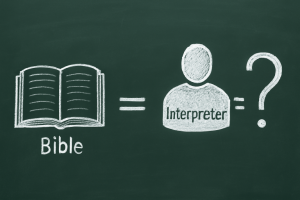
AI image created by author.
Recently, I engaged two Protestant friends in an online discussion about Scripture as the final authority in the Christian life (sola scriptura). I posed what I believe is the crucial question: By what concrete mechanism does Scripture—apart from an authoritative interpreter—correct the Church as a body and not merely individuals’ opinions? Closely related is this: Under sola scriptura, who or what has the authority to say, “You’re wrong—and I’m right—and this correction is binding on the Church”?
These questions are not tricks. They expose a genuine structural problem that demands a real solution.
My Protestant friends responded with this:
- Scripture corrects pastors, churches, and entire denominations.
- Scripture stands above human traditions.
- Scripture serves as the court of final appeal.
They also admitted:
- Scripture requires interpretation.
- Every denomination interprets it differently (hence the multiplicity of denominations).
- Any believer may appeal to Scripture against his own denomination.
- No living binding authority adjudicates competing interpretations.
And there lies the problem.
Protestants affirm Scripture as the “final authority,” yet they cannot point to any concrete mechanism by which Scripture—without an authoritative interpreter—corrects the Church as a whole. In practice, Scripture becomes “final” only as each denomination or each individual interprets it. As a result, sola scriptura preserves Scripture’s supremacy in theory while spreading interpretive authority across thousands of rival bodies and countless individuals in practice.
In short, the Protestant “solution” to the problem of sola scriptura fails because it never shows how Scripture corrects the Church—only that it should.
The Core Principle of Sola Scriptura
To avoid any charge of misrepresenting sola scriptura, I will lay out its core elements as Protestants themselves articulate them.
Sola scriptura affirms that:
- Scripture alone provides an infallible rule of faith and practice.
- Scripture tests and confirms all doctrines.
- The Church, councils, and traditions hold only fallible, secondary authority.
Sola scriptura aims to:
- Safeguard the sufficiency of divine revelation in Scripture.
- Prevent human traditions from overriding the Word of God.
The appeal of sola scriptura rests in this:
- It appears to elevate Scripture above human institutions.
- It promises a clear, objective authority for all Christians.
Sola scriptura claims that Scripture alone supplies an infallible rule of faith while the Church, councils, and traditions offer only fallible guidance. It promises to protect divine revelation from corruption and to give believers a standard above every human institution.
All of this sounds reasonable—until one notices the glaring flaw.
The Fundamental Problem of Biblical Interpretation
Every written text requires an interpreter. Scripture itself carries no operative authority apart from interpretation. Reformed theologian Keith Mathison admits this problem in The Shape of Sola Scriptura:
…any appeal to Scripture is an appeal to an interpretation of Scripture. The only question is: whose interpretation? When we face conflicting interpretations, we cannot set a Bible on a table and ask it to resolve our disagreement as if it were a Ouija board. For Scripture to serve as an authority at all, somebody must read, exegete, and interpret it. For the Holy Spirit to speak through Scripture, some human agency must get involved—even if that agency is simply one individual reading the text.
Mathison limits this problem to “Bible-and-me” Christians—non-confessional, non-denominational readers. He claims that confessional Protestants escape the issue by appealing to the “magisterial Reformers” and historic creeds.
But pushing the interpretive burden one fallible step back does not solve the problem. Why not? Because every Protestant Reformer invoked Scripture as the final authority, yet they disagreed profoundly. Luther and Zwingli split over the Eucharist. Calvin and Arminius split over grace. In every dispute among the Reformers, Scripture did not settle their competing interpretations.
Why the “Magisterial” Solution Fails
The pattern among the Reformers mirrors the pattern we see today among their successors: ongoing fragmentation and the proliferation of synods and denominations.
The Reformers failed to show how Scripture corrects the Church—only that it should. Their confessions cannot adjudicate modern disputes because they exist as historical documents, not living authorities.
Consider The Lutheran Church—Missouri Synod (LCMS) and The Wisconsin Evangelical Lutheran Synod (WELS), both heirs of Luther. Both claim Scripture as their final authority. Both appeal to the Book of Concord and the Augsburg Confession. Yet they remain divided to the point that LCMS members cannot receive communion in WELS congregations. Their shared heritage and confessions cannot repair the breach, because neither body possesses a mechanism to settle the disagreement and restore fellowship.
In theory, Scripture functions as the final authority for the LCMS, WELS, Presbyterians, Anglicans, Baptists, and every other Protestant body. In practice, the interpreter—the individual, the pastor, or the synod—becomes the final authority. Authority slides from the Word of God to the reader of the Word, even while Protestants insist otherwise.
The “Essentials” Escape Clause
Many Protestants attempt a final maneuver. They claim that disagreements concern only “non-essentials” while unity rests on the “essentials” of the faith.
But this move creates new problems:
- Scripture never identifies which doctrines count as “essential.”
- Calling a doctrine “non-essential” requires an extra-biblical judgment—precisely the problem at hand.
- Protestant bodies disagree on what counts as essential.
Baptists, Anglicans, Presbyterians, and Lutherans draw the line differently. The very act of drawing that line requires a binding authority—which sola scriptura denies.
Thus, the “essentials” category functions as an escape hatch that quietly assumes the very mechanism Protestants reject.
Final Thoughts: As Long as Scripture Requires Interpretation, Sola Scriptura Always Fails
Sola scriptura promises a single, infallible authority, yet it offers no binding mechanism to determine what that authority teaches. Every appeal to Scripture becomes an appeal to an interpretation—whether from an individual, a pastor, or a synod. Without a living, authoritative interpreter, Scripture cannot correct the Church; it can only multiply competing readings.
Thus, sola scriptura succeeds only in theory. In practice, it replaces one Magisterium with thousands and calls the result “Scripture alone.” Protestants affirm the supremacy of the Bible but distribute interpretive authority among countless rival voices, unable to bind the Church or preserve unity.
The Catholic Church resolves this impasse not by diminishing Scripture but by providing the very thing Scripture itself assumes: a living authority that speaks in Christ’s name, settles disputes, and preserves unity in the truth. If Scripture requires interpretation—and it always does—sola scriptura cannot function as the Church’s final authority. A text without a teacher cannot safeguard the faith; it can only multiply opinions.
And so, the question that launched this entire discussion remains unanswered by sola scriptura:
By what concrete mechanism does Scripture—apart from a living, authoritative interpreter—correct the Church as a whole and not merely individuals’ opinions?
Until someone answers that, sola scriptura remains merely an assertion, not a solution.
Thank you!
If you liked this article, please leave your comments below. I am very interested in your opinion on this topic.
Read The Latin Right’s other writing here.
Please visit my Facebook page and IM your questions (and follow my page) or topics for articles you would like covered.
General Christian
History and Religion
Previous Post

November 6, 2025
Is JD Vance the First True Catholic Presidential Hopeful?
Next Post

November 10, 2025 Between Mercy and Confusion: Amoris Laetitia's Challenge
Recent Comments
""It's reasonable to ask what those claims mean in practice."It is. And I've laid out ..."
Amoris Laetitia Deserves a Better Defence
"I've said what I said, Peter. Read the words. If you don't have anything new ..."
Amoris Laetitia Deserves a Better Defence
"I don't expect you to decide who should be admitted to the sacraments. I'm asking ..."
Amoris Laetitia Deserves a Better Defence
"But is that how you see it, Todd? You initially offered “salvation is more important ..."
Amoris Laetitia Deserves a Better Defence
Browse Our Archives
Select a Category Abortion Arius Atheists Catholic Apologetics Catholic Culture Catholic History Catholic Humor Catholic Poetry Catholic Politics Catholic Theology Dr. James White Faith Alone Joe Heschmeyer Kamala Harris Martin Luther Pope Francis Preborn Children President Biden Science and Catholicism Sola Scriptura Synod of Synodality Trinity
Select a Month October 2026 September 2026 August 2026 July 2026 June 2026 May 2026 April 2026 March 2026 February 2026 January 2026 December 2025 November 2025 October 2025 September 2025 August 2025 July 2025 June 2025 May 2025 April 2025 March 2025 February 2025 January 2025 December 2024 November 2024 October 2024 September 2024 August 2024 July 2024 June 2024 May 2024 April 2024 March 2024 February 2024 January 2024 December 2023 November 2023 October 2023 September 2023 August 2023 July 2023 June 2023 May 2023 April 2023 March 2023 February 2023 January 2023 December 2022 November 2022 October 2022 September 2022 August 2022 July 2022 June 2022 May 2022 April 2022 March 2022 February 2022 January 2022 December 2021 November 2021
Follow Us!
TAKE THE
Religious Wisdom Quiz
What type of insect is known from the plagues of Egypt?
Select your answer to see how you score.
Locusts Bees Flies Butterflies
Related posts from The Latin Right

Amoris Laetitia Deserves a Better Defence

Rich Man, Poor Man: Altruism and Agency

The Order We Did Not Make: The World...

Is This “Culture War” Catholicism—or Evangelization?
TRENDING AT PATHEOS Catholic

In "Irreplaceable," our book on vocation and technology, Trevor Sutton and I...

I was strolling through the top floor of the brand new Parthenon...

What Does Gêvâh Mean For Kimberley Guifoyle &...
This week, a lot of the news is focused on Kimberly Guilfoyle....

INNER CIRCLE: Profound Mystery (Of Christ In All...
Ephesians 5:31-32 “For this reason, a man will leave his father and...

Do Not Rejoice When Your Enemy Falls: The...
Turning an execution into a public spectacle is a disturbing expression of...

'The Chosen' S6 Trailer: The Passion Gets Very...
Not many watching 'The Chosen' worry about spoilers, but just because they...
view all Catholic blogs
What Are Your Thoughts?leave a comment
Ad-Free & Subscriber Log-In Subscription Support
- About Us
- 2026 Calendar
- Videos
- Podcasts
- Library of World Religions
- Faith In Media Tracker
- Advertise With Us
- Write for Us
- Privacy Policy
- Terms of Service
- Do Not Sell My Data
- Contact Us
- Radiant Digital
- Manage Newsletter Subscriptions
- Unsubscribe From Notifications
- Sitemap
Copyright 2008-2026, Patheos. All rights reserved.
Subscription Support Ad-Free & Subscriber Log-In
Follow Patheos