
BuddhistCatholicContemplativeEvangelicalGeneral ChristianHinduJewishLatter-day SaintMuslimNew VisionsProgressive Christian
Beliefs
- Buddhist
- Catholic
- Contemplative
- Evangelical
- General Christian
- Hindu
- Jewish
- Latter-day Saint
- More Voices
- Muslim
- New Visions
- Pagan
- Progressive Christian
Topics
- Religion News
- Food and Religion
- Sports and Religion
- Religious Art
- Religious Music and Entertainment
- Religious Events
- History and Religion
- Style and Religion
- Politics and Religion
- Women in Religion
- Recreation Outdoors and Religion
- Business Finance and Religion
- Careers Workplace and Religion
- Education and Religion
- Family Parenting and Religion
- Health Fitness and Religion
- Home and Religion
- Relationships and Religion
- Technology and Religion
- Travel and Religion
Columnists
- Buddhist Columnists
- Business Finance and Religion Columnists
- Careers Workplace and Religion Columnists
- Catholic Columnists
- Contemplative Columnists
- Education and Religion Columnists
- Evangelists Columnists
- Family Parenting and Religion Columnists
- General Christian Columnists
- Health Fitness and Religion Columnists
- Hindu Columnists
- History and Religion Columnists
- Home and Religion Columnists
- Jewish Columnists
- More Voices Columnists
- Latter Day Columnists
- Muslim Columnists
- New Visions Columnists
- Nonreligious Columnists
- Pagan Columnists
- Politics and Religion Columnists
- Progressive Columnists
- Recreation Outdoors and Religion Columnists
- Relationships and Religion Columnists
- Religion News Columnists
- Religious Art Columnists
- Religious Events Columnists
- Religious Music and Entertainment Columnists
- Sports and Religion Columnists
- Style and Religion Columnists
- Technology and Religion Columnists
- Travel and Religion Columnists
- Women in Religion Columnists
Resource Library
- 2026 Calendar
- Library of World Religions
- The 100 Most Holy Places on Earth
- Patheos Answers
- Podcasts
- Videos
- Faith Leaders Database
- Anglican Episcopalian
- Bahai
- Baptist
- Buddhism
- Christianity
- Confucianism
- Eastern Orthodoxy
- Hinduism
- Holiness and Pentecostal
- ISKCON
- Islam
- Judaism
- Lutheran
- Methodist
- The Church of Jesus Christ of Latter-day Saints
- New Age
- Paganism
- Presbytarian and Reformed
- Protestantism
- Religion Behind the Scenes
- Roman Catholic
- Scientology
- Shia Islam
- Sikhism
- Sufism
- Sunni Islam
- Taoism
- Zen
- See all religions
Research Tools
 Ad-Free & Subscriber Log-In Subscription Support
Ad-Free & Subscriber Log-In Subscription Support
Follow Patheos 

- Trending:
- Forgiveness
- |
- Marriage
- |
- Consciousness
- |
- Death Penalty
- |
- Election
- |
- Halloween

- Home
- Catholic
- Religion News
- Beyond Performative Hand-Wringing: Response to Mike Lewis
Beyond Performative Hand-Wringing: Response to Mike Lewis
Last updated on: October 14, 2025 at 8:00 am by Dennis Knapp
Beyond Performative Hand-Wringing: Response to Mike Lewis 2025-10-14T08:00:29-06:00 Dennis Knapp
Patheos Explore the world's faith through different perspectives on religion and spirituality! Patheos has the views of the prevalent religions and spiritualities of the world.
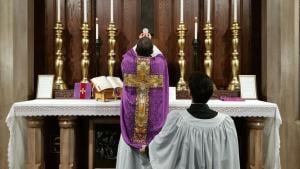 Guest writer: Pilgrim.
Mike Lewis’ recent article “Straight Answers: The Reasons Behind Restricting the Latin Mass“ raises legitimate concerns about unity and authority in the Church, yet it relies heavily on rhetorical manipulation and overgeneralization. This response examines where his critique succeeds, where it fails, and how the underlying tensions might be resolved.
Lewis correctly identifies extremism within traditionalism, but his framing collapses legitimate theological questions into moral pathology—a move that deepens division rather than fostering understanding. The Church’s crisis is not only about obedience but about the conditions under which authority can be trusted and credibly exercised.
Historical Context: From Reform to Restriction
The liturgical reform following Vatican II remains contested. Acting on Sacrosanctum Concilium (1963), Pope Paul VI’s 1969 Missale Romanum sought “full, conscious, and active participation” by the laity. Many Catholics experienced this reform less as renewal than as rupture. Archbishop Lefebvre resisted the changes, claiming the new Mass obscured Catholic doctrine. His defiance led to the formation of the SSPX and left a lasting wound on ecclesial unity.
Pope Benedict XVI sought healing. In Summorum Pontificum (2007), he declared the older form had “never abrogated” and sought liturgical peace through “mutual enrichment.” Pope Francis’s Traditionis Custodes (2021) reversed that openness, judging the old Mass to have become a banner for division rather than unity.
What Lewis Gets Right
The Legitimate Core and Failure to Police Extremism
Lewis’s most powerful argument is that traditionalism has failed to police its own extremes. Rome’s restrictions were reactive because the Vatican’s patience had worn thin; the movement’s most visible spokesmen had become increasingly divisive.
This critique deserves honesty. Archbishop Viganò has descended into apocalyptic denunciations that no Catholic in good standing can defend. Other voices – Taylor Marshall and Peter Kwasniewski – command substantial platforms while routinely undermining papal authority and treating post-conciliar teaching with systematic suspicion. When figures like these define the movement’s public face, the question “Is this really fringe?” needs an answer.
Many faithful attached to the old liturgy find these figures exhausting; however, their quiet fidelity rarely registers publicly. When the loudest voices are the most extreme, they define the movement. Most moderate traditionalists lead ordinary lives of faith, attending Mass, raising their families, and serving parishes. They may be unaware of online controversies. But visibility matters. When the movement’s public face consistently promotes problematic views with minimal internal resistance, then this moderation becomes practically irrelevant to how the movement shapes Catholic life.
The burden is real: those who love traditional liturgy and wish to preserve it must demonstrate their attachment is compatible with full communion. This requires public witness, creating and supporting voices that model both liturgical tradition and ecclesial obedience, not just private piety.
However, even where Lewis’s critique is justified, his analysis too often mistakes the symptoms of alienation for its causes.
Where the Argument Fails
The Rhetorical Trap: Performative Hand-Wringing
The article goes too far. It transforms legitimate concern into a sweeping indictment through performative moralising. The author anticipates backlash: “I am already anticipating the trolling and personal attacks…” This is not a cautious aside but a narrative frame, casting him as a “truth-teller” confronting a “hostile mob.” Thus, any criticism becomes proof of his thesis.
It is a rhetorical trap. By predicting attacks, he inoculates himself against critique. If traditionalists respond with anger, it confirms they are unreasonable. If they respond calmly, he appears magnanimous. The logic is self-sealing, an intellectual sleight of hand that substitutes immunity for substance.
This is the essence of performative hand-wringing – a genre of commentary that feigns pastoral concern while rehearsing well-worn condemnations. It is concern-trolling dressed up as prophetic bravery, a rhetorical pattern that appears across the Catholic commentariat, in traditionalist, progressive, and mainstream voices alike.
Such a strategy is boundary-policing, not persuasion. It reassures mainstream readers that “we” are sane while “they” are dangerous. In reality, it forecloses dialogue.
Conflation and Moral Equivalence
Lewis lists nearly every extreme accusation ever uttered in traditionalist media – Masonry, antisemitism, pseudo-science, fascist nostalgia – and suggests that “nearly every major traditionalist voice” shares several of these views. The tone in the “reality check” section is deliberately confrontational, creating a troubling conflation. By placing reasonable theological concerns (such as questioning non-infallible teachings) alongside genuinely toxic positions (antisemitism, the Protocols of the Elders of Zion), the undifferentiated list implies moral equivalence. Questioning Amoris Laetitia is not the same as promoting Judeo-Masonic conspiracy theories. Some items represent legitimate theological debate; others are views no Catholic should hold.
Catholic teaching has always recognized degrees of magisterial authority. Vatican I’s definition of papal infallibility in Pastor Aeternus (1870) was carefully limited to preserve space for theological inquiry and respectful questioning of non-definitive teaching. When Humanae Vitae was promulgated, Ratzinger acknowledged that Catholics may, in good conscience, struggle to fully assent to certain non-infallible teachings, provided they sincerely sought understanding. He recognized the difficulty of assent and the pastoral need for patience. Later, as Prefect of the Congregation for the Doctrine of the Faith, Cardinal Ratzinger affirmed that the prohibition of contraception expresses a teaching definitively proposed by the ordinary and universal Magisterium, and is therefore infallible in substance, even though Humanae Vitae itself is not an ex cathedra definition.
The 2018 revision of the Catechism on capital punishment illustrates this complexity. For two millennia, the Church taught that capital punishment could be legitimate under certain conditions. The new text declares it “inadmissible,” grounded in a deepened understanding of human dignity and the conditions of contemporary society. Yet the change is prudential and pastoral rather than dogmatic; it develops rather than reverses prior teaching. The Church cannot simply repudiate centuries of consistent doctrine as error.
When Peter Kwasniewski publicly contests this revision, he does so while claiming that his position represents the “true” Catholic teaching. The Vatican, for its part, insists that the new formulation expresses the authentic magisterium of Pope Francis. Both appeal to fidelity, yet from opposite directions. Lewis treats this tension as self-evidently resolved in favour of the latter. But that is precisely the question his framework cannot accommodate – the Catholic space between uncritical assent and systematic rejection.
By collapsing this distinction, Lewis implies that any questioning of recent papal teaching places one in the same category as antisemites and geocentrists. This is neither theologically sound nor pastorally wise. It is boundary-policing that forecloses genuine dialogue.
The FSSP Problem: When Obedience Is Insufficient
The Priestly Fraternity of Saint Peter exemplifies the problem. Founded explicitly in communion with Rome, accepting Vatican II and the validity of the reformed liturgy, the FSSP exists to preserve the traditional Mass as its charism. However, even they have faced increasing restrictions under Traditionis Custodes, despite modelling precisely the fidelity and obedience the hierarchy claims to seek. Lewis criticises FSSP priests for not concelebrating the Chrism Mass, treating their charism as inherently suspect rather than as a legitimate expression of liturgical heritage. This is akin to demanding that Carmelites behave as Franciscans.
If such communities are not exempt from suspicion, it suggests that the concern is not about extremism but about the rite itself and, more seriously, the theology it expresses. When obedience no longer protects the obedient, the implicit message is that communion demands not faithfulness but uniformity of expression. Whether fair or not, this perception deepens alienation and confirms suspicions that the restrictions are punitive rather than pastoral.
The Question of Authority
What Acceptance of Vatican II Actually Requires
Lewis is right that some traditionalists engage in “clever equivocation” about Vatican II, parsing its authority to minimise what they must accept. But his call for “genuine religious submission” remains vague. What does acceptance require?
It means affirming the Council’s legitimacy as an ecumenical council with genuine teaching authority; receiving its doctrinal presentations as authentic Catholic teaching interpreted within the living tradition; recognizing the reformed liturgy’s validity and legitimacy; refusing to portray the Council as the start of a false religion; and adopting a “hermeneutic of continuity” rather than rupture.
Acceptance does not mean treating every pastoral or prudential judgment as immutable, agreeing that every implementation was wise, denying that theological questions remain, suppressing concerns about liturgical abuse, or pretending the Council’s ambiguities don’t exist.
The real boundary is not the questions themselves but the spirit with which they’re asked. Questioning within communion presumes good faith in the Magisterium’s intention and seeks understanding. Questioning from outside communion presumes bad faith and seeks vindication. When every papal document is met with suspicion and systematic resistance, when post-conciliar teaching is treated as presumptively erroneous, that crosses the line from legitimate critique into something resembling an alternative magisterium.
The Problem of Ambiguity
Lewis’s argument presumes clarity where none exists. In recent decades, the Magisterium has often preferred pastoral elasticity and nuance over strict precision. This is a choice with real consequences for those trying to understand how new formulations relate to established doctrine.
When Amoris Laetitia was issued, four cardinals submitted formal dubia seeking clarification on how its teaching about admitting the divorced and remarried to Communion could be reconciled with prior doctrine. They received no response. As bishops across regions implemented contradictory pastoral practices based on the same text, Rome remained silent. This was not pastoral flexibility but doctrinal ambiguity that demanded theological interpretation.
A similar pattern followed the release of Fiducia Supplicans. Its declaration that priests could bless same-sex couples was applied differently across continents, with some bishops forbidding it, others embracing it, and the Vatican’s later clarifications appearing to contradict the document’s plain meaning. What, then, does “religious submission of intellect and will” entail when the teaching itself resists clarity?
Lewis demands unambiguous submission to ambiguous teaching. That is not coherent. When Cardinal Burke or Bishop Schneider raise questions about such documents, are they practicing systematic resistance, or doing what Catholic tradition has always permitted – seeking to understand how new formulations relate to established truth? The tension only deepens when popes acknowledge limits to their own authority while defenders demand absolute submission. Pope Francis repeatedly described himself as the Bishop of Rome and championed synodality, yet some of his defenders treated every papal statement as beyond question.
Ambiguity, then, is not a traditionalist invention but a feature of recent magisterial language itself. When teaching is unclear, bishops contradict one another, and Rome declines to resolve the confusion, asking for clarification is not rebellion but an act of responsible reception.
The Accompaniment Paradox
Nowhere is this inconsistency clearer than in the Church’s pastoral strategy.
The defining feature of Francis’s pontificate was an emphasis on accompaniment, mercy, and gradualness. Amoris Laetitia teaches that pastoral care must meet people where they are, recognizing that growth in holiness is a process rather than a single act of will. Those in irregular unions may approach the sacraments after discernment that respects their situation and the “law of gradualness,” accepting that conversion unfolds over time through prayer, formation, and the aid of grace.
This approach draws careful distinctions between material and formal sin, between culpability diminished by weakness or social pressure, and deliberate persistence in wrongdoing. It acknowledges that ignorance, habituation, psychological factors, and social conditions lessen moral responsibility even when actions remain objectively disordered. The Church’s task, therefore, is to accompany such people with patience, helping their conscience to mature in truth.
Yet the same flexible, compassionate, and discerning approach has not been extended to traditionalists. Instead, they encounter restriction, suspicion, and at times collective punishment, even when they remain canonically obedient. Those struggling with sexual disorders are met with accompaniment; those attached to older liturgical forms are met with sanctions. The divorced and remarried are told that culpability may be mitigated by circumstance; traditionalists are told their liturgy itself fosters division and must be curtailed.
The irony is striking. Francis described the Church as a “field hospital” tending to wounded souls, warning that pastoral rigidity harms rather than heals. When it comes to the Latin Mass, the very rigidity he condemned is what many experienced.
If accompaniment means walking patiently with those struggling, why not accompany traditionalists toward deeper communion rather than restricting their worship? If the law of gradualness applies to moral formation, why not to liturgical and theological formation as well? The selective application of pastoral principles suggests that something other than mercy shaped the policy.
Authority and Credibility
The hierarchy exercises legitimate teaching authority rooted in apostolic succession, and traditionalists represent a small minority. The Church’s structure is fundamentally hierarchical, not democratic; this is not a negotiation between equals.
Yet authority, while hierarchical, is not unilateral. It is credible only when exercised in ways that inspire trust. The Church’s teaching on the sensus fidelium presumes a dialogical relationship in which the faithful’s reception of doctrine informs the Magisterium’s discernment. This does not equalize power, but it recognizes that authority that cannot be trusted cannot be meaningfully obeyed. This asymmetry is crucial. The hierarchy possesses teaching authority that traditionalists do not. Yet authority requires credibility to be effective, and credibility requires both clarity in teaching and consistency in pastoral practice.
The Church’s credibility has been profoundly damaged by decades of abuse scandals, episcopal cover-ups**,** bureaucratic opacity, theological confusion, weak catechesis, and liturgical mediocrity. Many younger Catholics find that traditional liturgy offers a refuge, not rebellion, a tangible experience of order and transcendence in a disenchanted age. To interpret that attraction as pathology is to misread pastoral reality.
A Better Way Forward
Responsibility runs both ways, though not equally. If Rome asks traditionalists to distance themselves from extremism, it must also protect those who remain loyal from collective punishment. At the same time, traditionalists bear a particular burden. They must demonstrate through word and deed that their movement is compatible with full communion.
This means, for traditionalists: actively cultivating voices that show both love for the ancient liturgy and fidelity to the living Magisterium; publicly rejecting conspiracy theories and figures who undermine papal authority; accepting Vatican II as legitimate and binding; demonstrating religious submission to papal teaching, even when it requires struggle; and recognizing that silence toward extremism risks complicity.
For the hierarchy, the responsibility is complementary: distinguishing between those who undermine communion and those seeking spiritual nourishment; acknowledging legitimate critique of post-conciliar failures; clarifying what submission to recent teaching entails; enhancing the beauty of the Novus Ordo; articulating a vision of unity that accommodates legitimate diversity; and providing pastoral accompaniment rather than restriction.
Both sides must rediscover the humility of the Church herself – semper reformanda, always purified by truth and charity. The situation is not symmetrical. Genuine reconciliation requires conversion on both sides, with the greater movement necessarily coming from those in resistance.
Conclusion: Straight Answers Deserve Straight Questions
“Straight Answers … “ reflects real ecclesial concerns. Its diagnosis of extremism within visible traditionalism is largely accurate, even if its rhetorical strategy and overgeneralizations undermine persuasiveness.
The movement has failed to police its extremes. Its most visible voices often promote views incompatible with full communion. Until traditionalists answer the question “Do you accept the authority of Vatican II and the post-conciliar Magisterium?” with an unambiguous “yes”, not through clever equivocation but through genuine religious submission, the hierarchy’s concerns remain justified.
The hierarchy must also answer hard questions. If even canonically obedient communities face restriction, if legitimate theological questions are conflated with conspiracy theories, if unity is pursued through suppression rather than accompaniment, then the problem is not merely traditionalist extremism but how unity itself is being conceived.
Moreover, if the Magisterium issues ambiguous teaching and then condemns those who seek clarity, if contradictory implementations are permitted while questions are treated as defiance, if the papacy models humility over its authority whilst defenders demand absolute submission, then the crisis runs deeper than traditionalist resistance. The hierarchy cannot demand unambiguous submission to ambiguous teaching, then characterize all confusion as bad faith.
The Church’s crisis is not simply about obedience versus rebellion but about the credibility of authority itself. How can it be exercised in ways that command both faith and trust? The Latin Mass controversy is ultimately about whether authority, exercised ambiguously and often defensively, can still command the faithful’s confidence. Until credibility is restored on both sides, no amount of restriction or resistance will bring peace.
The path forward exists. But it requires traditionalists to walk it – and the hierarchy to make it walkable.
Thank you!
If you liked this article, please leave your comments below. I am very interested in your opinion on this topic.
Read The Latin Right’s other writing here.
Please visit my Facebook page and IM your questions (and follow my page) or topics for articles you would like covered.
Religion News
Previous Post
October 11, 2025
Is the Church Afraid to Appear Mean?
Next Post
October 17, 2025 The Next Faithful Generation Is Not Progressive
Recent Comments
"My honest take? I think St John Paul II was adamant that on his watch, ..."
Amoris Laetitia Deserves a Better Defence
""It's reasonable to ask what those claims mean in practice."It is. And I've laid out ..."
Amoris Laetitia Deserves a Better Defence
"I've said what I said, Peter. Read the words. If you don't have anything new ..."
Amoris Laetitia Deserves a Better Defence
"I don't expect you to decide who should be admitted to the sacraments. I'm asking ..."
Amoris Laetitia Deserves a Better Defence
Browse Our Archives
Select a Category Abortion Arius Atheists Catholic Apologetics Catholic Culture Catholic History Catholic Humor Catholic Poetry Catholic Politics Catholic Theology Dr. James White Faith Alone Joe Heschmeyer Kamala Harris Martin Luther Pope Francis Preborn Children President Biden Science and Catholicism Sola Scriptura Synod of Synodality Trinity
Select a Month October 2026 September 2026 August 2026 July 2026 June 2026 May 2026 April 2026 March 2026 February 2026 January 2026 December 2025 November 2025 October 2025 September 2025 August 2025 July 2025 June 2025 May 2025 April 2025 March 2025 February 2025 January 2025 December 2024 November 2024 October 2024 September 2024 August 2024 July 2024 June 2024 May 2024 April 2024 March 2024 February 2024 January 2024 December 2023 November 2023 October 2023 September 2023 August 2023 July 2023 June 2023 May 2023 April 2023 March 2023 February 2023 January 2023 December 2022 November 2022 October 2022 September 2022 August 2022 July 2022 June 2022 May 2022 April 2022 March 2022 February 2022 January 2022 December 2021 November 2021
Follow Us!
TAKE THE
Religious Wisdom Quiz
Who asked, "What is truth?" while questioning Jesus?
Select your answer to see how you score.
Herod Peter Pilate Nicodemus
Related posts from The Latin Right

Amoris Laetitia Deserves a Better Defence

Rich Man, Poor Man: Altruism and Agency

The Order We Did Not Make: The World...

Is This “Culture War” Catholicism—or Evangelization?
TRENDING AT PATHEOS Catholic

The Sermon on the Mount, Part I: Matthew...
The Sermon on the Mount, Part I (Matthew 4:12-5:12) St. Matthew moves...

What's up from Crossway: Reviewing some of their latest A few weeks...

Janie Learns the Way of the Cross: A...
Teaching children about Jesus' Passion can be challenging. Many parents and educators...

Looking For Good Catholic Writing - October 2026
He alone extends the heavens, and he walks upon the waves of...

In "Irreplaceable," our book on vocation and technology, Trevor Sutton and I...

I was strolling through the top floor of the brand new Parthenon...
view all Catholic blogs
What Are Your Thoughts?leave a comment
Ad-Free & Subscriber Log-In Subscription Support
- About Us
- 2026 Calendar
- Videos
- Podcasts
- Library of World Religions
- Faith In Media Tracker
- Advertise With Us
- Write for Us
- Privacy Policy
- Terms of Service
- Do Not Sell My Data
- Contact Us
- Radiant Digital
- Manage Newsletter Subscriptions
- Unsubscribe From Notifications
- Sitemap
Copyright 2008-2026, Patheos. All rights reserved.
Subscription Support Ad-Free & Subscriber Log-In
Follow Patheos