
BuddhistCatholicContemplativeEvangelicalGeneral ChristianHinduJewishLatter-day SaintMuslimNew VisionsProgressive Christian
Beliefs
- Buddhist
- Catholic
- Contemplative
- Evangelical
- General Christian
- Hindu
- Jewish
- Latter-day Saint
- More Voices
- Muslim
- New Visions
- Pagan
- Progressive Christian
Topics
- Religion News
- Food and Religion
- Sports and Religion
- Religious Art
- Religious Music and Entertainment
- Religious Events
- History and Religion
- Style and Religion
- Politics and Religion
- Women in Religion
- Recreation Outdoors and Religion
- Business Finance and Religion
- Careers Workplace and Religion
- Education and Religion
- Family Parenting and Religion
- Health Fitness and Religion
- Home and Religion
- Relationships and Religion
- Technology and Religion
- Travel and Religion
Columnists
- Buddhist Columnists
- Business Finance and Religion Columnists
- Careers Workplace and Religion Columnists
- Catholic Columnists
- Contemplative Columnists
- Education and Religion Columnists
- Evangelists Columnists
- Family Parenting and Religion Columnists
- General Christian Columnists
- Health Fitness and Religion Columnists
- Hindu Columnists
- History and Religion Columnists
- Home and Religion Columnists
- Jewish Columnists
- More Voices Columnists
- Latter Day Columnists
- Muslim Columnists
- New Visions Columnists
- Nonreligious Columnists
- Pagan Columnists
- Politics and Religion Columnists
- Progressive Columnists
- Recreation Outdoors and Religion Columnists
- Relationships and Religion Columnists
- Religion News Columnists
- Religious Art Columnists
- Religious Events Columnists
- Religious Music and Entertainment Columnists
- Sports and Religion Columnists
- Style and Religion Columnists
- Technology and Religion Columnists
- Travel and Religion Columnists
- Women in Religion Columnists
Resource Library
- 2026 Calendar
- Library of World Religions
- The 100 Most Holy Places on Earth
- Patheos Answers
- Podcasts
- Videos
- Faith Leaders Database
- Anglican Episcopalian
- Bahai
- Baptist
- Buddhism
- Christianity
- Confucianism
- Eastern Orthodoxy
- Hinduism
- Holiness and Pentecostal
- ISKCON
- Islam
- Judaism
- Lutheran
- Methodist
- The Church of Jesus Christ of Latter-day Saints
- New Age
- Paganism
- Presbytarian and Reformed
- Protestantism
- Religion Behind the Scenes
- Roman Catholic
- Scientology
- Shia Islam
- Sikhism
- Sufism
- Sunni Islam
- Taoism
- Zen
- See all religions
Research Tools
 Ad-Free & Subscriber Log-In Subscription Support
Ad-Free & Subscriber Log-In Subscription Support
Follow Patheos 

- Trending:
- Forgiveness
- |
- Marriage
- |
- Consciousness
- |
- Death Penalty
- |
- Election
- |
- Halloween

- Home
- Catholic
- Dear Protestants: Why Should I Agree with You?
Dear Protestants: Why Should I Agree with You?
Last updated on: September 20, 2025 at 11:37 pm by Dennis Knapp
Dear Protestants: Why Should I Agree with You? 2025-09-20T23:37:17-06:00 Dennis Knapp
Patheos Explore the world's faith through different perspectives on religion and spirituality! Patheos has the views of the prevalent religions and spiritualities of the world.
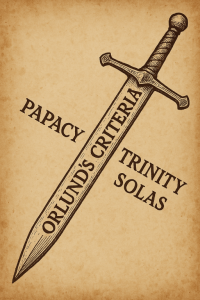
AI image created by author.
As most readers know, I converted from Protestantism to Catholicism. What many may not know is that I once viewed Catholicism as teaching a false gospel and a corruption of authentic Christianity. How did I change from a committed five-point Calvinist and anti-Catholic into a Catholic? In short, I studied the historical evidence—early Church writings and even pagan descriptions of Christians—and concluded that the Church Jesus established in the first century is the Catholic Church.
Why did I start researching Catholic claims? Honestly, I set out to disprove them and to rescue people from what I saw as a deceived organization. I never intended to join the Catholic Church.
Yet my research surprised me. I found truths I never expected and failed to find things I assumed existed.
What I discovered:
- Apostolic succession
- An authoritative Church
- A sacramental Church
- The primacy of Rome and the Petrine ministry
- A Church teaching that faith and works cooperate through God’s love and grace
What I did not find:
- Scripture as the sole authority (sola scriptura)
- Faith alone (sola fide)
- Forensic justification
- Substitutionary atonement (Jesus bearing the wrath of God)
- Church governance on strictly Reformed “low church” lines
These discoveries left me with two choices: join the Catholic Church or accept that the historic Church, which claimed Jesus as its founder, went astray almost immediately. That second option raised even more problems. Why should I accept Calvin or Luther, who appeared in the 16th century, and not Joseph Smith in the 19th? If the Church erred from the start, why trust its list of New Testament books? Why believe in doctrines like the Trinity and the Incarnation? If the early Church collapsed so quickly, even Protestant essentials rest on shaky ground.
So, I must ask: Protestants, why should I agree with you?
Gavin Ortlund vs. Joe Heschmeyer
A Protestant friend recently shared a debate between Dr. Gavin Ortlund, a Reformed Baptist, and Joe Heschmeyer, a Catholic apologist, on the papacy.
Here’s the debate:
My friend insisted Ortlund “destroyed” Heschmeyer. Ortlund argued that the early Church never taught papal infallibility as Vatican I defined it in 1870. Since he did not find a Vatican I view of the papacy in first-century writings, he rejected it. When asked about Scripture (Matthew 16:18–19, Luke 22:31–32, John 21:15–17, Acts 15), he dismissed it as a matter of interpretation. By “destroyed,” my friend meant that Heschmeyer failed to meet Ortlund’s impossible standard: historical proof of Vatican I language in the first century. When Heschmeyer showed biblical development toward the papacy, Ortlund dismissed it, wrongly claiming Vatican I disallows development.
What struck me most as a Catholic was Ortlund’s lack of awareness of the consequences of his reasoning. If applied consistently, his standard would also undermine belief in the Incarnation, the Trinity, and even Protestant essentials like sola scriptura and sola fide.
Ortlund’s Criteria Applied More Fairly
Take the Trinity. The final definition came at the Council of Constantinople in 381, long after the New Testament. The Church used terms absent from Scripture—ousia, homoousia—which Arius and his followers denounced as pagan corruption. Like Ortlund, Arius claimed no evidence from the first century supported those words, and he countered every appeal to Scripture with his own interpretation.
What about the solas? We do not see a clear articulation of sola scriptura or sola fide until the 16th century. Some suggest John Hus anticipated them in the 15th century, but I disagree. Measured by Ortlund’s standard, the solas fare far worse than the papacy, which has at least some second-century support. No one—absolutely no one—taught Luther’s and Calvin’s solas before the Reformation. Protestants like Ortlund argue that Scripture itself clearly teaches the solas and therefore the first century did as well. But that claim depends on interpretation. If you dismiss Catholic biblical arguments for the papacy as subjective interpretation, then I can just as easily dismiss your claims about the solas.
Again, Why Should I Agree with You?
If I accept Ortlund’s standard, then I must reject not only the papacy but also the Trinity, the Incarnation, and even the solas themselves, since none of them appear in the 1st century in their final form. If I relax the standard, then I can allow for development—but that same allowance makes room for the Catholic view of the papacy.
So, the real question is not whether the early Church taught Vatican I in the 1st century, but whether Christ gave His Church the authority to grow in clarity without losing the truth He entrusted to it. On that question, the historical evidence points unmistakably to the Catholic Church.
Again, I ask my Protestant friends: why should I agree with you?
If you disagree, I welcome your correction in the comments below.
Thank you!
If you liked this article, please leave your comments below. I am very interested in your opinion on this topic.
Read The Latin Right’s other writing here.
Please visit my Facebook page and IM your questions (and follow my page) or topics for articles you would like covered.
General Christian
Previous Post

September 15, 2025
Questions That Don't Have Easy Answers (Guest Writer)
Next Post
September 24, 2025 Where There Is No Vision: Reflections on Our Restless Age
Recent Comments
""It's reasonable to ask what those claims mean in practice."It is. And I've laid out ..."
Amoris Laetitia Deserves a Better Defence
"I've said what I said, Peter. Read the words. If you don't have anything new ..."
Amoris Laetitia Deserves a Better Defence
"I don't expect you to decide who should be admitted to the sacraments. I'm asking ..."
Amoris Laetitia Deserves a Better Defence
"But is that how you see it, Todd? You initially offered “salvation is more important ..."
Amoris Laetitia Deserves a Better Defence
Browse Our Archives
Select a Category Abortion Arius Atheists Catholic Apologetics Catholic Culture Catholic History Catholic Humor Catholic Poetry Catholic Politics Catholic Theology Dr. James White Faith Alone Joe Heschmeyer Kamala Harris Martin Luther Pope Francis Preborn Children President Biden Science and Catholicism Sola Scriptura Synod of Synodality Trinity
Select a Month October 2026 September 2026 August 2026 July 2026 June 2026 May 2026 April 2026 March 2026 February 2026 January 2026 December 2025 November 2025 October 2025 September 2025 August 2025 July 2025 June 2025 May 2025 April 2025 March 2025 February 2025 January 2025 December 2024 November 2024 October 2024 September 2024 August 2024 July 2024 June 2024 May 2024 April 2024 March 2024 February 2024 January 2024 December 2023 November 2023 October 2023 September 2023 August 2023 July 2023 June 2023 May 2023 April 2023 March 2023 February 2023 January 2023 December 2022 November 2022 October 2022 September 2022 August 2022 July 2022 June 2022 May 2022 April 2022 March 2022 February 2022 January 2022 December 2021 November 2021
Follow Us!
TAKE THE
Religious Wisdom Quiz
Who said, "My punishment is greater than I can bear"?
Select your answer to see how you score.
Judas Esau Cain Saul
Related posts from The Latin Right

Amoris Laetitia Deserves a Better Defence

Rich Man, Poor Man: Altruism and Agency

The Order We Did Not Make: The World...

The Poor Have Rights—and Responsibilities
TRENDING AT PATHEOS Catholic

In "Irreplaceable," our book on vocation and technology, Trevor Sutton and I...

I was strolling through the top floor of the brand new Parthenon...

What Does Gêvâh Mean For Kimberley Guifoyle &...
This week, a lot of the news is focused on Kimberly Guilfoyle....

INNER CIRCLE: Profound Mystery (Of Christ In All...
Ephesians 5:31-32 “For this reason, a man will leave his father and...

Do Not Rejoice When Your Enemy Falls: The...
Turning an execution into a public spectacle is a disturbing expression of...

'The Chosen' S6 Trailer: The Passion Gets Very...
Not many watching 'The Chosen' worry about spoilers, but just because they...
view all Catholic blogs
What Are Your Thoughts?leave a comment
Ad-Free & Subscriber Log-In Subscription Support
- About Us
- 2026 Calendar
- Videos
- Podcasts
- Library of World Religions
- Faith In Media Tracker
- Advertise With Us
- Write for Us
- Privacy Policy
- Terms of Service
- Do Not Sell My Data
- Contact Us
- Radiant Digital
- Manage Newsletter Subscriptions
- Unsubscribe From Notifications
- Sitemap
Copyright 2008-2026, Patheos. All rights reserved.
Subscription Support Ad-Free & Subscriber Log-In
Follow Patheos