
BuddhistCatholicContemplativeEvangelicalGeneral ChristianHinduJewishLatter-day SaintMuslimNew VisionsProgressive Christian
Beliefs
- Buddhist
- Catholic
- Contemplative
- Evangelical
- General Christian
- Hindu
- Jewish
- Latter-day Saint
- More Voices
- Muslim
- New Visions
- Pagan
- Progressive Christian
Topics
- Religion News
- Food and Religion
- Sports and Religion
- Religious Art
- Religious Music and Entertainment
- Religious Events
- History and Religion
- Style and Religion
- Politics and Religion
- Women in Religion
- Recreation Outdoors and Religion
- Business Finance and Religion
- Careers Workplace and Religion
- Education and Religion
- Family Parenting and Religion
- Health Fitness and Religion
- Home and Religion
- Relationships and Religion
- Technology and Religion
- Travel and Religion
Columnists
- Buddhist Columnists
- Business Finance and Religion Columnists
- Careers Workplace and Religion Columnists
- Catholic Columnists
- Contemplative Columnists
- Education and Religion Columnists
- Evangelists Columnists
- Family Parenting and Religion Columnists
- General Christian Columnists
- Health Fitness and Religion Columnists
- Hindu Columnists
- History and Religion Columnists
- Home and Religion Columnists
- Jewish Columnists
- More Voices Columnists
- Latter Day Columnists
- Muslim Columnists
- New Visions Columnists
- Nonreligious Columnists
- Pagan Columnists
- Politics and Religion Columnists
- Progressive Columnists
- Recreation Outdoors and Religion Columnists
- Relationships and Religion Columnists
- Religion News Columnists
- Religious Art Columnists
- Religious Events Columnists
- Religious Music and Entertainment Columnists
- Sports and Religion Columnists
- Style and Religion Columnists
- Technology and Religion Columnists
- Travel and Religion Columnists
- Women in Religion Columnists
Resource Library
- 2026 Calendar
- Library of World Religions
- The 100 Most Holy Places on Earth
- Patheos Answers
- Podcasts
- Videos
- Faith Leaders Database
- Anglican Episcopalian
- Bahai
- Baptist
- Buddhism
- Christianity
- Confucianism
- Eastern Orthodoxy
- Hinduism
- Holiness and Pentecostal
- ISKCON
- Islam
- Judaism
- Lutheran
- Methodist
- The Church of Jesus Christ of Latter-day Saints
- New Age
- Paganism
- Presbytarian and Reformed
- Protestantism
- Religion Behind the Scenes
- Roman Catholic
- Scientology
- Shia Islam
- Sikhism
- Sufism
- Sunni Islam
- Taoism
- Zen
- See all religions
Research Tools
 Ad-Free & Subscriber Log-In Subscription Support
Ad-Free & Subscriber Log-In Subscription Support
Follow Patheos 

- Trending:
- Forgiveness
- |
- Marriage
- |
- Consciousness
- |
- Death Penalty
- |
- Election
- |
- Halloween

- Home
- Catholic
- Religion News
- Mike Lewis’s “False Orthodoxy and Fired Professors” Revealed
Mike Lewis’s “False Orthodoxy and Fired Professors” Revealed
Last updated on: August 8, 2025 at 5:33 pm by Dennis Knapp
Mike Lewis’s “False Orthodoxy and Fired Professors” Revealed 2025-08-08T17:33:32-06:00 Dennis Knapp
Patheos Explore the world's faith through different perspectives on religion and spirituality! Patheos has the views of the prevalent religions and spiritualities of the world.
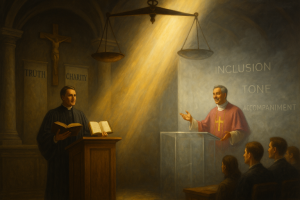
Image created by AI.
Guest writer: Pilgrim
Pastoralism, Doctrinal Ambiguity, and Asymmetry in Catholic Academic Life
Introduction
In the summer of 2025, the dismissal of three professors from Sacred Heart Seminary in Detroit might have been an occasion for sober discussion about academic freedom, theological method, and the limits of permissible dissent and enquiry in the Catholic Church. Instead, the public debate was framed by Mike Lewis’s in Where Peter Is: as “False Orthodoxy and Fired Professors” [1]. The title set the tone, casting these removals as a victory over a counterfeit form of Catholic belief. This was not a report. It was a diagnosis with the implicit claim that these men represented a widespread dangerous theological posture masquerading as fidelity.
Lewis’s framing reflects a broader shift in progressive Catholic circles, one that might be called A “New Pastoralism”: a tendency to priorities pastoral rhetoric, tone, and accompaniment over more precise doctrinal articulation and continuity. While often clothed in the language of mercy, the new pastoralism as ideology treats the Pope’s pastoral priorities as if they were definitive doctrinal developments, conflating prudential judgment with binding truth.
This essay examines Lewis’s 2025 article as an example of such pastoralism’s ecclesial consequences, situating it alongside Cardinal Robert McElroy’s rhetoric of “radical inclusion,” and placing both in the larger context of magisterial authority, theological ambiguity, and asymmetrical discipline in Catholic life.
Lewis’s Framing and the Concept of “False Orthodoxy”
Lewis implied that the three Sacred Heart Seminary professors, Eduardo Echeverria, Ralph Martin, and Ed Peters, embraced an ideological, static traditionalism that rejects the possibility of legitimate papal reform or adaptation [2]. By casting their alignment with broader American conservative Catholicism as not a defense of doctrine but more of an ideology at odds with ecclesial authority, Lewis reduced the debate to loyalty versus disloyalty. This sweeping categorization ignores the nuance between rejecting infallible dogma and raising prudential concerns about pastoral application.
By representing disagreement and dissent as ideological intransigence, Lewis sidesteps legitimate theological debate and recasts orthodoxy as alignment with prevailing papal priorities. This tendency illustrates a wider hermeneutic, “New Pastoralism” that elevates subjective accompaniment and pastoral tone over the precision and continuity of doctrinal teaching.
Defining Pastoralism and Its Theological Risks
Pastoralism, in its healthy form, is indispensable to the Church’s mission. Vatican II urged pastors to read “the signs of the times” and adapt methods accordingly [3]. Pope Francis’s Amoris Laetitia reflects this impulse, calling for discernment attentive to “the complexity of various situations” and rejecting “a cold bureaucratic morality” [4].
Yet this same exhortation contains ambiguous elements, most notably footnote 351, which suggests that in certain cases individuals in “irregular” unions might receive the sacraments without a firm purpose of amendment [5]. Critics such as Cardinal Gerhard Müller warn that such ambiguity risks creating “a second magisterium,” where pastoral exceptions function as new norms [6].
Historically, Catholic moral theology has required that conscience be properly formed in accord with objective moral truth [7]. But pastoralism, in its problematic form, reframes conscience as an autonomous moral arbiter, treating pastoral accommodation as an independent source of authority. This produces a hermeneutic of ambiguity, in which norms are upheld in theory while bracketed in practice, a dynamic Pope John Paul II warned against in Veritatis Splendor [8].
Progressive Exploitation and Academic Asymmetry
Progressive theologians often defend such shifts as legitimate doctrinal “development” or pastoral deepening, privileging lived experience as a theological source [9]. In this framework, pastoral practice not only applies but effectively reshapes doctrine. In academies, this risks dissent from magisterial teaching treated as a mark of intellectual seriousness, with strict fidelity being portrayed as rigidity [10].
The result is a striking asymmetry: progressive theologians who publicly contradict Church teaching often retain positions for decades, while faculty defending settled doctrine risk sanction or dismissal [11]. Catholic academic freedom, as defined in Ex Corde Ecclesiae, exists “within the confines of the truth revealed by God and faithfully preserved by the Church” [12]. Yet enforcement of the mandatum requirement of Canon 812 has been uneven at best [13].
Lewis’s commentary inadvertently reveals this asymmetry. In January 2025, he praised Cardinal Robert McElroy’s “alignment” with Pope Francis, suggesting that bishops who feel “passed over” for the red hat should “contemplate what they aren’t doing that McElroy is” [14]. The implication is clear: ecclesial advancement is increasingly tied to pastoral conformity with papal priorities rather than doctrinal clarity.
McElroy’s Pastoralism as Case Study
McElroy’s March 2023 America article calls for dismantling “structures and cultures of exclusion” and for “radical inclusion” of previously marginalized groups without defining inclusion in doctrinal terms [15]. The language is emotive and open-ended, with minimal reference to Scripture, the Fathers, or the Catechism. This conflates pastoral accompaniment with theological innovation, implicitly denying that exclusion can sometimes serve medicinal or sacramental purposes.
Elsewhere, McElroy muses that doctrinal tensions emerging in the synodal process may require divine resolution, “God will have to grace the Church profoundly,” presenting ambiguity not as a pastoral challenge to resolve but as a spiritual gift to embrace [16]. This pastoralist framing treats doctrinal clarity as secondary to affective and relational inclusion, thereby reinforcing the very asymmetry Lewis’s rhetoric exemplifies.
From Theological Nuance to Hyper-Papalism
Comparing Lewis’s 2022 “Living Authorities” essay, which defended papal authority while acknowledging limits, to his 2025 dismissal of Sacred Heart faculty shows a hardening trajectory. In 2022, Lewis maintained space for theological nuance; by 2025, he equated all public disagreement with papal priorities to ideological dissent.
This is functionally a form of hyper-papalism: the Pope’s pastoral will becomes the de facto interpretive key, such that questioning it, even on prudential grounds, is suspect. Catholic doctrine, however, distinguishes between infallible definitions, authoritative teachings, and prudential pastoral applications [17]. Theologians may question the latter without disloyalty, as history shows in the examples of saints and scholars who offered respectful critique.
Restoring the Unity of Truth and Charity
Doctrinal integrity and pastoral charity are inseparable: charity without truth collapses into sentimentality, and truth without charity risks becoming harsh legalism [18]. Pastoralism in its distorted form offers a superficial mercy detached from conversion, leaving moral norms vulnerable to erosion.
The way forward requires:
- Doctrinally tethered pastoral guidance – ensuring pastoral norms explicitly cohere with the deposit of faith.
- Symmetrical application of academic discipline – holding both progressive and conservative faculty equally accountable to Ex Corde Ecclesiae.
- Formation in authentic accompaniment – training clergy and theologians to integrate mercy with truth, resisting both rigidity and laxity.
Conclusion
The essay “False Orthodoxy and Fired Professors” is not just about three dismissed faculty members in Detroit. It is a microcosm of deeper currents within the contemporary Church: the rise of pastoralism as an operative hermeneutic, the growing conflation of papal pastoral priorities with doctrinal authority, and the inconsistent application of academic discipline depending on one’s theological orientation.
When pastoral language becomes a substitute for doctrinal clarity, and when ecclesial advancement depends more on alignment with current papal style than on fidelity to the perennial faith, the Church risks replacing unity in truth with unity in tone. Lewis’s framing, and McElroy’s rhetoric of “radical inclusion,” illustrate the dangers of a mercy untethered from the moral law.
True renewal will not come from caricaturing one’s opponents or rewarding ambiguity, but from reuniting truth and charity, clarity and compassion, pastoral care and doctrinal fidelity. Only then can the Church resist the false peace of doctrinal silence and embody the genuine accompaniment that leads souls to Christ, “the same yesterday, today, and forever.”
Footnotes
- Mike Lewis, “False Orthodoxy and Fired Professors,” Where Peter Is, July 2025.
- Ibid.
- Second Vatican Council, Gaudium et Spes
- Pope Francis, Amoris Laetitia, Apostolic Exhortation, March 19, 2016, no. 305.
- Ibid., n. 351.
- Cardinal Gerhard Müller, “The ‘Second Magisterium’ and Pastoral Ambiguity,” Catholic World Report, 2024, https://www.catholicworldreport.com/articles/second-magisterium-pastoral-ambiguity.
- Pope John Paul II, Veritatis Splendor, Encyclical Letter on the Splendor of Truth, August 6, 1993, no. 59,
- Ibid., no. 65.
- Sandra Schneiders, “Theology of Experience and the Development of Doctrine,” Theological Studies 80, no. 3 (2019): 563–88.
- Thomas G. Weinandy, “The Intellectual Seduction of Catholic Progressivism,” First Things, April 2022.
- John H. Borelli, “Discipline and Dissent in Catholic Academia,” Nova et Vetera 20, no. 2 (2022): 287–310.
- Pope John Paul II, Ex Corde Ecclesiae, Apostolic Constitution, August 15, 1990, no. 3,
- Code of Canon Law, 1983, canon 812,
- Mike Lewis, “Cardinal McElroy and Papal Conformity,” Where Peter Is, January 2025,
- Robert W. McElroy, “Radical Inclusion and the Synod,” America Magazine, March 2023,
- Ibid.
- Congregation for the Doctrine of the Faith, Donum Veritatis, Instruction on the Ecclesial Vocation of the Theologian, August 24, 1990, no. 14.
- Thomas Aquinas, Summa Theologica, II-II, q. 23,
Thank you!
If you liked this article, please leave your comments below. I am very interested in your opinion on this topic.
Read The Latin Right’s other writing here.
Please visit my Facebook page and IM your questions (and follow my page) or topics for articles you would like covered.
Progressive Christian
Religion News
Previous Post

August 5, 2025
Correcting Mike Lewis: Fired Professors Are Not Heretics
Next Post
August 15, 2025 Would You Sign This?
Recent Comments
"So, no answer."
Amoris Laetitia Deserves a Better Defence
"Thanks, Mike, but the history points in a different direction to the one you suggest.John ..."
Amoris Laetitia Deserves a Better Defence
"My honest take? I think St John Paul II was adamant that on his watch, ..."
Amoris Laetitia Deserves a Better Defence
""It's reasonable to ask what those claims mean in practice."It is. And I've laid out ..."
Amoris Laetitia Deserves a Better Defence
Browse Our Archives
Select a Category Abortion Arius Atheists Catholic Apologetics Catholic Culture Catholic History Catholic Humor Catholic Poetry Catholic Politics Catholic Theology Dr. James White Faith Alone Joe Heschmeyer Kamala Harris Martin Luther Pope Francis Preborn Children President Biden Science and Catholicism Sola Scriptura Synod of Synodality Trinity
Select a Month October 2026 September 2026 August 2026 July 2026 June 2026 May 2026 April 2026 March 2026 February 2026 January 2026 December 2025 November 2025 October 2025 September 2025 August 2025 July 2025 June 2025 May 2025 April 2025 March 2025 February 2025 January 2025 December 2024 November 2024 October 2024 September 2024 August 2024 July 2024 June 2024 May 2024 April 2024 March 2024 February 2024 January 2024 December 2023 November 2023 October 2023 September 2023 August 2023 July 2023 June 2023 May 2023 April 2023 March 2023 February 2023 January 2023 December 2022 November 2022 October 2022 September 2022 August 2022 July 2022 June 2022 May 2022 April 2022 March 2022 February 2022 January 2022 December 2021 November 2021
Follow Us!
TAKE THE
Religious Wisdom Quiz
What does the name "Elijah" mean?
Select your answer to see how you score.
God is Light God Provides God Saves My God is Yahweh
Related posts from The Latin Right

Amoris Laetitia Deserves a Better Defence

Rich Man, Poor Man: Altruism and Agency

The Order We Did Not Make: The World...

Is This “Culture War” Catholicism—or Evangelization?
TRENDING AT PATHEOS Catholic

Pope Leo Celebrates Mass for Nurses & Docs...
I don't have any idea how he did it, but Pope Leo...

The Sermon on the Mount, Part I: Matthew...
The Sermon on the Mount, Part I (Matthew 4:12-5:12) St. Matthew moves...

What's up from Crossway: Reviewing some of their latest A few weeks...

Janie Learns the Way of the Cross: A...
Teaching children about Jesus' Passion can be challenging. Many parents and educators...

Looking For Good Catholic Writing - October 2026
He alone extends the heavens, and he walks upon the waves of...

In "Irreplaceable," our book on vocation and technology, Trevor Sutton and I...
view all Catholic blogs
What Are Your Thoughts?leave a comment
Ad-Free & Subscriber Log-In Subscription Support
- About Us
- 2026 Calendar
- Videos
- Podcasts
- Library of World Religions
- Faith In Media Tracker
- Advertise With Us
- Write for Us
- Privacy Policy
- Terms of Service
- Do Not Sell My Data
- Contact Us
- Radiant Digital
- Manage Newsletter Subscriptions
- Unsubscribe From Notifications
- Sitemap
Copyright 2008-2026, Patheos. All rights reserved.
Subscription Support Ad-Free & Subscriber Log-In
Follow Patheos