
BuddhistCatholicContemplativeEvangelicalGeneral ChristianHinduJewishLatter-day SaintMuslimNew VisionsProgressive Christian
Beliefs
- Buddhist
- Catholic
- Contemplative
- Evangelical
- General Christian
- Hindu
- Jewish
- Latter-day Saint
- More Voices
- Muslim
- New Visions
- Pagan
- Progressive Christian
Topics
- Religion News
- Food and Religion
- Sports and Religion
- Religious Art
- Religious Music and Entertainment
- Religious Events
- History and Religion
- Style and Religion
- Politics and Religion
- Women in Religion
- Recreation Outdoors and Religion
- Business Finance and Religion
- Careers Workplace and Religion
- Education and Religion
- Family Parenting and Religion
- Health Fitness and Religion
- Home and Religion
- Relationships and Religion
- Technology and Religion
- Travel and Religion
Columnists
- Buddhist Columnists
- Business Finance and Religion Columnists
- Careers Workplace and Religion Columnists
- Catholic Columnists
- Contemplative Columnists
- Education and Religion Columnists
- Evangelists Columnists
- Family Parenting and Religion Columnists
- General Christian Columnists
- Health Fitness and Religion Columnists
- Hindu Columnists
- History and Religion Columnists
- Home and Religion Columnists
- Jewish Columnists
- More Voices Columnists
- Latter Day Columnists
- Muslim Columnists
- New Visions Columnists
- Nonreligious Columnists
- Pagan Columnists
- Politics and Religion Columnists
- Progressive Columnists
- Recreation Outdoors and Religion Columnists
- Relationships and Religion Columnists
- Religion News Columnists
- Religious Art Columnists
- Religious Events Columnists
- Religious Music and Entertainment Columnists
- Sports and Religion Columnists
- Style and Religion Columnists
- Technology and Religion Columnists
- Travel and Religion Columnists
- Women in Religion Columnists
Resource Library
- 2026 Calendar
- Library of World Religions
- The 100 Most Holy Places on Earth
- Patheos Answers
- Podcasts
- Videos
- Faith Leaders Database
- Anglican Episcopalian
- Bahai
- Baptist
- Buddhism
- Christianity
- Confucianism
- Eastern Orthodoxy
- Hinduism
- Holiness and Pentecostal
- ISKCON
- Islam
- Judaism
- Lutheran
- Methodist
- The Church of Jesus Christ of Latter-day Saints
- New Age
- Paganism
- Presbytarian and Reformed
- Protestantism
- Religion Behind the Scenes
- Roman Catholic
- Scientology
- Shia Islam
- Sikhism
- Sufism
- Sunni Islam
- Taoism
- Zen
- See all religions
Research Tools
 Ad-Free & Subscriber Log-In Subscription Support
Ad-Free & Subscriber Log-In Subscription Support
Follow Patheos 

- Trending:
- Forgiveness
- |
- Marriage
- |
- Consciousness
- |
- Death Penalty
- |
- Election
- |
- Halloween

- Home
- Catholic
- Politics and Religion
- A Church of Sentiment Over Substance
A Church of Sentiment Over Substance
Last updated on: July 22, 2025 at 3:00 pm by Dennis Knapp
A Church of Sentiment Over Substance 2025-07-21T13:58:58-06:00 Dennis Knapp
Patheos Explore the world's faith through different perspectives on religion and spirituality! Patheos has the views of the prevalent religions and spiritualities of the world.
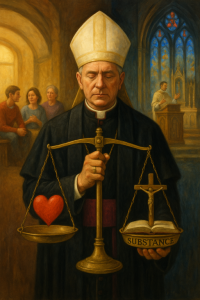
AI image created by author.
In my last article, I hypothesized about the future of the Catholic Church if progressive Catholics got their way, unhindered. One reader claimed my hypotheticals ventured too far (or totally) into the realm of imagination. Not only that, but my “what ifs” reflected a moral failure on my part for falsely representing progressive Catholicism. What were my hypotheticals? I contended that a Catholic Church in the hands of progressives:
- Values sentiment over substance.
- Makes each person their own magisterium.
- Reimagines the human person.
- Confirms the world instead of converting it.
- Cannot distinguish itself from the Episcopal Church.
In moving forward, I decided to tackle each hypothetical “what if” one at a time and show my “receipts.”
For this article, I address the first “what if” of valuing sentiment over substance. I reference writings from the National Catholic Reporter and America Magazine, and the recently released Synod of Synodality document, Pathways for the Implementation Phase of the Synod. These examples clearly show that valuing sentiment over substance results in:
- A focus on subjective “lived experience.”
- Deemphasizing concepts of sin, judgment, and sacrifice.
- Emphasizing a therapeutic spirituality centered on comfort, not conversion.
- Appeals to “pastoral sensitivity” that affirm disordered sexual preferences and lifestyles.
A Focus on Subjective “Lived Experience”
Anyone familiar with the ongoing Synod of Synodality knows that it focuses on incorporating the “lived experiences” of Catholics. In 2023, Daryl Grinsby of the National Catholic Reporter observed:
Synodality confirms our collective vocation as journeying together, along the ‘way’ to God’s presence… through listening to one another in order to hear what God is saying to all of us.
Likewise, Fr. James Martin, SJ, observed this in 2024 about his personal experience at the synod:
Everyone had the chance to have their say… The fundamental insight of the synod was not only that attentive listening was helpful in decision-making, but also that the Holy Spirit was at work in everyone, not simply in cardinals and bishops.
Finally, the aforementioned Pathways for the Implementation Phase of the Synod confirms that:
Growing as a synodal Church requires knowledge that can only be gained through experience, and it introduces us to an encounter with the Lord. (page 8)
Furthermore, the document contains thirty-six instances of the word experience, twenty-three instances of the word listening, and twenty-four instances of the word dialogue. However, it contains zero instances of the words fidelity, truth, doctrine, or dogma. It seems the synodal pathways do not include paths concerned with fidelity, truth, doctrine, or dogma.
Deemphasizing Concepts of Sin, Judgment, and Sacrifice
The document uses the word “conversion” fourteen times—but never in relation to sin or repentance. “Sin,” “hell,” and “judgment” fail to make an appearance. Instead, the document focuses on emotional resonance:
We are… a Church ever open to welcoming… all those who are in need of our charity, our presence, our readiness to dialogue and our love. (p. 2)
The sentiment reflects much of what we read from progressive publications like America Magazine and National Catholic Reporter. For example:
Judgmentalism is the worst sin in the Christian life, and his goal is “to make … L.G.B.T. people feel equally welcome in the life of the church as everyone else.” (Cardinal McElroy: Sex and sin need a new framework in the church, February 2023)
And:
Christ never withholds food to impose obedience; rather, he sets his table among the sinners and gains their hearts by pouring out his own body and blood. Submission to him comes from his submission in love to us. His teaching comes in word and act, in the healing of the leper and the calling of the tax collector. Jesus never comes with a threat, never teaches by withholding his presence, even to the spending of his life. (I don’t think we should be banning anyone from the Eucharist, May 2022)
In the Cardinal McElroy interview, sin and judgment are portrayed as more harmful than wrongdoing itself. The call for inclusion overshadows any call to repentance or doctrinal understanding—showing clear evidence of a pastoral retelling that avoids moral challenge. Moreover, the Eucharist piece reframes the Eucharist as emotional support, not as a means of sanctification or moral accountability. It presents withholding the Eucharist as unloving and not WWJD.
Emphasizing a Therapeutic Spirituality Centered on Comfort, Not Conversion
Without concrete changes, the vision of a synodal Church will not gain credibility. (p. 19)
The synodal document acknowledges needed change but frames it entirely in terms of structures, participation, and feelings of inclusion.
The FD proposes to the whole Church… a journey of conversion… likely to lead to changes in behavior and lifestyles. (p. 17)
What kind of conversion? Not conversion to Christ through repentance, but conversion to a synodal culture of participation and dialogue. This reflects a therapeutic anthropology: the Church helps people feel better, not become holy.
Again, such sentiment often appears in progressive theological reflections. Fr. Thomas Reese, writing for the National Catholic Reporter in December 2023, states that comfort, not holy fear, must motivate Christian lives:
…the church should be like a field hospital. Each of us has our own wounds, our own sins, our own disappointments, and we need to hear words of comfort from God… We do that by imitating God, by imitating Jesus, by comforting his people, by binding up wounds, by healing each other’s injuries, by righting wrongs with mercy and justice.
Words of conversion often cause discomfort, and discomfort is often anathema to those who preach a therapeutic Christ.
Appeals to “Pastoral Sensitivity” That Affirm Disordered Sexual Preferences and Lifestyles
The synodal document does not explicitly reference “pastoral sensitivity” as it relates to disordered sexual preferences and lifestyles. However, it does use language that other synodal documents (particularly, the Continental Stage Document [Documento-Tappa-Continentale, DCS]) use when doing so. For example, Pathways for the Implementation Phase of the Synod references people “made poor” and “those excluded” and how the Church “cannot lose the contribution of their point of view.” (p. 9) The DCS document makes clear the identity of these “excluded” in paragraph 39. It states:
Among those who ask for a more meaningful dialogue and a more welcoming space, we also find those who, for various reasons, feel a tension between belonging to the Church and their own loving relationships, such as: remarried divorcees, single parents, people living in a polygamous marriage, LGBTQ people, etc… This is a problematic challenge for the Church because these people feel excluded” (EC Lesotho).
Also absent in the DCS are any mentions of repentance, conversion (in the moral or spiritual sense), moral formation, sin, judgment, or holiness (as a spiritual or moral goal). The document reflects a pastoral sensitivity and relational approach that avoids confronting disordered behaviors or calling for repentance—an omission that risks affirming lifestyles inconsistent with Catholic moral teaching.
Final Thoughts…
The shift towards valuing sentiment over substance in some progressive circles within the Church presents a serious challenge to Catholic teaching. By prioritizing personal experience and emotional comfort over doctrine, we risk losing the very essence of the Church’s mission: to lead souls to Christ through truth, repentance, and holiness. Moreover, when terms like “sin” and “conversion” are omitted, the Church becomes a place of affirmation rather than transformation.
So, as mentioned in the introduction, this hypothetical “what if” is not some outlandish figment of my imagination. I’ve brought the “receipts” to prove it.
As Catholics, we must decide: Do we want a Church that mirrors the world, or one that stands firm in its teachings and calls all to holiness? The choice is clear—faithfulness to truth is essential if we are to truly convert hearts and souls in Christ’s name.
Thank you!
If you liked this article, please leave your comments below. I am very interested in your opinion on this topic.
Read The Latin Right’s other writing here.
Please visit my Facebook page and IM your questions (and follow my page) or topics for articles you would like covered.
Progressive Christian
Politics and Religion
Previous Post

July 20, 2025
The Call to Holiness and Catholicity
Next Post

July 28, 2025 In Progressivism: Each Person Becomes Their Own Magisterium
Recent Comments
"I agree that St John Paul II did not equivocate. He was insistent that the ..."
Amoris Laetitia Deserves a Better Defence
"Not a different answer.Peter, you have an occasional problem with the truth. Mike Lewis pointed ..."
Amoris Laetitia Deserves a Better Defence
"So, no answer."
Amoris Laetitia Deserves a Better Defence
"Thanks, Mike, but the history points in a different direction to the one you suggest.John ..."
Amoris Laetitia Deserves a Better Defence
Browse Our Archives
Select a Category Abortion Arius Atheists Catholic Apologetics Catholic Culture Catholic History Catholic Humor Catholic Poetry Catholic Politics Catholic Theology Dr. James White Faith Alone Joe Heschmeyer Kamala Harris Martin Luther Pope Francis Preborn Children President Biden Science and Catholicism Sola Scriptura Synod of Synodality Trinity
Select a Month October 2026 September 2026 August 2026 July 2026 June 2026 May 2026 April 2026 March 2026 February 2026 January 2026 December 2025 November 2025 October 2025 September 2025 August 2025 July 2025 June 2025 May 2025 April 2025 March 2025 February 2025 January 2025 December 2024 November 2024 October 2024 September 2024 August 2024 July 2024 June 2024 May 2024 April 2024 March 2024 February 2024 January 2024 December 2023 November 2023 October 2023 September 2023 August 2023 July 2023 June 2023 May 2023 April 2023 March 2023 February 2023 January 2023 December 2022 November 2022 October 2022 September 2022 August 2022 July 2022 June 2022 May 2022 April 2022 March 2022 February 2022 January 2022 December 2021 November 2021
Follow Us!
TAKE THE
Religious Wisdom Quiz
What does 1 John say the world and its desires are doing?
Select your answer to see how you score.
Growing darker Being judged Passing away Coming to an end
Related posts from The Latin Right

Amoris Laetitia Deserves a Better Defence

Rich Man, Poor Man: Altruism and Agency

The Order We Did Not Make: The World...

The Poor Have Rights—and Responsibilities
TRENDING AT PATHEOS Catholic

Swimfan: Forgotten Aughts Pleasures
This is a recovery effort. In 2002, My Big Fat Greek Wedding...

Top Three Anti-Catholic Lies About Catholicism
This is my initial transcript for the video, "THE 3 WORST...

Pope Leo Celebrates Mass for Nurses & Docs...
I don't have any idea how he did it, but Pope Leo...

The Sermon on the Mount, Part I: Matthew...
The Sermon on the Mount, Part I (Matthew 4:12-5:12) St. Matthew moves...

What's up from Crossway: Reviewing some of their latest A few weeks...

Janie Learns the Way of the Cross: A...
Teaching children about Jesus' Passion can be challenging. Many parents and educators...
view all Catholic blogs
What Are Your Thoughts?leave a comment
Ad-Free & Subscriber Log-In Subscription Support
- About Us
- 2026 Calendar
- Videos
- Podcasts
- Library of World Religions
- Faith In Media Tracker
- Advertise With Us
- Write for Us
- Privacy Policy
- Terms of Service
- Do Not Sell My Data
- Contact Us
- Radiant Digital
- Manage Newsletter Subscriptions
- Unsubscribe From Notifications
- Sitemap
Copyright 2008-2026, Patheos. All rights reserved.
Subscription Support Ad-Free & Subscriber Log-In
Follow Patheos