
BuddhistCatholicContemplativeEvangelicalGeneral ChristianHinduJewishLatter-day SaintMuslimNew VisionsProgressive Christian
Beliefs
- Buddhist
- Catholic
- Contemplative
- Evangelical
- General Christian
- Hindu
- Jewish
- Latter-day Saint
- More Voices
- Muslim
- New Visions
- Pagan
- Progressive Christian
Topics
- Religion News
- Food and Religion
- Sports and Religion
- Religious Art
- Religious Music and Entertainment
- Religious Events
- History and Religion
- Style and Religion
- Politics and Religion
- Women in Religion
- Recreation Outdoors and Religion
- Business Finance and Religion
- Careers Workplace and Religion
- Education and Religion
- Family Parenting and Religion
- Health Fitness and Religion
- Home and Religion
- Relationships and Religion
- Technology and Religion
- Travel and Religion
Columnists
- Buddhist Columnists
- Business Finance and Religion Columnists
- Careers Workplace and Religion Columnists
- Catholic Columnists
- Contemplative Columnists
- Education and Religion Columnists
- Evangelists Columnists
- Family Parenting and Religion Columnists
- General Christian Columnists
- Health Fitness and Religion Columnists
- Hindu Columnists
- History and Religion Columnists
- Home and Religion Columnists
- Jewish Columnists
- More Voices Columnists
- Latter Day Columnists
- Muslim Columnists
- New Visions Columnists
- Nonreligious Columnists
- Pagan Columnists
- Politics and Religion Columnists
- Progressive Columnists
- Recreation Outdoors and Religion Columnists
- Relationships and Religion Columnists
- Religion News Columnists
- Religious Art Columnists
- Religious Events Columnists
- Religious Music and Entertainment Columnists
- Sports and Religion Columnists
- Style and Religion Columnists
- Technology and Religion Columnists
- Travel and Religion Columnists
- Women in Religion Columnists
Resource Library
- 2026 Calendar
- Library of World Religions
- The 100 Most Holy Places on Earth
- Patheos Answers
- Podcasts
- Videos
- Faith Leaders Database
- Anglican Episcopalian
- Bahai
- Baptist
- Buddhism
- Christianity
- Confucianism
- Eastern Orthodoxy
- Hinduism
- Holiness and Pentecostal
- ISKCON
- Islam
- Judaism
- Lutheran
- Methodist
- The Church of Jesus Christ of Latter-day Saints
- New Age
- Paganism
- Presbytarian and Reformed
- Protestantism
- Religion Behind the Scenes
- Roman Catholic
- Scientology
- Shia Islam
- Sikhism
- Sufism
- Sunni Islam
- Taoism
- Zen
- See all religions
Research Tools
 Ad-Free & Subscriber Log-In Subscription Support
Ad-Free & Subscriber Log-In Subscription Support
Follow Patheos 

- Trending:
- Forgiveness
- |
- Marriage
- |
- Consciousness
- |
- Death Penalty
- |
- Election
- |
- Halloween

- Home
- Catholic
- Unfortunate Catholic Trigger Words: Docility and Obligation
Unfortunate Catholic Trigger Words: Docility and Obligation
Last updated on: November 19, 2024 at 7:25 pm by Dennis Knapp
Unfortunate Catholic Trigger Words: Docility and Obligation 2024-11-19T19:25:39-06:00 Dennis Knapp
Patheos Explore the world's faith through different perspectives on religion and spirituality! Patheos has the views of the prevalent religions and spiritualities of the world.
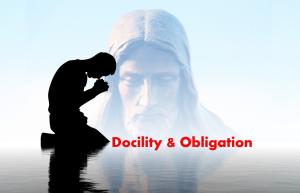
In the US, two words seem to trigger negative emotions among Catholics more than any other: docility and obligation. Now, many US Catholics reading this will think I overstate the situation. They may feel no initial emotional response at all to words like docility and obligation. However, if they take the time to examine the role of docility and obligation in Catholicism, they will inevitably arrive at a strong emotional response. In short, US Catholics do not like others, including other authorities, telling them what to think or how to live.
Allow me to explain.
What Does Docility Mean, Really?
According to the Mirriam Webster online dictionary, docility (or docile) means:
1: easily taught
a docile pupil
2: easily led or managed: tractable
a docile pony
Docile implies a predisposition to submit readily to control or guidance.
Therefore, a docile person possesses a predisposition to submit to control or guidance. In Catholic terms, a docile Catholic possesses a predisposition to submit to Church authority and teaching.
What Does the Catechism Teach on Docility?
87 Mindful of Christ’s words to his apostles: “He who hears you, hears me”. The faithful receive with docility the teachings and directives that their pastors give them in different forms. [emphasis added]
2037 The law of God entrusted to the Church is taught to the faithful as the way of life and truth. The faithful therefore have the right to be instructed in the divine saving precepts that purify judgment and, with grace, heal wounded human reason. They have the duty of observing the constitutions and decrees conveyed by the legitimate authority of the Church. Even if they concern disciplinary matters, these determinations call for docility in charity. [emphasis added]
The Church teaches that, due to her divine nature rooted in Christ, the faithful receive the Church’s instruction as coming from Christ Himself. The faithful hear the Church because the faithful hear Christ. Therefore, as the faithful submits to Christ, they submit to the Church. This, then, encapsulates how the faithful ought to understand the word docility. We must ask ourselves, do we as the faithful possess a predisposition of docility? If not, why not?
What is an Obligation?
Referring to the Mirriam Webster online dictionary, we read the following definitions of obligation:
1: the action of obligating oneself to a course of action (as by a promise or vow)
2 a: something (such as a formal contract, a promise, or the demands of conscience or custom) that obligates one to a course of action
made an obligation to pay their children’s college expenses
b: a debt security (such as a mortgage or corporate bond)
c: a commitment (as by a government) to pay a particular sum of money
also: an amount owed under such an obligation
Unable to meet its obligations, the company went into bankruptcy.
3 a: a condition or feeling of being obligated
felt an obligation to vote
b: a debt of gratitude
returned the favor as an obligation
4: something one is bound to do : duty, responsibility
countries in which military service is an obligation
fulfilled their familial obligations
Basically, one under an obligation owes a favor, or a debt. Concerning Christianity, Christians owe a debt of gratitude to God for creating them and ultimately saving them through Jesus Christ. In this context, the Catechism addresses what the Catholic Church means by obligation.
What Does the Catechism Teach on Obligation?
2041 The precepts of the Church are set in the context of a moral life bound to and nourished by liturgical life. the obligatory character of these positive laws decreed by the pastoral authorities is meant to guarantee to the faithful the indispensable minimum in the spirit of prayer and moral effort, in the growth in love of God and neighbor:
According to the Catechism, the Church requires a minimum obligation: the five precepts. These precepts include:
- (“You shall attend Mass on Sundays and holy days of obligation.”) requires the faithful to participate in the Eucharistic celebration when the Christian community gathers together on the day commemorating the Resurrection of the Lord.
- (“You shall confess your sins at least once a year.”) ensures preparation for the Eucharist by the reception of the sacrament of reconciliation, which continues Baptism’s work of conversion and forgiveness.
- (“You shall humbly receive your Creator in Holy Communion at least during the Easter season.”) guarantees as a minimum the reception of the Lord’s Body and Blood in connection with the Paschal feasts, the origin and center of the Christian liturgy.
- (“You shall keep holy the holy days of obligation.”) completes the Sunday observance by participation in the principal liturgical feasts which honor the mysteries of the Lord, the Virgin Mary, and the saints.
- (“You shall observe the prescribed days of fasting and abstinence.”) ensures the times of ascesis and penance which prepare us for the liturgical feasts; they help us acquire mastery over our instincts and freedom of heart.
Again, the above reflects the bare minimum a Christian owes in obligation to God. To participate in these minimum moments of grace contributes to continued growth in the love of God. In the Eucharist, Catholics partake in the body and blood of the Lord. In Confession, Catholics reconcile with God and His Church as they continue to grow in holiness and conversion. In attending Mass and Holy Days, Catholics celebrate Christ’s resurrection with the Christian community.
What of Those Catholics Who Dissent or Don’t Want to Go to Mass?
Moreover, let’s circle back to the initial point regarding the two triggering words docility and obligation. Many US Catholics dissent from Church moral teaching, especially concerning Church teachings on human sexuality and marriage. These same Catholics appeal to conscience to justify their dissent. Some even go so far as to humanize and delegitimize Church authority as mere “rules of men.” In no way do these appeals reflect anything approaching docility. They also fail to consider what is required for a well-formed conscience.
Furthermore, despite all Christ did in His life, death, and resurrection, some Catholics bemoan any sort of obligation in appreciation of and repaying a debt of gratitude with even one hour a week. Many may even call me judgmental for pointing this last fact out. I ask them to hold their own judgement and to meditate on all Christ did (and continues to do) for them.
Final Thoughts…
In closing, I make a final appeal to reframe our initial negative reactions to words like docility and obligation. Catholics in the US do not like other people (or institutions) telling them how to think or how to live. However, if Catholics truly seek to follow Christ, how can we not also accept His Church’s teaching with docility and do the bare minimum of our obligation (in the least)? The Catechism sums up the situation Catholics find themselves in perfectly:
2037 The law of God entrusted to the Church is taught to the faithful as the way of life and truth. The faithful therefore have the right to be instructed in the divine saving precepts that purify judgment and, with grace, heal wounded human reason. They have the duty of observing the constitutions and decrees conveyed by the legitimate authority of the Church. Even if they concern disciplinary matters, these determinations call for docility in charity.
What do you think?
Thank you!
Read The Latin Right’s other writing here.
Please visit my Facebook page and IM your questions (and follow my page) or topics for articles you would like covered.
Also, please subscribe my YouTube page for updates on upcoming articles.
General Christian
Previous Post

November 16, 2024
Should a Christian Vote for a Pro-Choice Candidate?
Next Post
November 21, 2024 Let the Bishops Individually Demonstrate Docility
Recent Comments
"Not a different answer.Peter, you have an occasional problem with the truth. Mike Lewis pointed ..."
Amoris Laetitia Deserves a Better Defence
"So, no answer."
Amoris Laetitia Deserves a Better Defence
"Thanks, Mike, but the history points in a different direction to the one you suggest.John ..."
Amoris Laetitia Deserves a Better Defence
"My honest take? I think St John Paul II was adamant that on his watch, ..."
Amoris Laetitia Deserves a Better Defence
Browse Our Archives
Select a Category Abortion Arius Atheists Catholic Apologetics Catholic Culture Catholic History Catholic Humor Catholic Poetry Catholic Politics Catholic Theology Dr. James White Faith Alone Joe Heschmeyer Kamala Harris Martin Luther Pope Francis Preborn Children President Biden Science and Catholicism Sola Scriptura Synod of Synodality Trinity
Select a Month October 2026 September 2026 August 2026 July 2026 June 2026 May 2026 April 2026 March 2026 February 2026 January 2026 December 2025 November 2025 October 2025 September 2025 August 2025 July 2025 June 2025 May 2025 April 2025 March 2025 February 2025 January 2025 December 2024 November 2024 October 2024 September 2024 August 2024 July 2024 June 2024 May 2024 April 2024 March 2024 February 2024 January 2024 December 2023 November 2023 October 2023 September 2023 August 2023 July 2023 June 2023 May 2023 April 2023 March 2023 February 2023 January 2023 December 2022 November 2022 October 2022 September 2022 August 2022 July 2022 June 2022 May 2022 April 2022 March 2022 February 2022 January 2022 December 2021 November 2021
Follow Us!
TAKE THE
Religious Wisdom Quiz
Which city was destroyed by fire and brimstone along with Gomorrah?
Select your answer to see how you score.
Sodom Jericho Babylon Nineveh
Related posts from The Latin Right

Amoris Laetitia Deserves a Better Defence

Rich Man, Poor Man: Altruism and Agency

The Order We Did Not Make: The World...

Is This “Culture War” Catholicism—or Evangelization?
TRENDING AT PATHEOS Catholic

Swimfan: Forgotten Aughts Pleasures
This is a recovery effort. In 2002, My Big Fat Greek Wedding...

Top Three Anti-Catholic Lies About Catholicism
This is my initial transcript for the video, "THE 3 WORST...

Pope Leo Celebrates Mass for Nurses & Docs...
I don't have any idea how he did it, but Pope Leo...

The Sermon on the Mount, Part I: Matthew...
The Sermon on the Mount, Part I (Matthew 4:12-5:12) St. Matthew moves...

What's up from Crossway: Reviewing some of their latest A few weeks...

Janie Learns the Way of the Cross: A...
Teaching children about Jesus' Passion can be challenging. Many parents and educators...
view all Catholic blogs
What Are Your Thoughts?leave a comment
Ad-Free & Subscriber Log-In Subscription Support
- About Us
- 2026 Calendar
- Videos
- Podcasts
- Library of World Religions
- Faith In Media Tracker
- Advertise With Us
- Write for Us
- Privacy Policy
- Terms of Service
- Do Not Sell My Data
- Contact Us
- Radiant Digital
- Manage Newsletter Subscriptions
- Unsubscribe From Notifications
- Sitemap
Copyright 2008-2026, Patheos. All rights reserved.
Subscription Support Ad-Free & Subscriber Log-In
Follow Patheos