
BuddhistCatholicContemplativeEvangelicalGeneral ChristianHinduJewishLatter-day SaintMuslimNew VisionsProgressive Christian
Beliefs
- Buddhist
- Catholic
- Contemplative
- Evangelical
- General Christian
- Hindu
- Jewish
- Latter-day Saint
- More Voices
- Muslim
- New Visions
- Pagan
- Progressive Christian
Topics
- Religion News
- Food and Religion
- Sports and Religion
- Religious Art
- Religious Music and Entertainment
- Religious Events
- History and Religion
- Style and Religion
- Politics and Religion
- Women in Religion
- Recreation Outdoors and Religion
- Business Finance and Religion
- Careers Workplace and Religion
- Education and Religion
- Family Parenting and Religion
- Health Fitness and Religion
- Home and Religion
- Relationships and Religion
- Technology and Religion
- Travel and Religion
Columnists
- Buddhist Columnists
- Business Finance and Religion Columnists
- Careers Workplace and Religion Columnists
- Catholic Columnists
- Contemplative Columnists
- Education and Religion Columnists
- Evangelists Columnists
- Family Parenting and Religion Columnists
- General Christian Columnists
- Health Fitness and Religion Columnists
- Hindu Columnists
- History and Religion Columnists
- Home and Religion Columnists
- Jewish Columnists
- More Voices Columnists
- Latter Day Columnists
- Muslim Columnists
- New Visions Columnists
- Nonreligious Columnists
- Pagan Columnists
- Politics and Religion Columnists
- Progressive Columnists
- Recreation Outdoors and Religion Columnists
- Relationships and Religion Columnists
- Religion News Columnists
- Religious Art Columnists
- Religious Events Columnists
- Religious Music and Entertainment Columnists
- Sports and Religion Columnists
- Style and Religion Columnists
- Technology and Religion Columnists
- Travel and Religion Columnists
- Women in Religion Columnists
Resource Library
- 2026 Calendar
- Library of World Religions
- The 100 Most Holy Places on Earth
- Patheos Answers
- Podcasts
- Videos
- Faith Leaders Database
- Anglican Episcopalian
- Bahai
- Baptist
- Buddhism
- Christianity
- Confucianism
- Eastern Orthodoxy
- Hinduism
- Holiness and Pentecostal
- ISKCON
- Islam
- Judaism
- Lutheran
- Methodist
- The Church of Jesus Christ of Latter-day Saints
- New Age
- Paganism
- Presbytarian and Reformed
- Protestantism
- Religion Behind the Scenes
- Roman Catholic
- Scientology
- Shia Islam
- Sikhism
- Sufism
- Sunni Islam
- Taoism
- Zen
- See all religions
Research Tools
 Ad-Free & Subscriber Log-In Subscription Support
Ad-Free & Subscriber Log-In Subscription Support
Follow Patheos 

- Trending:
- Forgiveness
- |
- Marriage
- |
- Consciousness
- |
- Death Penalty
- |
- Election
- |
- Halloween

- Home
- Catholic
- History and Religion
- Is Veneration of the Saints and Virgin Mary Idolatrous?
Is Veneration of the Saints and Virgin Mary Idolatrous?
Last updated on: November 29, 2024 at 12:51 am by Dennis Knapp
Is Veneration of the Saints and Virgin Mary Idolatrous? 2024-11-29T00:51:31-06:00 Dennis Knapp
Patheos Explore the world's faith through different perspectives on religion and spirituality! Patheos has the views of the prevalent religions and spiritualities of the world.
I recently watched a series of videos by Dr. Jordan Cooper, a Lutheran theologian and YouTuber, concerning the Catholic practice of venerating (praying to) the Saints and the Virgin Mary. Dr. Cooper considers this practice unbiblical and a historical accretion into Christianity via Roman pagan syncretism. In this article, I lay out the Catholic practice of venerating the Saints and the Virgin Mary and address Dr. Cooper’s criticisms. As an added layer of analysis, my Protestant friend Matthew Graham agreed to do a written exchange on this topic. He will address my points and then offer his own points, all of which I will post on this blog.
Criticisms First
What Does Scripture Teach?
To begin this discussion, we must first look at Dr. Cooper’s criticisms. The best (and most concise) video that sums up Dr. Cooper’s position is: A Response to Arguments for the Invocation of Saints. In this video, he responds to the Catholic “go to” passages in Scripture that support Saint veneration. Specifically, he cites the Transfiguration, Jesus on the cross crying “Eli, Eli, lema sabachthani?”, and the heavenly saints in the book of Revelation offering God the prayers of the saints on earth. Of all three examples, Dr. Cooper thinks the last one presents the greatest potential. This verse states:
And when he had taken the scroll, the four living creatures and the twenty-four elders fell down before the Lamb, each holding a harp, and golden bowls full of incense, which are the prayers of the saints. (Revelation 5:8)
This verse clearly states that some saints (the twenty-four elders) in heaven offer the prayers of the saints to the Lamb as incense. Moreover, he also thinks that the idea of a relationship with saints in heaven and on earth presented in Revelation does not present an issue, as those in heaven live now in Christ.
Catholics Cross the Line into Idolatry
Dr. Cooper’s main issue concerns the indistinction between the kind of prayers to the Saints and the Virgin Mary and prayers to God. He contends that Catholics cross the line into idolatry in their prayers and veneration of the Saints and Virgin Mary. What started out as legitimate respect and honor of holy people and martyrs in the early Church, Catholics made these special individuals into demi-gods and a God substitute. Drawing comparison to the bronze serpent in the Old Testament, he states:
What you find with almost any of these ideas that develop is that it starts off with good intentions, as something that is trying to express a truth that is biblical. Then it slowly gets distorted to the point where it was in the late Middle Ages that made the Reformation a necessity because things got so corrupt in so many ways.
Furthermore, he goes on to anecdotally state that we ought not think it surprising that Christians eventually abused the good of honoring and respecting the Saints and Virgin Mary because as humans, “that is what we do.” Dr. Cooper acknowledges that “official” Catholic teaching condemns Marian and Saint worship. However, he also thinks the Catholic distinctions between prayer and worship of God (latria) and prayer and veneration of the saints (dulia) and Virgin Mary (hyper-dulia)* are distinctions without a difference.
The Catholic Position
The Council of Trent
First, the Church understands and acknowledges that abuses occurred in the Middle-Ages. In fact, the Council of Trent addressed the Saint and Virgin Mary issue directly in the Twenty-Fifth Session. Drawing from the Second Council of Nicaea, the council declared:
Moreover, that the images of Christ, of the Virgin Mother of God, and of the other saints are to be placed and retained especially in the churches, and that due honor and veneration is to be given them; not, however, that any divinity or virtue is believed to be in them by reason of which they are to be venerated, or that something is to be asked of them, or that trust is to be placed in images, as was done of old by the Gentiles who placed their hope in idols; but because the honor which is shown them is referred to the prototypes which they represent, so that by means of the images which we kiss and before which we uncover the head and prostrate ourselves, we adore Christ and venerate the saints whose likeness they bear.
Here, the Council fathers draw a direct distinction between the pagan hope placed in idols and the Christian practice that seeks to honor the person in whom an image represents a prototype of a real person and not an idol. Moreover, any discovery of abuses that arise, the council demands swift action.
If any abuses shall have found their way into these holy and salutary observances, the holy council desires earnestly that they be completely removed, so that no representation of false doctrines and such as might be the occasion of grave error to the uneducated be exhibited.
And:
Furthermore, in the invocation of the saints, the veneration of relics, and the sacred use of images, all superstition shall be removed, all filthy quest for gain eliminated, and all lasciviousness avoided, so that images shall not be painted and adorned with a seductive charm, or the celebration of saints and the visitation of relics be perverted by the people into boisterous festivities and drunkenness, as if the festivals in honor of the saints are to be celebrated with revelry and with no sense of decency.
Again, the Church still holds to the above declarations of Trent.
The Catechism of the Catholic Church
The Catechism reflects the summation of the official teaching of the Catholic Church. Any honest seekers ought to first look here for what the Church teaches. Concerning Marian veneration, the Catechism states:
971 “All generations will call me blessed”: “The Church’s devotion to the Blessed Virgin is intrinsic to Christian worship.” The Church rightly honors “the Blessed Virgin with special devotion. From the most ancient times the Blessed Virgin has been honored with the title of ‘Mother of God,’ to whose protection the faithful fly in all their dangers and needs…. This very special devotion … differs essentially from the adoration which is given to the incarnate Word and equally to the Father and the Holy Spirit, and greatly fosters this adoration.” The liturgical feasts dedicated to the Mother of God and Marian prayer, such as the rosary, an “epitome of the whole Gospel,” express this devotion to the Virgin Mary. [emphasis added]
Concerning the Saints, it states:
2132 The Christian veneration of images is not contrary to the first commandment which proscribes idols. Indeed, “the honor rendered to an image passes to its prototype,” and “whoever venerates an image venerates the person portrayed in it.” The honor paid to sacred images is a “respectful veneration,” not the adoration due to God alone:
Religious worship is not directed to images in themselves, considered as mere things, but under their distinctive aspect as images leading us on to God incarnate. The movement toward the image does not terminate in it as image, but tends toward that whose image it is. [emphasis added]
Notice that in both instances, the Church differentiates between adoration (worship) reserved for God alone and the veneration given to the Saints and Virgin Mary. Therefore, according to Church teaching, Catholics worship God alone. Likewise, the Church condemns and forbids all abuses and superstitions related to the veneration of the Saints and Virgin Mary.
Final Thoughts…
In the multiple videos about the veneration of the Saints, Dr. Jordan Cooper’s main concern, besides any substantial Scriptural support, comes down to his belief that Catholics cross the line into idolatry when they venerate, honor, and pray to the Saints and the Virgin Mary. He also understands the desire of early Christians to honor examples of heroic Christian witnesses, especially the martyrs. However, his primary evidence, since official Catholic teaching forbids and condemns idolatry, boils down to “that is what we do,” as humans. Humans, according to Dr. Cooper, always take things, even good things, too far.
Therefore, just as the Hebrews took the good bronze serpent and eventually worshiped it, Catholics took the good honor and respect given to the Saints and Virgin Mary and turned it into idolatry. It does not seem to matter to Dr. Cooper that the Church officially denies this claim.
So, I guess the reader must decide. Do you believe Dr. Jordan Cooper or the Catholic Church?
What do you think?
*Helpful Definitions
Latria: the supreme homage that is given to God alone – distinguished from dulia and hyperdulia.
Dulia: veneration or respect paid to the saints and angels as the servants and friends of God.
Hyperdulia: veneration of the Virgin Mary as the holiest of creatures.
Thank you!
Read The Latin Right’s other writing here.
Please visit my Facebook page and IM your questions (and follow my page) or topics for articles you would like covered.
Also, please subscribe my YouTube page for updates on upcoming articles.
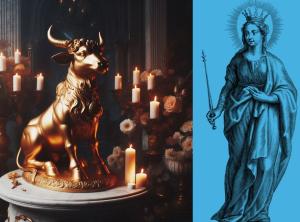
General Christian
History and Religion
Previous Post
November 21, 2024
Let the Bishops Individually Demonstrate Docility
Next Post
November 27, 2024 Veneration Of The Saints and Virgin Mary Idolatrous: Reply 1
Recent Comments
"Not a different answer.Peter, you have an occasional problem with the truth. Mike Lewis pointed ..."
Amoris Laetitia Deserves a Better Defence
"So, no answer."
Amoris Laetitia Deserves a Better Defence
"Thanks, Mike, but the history points in a different direction to the one you suggest.John ..."
Amoris Laetitia Deserves a Better Defence
"My honest take? I think St John Paul II was adamant that on his watch, ..."
Amoris Laetitia Deserves a Better Defence
Browse Our Archives
Select a Category Abortion Arius Atheists Catholic Apologetics Catholic Culture Catholic History Catholic Humor Catholic Poetry Catholic Politics Catholic Theology Dr. James White Faith Alone Joe Heschmeyer Kamala Harris Martin Luther Pope Francis Preborn Children President Biden Science and Catholicism Sola Scriptura Synod of Synodality Trinity
Select a Month October 2026 September 2026 August 2026 July 2026 June 2026 May 2026 April 2026 March 2026 February 2026 January 2026 December 2025 November 2025 October 2025 September 2025 August 2025 July 2025 June 2025 May 2025 April 2025 March 2025 February 2025 January 2025 December 2024 November 2024 October 2024 September 2024 August 2024 July 2024 June 2024 May 2024 April 2024 March 2024 February 2024 January 2024 December 2023 November 2023 October 2023 September 2023 August 2023 July 2023 June 2023 May 2023 April 2023 March 2023 February 2023 January 2023 December 2022 November 2022 October 2022 September 2022 August 2022 July 2022 June 2022 May 2022 April 2022 March 2022 February 2022 January 2022 December 2021 November 2021
Follow Us!
TAKE THE
Religious Wisdom Quiz
What does Paul tell Titus that the grace of God teaches us to do?
Select your answer to see how you score.
Spread the gospel Obey the authorities Love one another Say no to ungodliness and live self-controlled, upright and godly lives
Related posts from The Latin Right

Amoris Laetitia Deserves a Better Defence

Rich Man, Poor Man: Altruism and Agency

The Order We Did Not Make: The World...

The Poor Have Rights—and Responsibilities
TRENDING AT PATHEOS Catholic

Pope Leo Celebrates Mass for Nurses & Docs...
I don't have any idea how he did it, but Pope Leo...

The Sermon on the Mount, Part I: Matthew...
The Sermon on the Mount, Part I (Matthew 4:12-5:12) St. Matthew moves...

What's up from Crossway: Reviewing some of their latest A few weeks...

Janie Learns the Way of the Cross: A...
Teaching children about Jesus' Passion can be challenging. Many parents and educators...

Looking For Good Catholic Writing - October 2026
He alone extends the heavens, and he walks upon the waves of...

In "Irreplaceable," our book on vocation and technology, Trevor Sutton and I...
view all Catholic blogs
What Are Your Thoughts?leave a comment
Ad-Free & Subscriber Log-In Subscription Support
- About Us
- 2026 Calendar
- Videos
- Podcasts
- Library of World Religions
- Faith In Media Tracker
- Advertise With Us
- Write for Us
- Privacy Policy
- Terms of Service
- Do Not Sell My Data
- Contact Us
- Radiant Digital
- Manage Newsletter Subscriptions
- Unsubscribe From Notifications
- Sitemap
Copyright 2008-2026, Patheos. All rights reserved.
Subscription Support Ad-Free & Subscriber Log-In
Follow Patheos