
BuddhistCatholicContemplativeEvangelicalGeneral ChristianHinduJewishLatter-day SaintMuslimNew VisionsProgressive Christian
Beliefs
- Buddhist
- Catholic
- Contemplative
- Evangelical
- General Christian
- Hindu
- Jewish
- Latter-day Saint
- More Voices
- Muslim
- New Visions
- Pagan
- Progressive Christian
Topics
- Religion News
- Food and Religion
- Sports and Religion
- Religious Art
- Religious Music and Entertainment
- Religious Events
- History and Religion
- Style and Religion
- Politics and Religion
- Women in Religion
- Recreation Outdoors and Religion
- Business Finance and Religion
- Careers Workplace and Religion
- Education and Religion
- Family Parenting and Religion
- Health Fitness and Religion
- Home and Religion
- Relationships and Religion
- Technology and Religion
- Travel and Religion
Columnists
- Buddhist Columnists
- Business Finance and Religion Columnists
- Careers Workplace and Religion Columnists
- Catholic Columnists
- Contemplative Columnists
- Education and Religion Columnists
- Evangelists Columnists
- Family Parenting and Religion Columnists
- General Christian Columnists
- Health Fitness and Religion Columnists
- Hindu Columnists
- History and Religion Columnists
- Home and Religion Columnists
- Jewish Columnists
- More Voices Columnists
- Latter Day Columnists
- Muslim Columnists
- New Visions Columnists
- Nonreligious Columnists
- Pagan Columnists
- Politics and Religion Columnists
- Progressive Columnists
- Recreation Outdoors and Religion Columnists
- Relationships and Religion Columnists
- Religion News Columnists
- Religious Art Columnists
- Religious Events Columnists
- Religious Music and Entertainment Columnists
- Sports and Religion Columnists
- Style and Religion Columnists
- Technology and Religion Columnists
- Travel and Religion Columnists
- Women in Religion Columnists
Resource Library
- 2026 Calendar
- Library of World Religions
- The 100 Most Holy Places on Earth
- Patheos Answers
- Podcasts
- Videos
- Faith Leaders Database
- Anglican Episcopalian
- Bahai
- Baptist
- Buddhism
- Christianity
- Confucianism
- Eastern Orthodoxy
- Hinduism
- Holiness and Pentecostal
- ISKCON
- Islam
- Judaism
- Lutheran
- Methodist
- The Church of Jesus Christ of Latter-day Saints
- New Age
- Paganism
- Presbytarian and Reformed
- Protestantism
- Religion Behind the Scenes
- Roman Catholic
- Scientology
- Shia Islam
- Sikhism
- Sufism
- Sunni Islam
- Taoism
- Zen
- See all religions
Research Tools
 Ad-Free & Subscriber Log-In Subscription Support
Ad-Free & Subscriber Log-In Subscription Support
Follow Patheos 

- Trending:
- Forgiveness
- |
- Marriage
- |
- Consciousness
- |
- Death Penalty
- |
- Election
- |
- Halloween

- Home
- Catholic
- History and Religion
- Closing Statement: Who Defines and Who Submits?
Closing Statement: Who Defines and Who Submits?
Last updated on: October 1, 2024 at 6:23 pm by Dennis Knapp
Closing Statement: Who Defines and Who Submits? 2024-10-01T18:23:10-06:00 Dennis Knapp
Patheos Explore the world's faith through different perspectives on religion and spirituality! Patheos has the views of the prevalent religions and spiritualities of the world.
Again, thanks to Eric for taking the time to discuss this important topic with me.
In closing out our dialogue, I need to make things perfectly clear regarding what I did not argue for or against. I did not argue that a correct biblical interpretation is impossible. A proper hermeneutic and the Holy Spirit can provide an individual with a correct understanding of the Bible. Furthermore, I did not argue that the Pope maintains infallibility in all his biblical interpretations, teachings, and theological musings. In fact, infallibility operates in an extremely limited way within the Catholic Church. Infallibility, when used by either a council or the Pope, concerns the settling of theological disputes and the cementing of theological definitions, like the Trinity and Incarnation. The faithful, in turn, submit and assent to the definitions provided by councils and popes.
Unfortunately, in our dialogue, Eric argued in favor of personal interpretation and against papal infallibility (or an inaccurate view of infallibility) and Magisterial authority. In so doing. Eric pits his personal interpretation of the Bible against the Magisterium’s authoritative interpretation (for clarity, the Pope and bishops comprise the teaching office of the Church known as the Magisterium). In the end, Eric determines for himself “what the Bible says” and submits to no one. He separates himself from the historical Church and merely accepts what she teaches if he “sees it in the Bible.”
Now, let’s address some of these final concerns of Eric’s when one submits to Church authority.
Can the Church Change Its Doctrine on a Whim?
…if a future Magisterium were to declare the sacrament of marriage as applying equally to same-sex marriages, it could theoretically justify that change by stating that this is the next phase of the oak tree. How would anyone be able to argue differently? What standard would be used?
The above represents a key example of Eric’s misunderstanding of the Magisterium. The Magisterium cannot cut new teaching out of whole cloth. The Magisterium also cannot teach contrary to the consistent Church teaching (Tradition) and Scripture. To apply sacramentality to same-sex marriage contradicts both. Therefore, it cannot represent “the next phase of the oak tree,” as this idea of “marriage” appears nowhere in Church teaching (Tradition) or Scripture.
Who Corrects the Church?
The issue comes down to final authority. Protestants affirm that God’s word is at the top, having authority over all believers (both individually and corporately). If an individual deviates, the corporate can correct him. And if the corporate deviates, the individual can correct it.
For the person who holds to Sola Scriptura, the epistemological starting point is that there is a God, and he has spoken (Hebrews 1:1-2). But the epistemological starting point of the Roman Catholic is that there is a Church, and she has spoken – Sola Ecclesia.
Here, Eric and I agree. The ISSUE does come down to authority. However, the Church does not teach that she speaks for herself and therefore all must submit. The Church claims to speak for God. We see this clearly taught in the Catechism of the Catholic Church (CCC) paragraphs 85 and 86:
85 “The task of giving an authentic interpretation of the Word of God, whether in its written form or in the form of Tradition, has been entrusted to the living teaching office of the Church alone. Its authority in this matter is exercised in the name of Jesus Christ.” This means that the task of interpretation has been entrusted to the bishops in communion with the successor of Peter, the Bishop of Rome.
86 “Yet this Magisterium is not superior to the Word of God, but is its servant. It teaches only what has been handed on to it. At the divine command and with the help of the Holy Spirit, it listens to this devotedly, guards it with dedication and expounds it faithfully. All that it proposes for belief as being divinely revealed is drawn from this single deposit of faith.”
Moreover, stating that “Protestants affirm that God’s word is at the top” has no meaning when these same Protestants think they authoritatively interpret God’s word to “correct” other Christians and Christ’s Church. They, not God’s word, sit at the “top.”
The Church Assumes God’s Authority
By adopting this position, the Roman Catholic transfers divine qualities, such as infallibility, from God to the Magisterium. God is robbed of his glory, and the Magisterium lays claim to a level of authority not granted to it. Rather than allowing God to speak, the Magisterium functionally speaks for God and cannot be questioned or corrected.
Again, the Church only engages in infallibility in a very limited sense. Furthermore, her authority does not merely exist in her infallible declarations and definitions. Her authority rests in her relationship with Christ. Again, in paragraph 87 of the CCC, we read:
87 Mindful of Christ’s words to his apostles: “He who hears you, hears me“, The faithful receive with docility the teachings and directives that their pastors give them in different forms.
We follow our pastors (bishops and Pope) because we follow Christ, the one who appointed them. Continuing with paragraphs 88 and 89, the Catechism affirms the ability to define dogma as the “fullest extent” of Magisterial authority:
88 The Church’s Magisterium exercises the authority it holds from Christ to the fullest extent when it defines dogmas, that is, when it proposes truths contained in divine Revelation or also when it proposes in a definitive way truths having a necessary connection with them.
89 There is an organic connection between our spiritual life and the dogmas. Dogmas are lights along the path of faith; they illuminate it and make it secure. Conversely, if our life is upright, our intellect and heart will be open to welcome the light shed by the dogmas of faith.
Again, we see this actively used in Church history in the definitions of the holy Trinity and Incarnation. When the faithful in the 4th century were presented with various views (paths) regarding the nature of the Trinity and Christ (Arianism), the Church stepped in to illuminate the correct view (path) to follow.
The Catholic Church Teaches False Doctrine (According to Whom)
Yet when we look carefully, we find that the current Magisterium both teaches and requires things that the Apostles neither taught nor required.
These false doctrines and dogmas are not natural outgrowths from a maturing tree but are invading plants that ought to be cut away.
Sadly, Arius and his followers agree with the statement above, as do all who considered themselves (and their understanding of the Bible) above all authoritative definition set by the Church. Arius considered words like homoousion (of one substance) unbiblical since it does not appear in the Bible. He considered its use on par with an “invading plant” and sought, like his followers after him, to cut it away. He determined the Church erred, and in turn, he the individual attempted “correction” of the corporate (Church).
Eric considers authoritative definitions concerning Mary’s Assumption and Immaculate Conception on par with Arius’ issues with homoousion. Scripture tells us nothing of the end of Mary’s earthly life, therefore, the dogma of her bodily Assumption into heaven reflects an alien plant; an alien plant sucking the life out of the Church’s tree. Now, the fact that John Calvin accepted the doctrine of Mary’s Immaculate Conception and Martin Luther accepted both her Immaculate Conception and Assumption appears unpersuasive to current Protestants, even a current Calvinist like Eric.
Final Thoughts…
In closing, I again want to thank Eric for this engaging exchange. I know we both care deeply about truth and desire to follow truth wherever it leads us. Unfortunately for Eric, I remain unconvinced by his arguments that he merely allows the Bible to “speak for itself.” He claims to place the Bible in “the top” authoritative position, however, as the interpreter of the Bible, he resides at “the top.” Now, this does not mean he cannot arrive at an accurate interpretation of the Bible. He can. But it does mean that he cannot arrive at an authoritative interpretation of the Bible. Such a privilege rests in the authoritative teaching office of the Church alone—the Magisterium. Eric can (and does) disagree with the Magisterium on some key issues. And, like Arius, the Church is under no obligation to submit to him (or any other Protestant who thinks they know better).
Finally, Eric often observed that I needed to interpret the teaching of the Magisterium, and I could be wrong in that interpretation. True, I could misinterpret the Magisterium. However, my individual misinterpretation of the Magisterium in no way makes void the authenticity of Magisterial authority. My “responsibility” as a member of the faithful is to “receive with docility” the teachings of the Church.
Although, I do try to also understand and interpret them correctly.
Thank you!
Read The Latin Right’s other writing here.
Please visit my Facebook page and IM your questions (and follow my page) or topics for articles you would like covered.
Also, please subscribe my YouTube page for updates on upcoming articles.
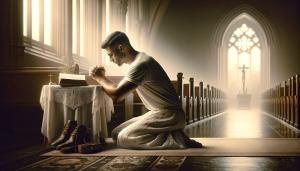
Closing Statement: Who Defines and Who Submits?
***All future follow-ups will be addressed in the comment section at the author’s discretion.
Evangelical
History and Religion
Previous Post

October 1, 2024
Synod on Synodality II: Is Fr. Martin Really “Listening?”
Next Post

October 3, 2024 Authority in the Christian Life: Complete Written Dialogue
Recent Comments
""It's reasonable to ask what those claims mean in practice."It is. And I've laid out ..."
Amoris Laetitia Deserves a Better Defence
"I've said what I said, Peter. Read the words. If you don't have anything new ..."
Amoris Laetitia Deserves a Better Defence
"I don't expect you to decide who should be admitted to the sacraments. I'm asking ..."
Amoris Laetitia Deserves a Better Defence
"But is that how you see it, Todd? You initially offered “salvation is more important ..."
Amoris Laetitia Deserves a Better Defence
Browse Our Archives
Select a Category Abortion Arius Atheists Catholic Apologetics Catholic Culture Catholic History Catholic Humor Catholic Poetry Catholic Politics Catholic Theology Dr. James White Faith Alone Joe Heschmeyer Kamala Harris Martin Luther Pope Francis Preborn Children President Biden Science and Catholicism Sola Scriptura Synod of Synodality Trinity
Select a Month October 2026 September 2026 August 2026 July 2026 June 2026 May 2026 April 2026 March 2026 February 2026 January 2026 December 2025 November 2025 October 2025 September 2025 August 2025 July 2025 June 2025 May 2025 April 2025 March 2025 February 2025 January 2025 December 2024 November 2024 October 2024 September 2024 August 2024 July 2024 June 2024 May 2024 April 2024 March 2024 February 2024 January 2024 December 2023 November 2023 October 2023 September 2023 August 2023 July 2023 June 2023 May 2023 April 2023 March 2023 February 2023 January 2023 December 2022 November 2022 October 2022 September 2022 August 2022 July 2022 June 2022 May 2022 April 2022 March 2022 February 2022 January 2022 December 2021 November 2021
Follow Us!
TAKE THE
Religious Wisdom Quiz
What type of insect is known from the plagues of Egypt?
Select your answer to see how you score.
Locusts Bees Flies Butterflies
Related posts from The Latin Right

Amoris Laetitia Deserves a Better Defence

Rich Man, Poor Man: Altruism and Agency

The Order We Did Not Make: The World...

Is This “Culture War” Catholicism—or Evangelization?
TRENDING AT PATHEOS Catholic

In "Irreplaceable," our book on vocation and technology, Trevor Sutton and I...

I was strolling through the top floor of the brand new Parthenon...

What Does Gêvâh Mean For Kimberley Guifoyle &...
This week, a lot of the news is focused on Kimberly Guilfoyle....

INNER CIRCLE: Profound Mystery (Of Christ In All...
Ephesians 5:31-32 “For this reason, a man will leave his father and...

Do Not Rejoice When Your Enemy Falls: The...
Turning an execution into a public spectacle is a disturbing expression of...

'The Chosen' S6 Trailer: The Passion Gets Very...
Not many watching 'The Chosen' worry about spoilers, but just because they...
view all Catholic blogs
What Are Your Thoughts?leave a comment
Ad-Free & Subscriber Log-In Subscription Support
- About Us
- 2026 Calendar
- Videos
- Podcasts
- Library of World Religions
- Faith In Media Tracker
- Advertise With Us
- Write for Us
- Privacy Policy
- Terms of Service
- Do Not Sell My Data
- Contact Us
- Radiant Digital
- Manage Newsletter Subscriptions
- Unsubscribe From Notifications
- Sitemap
Copyright 2008-2026, Patheos. All rights reserved.
Subscription Support Ad-Free & Subscriber Log-In
Follow Patheos