
BuddhistCatholicContemplativeEvangelicalGeneral ChristianHinduJewishLatter-day SaintMuslimNew VisionsProgressive Christian
Beliefs
- Buddhist
- Catholic
- Contemplative
- Evangelical
- General Christian
- Hindu
- Jewish
- Latter-day Saint
- More Voices
- Muslim
- New Visions
- Pagan
- Progressive Christian
Topics
- Religion News
- Food and Religion
- Sports and Religion
- Religious Art
- Religious Music and Entertainment
- Religious Events
- History and Religion
- Style and Religion
- Politics and Religion
- Women in Religion
- Recreation Outdoors and Religion
- Business Finance and Religion
- Careers Workplace and Religion
- Education and Religion
- Family Parenting and Religion
- Health Fitness and Religion
- Home and Religion
- Relationships and Religion
- Technology and Religion
- Travel and Religion
Columnists
- Buddhist Columnists
- Business Finance and Religion Columnists
- Careers Workplace and Religion Columnists
- Catholic Columnists
- Contemplative Columnists
- Education and Religion Columnists
- Evangelists Columnists
- Family Parenting and Religion Columnists
- General Christian Columnists
- Health Fitness and Religion Columnists
- Hindu Columnists
- History and Religion Columnists
- Home and Religion Columnists
- Jewish Columnists
- More Voices Columnists
- Latter Day Columnists
- Muslim Columnists
- New Visions Columnists
- Nonreligious Columnists
- Pagan Columnists
- Politics and Religion Columnists
- Progressive Columnists
- Recreation Outdoors and Religion Columnists
- Relationships and Religion Columnists
- Religion News Columnists
- Religious Art Columnists
- Religious Events Columnists
- Religious Music and Entertainment Columnists
- Sports and Religion Columnists
- Style and Religion Columnists
- Technology and Religion Columnists
- Travel and Religion Columnists
- Women in Religion Columnists
Resource Library
- 2026 Calendar
- Library of World Religions
- The 100 Most Holy Places on Earth
- Patheos Answers
- Podcasts
- Videos
- Faith Leaders Database
- Anglican Episcopalian
- Bahai
- Baptist
- Buddhism
- Christianity
- Confucianism
- Eastern Orthodoxy
- Hinduism
- Holiness and Pentecostal
- ISKCON
- Islam
- Judaism
- Lutheran
- Methodist
- The Church of Jesus Christ of Latter-day Saints
- New Age
- Paganism
- Presbytarian and Reformed
- Protestantism
- Religion Behind the Scenes
- Roman Catholic
- Scientology
- Shia Islam
- Sikhism
- Sufism
- Sunni Islam
- Taoism
- Zen
- See all religions
Research Tools
 Ad-Free & Subscriber Log-In Subscription Support
Ad-Free & Subscriber Log-In Subscription Support
Follow Patheos 

- Trending:
- Forgiveness
- |
- Marriage
- |
- Consciousness
- |
- Death Penalty
- |
- Election
- |
- Halloween

- Home
- Catholic
- History and Religion
- Response 1 To: Christian Authority: Who Gets to Define It?
Response 1 To: Christian Authority: Who Gets to Define It?
Last updated on: September 7, 2024 at 3:28 pm by Dennis Knapp
Response 1 To: Christian Authority: Who Gets to Define It? 2024-09-07T15:28:39-06:00 Dennis Knapp
Patheos Explore the world's faith through different perspectives on religion and spirituality! Patheos has the views of the prevalent religions and spiritualities of the world.
Guest writer: Eric Luppold.
Introduction
When it comes to ultimate authority, the church does not “define” a theological truth, as if it were the source of that truth. It is the recipient of truth. Its job as a pillar of the truth (1 Timothy 3:15) is to obey and proclaim the gospel faithfully. To do this it must receive and interpret God’s message. But this is true for all communication, which involves a speaker, a message, and a receiver. The receiver’s job is to accurately interpret the speaker’s message. Even a single text-message requires interpretation. In the case of Scripture, the question is not whether interpretation is required but whether we will allow God to speak for himself.
Defining the Church?
In this debate, Dennis seems to use the word ‘church’ to refer to the Roman Catholic Church as it is currently structured. This is a something that I disagree with, and I would argue that the definition of the church must be defined by Scripture, not by imposing the modern structure onto the ancient text. When we let Scripture define the church, we find a body of believers that is organized at the local level, led by a plurality of elders who are in submission to God’s word.
Councils, Creeds, and Confessions
Regarding councils, they can help mediate conflict and resolve debates (as one man helps to sharpen another). But God’s word remains the final authority in which and by which this is accomplished. The Council of Jerusalem was called to bring peace and unity between Gentile and Jewish believers. Its decision was the result of a theological truth that already existed. The reason why circumcision was no longer needed was because Christ inaugurated the New Covenant, not because the Jerusalem Council said so. In other words, the council did not cause the Old Covenant to become obsolete. Christ did. The council simply recognized a theological truth that already existed and applied it to a specific situation.
What Gives a Council Authority?
If we give councils preeminence over Scripture, we end up in a conundrum. For example, the Council of Ariminum in 359 AD was attended by over 400 bishops and adopted the Arian position. Why was that council invalid? Dennis might argue that the church does not recognize that council as ecumenical. But he has the luxury of looking back on history. How could a Christian living in 360 AD know that the Council of Ariminum was wrong? And, when the next council met in 362 AD., what standard did they use to overturn the previous council? God’s revealed word.
Like Arius, many people twist Scripture. But this is nothing new. For example, when Jesus responded to Satan with Scripture, Satan used Scripture (Psalm 91) against Jesus. Did Jesus throw up his hands in frustration? Was he at an impasse until a council could be called? Not at all. Jesus responded to Satan’s twisting of Scripture by properly using Scripture against him.
Now, while Scripture is the final authority, councils, creeds, and confessions do have authority insofar as they rightly conform to Scripture. While Dennis would accuse Protestants of defining doctrine bottom-up, the position of Sola Scriptura is the ultimate top-down position. Since doctrine comes from God himself through his word, the Protestant holds to a more accurate hierarchical structure than the Catholic. For the Protestant, God’s word is at the top. For the Catholic, man’s word (the word of the Magisterium) is at the top. In this way, Catholics have traded divine truth for man-made certainty.
The Problem of Certainty
But even Dennis’s position does not solve the problem of certainty. For how does he know if the Magisterium got it right? What decision-making process did it use and how could he ever discern whether it made a mistake?
To be clear, I firmly believe in the authority of the church and in apostolic succession. But Dennis and I disagree on what those things mean and what they look like. True apostolic succession involves teaching what the apostles taught as they spoke from God. That is why we cannot receive a gospel that is contrary to the one we have already received (Galatians 1:8-9).
Tyranny vs. Legitimacy
God’s word sets the boundaries and defines terms. That has always been the case. That was true with creation, when God spoke the waters into existence and set their limits (Job 38:8-11). The same is true concerning earthly authorities. The standard of discerning a tyrant from a legitimate authority is God’s word. God is the one who grants authority. If that authority is being wielded as God instructs, then it is legitimate. If not, it is tyrannical.
The goal of legitimate authority (i.e., the corporate) is to correct the individual using an objective standard. When that is done, the individual should humbly receive correction. But the corporate should not think of itself as infallible. It should be willing to listen to those individuals who seek to correct it by the word of God. In either case, the tool of correction is Scripture, which is the authority over both the individual and the corporate.
A legitimate authority is one that is in submission to the authority of God’s word. But when an authority would equate itself with God or declare itself to have the divine trait of infallibility, it ought to be rejected.
Conclusion
At the end of the day, I am part of the true church, that ancient tradition that teaches what the apostles taught. It is the modern Roman Catholic Church that has deviated from what God has spoken by twisting the word of God and by adding non-apostolic traditions as dogmas.
Ironically, even Catholics today disagree on how to interpret and apply Scripture. So, if the goal is to get everyone to agree, that is something that can only be done by the power of the Holy Spirit, which uses the word of God to pierce a person’s innermost being (Hebrews 4:12). For when people truly treat God’s word as the final infallible rule of faith, they will experience genuine unity, a unity formed by sanctification through the word of truth (John 17:17).
Thank you!
Read The Latin Right’s other writing here.
Please visit my Facebook page and IM your questions (and follow my page) or topics for articles you would like covered.
Also, please subscribe my YouTube page for updates on upcoming articles.

Response 1 To: Christian Authority: Who Gets to Define It?
Evangelical
History and Religion
Previous Post

September 3, 2024
Christian Authority: Who Gets to Define It? (TLR's Opening)
Next Post

September 9, 2024 Response 1 To: Authority in the Christian Life
Recent Comments
"I agree that St John Paul II did not equivocate. He was insistent that the ..."
Amoris Laetitia Deserves a Better Defence
"Not a different answer.Peter, you have an occasional problem with the truth. Mike Lewis pointed ..."
Amoris Laetitia Deserves a Better Defence
"So, no answer."
Amoris Laetitia Deserves a Better Defence
"Thanks, Mike, but the history points in a different direction to the one you suggest.John ..."
Amoris Laetitia Deserves a Better Defence
Browse Our Archives
Select a Category Abortion Arius Atheists Catholic Apologetics Catholic Culture Catholic History Catholic Humor Catholic Poetry Catholic Politics Catholic Theology Dr. James White Faith Alone Joe Heschmeyer Kamala Harris Martin Luther Pope Francis Preborn Children President Biden Science and Catholicism Sola Scriptura Synod of Synodality Trinity
Select a Month October 2026 September 2026 August 2026 July 2026 June 2026 May 2026 April 2026 March 2026 February 2026 January 2026 December 2025 November 2025 October 2025 September 2025 August 2025 July 2025 June 2025 May 2025 April 2025 March 2025 February 2025 January 2025 December 2024 November 2024 October 2024 September 2024 August 2024 July 2024 June 2024 May 2024 April 2024 March 2024 February 2024 January 2024 December 2023 November 2023 October 2023 September 2023 August 2023 July 2023 June 2023 May 2023 April 2023 March 2023 February 2023 January 2023 December 2022 November 2022 October 2022 September 2022 August 2022 July 2022 June 2022 May 2022 April 2022 March 2022 February 2022 January 2022 December 2021 November 2021
Follow Us!
TAKE THE
Religious Wisdom Quiz
I saw my master taken up to heaven in a whirlwind and received a double portion of his spirit. Who am I?
Select your answer to see how you score.
Elisha Elijah Samuel Joshua
Related posts from The Latin Right
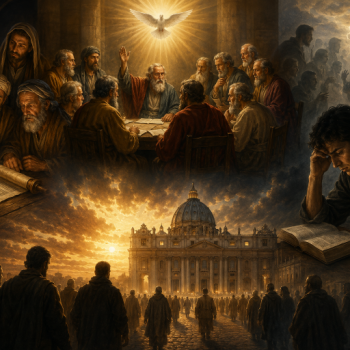
Don't Misinterpret the Bereans: Berean Principle Reexamined
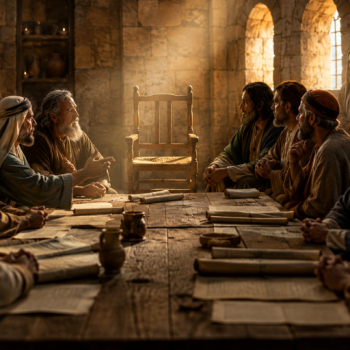
Did Christ Give Church Authority an Expiration Date?
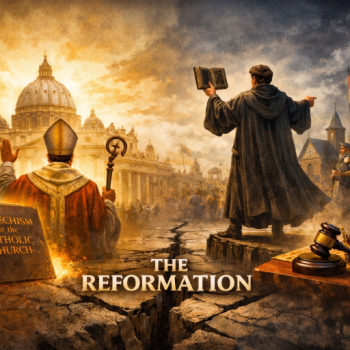
Binding Authority or Private Judgment? Luther Reconsidered
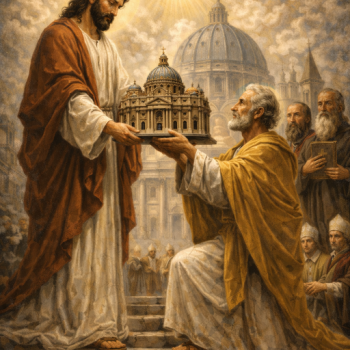
Ecclesia Sola, Not Sola Ecclesia (What Jesus Left...
TRENDING AT PATHEOS Catholic

How to Make a Decision When You Can't...
Main point: It’s much more valuable to stay close to God so...

Archdiocese Hosts Military Marriage Retreat in Germany
RASTATT, Germany — The transient military lifestyle, with its frequent deployments and...

Nearly every morning, I make the drive to Detroit with my high-school-age...

The Real AI Story Is Adoption Without Trust
Artificial intelligence has crossed a political threshold. It is no longer a...

A new article, written by Jeff Lindsay and Gale L. Pooley,...

Swimfan: Forgotten Aughts Pleasures
This is a recovery effort. In 2002, My Big Fat Greek Wedding...
view all Catholic blogs
What Are Your Thoughts?leave a comment
Ad-Free & Subscriber Log-In Subscription Support
- About Us
- 2026 Calendar
- Videos
- Podcasts
- Library of World Religions
- Faith In Media Tracker
- Advertise With Us
- Write for Us
- Privacy Policy
- Terms of Service
- Do Not Sell My Data
- Contact Us
- Radiant Digital
- Manage Newsletter Subscriptions
- Unsubscribe From Notifications
- Sitemap
Copyright 2008-2026, Patheos. All rights reserved.
Subscription Support Ad-Free & Subscriber Log-In
Follow Patheos