
BuddhistCatholicContemplativeEvangelicalGeneral ChristianHinduJewishLatter-day SaintMuslimNew VisionsProgressive Christian
Beliefs
- Buddhist
- Catholic
- Contemplative
- Evangelical
- General Christian
- Hindu
- Jewish
- Latter-day Saint
- More Voices
- Muslim
- New Visions
- Pagan
- Progressive Christian
Topics
- Religion News
- Food and Religion
- Sports and Religion
- Religious Art
- Religious Music and Entertainment
- Religious Events
- History and Religion
- Style and Religion
- Politics and Religion
- Women in Religion
- Recreation Outdoors and Religion
- Business Finance and Religion
- Careers Workplace and Religion
- Education and Religion
- Family Parenting and Religion
- Health Fitness and Religion
- Home and Religion
- Relationships and Religion
- Technology and Religion
- Travel and Religion
Columnists
- Buddhist Columnists
- Business Finance and Religion Columnists
- Careers Workplace and Religion Columnists
- Catholic Columnists
- Contemplative Columnists
- Education and Religion Columnists
- Evangelists Columnists
- Family Parenting and Religion Columnists
- General Christian Columnists
- Health Fitness and Religion Columnists
- Hindu Columnists
- History and Religion Columnists
- Home and Religion Columnists
- Jewish Columnists
- More Voices Columnists
- Latter Day Columnists
- Muslim Columnists
- New Visions Columnists
- Nonreligious Columnists
- Pagan Columnists
- Politics and Religion Columnists
- Progressive Columnists
- Recreation Outdoors and Religion Columnists
- Relationships and Religion Columnists
- Religion News Columnists
- Religious Art Columnists
- Religious Events Columnists
- Religious Music and Entertainment Columnists
- Sports and Religion Columnists
- Style and Religion Columnists
- Technology and Religion Columnists
- Travel and Religion Columnists
- Women in Religion Columnists
Resource Library
- 2026 Calendar
- Library of World Religions
- The 100 Most Holy Places on Earth
- Patheos Answers
- Podcasts
- Videos
- Faith Leaders Database
- Anglican Episcopalian
- Bahai
- Baptist
- Buddhism
- Christianity
- Confucianism
- Eastern Orthodoxy
- Hinduism
- Holiness and Pentecostal
- ISKCON
- Islam
- Judaism
- Lutheran
- Methodist
- The Church of Jesus Christ of Latter-day Saints
- New Age
- Paganism
- Presbytarian and Reformed
- Protestantism
- Religion Behind the Scenes
- Roman Catholic
- Scientology
- Shia Islam
- Sikhism
- Sufism
- Sunni Islam
- Taoism
- Zen
- See all religions
Research Tools
 Ad-Free & Subscriber Log-In Subscription Support
Ad-Free & Subscriber Log-In Subscription Support
Follow Patheos 

- Trending:
- Forgiveness
- |
- Marriage
- |
- Consciousness
- |
- Death Penalty
- |
- Election
- |
- Halloween

- Home
- Catholic
- History and Religion
- The God Who Hides in Plain Sight…
The God Who Hides in Plain Sight…
Last updated on: June 10, 2024 at 5:27 pm by Dennis Knapp
The God Who Hides in Plain Sight… 2024-06-10T17:27:49-06:00 Dennis Knapp
Patheos Explore the world's faith through different perspectives on religion and spirituality! Patheos has the views of the prevalent religions and spiritualities of the world.
Sorry for the delay in posting articles. Life got a bit busy at the end of the school year. Those with school-aged kids know this all too well.
On the Feast of Corpus Christi, Catholics around the world celebrated the mystery of the body and blood of Christ present in the Eucharist. Western (Roman) Catholics call this mystery transubstantiation. Basically, Catholics believe Christ is hidden, yet substantially present in the Eucharist: body, blood, soul, and divinity. Since the beginning, this belief scandalized many who sought to follow Jesus, as witnessed in John 6:66, where many followers walked away from Christ due to this teaching. The Catechism states in paragraph 1336:
The first announcement of the Eucharist divided the disciples, just as the announcement of the Passion scandalized them: “This is a hard saying; who can listen to it?” The Eucharist and the Cross are stumbling blocks. It is the same mystery and it never ceases to be an occasion of division. “Will you also go away?”: the Lord’s question echoes through the ages, as a loving invitation to discover that only he has “the words of eternal life” and that to receive in faith the gift of his Eucharist is to receive the Lord himself.
Moreover, these truths of our faith led me to think of those who fail to see God, not only as hidden in the Eucharist, but in creation itself. In philosophy, this idea often gets labeled as divine hiddenness.
In this article, I do not offer a comprehensive response to divine hiddenness, only a reflection on how God can seem to “hide” in plain sight. I leave it to highly trained philosophers and apologists for a more thorough explanation.
Divine Hiddenness
J.L. Schellenberg presents the most common form of the problem (taken from the link above).
(1) There are people who are capable of relating personally to God but who, through no fault of their own, fail to believe.
(2) If there is a personal God who is unsurpassably great, then there are no such people.
(3) So, there is no such God (from 1 and 2).
For those interested, please click here for an excellent dialogue between Dr. Gavin Ortland and Justin Schieber on divine hiddenness. In that dialogue, Mr. Schieber explains that a truly loving God would ensure that “all who are capable” (everyone) believe in God. Since not everyone believes, a truly loving God does not exist (or any God exists at all). In other words, a great God ensures unbelief does not exist.
Who Really Hides?
After the Fall, we read in Genesis 3:9-10 that Adam and Eve hid themselves from God.
But the Lord God called to the man and said to him, “Where are you?” And he said, “I heard the sound of you in the garden, and I was afraid, because I was naked, and I hid myself.”
Here, due to their disobedience, Adam and Eve experienced fear for the first time. They also experienced exposure before God, having removed themselves from God’s favor (grace). Notice, too, that God looked for them. God sought them out.
Like Adam and Eve, do we hide from God?
The Naked and Deadly Presence of God
Later in Genesis, God reveals Himself to Moses. During the crafting of the Ten Commandments, Moses asks to see God’s glory, or, face-to-face. To this God replies:
But,” he said, “you cannot see my face, for man shall not see me and live.” And the Lord said, “Behold, there is a place by me where you shall stand on the rock, and while my glory passes by I will put you in a cleft of the rock, and I will cover you with my hand until I have passed by. Then I will take away my hand, and you shall see my back, but my face shall not be seen.” Exodus 33:20-23
Interestingly, here, God hides Moses in a cleft of a rock and covers him. God does this to protect Moses from the unfiltered glory or presence of God, as such an experience would prove deadly for Moses. However, such an experience of even the filtered presence of God physically alters the appearance of Moses.
When Moses came down from Mount Sinai, with the two tablets of the testimony in his hand as he came down from the mountain, Moses did not know that the skin of his face shone because he had been talking with God. Aaron and all the people of Israel saw Moses, and behold, the skin of his face shone, and they were afraid to come near him. But Moses called to them, and Aaron and all the leaders of the congregation returned to him, and Moses talked with them. Exodus 34:29-31
Moreover, does the above reflect an experience of an “unsurpassably great” God per Schellenberg’s argument? If so, to what profit does such an experience lead when it proves ultimately lethal?
Till We Have Faces
C.S. Lewis’ last novel addressed the topic of divine hiddenness. Presented as a retelling of pagan myth, Lewis retells the story of Apuleius’s Cupid and Psyche. In this tale, we read about the relationship between Psyche and her half-sister Orual. The story, told from the perspective of Orual, concerns her indictment against the gods. She contends that the gods remain hidden and uninterested in human affairs. Ironically, Orual chooses to wear a veil to hide her ugliness. She also hides her true self away in her pursuit of power, selfishness, and wickedness. At the end of her life, Orual learns why the gods remain silent.
I saw well why the gods do not speak to us openly, nor let us answer. Till that word can be dug out of us, why should they hear the babble that we think we mean? How can they meet us face to face till we have faces?
And
I know now, Lord, why you utter no answer. You are yourself the answer. Before your face questions die away. What other answer would suffice?
Here again we read of hiding and hidden things. Orual seeks the gods on her terms, not theirs. She expects them to answer her “babbling” when she does not even know what she means herself. Once she realizes the truth, once she assumes a face in which to meet the gods “face to face,” the gods had nothing to converse with. Furthermore, the answer is ultimately the gods themselves. The answer is presence, not mere words.
The Hidden God of the Incarnation
In conclusion, let’s circle back to the Feast of Corpus Christ. Catholics believe Christ is hidden within the substance of the Eucharist. This idea of hiddenness comes from belief in the incarnation of the Logos in a human body. As Vatican document The Reciprocity Between Faith and Sacraments in the Sacramental Economy states:
For in Jesus Christ, as the summit of history and the fullness of time (Gal 4:4), there is the closest possible unity between a creatural symbol, its humanity, and what is symbolized, the saving presence of God in his Son in the midst of history. Christ’s humanity, as humanity inseparable from the divine person of the Son of God, is a “real symbol” of the divine person. In this supreme case, the created communicates to the highest degree the presence of God.
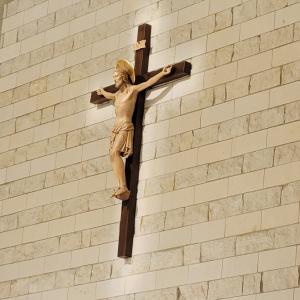
In Christ, God conceals His lethal glory to touch us, to embrace us, to save us. He leaves behind the Sacraments, especially the Eucharist, to continue this embrace. He continues to hide in plain sight. We, in turn, must cease our own hiding and show our true face.
Thank you!
Read The Latin Right’s other writing here.
Please visit my Facebook page and IM your questions (and follow my page) or topics for articles you would like covered.
Also, please subscribe my YouTube page for updates on upcoming articles.
The God Who Hides in Plain Sight…
History and Religion
Previous Post

May 31, 2024
In America, Trump Is Not the Problem, We Are: Guest Writer
Next Post

June 19, 2024 Catholics Hear the Gospel During Mass. Do They Listen?
Recent Comments
"I agree that St John Paul II did not equivocate. He was insistent that the ..."
Amoris Laetitia Deserves a Better Defence
"Not a different answer.Peter, you have an occasional problem with the truth. Mike Lewis pointed ..."
Amoris Laetitia Deserves a Better Defence
"So, no answer."
Amoris Laetitia Deserves a Better Defence
"Thanks, Mike, but the history points in a different direction to the one you suggest.John ..."
Amoris Laetitia Deserves a Better Defence
Browse Our Archives
Select a Category Abortion Arius Atheists Catholic Apologetics Catholic Culture Catholic History Catholic Humor Catholic Poetry Catholic Politics Catholic Theology Dr. James White Faith Alone Joe Heschmeyer Kamala Harris Martin Luther Pope Francis Preborn Children President Biden Science and Catholicism Sola Scriptura Synod of Synodality Trinity
Select a Month October 2026 September 2026 August 2026 July 2026 June 2026 May 2026 April 2026 March 2026 February 2026 January 2026 December 2025 November 2025 October 2025 September 2025 August 2025 July 2025 June 2025 May 2025 April 2025 March 2025 February 2025 January 2025 December 2024 November 2024 October 2024 September 2024 August 2024 July 2024 June 2024 May 2024 April 2024 March 2024 February 2024 January 2024 December 2023 November 2023 October 2023 September 2023 August 2023 July 2023 June 2023 May 2023 April 2023 March 2023 February 2023 January 2023 December 2022 November 2022 October 2022 September 2022 August 2022 July 2022 June 2022 May 2022 April 2022 March 2022 February 2022 January 2022 December 2021 November 2021
Follow Us!
TAKE THE
Religious Wisdom Quiz
True or False: The fruit of the Spirit includes love, joy, peace, and twelve other qualities.
Select your answer to see how you score.
FALSE TRUE
Related posts from The Latin Right

Amoris Laetitia Deserves a Better Defence

Rich Man, Poor Man: Altruism and Agency

The Order We Did Not Make: The World...

The Poor Have Rights—and Responsibilities
TRENDING AT PATHEOS Catholic

A new article, written by Jeff Lindsay and Gale L. Pooley,...

Swimfan: Forgotten Aughts Pleasures
This is a recovery effort. In 2002, My Big Fat Greek Wedding...

Top Three Anti-Catholic Lies About Catholicism
This is my initial transcript for the video, "THE 3 WORST...

Pope Leo Celebrates Mass for Nurses & Docs...
I don't have any idea how he did it, but Pope Leo...

The Sermon on the Mount, Part I: Matthew...
The Sermon on the Mount, Part I (Matthew 4:12-5:12) St. Matthew moves...

What's up from Crossway: Reviewing some of their latest A few weeks...
view all Catholic blogs
What Are Your Thoughts?leave a comment
Ad-Free & Subscriber Log-In Subscription Support
- About Us
- 2026 Calendar
- Videos
- Podcasts
- Library of World Religions
- Faith In Media Tracker
- Advertise With Us
- Write for Us
- Privacy Policy
- Terms of Service
- Do Not Sell My Data
- Contact Us
- Radiant Digital
- Manage Newsletter Subscriptions
- Unsubscribe From Notifications
- Sitemap
Copyright 2008-2026, Patheos. All rights reserved.
Subscription Support Ad-Free & Subscriber Log-In
Follow Patheos