
BuddhistCatholicContemplativeEvangelicalGeneral ChristianHinduJewishLatter-day SaintMuslimNew VisionsProgressive Christian
Beliefs
- Buddhist
- Catholic
- Contemplative
- Evangelical
- General Christian
- Hindu
- Jewish
- Latter-day Saint
- More Voices
- Muslim
- New Visions
- Pagan
- Progressive Christian
Topics
- Religion News
- Food and Religion
- Sports and Religion
- Religious Art
- Religious Music and Entertainment
- Religious Events
- History and Religion
- Style and Religion
- Politics and Religion
- Women in Religion
- Recreation Outdoors and Religion
- Business Finance and Religion
- Careers Workplace and Religion
- Education and Religion
- Family Parenting and Religion
- Health Fitness and Religion
- Home and Religion
- Relationships and Religion
- Technology and Religion
- Travel and Religion
Columnists
- Buddhist Columnists
- Business Finance and Religion Columnists
- Careers Workplace and Religion Columnists
- Catholic Columnists
- Contemplative Columnists
- Education and Religion Columnists
- Evangelists Columnists
- Family Parenting and Religion Columnists
- General Christian Columnists
- Health Fitness and Religion Columnists
- Hindu Columnists
- History and Religion Columnists
- Home and Religion Columnists
- Jewish Columnists
- More Voices Columnists
- Latter Day Columnists
- Muslim Columnists
- New Visions Columnists
- Nonreligious Columnists
- Pagan Columnists
- Politics and Religion Columnists
- Progressive Columnists
- Recreation Outdoors and Religion Columnists
- Relationships and Religion Columnists
- Religion News Columnists
- Religious Art Columnists
- Religious Events Columnists
- Religious Music and Entertainment Columnists
- Sports and Religion Columnists
- Style and Religion Columnists
- Technology and Religion Columnists
- Travel and Religion Columnists
- Women in Religion Columnists
Resource Library
- 2026 Calendar
- Library of World Religions
- The 100 Most Holy Places on Earth
- Patheos Answers
- Podcasts
- Videos
- Faith Leaders Database
- Anglican Episcopalian
- Bahai
- Baptist
- Buddhism
- Christianity
- Confucianism
- Eastern Orthodoxy
- Hinduism
- Holiness and Pentecostal
- ISKCON
- Islam
- Judaism
- Lutheran
- Methodist
- The Church of Jesus Christ of Latter-day Saints
- New Age
- Paganism
- Presbytarian and Reformed
- Protestantism
- Religion Behind the Scenes
- Roman Catholic
- Scientology
- Shia Islam
- Sikhism
- Sufism
- Sunni Islam
- Taoism
- Zen
- See all religions
Research Tools
 Ad-Free & Subscriber Log-In Subscription Support
Ad-Free & Subscriber Log-In Subscription Support
Follow Patheos 

- Trending:
- Forgiveness
- |
- Marriage
- |
- Consciousness
- |
- Death Penalty
- |
- Election
- |
- Halloween

- Home
- Catholic
- Religion News
- Guest Contributor Todd Flowerday: Fear is Useless; What is Needed is Trust
Guest Contributor Todd Flowerday: Fear is Useless; What is Needed is Trust
Last updated on: September 2, 2023 at 10:54 am by Dennis Knapp
Guest Contributor Todd Flowerday: Fear is Useless; What is Needed is Trust 2023-09-02T10:54:24-06:00 Dennis Knapp
Patheos Explore the world's faith through different perspectives on religion and spirituality! Patheos has the views of the prevalent religions and spiritualities of the world.
In the spirit of dialogue, I provided one of my critics a space to contribute. His essay is below. Thank you for reading.
Fear is useless; what is needed is trust
From the last thread, it’s no secret I was alarmed at Cardinal Burke’s seeming ignorance on the history of Church meetings–councils, synods, and other forms of consultation. In its broad sense, synodality happens all the time in the Church: parish councils, finance committees, and even the one-on-one experiences common in everyday life. Sometimes, democracy is practiced, as in the election of abbesses and abbots, religious superiors, and even a pope. Sometimes these meetings come to nothing. Sometimes, a person finds themselves deep in a conversion event, and their relationship with God has intensified or been renewed—all this without a vote or even an opinion.
Cardinal Burke penned an introduction to a self-published pamphlet listing a round number of concerns wrapped in questions and self-provided answers. He is free to do so. And he has his opinions, some of which are based on his knowledge of Church teaching, but others based on his personal experiences and his suspicions, of which none have really come to pass–at least in terms of changing Church teaching.
My reading of the synod documents is that the Church is on a path to reconsider how we present ourselves to the world. Our prime mission is not to attend to people already with us, but to evangelize the doubtful, the embittered, the skeptics, and yes–even the sinners.
The cardinal’s words are colored red. My responses follow.
“We are told that the Church which we profess, in communion with our ancestors in the faith from the time of the Apostles, to be One, Holy, Catholic, and Apostolic is now to be defined by synodality, a term which has no history in the doctrine of the Church and for which there is no reasonable definition.”
Cardinal Burke plays a little loose with two things here. First, Pope Francis has said that “synodality expresses the nature of the Church, its form, its style, its mission.” That is not a definition; it is an outward way of being, of presenting the Church to others, both Christians and non-believers.
If the Church is a barque, synodality is the painting of the boat, the width of its gangplank, the arrangement of the dining room, among other similar things. Most importantly, the assignment of friendly crew to welcome passengers. We aren’t talking about changing from steam to nuclear power, nor eliminating meals, nor asking people to swim to the boat. The boat and its journey remain the same.
As for the term synodality, it is an invented noun that does indeed have a meaning. Professor Jessica Murdoch was quoted here (https://www.catholicnewsagency.com/news/39731/what-is-synodality-experts-explain):
“Synodality as a concept really just means collegiality. It is the way in which the different parts of the Church come together as the mystical Body of Christ.”
Meetings of all sorts happen on all levels of the Church. Councils and popes work together to address major issues. Synods are convened for bishops to address regional matters or single topics. These have been regular occurrences for the past sixty years. Cadl Burke hasn’t objected this strenuously before. In fact, he has even participated in them.
On the diocesan level, bishops consult with many advisory boards. In parishes, pastors have committees and councils. Two people meet to share faith over a cup of coffee or a beer. Synodality is all of these, a notion that two or more people come together in faith (cf. Matthew 18:20) to further the mission of Jesus in some way, large or small.
Synodality and its adjective, synodal, have become slogans behind which a revolution is at work to change radically the Church’s self-understanding, in accord with a contemporary ideology which denies much of what the Church has always taught and practiced.
And yet, Cdl Burke offers no proof of his suspicions. And attributing that motive to the synod as a whole and its participants causes doubts to be raised about people who may have other issues wholly within the bounds of orthodoxy, who are honestly participating in the synod. This is imprudent on his part.
Synod supporters recognize the Catholic Church is in deep trouble. (Even some synod skeptics admit it too.) A council failed to realize its full potential. World Youth Days and other initiatives of St John Paul II have failed to stem the mass youth exodus from the faith.
A universal catechism assembled three decades ago doesn’t seem to have improved the state of religious education. People still complain about poor catechesis. A papacy by a well-regarded theologian ended in resignation and, on the part of many of his supporters, confusion about who is really the Bishop of Rome.
A generous allowance for an older style of worship has been rescinded, failing to meet its own goal of mutual enrichment of both forms of the Mass. Instead it deepened divisions within Roman Catholicism, especially in the US and western Europe.
It seems that most initiatives to recover tradition have been cheered by a small minority, and still: in the First World, the Church shrinks in membership and influence.
To many observers, even some traditionalists and conservatives, what we’ve been doing hasn’t worked. The old format of synods doesn’t seem to have budged the ship. The curia used to produce preliminary documents to guide the topics and narrow the discussion in synods. That process has been scuttled for this synod. It would seem we can’t do worse than try something new.
It is not a purely theoretical matter, for the ideology has already, for some years, been put into practice in the Church in Germany, spreading widely confusion and error and their fruit, division – indeed schism – , to the grave harm of many souls.
It is true that individual pastors have taken matters into their own hands here and there throughout the history of the Church. I knew a priest who ordained his own deacons—twelve of them—before the permanent diaconate was authorized in his diocese. He fancied himself a sort-of Jesus who needed twelve to assist him. Imagine the confusion when a new pastor was assigned and discovered he has a dozen “assistant clergy” operating in various roles.
Many bishops thought they were protecting the reputation and finances of their dioceses by handling crimes of their clergy silently. Many promised that predators would be handled and would do no more harm. They ignored the sound advice of their own priests and psychologists, choosing instead to listen to people who agreed with their policies. So-called orthodox bishops were outed for crimes of mismanagement, lying, and cooperating more readily with predators—and a few of them were even bounced out of their administrative role by their own sins. This is the scandal that has caused more harm than the odd opinion about women’s ordination.
Mistakes by pastors, even bishops, do indeed cause people to be chased away from the Church. I’m not sure that a gay person who imagines their relationship is accepted on some level is worse than someone who has experienced something so traumatic as rape by a priest and subsequently cannot bear to return to the Church.
Where Cdl. Burke misses the boat is to fail to look to people who are no longer with us. Indeed, I’d rather have same-sex couples and remarried persons coming to Mass, and experiencing the graces of liturgy, than to find them absent from the Sunday assembly. Are they really going to buy Bishop Barron’s latest book or visit this blog to get some come-to-Jesus moment? That’s hardly likely.
We know that the orthodox approach to silence, management, and vocations has also spread division. But we really can’t do nothing.
With the imminent Synod on Synodality, it is rightly to be feared that the same confusion and error and division will be visited upon the universal Church.
I don’t think this fear is grounded. We’ve experienced a lot of “confusion, error, and division” in the past few decades, some perpetrated by people who were once assessed as the “good guys.” We’ve lost a lot of people. I’d rather listen to the ones who left and assess the synodal direction based in part on that. Let’s not be afraid to ask ourselves: what have we done wrong?
In fact, it has already begun to happen through the preparation of the Synod at the local level. Only the truth of Christ, as it is handed down to us in the unchanging and unchangeable doctrine and discipline of the Church, can address effectively the situation by uncovering the ideology at work, by correcting the deadly confusion and error and division it is propagating, and by inspiring the members of the Church to undertake the true reform which is daily conversion to Christ alive for us in the Church’s teaching, her prayer and worship, and her practice of the virtues and discipline.
I suspect Pope Francis and others are well aware that some are advocating for moral adjustment on relationships, or an administrative development in ordaining women to the diaconate or more. These are not the only advocacies, nor are they by any means universally accepted, even by progressive Catholics. I also suspect that Pope Francis is willing to let Matthew 13:24-30 be in play here. If well-known teaching and policy as detailed in the Catechism hasn’t taken root, perhaps adult discussions will reinforce Church teaching. After all, are some bishops like Raymond Burke likely to be convinced to change their minds? I think not.
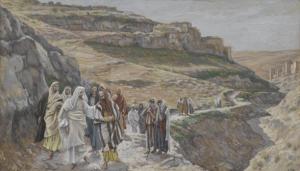
Dennis asked me to provide an accompanying image for this piece. I chose James Tissot’s late 19th century painting “Jesus Discourses with His Disciples.” It illustrates synodality well to me: people not in lockstep, some straggling behind, but for those who approach close to the Lord, his encouraging and gentle hand. No Christian need be afraid of that.
For myself, I pray a composition attributed to Saint Isidore of Seville, also used at the Second Vatican Council:
We stand before you, Holy Spirit,
conscious of our sinfulness,
but aware that we gather in your name.
Come to us, remain with us,
and enlighten our hearts.
Give us light and strength to know your will,
to make it our own, and to live it in our lives.
Guide us by your wisdom,
support us by your power,
for you are God,
sharing the glory of Father and Son.
You desire justice for all:
enable us to uphold the rights of others;
do not allow us to be misled
by ignorance or corrupted by fear or favor.
Unite us to yourself in the bond of love
and keep us faithful to all that is true.
As we gather in your name
may we temper justice with love,
so that all our decisions may be pleasing to you,
and earn the reward promised
to good and faithful servants.
You live and reign with the Father and the Son,
One God, forever and ever.
Amen.
Jesus wraps it up in Luke 8:50: “Fear is useless; what is needed is trust.”
Thank you!
Read The Latin Right’s other writing here.
Please click the link below to join.
Voices of the Faithful in the Synod on Synodality
Please make your voice heard.
I Support Church Teaching in the Synod of Synodality
Religion News
Previous Post

August 31, 2023
Cracking the Code of Synodality
Next Post

September 3, 2023 3 Things Some Progressive Catholics Want (In My Opinion)
Recent Comments
"My honest take? I think St John Paul II was adamant that on his watch, ..."
Amoris Laetitia Deserves a Better Defence
""It's reasonable to ask what those claims mean in practice."It is. And I've laid out ..."
Amoris Laetitia Deserves a Better Defence
"I've said what I said, Peter. Read the words. If you don't have anything new ..."
Amoris Laetitia Deserves a Better Defence
"I don't expect you to decide who should be admitted to the sacraments. I'm asking ..."
Amoris Laetitia Deserves a Better Defence
Browse Our Archives
Select a Category Abortion Arius Atheists Catholic Apologetics Catholic Culture Catholic History Catholic Humor Catholic Poetry Catholic Politics Catholic Theology Dr. James White Faith Alone Joe Heschmeyer Kamala Harris Martin Luther Pope Francis Preborn Children President Biden Science and Catholicism Sola Scriptura Synod of Synodality Trinity
Select a Month October 2026 September 2026 August 2026 July 2026 June 2026 May 2026 April 2026 March 2026 February 2026 January 2026 December 2025 November 2025 October 2025 September 2025 August 2025 July 2025 June 2025 May 2025 April 2025 March 2025 February 2025 January 2025 December 2024 November 2024 October 2024 September 2024 August 2024 July 2024 June 2024 May 2024 April 2024 March 2024 February 2024 January 2024 December 2023 November 2023 October 2023 September 2023 August 2023 July 2023 June 2023 May 2023 April 2023 March 2023 February 2023 January 2023 December 2022 November 2022 October 2022 September 2022 August 2022 July 2022 June 2022 May 2022 April 2022 March 2022 February 2022 January 2022 December 2021 November 2021
Follow Us!
TAKE THE
Religious Wisdom Quiz
True or False: James says that whoever keeps the whole law but stumbles at just one point is guilty of breaking all of it.
Select your answer to see how you score.
TRUE FALSE
Related posts from The Latin Right

Amoris Laetitia Deserves a Better Defence

Rich Man, Poor Man: Altruism and Agency

The Order We Did Not Make: The World...

The Poor Have Rights—and Responsibilities
TRENDING AT PATHEOS Catholic

The Sermon on the Mount, Part I: Matthew...
The Sermon on the Mount, Part I (Matthew 4:12-5:12) St. Matthew moves...

What's up from Crossway: Reviewing some of their latest A few weeks...

Janie Learns the Way of the Cross: A...
Teaching children about Jesus' Passion can be challenging. Many parents and educators...

Looking For Good Catholic Writing - October 2026
He alone extends the heavens, and he walks upon the waves of...

In "Irreplaceable," our book on vocation and technology, Trevor Sutton and I...

I was strolling through the top floor of the brand new Parthenon...
view all Catholic blogs
What Are Your Thoughts?leave a comment
Ad-Free & Subscriber Log-In Subscription Support
- About Us
- 2026 Calendar
- Videos
- Podcasts
- Library of World Religions
- Faith In Media Tracker
- Advertise With Us
- Write for Us
- Privacy Policy
- Terms of Service
- Do Not Sell My Data
- Contact Us
- Radiant Digital
- Manage Newsletter Subscriptions
- Unsubscribe From Notifications
- Sitemap
Copyright 2008-2026, Patheos. All rights reserved.
Subscription Support Ad-Free & Subscriber Log-In
Follow Patheos