
BuddhistCatholicContemplativeEvangelicalGeneral ChristianHinduJewishLatter-day SaintMuslimNew VisionsProgressive Christian
Beliefs
- Buddhist
- Catholic
- Contemplative
- Evangelical
- General Christian
- Hindu
- Jewish
- Latter-day Saint
- More Voices
- Muslim
- New Visions
- Pagan
- Progressive Christian
Topics
- Religion News
- Food and Religion
- Sports and Religion
- Religious Art
- Religious Music and Entertainment
- Religious Events
- History and Religion
- Style and Religion
- Politics and Religion
- Women in Religion
- Recreation Outdoors and Religion
- Business Finance and Religion
- Careers Workplace and Religion
- Education and Religion
- Family Parenting and Religion
- Health Fitness and Religion
- Home and Religion
- Relationships and Religion
- Technology and Religion
- Travel and Religion
Columnists
- Buddhist Columnists
- Business Finance and Religion Columnists
- Careers Workplace and Religion Columnists
- Catholic Columnists
- Contemplative Columnists
- Education and Religion Columnists
- Evangelists Columnists
- Family Parenting and Religion Columnists
- General Christian Columnists
- Health Fitness and Religion Columnists
- Hindu Columnists
- History and Religion Columnists
- Home and Religion Columnists
- Jewish Columnists
- More Voices Columnists
- Latter Day Columnists
- Muslim Columnists
- New Visions Columnists
- Nonreligious Columnists
- Pagan Columnists
- Politics and Religion Columnists
- Progressive Columnists
- Recreation Outdoors and Religion Columnists
- Relationships and Religion Columnists
- Religion News Columnists
- Religious Art Columnists
- Religious Events Columnists
- Religious Music and Entertainment Columnists
- Sports and Religion Columnists
- Style and Religion Columnists
- Technology and Religion Columnists
- Travel and Religion Columnists
- Women in Religion Columnists
Resource Library
- 2026 Calendar
- Library of World Religions
- The 100 Most Holy Places on Earth
- Patheos Answers
- Podcasts
- Videos
- Faith Leaders Database
- Anglican Episcopalian
- Bahai
- Baptist
- Buddhism
- Christianity
- Confucianism
- Eastern Orthodoxy
- Hinduism
- Holiness and Pentecostal
- ISKCON
- Islam
- Judaism
- Lutheran
- Methodist
- The Church of Jesus Christ of Latter-day Saints
- New Age
- Paganism
- Presbytarian and Reformed
- Protestantism
- Religion Behind the Scenes
- Roman Catholic
- Scientology
- Shia Islam
- Sikhism
- Sufism
- Sunni Islam
- Taoism
- Zen
- See all religions
Research Tools
 Ad-Free & Subscriber Log-In Subscription Support
Follow Patheos 

- Trending:
- Advent
- |
- Forgiveness
- |
- Thanksgiving
- |
- Election
- |
- Seasonal Holidays
- |
- Marriage

- Home
- Catholic
- Politics and Religion
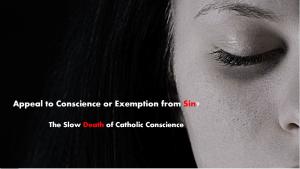
- Appeal to Conscience or Exemption from Sin? The Slow Death of Catholic Conscience
Appeal to Conscience or Exemption from Sin? The Slow Death of Catholic Conscience
Last updated on: September 28, 2023 at 12:26 pm by Dennis Knapp
Appeal to Conscience or Exemption from Sin? The Slow Death of Catholic Conscience 2023-09-28T12:26:56-06:00 Dennis Knapp
Patheos Explore the world's faith through different perspectives on religion and spirituality! Patheos has the views of the prevalent religions and spiritualities of the world.
The false appeal to “follow your conscience” so as to exempt oneself from following the Church’s moral teaching has had incalculable consequences. Many Catholics consider their own desires, not the Church’s teaching, to be the standard for good behavior. The Church becomes a point of reference for selective consultation on matters of morality. She is no longer considered the teacher of universal truths binding upon the consciences of believers. “Cafeteria Catholicism,” pick and choose whatever you like, is a widespread reality in the Church today. (Fr. Gerald Murray, Calming the Storm: Navigating the Crises Facing the Catholic Church and Society)
Sadly, Fr. Murray is right. We live during an epoch in Church history where an appeal to “conscience” seems to cover a multitude of sins. The standard for moral Catholic behavior no longer resides in Christ and His teaching found in the Church, but in the whims of everyone’s desires. Universal truth no longer binds Catholic conscience, as each believer appeals to relativism and only grants the Church a consultative role in their daily lives.
Such an understanding contradicts the proper use of “conscience,” which, according to Fr. Murray, “…is there to guide you to make good decisions and to obey God’s law, not the other way around.”
How did we arrive at this moment? Where do we see the appeal to conscience most misused and abused? What role does conscience play in our daily lives when properly used?
How Did We Get Here?
The slow death of the Catholic conscience started with the embrace of the sexual revolution by many lay Catholics and rejection (or de-emphasis) of Humanae Vitae (HV) by some priests and bishops in the late 1960s. Contrary to the “free-love” contraceptive mentality of the sexual revolution, HV bound Catholic consciences to reject contraception. This led to immediate dissent. For example, after its publication, 600 theologians signed a dissenting statement written by theologian Charles Curran, which appealed to the use of “conscience.” The statement read in part:
…spouses may responsibly decide according to their conscience that artificial contraception in some circumstances is permissible and indeed necessary to preserve and foster the value and sacredness of marriage. [emphasis added]
In turn, the USCCB issued a collective pastoral letter in November of 1968 in response to HV. The bishops mentioned conscience twenty-two times and attempted to clarify the “norms of licit theological dissent.”
Clearly, since the release of HV, those in dissent saw in “conscience” the carve out needed to disregard Church teaching. But they use it in an inappropriate way. Instead of using it to make good decisions and obey God’s law, dissenters appeal to “conscience” to justify sin and disregard Church teaching they find too difficult or inconvenient.
The Extreme Appeal to “Conscience” (Abortion)
Moreover, the dissent from the Church’s teaching on contraception represents the mere tip of the iceberg. Now, dissenting “Catholic” groups, further down the slippery slope, also appeal to “conscience” to justify their disregard of Church teaching and justification for sin. For example, the pro-abortion group, Catholics for Choice (CFC), states on their website:
One of the most fundamental teachings in the Catholic tradition is the primacy of conscience. This doctrine states that Catholics must use their reason to discern ethically complex situations and that our individual consciences should be the final arbiter in all moral decision-making.
CFC goes on to reference the Catholic Catechism for support of the fallacious claim above, while not providing a link or paragraph number. Click here for the section on conscience. Fr. Murray’s summation of conscience perfectly matches Church teaching, CFC, not so much. For example:
1776 …Its voice, ever calling him to love and to do what is good and to avoid evil…
1786 Faced with a moral choice, conscience can make either a right judgment in accordance with reason and the divine law or, on the contrary, an erroneous judgment that departs from them.
The Catechism does speak of a certain “primacy” of conscience, but it makes clear that such a “primacy” does not justify committing or supporting evil actions (paragraph 1791 and 1792). Therefore, an appeal to “conscience” cannot justify support for the evil of abortion.
The Amoris Laetitia Problem with Conscience
Adding to the current confusion over the use of conscience is Amoris Laetitia (AL), particularly paragraph 37, where we read:
We also find it hard to make room for the consciences of the faithful, who very often respond as best they can to the Gospel amid their limitations, and are capable of carrying out their own discernment in complex situations. We have been called to form consciences, not to replace them. [emphasis added]
The focus here on “limitations” and “complex situations” in the light of the formation of consciences (and not replacing them) seems paradoxical to the exhortation regarding conscience found in HV orientated toward “right order.” Concerning responsible parenthood, HV states:
It concerns the objective moral order which was established by God, and of which a right conscience is the true interpreter. In a word, the exercise of responsible parenthood requires that husband and wife, keeping a right order of priorities, recognize their own duties toward God, themselves, their families and human society. [emphasis added]
Contrary to AL’s emphasis on limitations and complexity, HV focuses on right order, right conscience, and right duty. In other words, AL’s appeal to limitations and complexity seems an allowance for situations where culpability regarding sin lessens. Such situations, if possible, would contribute to a poorly formed conscience. True, the Church cannot replace personal conscience, but appearing to allow sin due to limitations and complexity does not a formed conscience make.
The Proper Use of Conscience
The USCCB provides an excellent resource on the conscience and its proper formation and use. Under its definition of conscience, we read:
Conscience helps us hear the voice of God; it helps us recognize the truth about God and the truth about how we ought to live. Conscience is “a judgment of reason” by which we determine whether an action is right or wrong.
Jesus told the apostles, “If you love me, you will keep my commandments” (John 14:15). We deepen our relationship with God by following him, and in doing so, we become more fully ourselves.
Contrary to those who use “conscience” as an excuse for sin and the disregard for Church teaching, conscience’s true purpose is to hear the interior voice of God directing us towards good and away from evil. A truly properly formed conscience seeks Jesus and does what He commands. Furthermore, it does not redefine Jesus’ love as something contrary to His commandments. The USCCB gives suggestions to help inform and strengthen conscience. These include:
- Prayer and participation in the Sacraments, especially Confession and the Eucharist.
- Learning and discerning from the teaching authority of the Church and the Catechism of the Catholic Church.
- Reflect on the stories from the lives of the Saints as examples of how to live one’s Christian life.
- Nurture holy friendships where life’s challenges are discussed in the context of Chrisitan discipleship.
- Avoid indifference and coercion.
Final Thoughts…
In conclusion, let us all use our God-given conscience to choose good and flee evil. Let us never use our conscience as justification for our sin or to dissent from Church teaching because it is difficult or inconvenient. If we find it difficult to follow God’s moral law, let us remember the words of Fr. Murray:
…if your conscience doesn’t respond to that [Church] teaching in the affirmative sense, spend time informing yourself, guiding your conscience to understand why it’s true, and praying for light.
Amen!
Thank you!
Read The Latin Right’s other writing here.
Please click the link below to join.
Voices of the Faithful in the Synod on Synodality
Please make your voice heard.
I Support Church Teaching in the Synod of Synodality
The Slow Death of Catholic Conscience
Politics and Religion
Previous Post

September 24, 2023
A Counterfeit Church: When the Church Becomes a Compassionate NGO

Recent Comments
"Saying "she has no reason to feel guilty" is a legalistic, out of touch response. ..."
Pope Leo in Lima: The Speech ..."
"You're right about one thing: there is evidence that average female sexual desire increases around ..."
Pope Leo in Lima: The Speech ..."
"If you really believe that the purpose of sex is procreation, you can't deny that ..."
Pope Leo in Lima: The Speech ..."
"Several things are being conflated here. I think your imaginary Eileen illustrates the problem with ..."
Pope Leo in Lima: The Speech ..."
Browse Our Archives
Select a Category Abortion Arius Atheists Catholic Apologetics Catholic Culture Catholic History Catholic Humor Catholic Poetry Catholic Politics Catholic Theology Dr. James White Faith Alone Joe Heschmeyer Kamala Harris Martin Luther Pope Francis Preborn Children President Biden Science and Catholicism Sola Scriptura Synod of Synodality Trinity
Select a Month November 2026 October 2026 September 2026 August 2026 July 2026 June 2026 May 2026 April 2026 March 2026 February 2026 January 2026 December 2025 November 2025 October 2025 September 2025 August 2025 July 2025 June 2025 May 2025 April 2025 March 2025 February 2025 January 2025 December 2024 November 2024 October 2024 September 2024 August 2024 July 2024 June 2024 May 2024 April 2024 March 2024 February 2024 January 2024 December 2023 November 2023 October 2023 September 2023 August 2023 July 2023 June 2023 May 2023 April 2023 March 2023 February 2023 January 2023 December 2022 November 2022 October 2022 September 2022 August 2022 July 2022 June 2022 May 2022 April 2022 March 2022 February 2022 January 2022 December 2021 November 2021
Follow Us!
TAKE THE
Religious Wisdom Quiz
What happened to Lot's wife as they fled Sodom?
Select your answer to see how you score.
She became blind She fell into a well She turned into a pillar of salt She died by fire
Related posts from The Latin Right
The West's Christian Moral Inheritance: A Legacy Denied
Pope Leo in Lima: The Speech That Inconveniences...

Culture Wars: A Lesson In Selective Moral Legitimacy
Why Is Abortion a Lost Cause but Social...
TRENDING AT PATHEOS Catholic

Adventurous Lectionary -1st. Sunday of Advent - November...
The Adventurous Lectionary - The First Sunday of Advent – November 29,...

Will Islam become the world's biggest religion by 2035? Congo will replace...

The resilience of the Christian faith in the english speaking world of...

An Advent Calendar, and a Tree full of...
I've spent the weekend deeply invested in internet drama about a $150...

How to Have Financial Transparency in Marriage
Despite the fact that financial issues and money problems are the number...
The Healing Power of Forgiveness in Marriage
Learning how to give and accept apologies are essential ingredients of a...
view all Catholic blogs
What Are Your Thoughts?leave a comment
Ad-Free & Subscriber Log-In Subscription Support
- About Us
- 2026 Calendar
- Videos
- Podcasts
- Library of World Religions
- Faith In Media Tracker
- Advertise With Us
- Write for Us
- Privacy Policy
- Terms of Service
- Do Not Sell My Data
- Contact Us
- Radiant Digital
- Manage Newsletter Subscriptions
- Unsubscribe From Notifications
- Sitemap
Copyright 2008-2026, Patheos. All rights reserved.
Subscription Support Ad-Free & Subscriber Log-In
Follow Patheos