
BuddhistCatholicContemplativeEvangelicalGeneral ChristianHinduJewishLatter-day SaintMuslimNew VisionsProgressive Christian
Beliefs
- Buddhist
- Catholic
- Contemplative
- Evangelical
- General Christian
- Hindu
- Jewish
- Latter-day Saint
- More Voices
- Muslim
- New Visions
- Pagan
- Progressive Christian
Topics
- Religion News
- Food and Religion
- Sports and Religion
- Religious Art
- Religious Music and Entertainment
- Religious Events
- History and Religion
- Style and Religion
- Politics and Religion
- Women in Religion
- Recreation Outdoors and Religion
- Business Finance and Religion
- Careers Workplace and Religion
- Education and Religion
- Family Parenting and Religion
- Health Fitness and Religion
- Home and Religion
- Relationships and Religion
- Technology and Religion
- Travel and Religion
Columnists
- Buddhist Columnists
- Business Finance and Religion Columnists
- Careers Workplace and Religion Columnists
- Catholic Columnists
- Contemplative Columnists
- Education and Religion Columnists
- Evangelists Columnists
- Family Parenting and Religion Columnists
- General Christian Columnists
- Health Fitness and Religion Columnists
- Hindu Columnists
- History and Religion Columnists
- Home and Religion Columnists
- Jewish Columnists
- More Voices Columnists
- Latter Day Columnists
- Muslim Columnists
- New Visions Columnists
- Nonreligious Columnists
- Pagan Columnists
- Politics and Religion Columnists
- Progressive Columnists
- Recreation Outdoors and Religion Columnists
- Relationships and Religion Columnists
- Religion News Columnists
- Religious Art Columnists
- Religious Events Columnists
- Religious Music and Entertainment Columnists
- Sports and Religion Columnists
- Style and Religion Columnists
- Technology and Religion Columnists
- Travel and Religion Columnists
- Women in Religion Columnists
Resource Library
- 2026 Calendar
- Library of World Religions
- The 100 Most Holy Places on Earth
- Patheos Answers
- Podcasts
- Videos
- Faith Leaders Database
- Anglican Episcopalian
- Bahai
- Baptist
- Buddhism
- Christianity
- Confucianism
- Eastern Orthodoxy
- Hinduism
- Holiness and Pentecostal
- ISKCON
- Islam
- Judaism
- Lutheran
- Methodist
- The Church of Jesus Christ of Latter-day Saints
- New Age
- Paganism
- Presbytarian and Reformed
- Protestantism
- Religion Behind the Scenes
- Roman Catholic
- Scientology
- Shia Islam
- Sikhism
- Sufism
- Sunni Islam
- Taoism
- Zen
- See all religions
Research Tools
 Ad-Free & Subscriber Log-In Subscription Support
Ad-Free & Subscriber Log-In Subscription Support
Follow Patheos 

- Trending:
- Forgiveness
- |
- Marriage
- |
- Consciousness
- |
- Death Penalty
- |
- Election
- |
- Halloween

- Home
- Catholic
- Politics and Religion
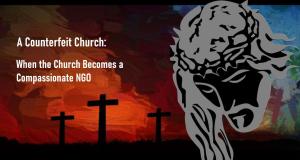
- A Counterfeit Church: When the Church Becomes a Compassionate NGO
A Counterfeit Church: When the Church Becomes a Compassionate NGO
Last updated on: September 24, 2023 at 2:36 pm by Dennis Knapp
A Counterfeit Church: When the Church Becomes a Compassionate NGO 2023-09-24T14:36:55-06:00 Dennis Knapp
Patheos Explore the world's faith through different perspectives on religion and spirituality! Patheos has the views of the prevalent religions and spiritualities of the world.
During his first homily as Pope in 2013, Pope Francis gave the following warning:
…if we do not confess Jesus Christ, nothing will avail. We will become a compassionate NGO [non-government organization], but not the Church, the Bride of Christ.
When we walk without the Cross, when we build without the Cross, and when we profess Christ without the Cross, we are not disciples of the Lord. We are worldly, we are bishops, priests, cardinals, Popes, but not disciples of the Lord.
Amen, Holy Father!
The temptation to remake the Church into a compassionate NGC (CNGO) manifest most when some within the Church seek to replace Christ’s call for personal holiness with a more humanist call for “social justice.” This humanistic call rejects Christ and turns the Church into a hospital devoid of proper medicine and the Good Doctor required to heal the sick within.
Therefore, we need to understand Christ’s call for holiness, identify the attempts of those within the Church to lead us away from this call (and thus create an CNGO), and how to understand true social justice in the light of Christ.
Christ’s Call to Holiness
If you love me… keep my commandments. (John 14:15)
Whoever has my commandments and keeps them… (John 14:21)
“Not everyone… will enter the kingdom of heaven, but the one who does the will of my Father who is in heaven. (Matthew 7:21)
You therefore must be perfect, as your heavenly Father is perfect. (Matthew 5:48)
“You shall be holy, for I am holy.” (1 Peter 1:14-16) and (Leviticus 11:45)
Go, and from now on sin no more (John 8:11)
Enabled by the God’s grace, Christ calls all Christians to holiness and away from sin. Additionally, Jesus provided the means to achieve holiness and flee sin through His death and resurrection. As ransomed by Christ’s precious blood (1 Peter 1:19), Christians, in gratitude for such a gift, ought to respond in true conversion by fleeing sin and living a life marked by holiness and grace. St. Paul, in his letter to the Galatians (Galatians 5:19-26), provides key insights into a life in pursuit of holiness, both positively (in the Spirit) and negatively (in the flesh).
To lessen or de-emphasize Christ’s call to holiness equates to the denial of Christ Himself. In turn, this denial robs the Church of its full Gospel message and creates a counterfeit Church or CNGO.
A Holy Catholic Life
Moreover, a holy Catholic life is one devoted to the pursuit of Christ, not merely the avoidance of evil and the doing of good. In Lumen Gentium (LG) 40, we read:
…all the faithful of Christ of whatever rank or status, are called to the fullness of the Christian life and to the perfection of charity; by this holiness as such a more human manner of living is promoted in this earthly society…They must follow in His footsteps and conform themselves to His image seeking the will of the Father in all things. [emphasis added]
Holiness, as the pursuit of Christ, is a life-long process. Thus, all Catholics stumble and fall along the way, a way the Catechism states “passes by way of the Cross.” For those that fall, Christ provided a way of reconciliation with God and the Church through the sacrament of Penance (or Reconciliation). In this sacrament, the contrite penitent recognizes his/her sin and seeks God’s forgiveness through His ministers of reconciliation (priests and bishops).
Furthermore, the holy life finds its nourishment in the Holy Eucharist. The Catechism beautifully states:
As bodily nourishment restores lost strength, so the Eucharist strengthens our charity, which tends to be weakened in daily life; and this living charity wipes away venial sins. By giving himself to us Christ revives our love and enables us to break our disordered attachments to creatures and root ourselves in him…
Again, any who attempt to lessen or de-emphasize the “way of the Cross,” by denying the reality of sin and God’s power to forgiven and restore the sinner, promotes a counterfeit Church or CNGO. They also place souls in danger of profaning the body and blood of Christ by partaking of the Eucharist in an unworthy manner.
Marks of a Holy Church
One, Holy, Catholic, and Apostolic. These are attributes of the true Church established by Christ. One mark of the true Church resides in her ability to produce holy people. In Solmni Hac Liturgia, St. Pope Paul VI observes:
She is therefore holy, though she has sinners in her bosom, because she herself has no other life but that of grace: it is by living by her life that her members are sanctified; it is by removing themselves from her life that they fall into sins and disorders that prevent the radiation of her sanctity. This is why she suffers and does penance for these offenses, of which she has the power to heal her children through the blood of Christ and the gift of the Holy Spirit.
To reiterate, a holy Church produces holy people. When those within her remove themselves from her life (see above), they fall into sins and disorders. These sins and disorders cause critics to question the holiness of the Church herself. To such critics, the Church becomes a mere human institution, the CNGO Pope Francis warned about.
Marks of a Counterfeit Church or CNGO
Conversely, the counterfeit Church or CNGO marks itself by a de-emphasis on holiness and an overemphasis on worldliness. The Church as CNGO does not profess the true Christ, but a false worldly Christ. This Christ discounts the effects of sin, or, in the name of indiscriminate “love,” morally accepts everyone and demands nothing, especially genuine conversion (holiness). As an CNGO, the focus moves from holiness to “social justice.” One commits “sin” in an CNGO when they (or anyone) violate the tenants of “social justice.” For example:
- The dignity of the human person, but only as it relates to marginalized population.
- Emphasis on collectivism (poverty, social programs, and environmentalism).
- Victimhood narrative against patriarchy, systematic racism, and heteronormativity.
- Immutable human nature: the inability to change one’s “nature,” or sexual “identity,” once this said “identity” becomes identified.
- Reproductive justice: access to abortion.
Some popular “Catholic” organizations that appeal to this form of “social justice” for support include Catholics for Choice and New Ways Ministry. Sadly, these groups (and others like them) pervert valid Catholic teaching found in Catholic social justice and remake them into something anti-Catholic.
True Catholic Social Justice
The United States Conference of Catholic Bishop (USCCB) provides the faithful with resources concerning Catholic social justice. The USCCB lists seven themes of Catholic social justice:
- Life and Dignity of the Human Person
- Call to Family, Community, and Participation
- Rights and Responsibilities
- Option for the Poor and Vulnerable
- The Dignity of Work and the Rights of Workers
- Solidarity
- Care for God’s Creation
Word of Fire’s Dr. Matthew Petrusek May, 2023 article Rehabilitating Social Justice precisely explains true Catholic social justice as both the care of each human person, regardless of development or location, and the social responsibility of each individual Catholic. In his concluding paragraph, Dr. Petrusek makes the following observation regarding the instances when principles of Catholic social justice come into play:
In the end, the Catholic conception of social justice comes down to asking and answering two fundamental questions:
- Can we identify a policy that is causally contributing to (and not merely correlated with) an unjust impediment to the full, authentic flourishing of families, individuals, and communities?
- Is there a realistic possibility that a change to that policy (either by means of addition, revision, or deletion) could quantifiably remove or reduce the unjust impediment—without violating natural law or causing greater harm—and thereby support the full, authentic flourishing of families, individuals, and communities?
Therefore, the employment of Catholic social justice cannot in any way violate Catholic teaching and remain truly “just.” The moment an organization’s “social justice” violates Catholic teaching, it denies Christ and becomes part of a counterfeit Church or a mere CNGO.
Final Thoughts…
To conclude, according to the first paragraph of the Catechism, the purpose of all human life is to know God and live with Him forever.
God, infinitely perfect and blessed in himself, in a plan of sheer goodness freely created man to make him share in his own blessed life. For this reason, at every time and in every place, God draws close to man. He calls man to seek him, to know him, to love him with all his strength. He calls together all men, scattered and divided by sin, into the unity of his family, the Church. To accomplish this, when the fullness of time had come, God sent his Son as Redeemer and Savior. In his Son and through him, he invites men to become, in the Holy Spirit, his adopted children and thus heirs of his blessed life.
The key to becoming God’s “adopted children and thus heirs of his blessed life” is holiness. To seek holiness is to seek God, know God, and love God with all our strength. God make this “blessed life” possible through Christ Jesus. For, as Pope Francis warned during his first homily as Pope:
…if we do not confess Jesus Christ, nothing will avail. We will become a compassionate NGO, but not the Church, the Bride of Christ.
Amen!
Thank you!
Read The Latin Right’s other writing here.
Please click the link below to join.
Voices of the Faithful in the Synod on Synodality
Please make your voice heard.
I Support Church Teaching in the Synod of Synodality
A Counterfeit Church: When the Church Becomes a Compassionate NGO
Politics and Religion
Recent Comments
"My honest take? I think St John Paul II was adamant that on his watch, ..."
Amoris Laetitia Deserves a Better Defence
""It's reasonable to ask what those claims mean in practice."It is. And I've laid out ..."
Amoris Laetitia Deserves a Better Defence
"I've said what I said, Peter. Read the words. If you don't have anything new ..."
Amoris Laetitia Deserves a Better Defence
"I don't expect you to decide who should be admitted to the sacraments. I'm asking ..."
Amoris Laetitia Deserves a Better Defence
Browse Our Archives
Select a Category Abortion Arius Atheists Catholic Apologetics Catholic Culture Catholic History Catholic Humor Catholic Poetry Catholic Politics Catholic Theology Dr. James White Faith Alone Joe Heschmeyer Kamala Harris Martin Luther Pope Francis Preborn Children President Biden Science and Catholicism Sola Scriptura Synod of Synodality Trinity
Select a Month October 2026 September 2026 August 2026 July 2026 June 2026 May 2026 April 2026 March 2026 February 2026 January 2026 December 2025 November 2025 October 2025 September 2025 August 2025 July 2025 June 2025 May 2025 April 2025 March 2025 February 2025 January 2025 December 2024 November 2024 October 2024 September 2024 August 2024 July 2024 June 2024 May 2024 April 2024 March 2024 February 2024 January 2024 December 2023 November 2023 October 2023 September 2023 August 2023 July 2023 June 2023 May 2023 April 2023 March 2023 February 2023 January 2023 December 2022 November 2022 October 2022 September 2022 August 2022 July 2022 June 2022 May 2022 April 2022 March 2022 February 2022 January 2022 December 2021 November 2021
Follow Us!
TAKE THE
Religious Wisdom Quiz
True or False: James says that whoever keeps the whole law but stumbles at just one point is guilty of breaking all of it.
Select your answer to see how you score.
TRUE FALSE
Related posts from The Latin Right

Amoris Laetitia Deserves a Better Defence

Rich Man, Poor Man: Altruism and Agency

The Order We Did Not Make: The World...

The Poor Have Rights—and Responsibilities
TRENDING AT PATHEOS Catholic

The Sermon on the Mount, Part I: Matthew...
The Sermon on the Mount, Part I (Matthew 4:12-5:12) St. Matthew moves...

What's up from Crossway: Reviewing some of their latest A few weeks...

Janie Learns the Way of the Cross: A...
Teaching children about Jesus' Passion can be challenging. Many parents and educators...

Looking For Good Catholic Writing - October 2026
He alone extends the heavens, and he walks upon the waves of...

In "Irreplaceable," our book on vocation and technology, Trevor Sutton and I...

I was strolling through the top floor of the brand new Parthenon...
view all Catholic blogs
What Are Your Thoughts?leave a comment
Ad-Free & Subscriber Log-In Subscription Support
- About Us
- 2026 Calendar
- Videos
- Podcasts
- Library of World Religions
- Faith In Media Tracker
- Advertise With Us
- Write for Us
- Privacy Policy
- Terms of Service
- Do Not Sell My Data
- Contact Us
- Radiant Digital
- Manage Newsletter Subscriptions
- Unsubscribe From Notifications
- Sitemap
Copyright 2008-2026, Patheos. All rights reserved.
Subscription Support Ad-Free & Subscriber Log-In
Follow Patheos