
BuddhistCatholicContemplativeEvangelicalGeneral ChristianHinduJewishLatter-day SaintMuslimNew VisionsProgressive Christian
Beliefs
- Buddhist
- Catholic
- Contemplative
- Evangelical
- General Christian
- Hindu
- Jewish
- Latter-day Saint
- More Voices
- Muslim
- New Visions
- Pagan
- Progressive Christian
Topics
- Religion News
- Food and Religion
- Sports and Religion
- Religious Art
- Religious Music and Entertainment
- Religious Events
- History and Religion
- Style and Religion
- Politics and Religion
- Women in Religion
- Recreation Outdoors and Religion
- Business Finance and Religion
- Careers Workplace and Religion
- Education and Religion
- Family Parenting and Religion
- Health Fitness and Religion
- Home and Religion
- Relationships and Religion
- Technology and Religion
- Travel and Religion
Columnists
- Buddhist Columnists
- Business Finance and Religion Columnists
- Careers Workplace and Religion Columnists
- Catholic Columnists
- Contemplative Columnists
- Education and Religion Columnists
- Evangelists Columnists
- Family Parenting and Religion Columnists
- General Christian Columnists
- Health Fitness and Religion Columnists
- Hindu Columnists
- History and Religion Columnists
- Home and Religion Columnists
- Jewish Columnists
- More Voices Columnists
- Latter Day Columnists
- Muslim Columnists
- New Visions Columnists
- Nonreligious Columnists
- Pagan Columnists
- Politics and Religion Columnists
- Progressive Columnists
- Recreation Outdoors and Religion Columnists
- Relationships and Religion Columnists
- Religion News Columnists
- Religious Art Columnists
- Religious Events Columnists
- Religious Music and Entertainment Columnists
- Sports and Religion Columnists
- Style and Religion Columnists
- Technology and Religion Columnists
- Travel and Religion Columnists
- Women in Religion Columnists
Resource Library
- 2026 Calendar
- Library of World Religions
- The 100 Most Holy Places on Earth
- Patheos Answers
- Podcasts
- Videos
- Faith Leaders Database
- Anglican Episcopalian
- Bahai
- Baptist
- Buddhism
- Christianity
- Confucianism
- Eastern Orthodoxy
- Hinduism
- Holiness and Pentecostal
- ISKCON
- Islam
- Judaism
- Lutheran
- Methodist
- The Church of Jesus Christ of Latter-day Saints
- New Age
- Paganism
- Presbytarian and Reformed
- Protestantism
- Religion Behind the Scenes
- Roman Catholic
- Scientology
- Shia Islam
- Sikhism
- Sufism
- Sunni Islam
- Taoism
- Zen
- See all religions
Research Tools
 Ad-Free & Subscriber Log-In Subscription Support
Ad-Free & Subscriber Log-In Subscription Support
Follow Patheos 

- Trending:
- Forgiveness
- |
- Marriage
- |
- Consciousness
- |
- Death Penalty
- |
- Election
- |
- Halloween

- Home
- Catholic
- Politics and Religion
- Two Lessons Learned from Catholic Integralism
Two Lessons Learned from Catholic Integralism
Last updated on: June 18, 2023 at 10:40 pm by Dennis Knapp
Two Lessons Learned from Catholic Integralism 2023-06-18T22:40:22-06:00 Dennis Knapp
Patheos Explore the world's faith through different perspectives on religion and spirituality! Patheos has the views of the prevalent religions and spiritualities of the world.
I recently came across a new concept—well, new to me, in a 2022 article for the National Catholic Reporter about then senate contender JD Vance. The concept: Christian/Catholic integralism. This then lead me to another article about a “conservative” conference at Steubenville that further explained this concept, although in an aggressively negative and uncharitable way.
Christopher van der Krogt offers a scholarly definition of Catholic Integralism. In his article, Catholic Fundamentalism or Catholic Integralism, he states:
Integralism derives its name not only from the concern to preserve the integrity of Catholic tradition but, more particularly, from its conviction that Catholicism provides the only satisfactory basis for the ordering of society. Religion, it is argued, is not a merely a private concern, for it determines the ethical values for all social conduct and the state has a duty to defend the interests of the Church.
And
Waldemar Molinski defines “integralism” as the belief that “the world is to take shape only under the direct or indirect action of the Church.”
In other words, Catholic integralists take seriously the claims of their faith and their faith’s relation to civic engagement. To integralists, since Catholicism is true, only the Catholic Church fully understands anthropology and, therefore, all human institutions should fall under Church authority, both spiritual and temporal. While not an integralist, I think all Catholics can learn something from this political philosophy.
In this article, I reflect on two specific lesson all Catholics should learn from Catholic integralism.
The Goal of All Human Life is Beatitude
In the book Integralism: A Manual of Political Philosophy, authors Fr. Thomas Crean and Alan Fimister make the following claim regarding the ultimate goal of human existence, divine revelation’s role in achieving this goal, and the Catholic Church’s role within divine revelation:
Hence only the Catholic Church is properly speaking and intrinsically a perfect society. For her end is beatitude: the vision of God in union with Christ and the saints. When attained, this brings complete fulfilment and a happiness experienced as wholly satisfying: first for the soul alone, and then, after the resurrection, for the whole man.
Beatitudes reflect the true end to which humans can achieve complete fulfillment and happiness. Jesus lists the Beatitudes in Matthew 5:3-12.
The Catechism of the Catholic Church, paragraph 1719, confirms this Catholic truth. It states:
The Beatitudes reveal the goal of human existence, the ultimate end of human acts: God calls us to his own beatitude. This vocation is addressed to each individual personally, but also to the Church as a whole, the new people made up of those who have accepted the promise and live from it in faith.
And in paragraph 1721, the practical aspect of Beatitude is explained:
God put us in the world to know, to love, and to serve him, and so to come to paradise. Beatitude makes us “partakers of the divine nature” and of eternal life. With beatitude, man enters into the glory of Christ and into the joy of the Trinitarian life.
Lesson 1
As stated at the beginning of this article, Catholic integralists affirm Catholic anthropology as THE anthropology. Therefore, they take very seriously the Church’s teaching on how to live the best possible human life. God created humans and knew how best to satisfy their needs and desires. God also revealed the best way to achieve human fulfillment through Jesus Christ, and Jesus sent the Holy Spirit and established a Church to guide humankind towards attaining “the joy of the Trinitarian life.”
Moreover, if all Catholics took the Church’s teaching as seriously as Catholic integralists, that is, truly believed Catholic anthropology as THE anthropology, how different our world would look today. While not going as far as believing only Catholics need govern society, Catholics must use their political voices ways that aligns with their religious beliefs, as if they actually believe it to be truth. To identify as Catholic, yet express oneself contrary to Catholic belief, demonstrates that one does not actually believe Church teaching in the first place.
Supernatural Ends Transcends the Good of Natural Society
Fr. Crean and Fimister go on to state that, as an eternal creature, humans were made for heaven, not for mere human society.
Finally, this papal aphorism indicates that man has a supernatural end, which infinitely transcends the good of any natural society. Not even the most outstanding such society could have the right to preserve itself at the cost of the faith, hope or charity of a single citizen…
Moreover, each saint loves the good of the heavenly city more than his own good, and if per impossibile there could be occasion for him to renounce the latter for the sake of the former, he would not hesitate to do so. Man is for the heavenly city.
All earthly common good subordinates to heavenly ones. Again, Catholicism taken at face value means the goal for all human lives is heaven. Therefore, we must determine if any perceived “good” leads to eternal life or death. This, according to integralists, is known only through divine revelation.
Hence, the end to which the temporal ruler directs the multitude can only be correctly pursued when it is subordinated to the higher goal which is eternal life. Most especially does this apply to the highest naturally knowable good, that of religion, and the fulfilment of our most fundamental naturally knowable duty, namely to worship our Creator according to the manner that He has appointed: for without submitting to an authority based on revelation, the temporal power cannot know in what this good and this duty concretely consist and order its actions accordingly.
Lesson 2
In Matthew 16:26, Jesus posed a question about the cost of a human soul. He asks:
For what will it profit a man if he gains the whole world and forfeits his soul? Or what shall a man give in return for his soul?
In other words, all the material goods in the world do not equate to the worth of one human soul, even morally good goods. Some Catholics, on the more liberal side, tend to point to the common good in their continued support of politicians (even Catholic politicians) who support abortion rights and gender theories that contradict Catholic anthropology. They claim that “at least these politicians support social programs that help the majority of people and therefore contribute most to the “common good.” My question to them is: what does it profit a society to gain expansive social programs at the expense of its soul? How many aborted babies will our society sacrifice for greater access to SNAP?
Now, if these same politicians (the Catholic ones) acted in accordance with their faith and not in opposition to it, they could both support the unborn and social programs—a consistently Catholic position. Then Catholic voters could, in good conscience, vote to protect the unborn and provide greater access to SNAP and other social programs. All Catholics can learn from Catholic integralists that no “common good” should trump the ultimate good of the heavenly good.
Take the Faith Seriously
In conclusion, Catholic integralism offers some serious food for thought to all thoughtful Catholics. Catholic integralists, in an extreme way, reflect a logical outcome of taking Catholic teaching seriously. If God exists and if Jesus Christ, the second Person of the Divine Trinity, established the Church, thereby setting up the means by which humans find their ultimate meaning and fulfillment, then such truth has real world consequences. Moreover, if Catholicism is true, it is true regardless of who does or does not believe it. If it is true, Catholicism provides the only way to experience “complete fulfillment and a happiness experienced as wholly satisfying.” This satisfaction is not limited to just the afterlife, but the life here and now. If true, and we believe it as such, this truth must influence how we engage private and public life. In other words, how we express our political and social wills.
All Catholics must ask themselves how seriously they take the tenants of their faith. Catholic integralists certainly do.
Thank you!
If you enjoy my writing and want to support my work, please consider donating $1 or any size gift by clicking here. Thank you!
Read my other writing here.
Please click the link below to join.
Voices of the Faithful in the Synod on Synodality
Please make your voice heard.
I Support Church Teaching in the Synod of Synodality
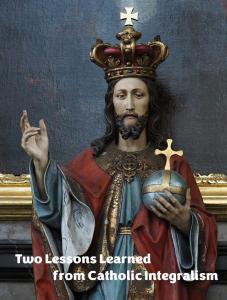
Two Lessons Learned from Catholic Integralism
Politics and Religion

Next Post

June 27, 2023 A Reflection on Suffering and End of Life Grace: In Memory of My Father
Recent Comments
"My honest take? I think St John Paul II was adamant that on his watch, ..."
Amoris Laetitia Deserves a Better Defence
""It's reasonable to ask what those claims mean in practice."It is. And I've laid out ..."
Amoris Laetitia Deserves a Better Defence
"I've said what I said, Peter. Read the words. If you don't have anything new ..."
Amoris Laetitia Deserves a Better Defence
"I don't expect you to decide who should be admitted to the sacraments. I'm asking ..."
Amoris Laetitia Deserves a Better Defence
Browse Our Archives
Select a Category Abortion Arius Atheists Catholic Apologetics Catholic Culture Catholic History Catholic Humor Catholic Poetry Catholic Politics Catholic Theology Dr. James White Faith Alone Joe Heschmeyer Kamala Harris Martin Luther Pope Francis Preborn Children President Biden Science and Catholicism Sola Scriptura Synod of Synodality Trinity
Select a Month October 2026 September 2026 August 2026 July 2026 June 2026 May 2026 April 2026 March 2026 February 2026 January 2026 December 2025 November 2025 October 2025 September 2025 August 2025 July 2025 June 2025 May 2025 April 2025 March 2025 February 2025 January 2025 December 2024 November 2024 October 2024 September 2024 August 2024 July 2024 June 2024 May 2024 April 2024 March 2024 February 2024 January 2024 December 2023 November 2023 October 2023 September 2023 August 2023 July 2023 June 2023 May 2023 April 2023 March 2023 February 2023 January 2023 December 2022 November 2022 October 2022 September 2022 August 2022 July 2022 June 2022 May 2022 April 2022 March 2022 February 2022 January 2022 December 2021 November 2021
Follow Us!
TAKE THE
Religious Wisdom Quiz
Which Old Testament prophet's book has the most chapters?
Select your answer to see how you score.
Isaiah Jeremiah Ezekiel Daniel
Related posts from The Latin Right

Rich Man, Poor Man: Altruism and Agency

The Poor Have Rights—and Responsibilities

The Clancy Effect: A Criminal Trial is Not...

Lindsay Clancy: Sympathy and Systematic Victimhood
TRENDING AT PATHEOS Catholic

The Sermon on the Mount, Part I: Matthew...
The Sermon on the Mount, Part I (Matthew 4:12-5:12) St. Matthew moves...

What's up from Crossway: Reviewing some of their latest A few weeks...

Janie Learns the Way of the Cross: A...
Teaching children about Jesus' Passion can be challenging. Many parents and educators...

Looking For Good Catholic Writing - October 2026
He alone extends the heavens, and he walks upon the waves of...

In "Irreplaceable," our book on vocation and technology, Trevor Sutton and I...

I was strolling through the top floor of the brand new Parthenon...
view all Catholic blogs
What Are Your Thoughts?leave a comment
Ad-Free & Subscriber Log-In Subscription Support
- About Us
- 2026 Calendar
- Videos
- Podcasts
- Library of World Religions
- Faith In Media Tracker
- Advertise With Us
- Write for Us
- Privacy Policy
- Terms of Service
- Do Not Sell My Data
- Contact Us
- Radiant Digital
- Manage Newsletter Subscriptions
- Unsubscribe From Notifications
- Sitemap
Copyright 2008-2026, Patheos. All rights reserved.
Subscription Support Ad-Free & Subscriber Log-In
Follow Patheos