
BuddhistCatholicContemplativeEvangelicalGeneral ChristianHinduJewishLatter-day SaintMuslimNew VisionsProgressive Christian
Beliefs
- Buddhist
- Catholic
- Contemplative
- Evangelical
- General Christian
- Hindu
- Jewish
- Latter-day Saint
- More Voices
- Muslim
- New Visions
- Pagan
- Progressive Christian
Topics
- Religion News
- Food and Religion
- Sports and Religion
- Religious Art
- Religious Music and Entertainment
- Religious Events
- History and Religion
- Style and Religion
- Politics and Religion
- Women in Religion
- Recreation Outdoors and Religion
- Business Finance and Religion
- Careers Workplace and Religion
- Education and Religion
- Family Parenting and Religion
- Health Fitness and Religion
- Home and Religion
- Relationships and Religion
- Technology and Religion
- Travel and Religion
Columnists
- Buddhist Columnists
- Business Finance and Religion Columnists
- Careers Workplace and Religion Columnists
- Catholic Columnists
- Contemplative Columnists
- Education and Religion Columnists
- Evangelists Columnists
- Family Parenting and Religion Columnists
- General Christian Columnists
- Health Fitness and Religion Columnists
- Hindu Columnists
- History and Religion Columnists
- Home and Religion Columnists
- Jewish Columnists
- More Voices Columnists
- Latter Day Columnists
- Muslim Columnists
- New Visions Columnists
- Nonreligious Columnists
- Pagan Columnists
- Politics and Religion Columnists
- Progressive Columnists
- Recreation Outdoors and Religion Columnists
- Relationships and Religion Columnists
- Religion News Columnists
- Religious Art Columnists
- Religious Events Columnists
- Religious Music and Entertainment Columnists
- Sports and Religion Columnists
- Style and Religion Columnists
- Technology and Religion Columnists
- Travel and Religion Columnists
- Women in Religion Columnists
Resource Library
- 2026 Calendar
- Library of World Religions
- The 100 Most Holy Places on Earth
- Patheos Answers
- Podcasts
- Videos
- Faith Leaders Database
- Anglican Episcopalian
- Bahai
- Baptist
- Buddhism
- Christianity
- Confucianism
- Eastern Orthodoxy
- Hinduism
- Holiness and Pentecostal
- ISKCON
- Islam
- Judaism
- Lutheran
- Methodist
- The Church of Jesus Christ of Latter-day Saints
- New Age
- Paganism
- Presbytarian and Reformed
- Protestantism
- Religion Behind the Scenes
- Roman Catholic
- Scientology
- Shia Islam
- Sikhism
- Sufism
- Sunni Islam
- Taoism
- Zen
- See all religions
Research Tools
 Ad-Free & Subscriber Log-In Subscription Support
Ad-Free & Subscriber Log-In Subscription Support
Follow Patheos 

- Trending:
- Forgiveness
- |
- Marriage
- |
- Consciousness
- |
- Death Penalty
- |
- Election
- |
- Halloween

- Home
- Catholic
- Religious Art
- 5 Reasons Catholics “Leave” Jesus on the Cross
5 Reasons Catholics “Leave” Jesus on the Cross
Last updated on: May 3, 2023 at 4:40 pm by Dennis Knapp
5 Reasons Catholics “Leave” Jesus on the Cross 2023-05-03T16:40:49-06:00 Dennis Knapp
Patheos Explore the world's faith through different perspectives on religion and spirituality! Patheos has the views of the prevalent religions and spiritualities of the world.
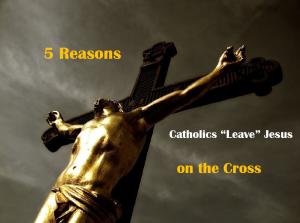
Recently, a very dear friend of mine (a Presbyterian pastor) asked me a question often asked Catholics: Why the crucifix in Catholic Churches? Good question. Why do Catholics “leave” Jesus on the cross in our churches?
St. Paul answers this question in 1 Corinthians 2:2:
For I decided to know nothing among you except Jesus Christ and him crucified.
Now, to leave it at that would not appease my friend. So, below are the five reasons Catholic Churches leave Jesus on the cross.
Whose Cross Anyway?
Our Lord Jesus was not the first the Romans crucified on a cross, although He is the most well-known. During the earthly life of Jesus, the Romans used crucifixion to send a message—mess with the Roman Empire and suffer the same fate. Most notably, crucifixion is widely understood as the most cruel and excruciating form of public execution. In fact, the etymology of the word excruciate means to crucify. In short, the cross was a means of horrific public execution. Furthermore, only with Jesus does the cross take on meaning synonymous with hope. Through His sacrifice, Jesus transformed an instrument of death into one of salvation and hope. Therefore, for Catholics, a cross without Christ reverts to a mere instrument of torture. The corpus (body) on the cross shows the transformed cross, Christ’s cross.
A Sacramental People
In a past article on sacraments, I wrote:
Saint Pope John Paul II states that being created in the image of God humans are “both a corporeal and spiritual being.” As corporeal we relate to the external world physically via five senses. We see, hear, smell, touch, and taste the world. We are therefore sensory dependent.
Furthermore, as an incarnational faith, a faith of the God-man, God took on an image (Philippians 2:7). This image, the human body of Jesus, died on a cross. As those who looked upon the crucifixion as it happened, so too we look upon the crucifix and see the price paid for our sins. While not a sacrament, the crucifix has a sacramental aspect, as it has a material form but also relates an underlying spiritual truth.
A Reflection of Gospel Liturgy
For the life of me, one of the greatest misnomers I read from former Catholics is that they never heard the gospel in “all their years in the Catholic Church.” Did they open their eyes? Did they listen to the words of the scripture reading and the Eucharist prayers? For example:
It is truly right and just, our duty and salvation, always and everywhere to give you thanks, Father most holy, through your beloved Son, Jesus Christ, your Word through whom you made all things, whom you sent as our Savior and Redeemer, incarnate by the Holy Spirit and born of the Virgin. Fulfilling your will and gaining for you a holy people, he stretched out his hands as he endured his Passion, so as to break the bonds of death and manifest the resurrection.
With this prayer the priest begins the Eucharistic celebration. This prayer presents the clear message of the gospel, that is, our salvation comes through Jesus as savior and redeemer of the world. In Jesus’s death, the bonds of death are broken. In Jesus’s resurrection, the promise of resurrection secured. Moreover, through their eyes, the Catholic sees the image of the savior and redeemer on the cross. In the crucifix, Christ “stretched out his hands as he endured his Passion…”
The Way of Salvation Through the Cross
The Catechism of the Catholic Church, paragraph 618, perfectly expresses meaning of the crucifix in Catholic life. It states:
The cross is the unique sacrifice of Christ, the “one mediator between God and men”. (1 Timothy 2:5) But because in his incarnate divine person he has in some way united himself to every man, “the possibility of being made partners, in a way known to God, in the paschal mystery” is offered to all men. He calls his disciples to “take up [their] cross and follow [him]”, (Matthew 16:24) for “Christ also suffered for [us], leaving [us] an example so that [we] should follow in his steps.” (1 Peter 2:21) In fact Jesus desires to associate with his redeeming sacrifice those who were to be its first beneficiaries. (Colossians 1:24) This is achieved supremely in the case of his mother, who was associated more intimately than any other person in the mystery of his redemptive suffering. (Luke 2:35)
The crucifix reminds Catholics that following the way of Christ leads to suffering—but redemptive suffering. To follow Christ, we must take up our crosses and die to our own selfishness and sin. We must become like Christ to the point of death. For…
If we have died with him, we will also live with him;
if we endure, we will also reign with him;
if we deny him, he also will deny us;
if we are faithless, he remains faithful—
The Crucifix Affirms, Not Devalues the Resurrection
Moreover, some claim that the crucifix (with Christ on the cross) devalues and deemphasizes the resurrection of Christ. They further claim that a naked cross better reflects the truth of the resurrection, as Christ is no longer there. True, Christ no longer suffers on the cross. Also true—a bare cross only tells half the story. This is why St. Augustine echoing St. Paul stated in a sermon:
The apostle Paul saw Christ and extolled his claim to glory. He had many great and inspired things to say about Christ, but he did not say that he boasted in Christ’s wonderful works: in creating the world, since he was God with the Father, or in ruling the world, though he was also a man like us. Rather, he said: Let me not boast except in the cross of our Lord Jesus Christ.
In John 10:9, Jesus states:
I am the door; if anyone enters through Me, he will be saved, and will go in and out and find pasture.
A priest once said that the shape of this door is the cross and we must enter through Christ crucified to receive salvation. Before Easter Sunday, there was Good Friday. Likewise, a crucifix with Jesus (Good Friday) anticipates the resurrection to come (Easter). Therefore, the crucifix affirms and does not devalue the resurrection.
To Sum Up
In summary, Catholics prefer crucifixes for the following reasons:
- Through His sacrifice, Jesus transformed an instrument of death into one of salvation and hope. For Catholics, a cross without Christ reverts to a mere instrument of torture, not a symbol of hope.
- While not a sacrament, the crucifix has a sacramental aspect, as it has a material form but also relates an underlying spiritual truth. This truth: God took on human form and gave everything for our salvation.
- Through their eyes during Mass, the Catholic sees the image of the savior and redeemer on the cross. In the crucifix, Christ “stretched out his hands as he endured his Passion…” In this way, the Catholic understands the gospel message presented during the Eucharist.
- The crucifix reminds Catholics that following the way of Christ leads to suffering—redemptive suffering. To follow Christ, we must take up our crosses and die to our own selfishness and sin. We must become like Christ to the point of death.
- Before Easter Sunday, there was Good Friday. Likewise, a crucifix with Jesus (Good Friday) anticipates the resurrection to come (Easter). Therefore, the crucifix affirms and does not devalue the resurrection.
May we all look upon the crucifix and come to believe in the One who gave all for our salvation.
Thank you!
If you enjoy my writing and want to support my work, please consider donating $1 or any size gift by clicking here. Thank you!
Read my other writing here.
Please click the link below to join.
Voices of the Faithful in the Synod on Synodality
Please make your voice heard.
I Support Church Teaching in the Synod of Synodality
5 Reasons Catholics “Leave” Jesus on the Cross
Evangelical
Religious Art
History and Religion
Previous Post

April 28, 2023
Who Chooses Hell?
Next Post
May 17, 2023 What Yields When Political and Religious Thought Converge and Conflict?
Recent Comments
"Not a different answer.Peter, you have an occasional problem with the truth. Mike Lewis pointed ..."
Amoris Laetitia Deserves a Better Defence
"So, no answer."
Amoris Laetitia Deserves a Better Defence
"Thanks, Mike, but the history points in a different direction to the one you suggest.John ..."
Amoris Laetitia Deserves a Better Defence
"My honest take? I think St John Paul II was adamant that on his watch, ..."
Amoris Laetitia Deserves a Better Defence
Browse Our Archives
Select a Category Abortion Arius Atheists Catholic Apologetics Catholic Culture Catholic History Catholic Humor Catholic Poetry Catholic Politics Catholic Theology Dr. James White Faith Alone Joe Heschmeyer Kamala Harris Martin Luther Pope Francis Preborn Children President Biden Science and Catholicism Sola Scriptura Synod of Synodality Trinity
Select a Month October 2026 September 2026 August 2026 July 2026 June 2026 May 2026 April 2026 March 2026 February 2026 January 2026 December 2025 November 2025 October 2025 September 2025 August 2025 July 2025 June 2025 May 2025 April 2025 March 2025 February 2025 January 2025 December 2024 November 2024 October 2024 September 2024 August 2024 July 2024 June 2024 May 2024 April 2024 March 2024 February 2024 January 2024 December 2023 November 2023 October 2023 September 2023 August 2023 July 2023 June 2023 May 2023 April 2023 March 2023 February 2023 January 2023 December 2022 November 2022 October 2022 September 2022 August 2022 July 2022 June 2022 May 2022 April 2022 March 2022 February 2022 January 2022 December 2021 November 2021
Follow Us!
TAKE THE
Religious Wisdom Quiz
According to Hebrews 11, what is the correct chronological order of these faith heroes?
Select your answer to see how you score.
Abraham, Noah, Enoch, Abel Noah, Abraham, Abel, Enoch Abel, Enoch, Noah, Abraham Enoch, Abel, Abraham, Noah
Related posts from The Latin Right

Amoris Laetitia Deserves a Better Defence

Rich Man, Poor Man: Altruism and Agency

The Order We Did Not Make: The World...

Is This “Culture War” Catholicism—or Evangelization?
TRENDING AT PATHEOS Catholic

Swimfan: Forgotten Aughts Pleasures
This is a recovery effort. In 2002, My Big Fat Greek Wedding...

Top Three Anti-Catholic Lies About Catholicism
This is my initial transcript for the video, "THE 3 WORST...

Pope Leo Celebrates Mass for Nurses & Docs...
I don't have any idea how he did it, but Pope Leo...

The Sermon on the Mount, Part I: Matthew...
The Sermon on the Mount, Part I (Matthew 4:12-5:12) St. Matthew moves...

What's up from Crossway: Reviewing some of their latest A few weeks...

Janie Learns the Way of the Cross: A...
Teaching children about Jesus' Passion can be challenging. Many parents and educators...
view all Catholic blogs
What Are Your Thoughts?leave a comment
Ad-Free & Subscriber Log-In Subscription Support
- About Us
- 2026 Calendar
- Videos
- Podcasts
- Library of World Religions
- Faith In Media Tracker
- Advertise With Us
- Write for Us
- Privacy Policy
- Terms of Service
- Do Not Sell My Data
- Contact Us
- Radiant Digital
- Manage Newsletter Subscriptions
- Unsubscribe From Notifications
- Sitemap
Copyright 2008-2026, Patheos. All rights reserved.
Subscription Support Ad-Free & Subscriber Log-In
Follow Patheos