
BuddhistCatholicContemplativeEvangelicalGeneral ChristianHinduJewishLatter-day SaintMuslimNew VisionsProgressive Christian
Beliefs
- Buddhist
- Catholic
- Contemplative
- Evangelical
- General Christian
- Hindu
- Jewish
- Latter-day Saint
- More Voices
- Muslim
- New Visions
- Pagan
- Progressive Christian
Topics
- Religion News
- Food and Religion
- Sports and Religion
- Religious Art
- Religious Music and Entertainment
- Religious Events
- History and Religion
- Style and Religion
- Politics and Religion
- Women in Religion
- Recreation Outdoors and Religion
- Business Finance and Religion
- Careers Workplace and Religion
- Education and Religion
- Family Parenting and Religion
- Health Fitness and Religion
- Home and Religion
- Relationships and Religion
- Technology and Religion
- Travel and Religion
Columnists
- Buddhist Columnists
- Business Finance and Religion Columnists
- Careers Workplace and Religion Columnists
- Catholic Columnists
- Contemplative Columnists
- Education and Religion Columnists
- Evangelists Columnists
- Family Parenting and Religion Columnists
- General Christian Columnists
- Health Fitness and Religion Columnists
- Hindu Columnists
- History and Religion Columnists
- Home and Religion Columnists
- Jewish Columnists
- More Voices Columnists
- Latter Day Columnists
- Muslim Columnists
- New Visions Columnists
- Nonreligious Columnists
- Pagan Columnists
- Politics and Religion Columnists
- Progressive Columnists
- Recreation Outdoors and Religion Columnists
- Relationships and Religion Columnists
- Religion News Columnists
- Religious Art Columnists
- Religious Events Columnists
- Religious Music and Entertainment Columnists
- Sports and Religion Columnists
- Style and Religion Columnists
- Technology and Religion Columnists
- Travel and Religion Columnists
- Women in Religion Columnists
Resource Library
- 2026 Calendar
- Library of World Religions
- The 100 Most Holy Places on Earth
- Patheos Answers
- Podcasts
- Videos
- Faith Leaders Database
- Anglican Episcopalian
- Bahai
- Baptist
- Buddhism
- Christianity
- Confucianism
- Eastern Orthodoxy
- Hinduism
- Holiness and Pentecostal
- ISKCON
- Islam
- Judaism
- Lutheran
- Methodist
- The Church of Jesus Christ of Latter-day Saints
- New Age
- Paganism
- Presbytarian and Reformed
- Protestantism
- Religion Behind the Scenes
- Roman Catholic
- Scientology
- Shia Islam
- Sikhism
- Sufism
- Sunni Islam
- Taoism
- Zen
- See all religions
Research Tools
 Ad-Free & Subscriber Log-In Subscription Support
Ad-Free & Subscriber Log-In Subscription Support
Follow Patheos 

- Trending:
- Forgiveness
- |
- Marriage
- |
- Consciousness
- |
- Death Penalty
- |
- Election
- |
- Halloween

- Home
- Catholic
- Politics and Religion
- Beware This Type of Nuanced Thinking
Beware This Type of Nuanced Thinking
Last updated on: February 17, 2023 at 9:18 pm by Dennis Knapp
Beware This Type of Nuanced Thinking 2023-02-17T21:18:50-06:00 Dennis Knapp
Patheos Explore the world's faith through different perspectives on religion and spirituality! Patheos has the views of the prevalent religions and spiritualities of the world.
During my time writing on Patheos, many of my readers on the more politically and culturally liberal side claim that my writing lacks “nuance” and tends towards binary thinking. They claim that more “mature” and “sophisticated” thinkers comprehend the complexities of morality and theology, especially when one factors in the supremacy of individual conscience. Moreover, they also claim black and white thinking, or thinking that seeks objective truth, shows an unhealthy psychological dependency on certainty, or in the case of immature unnuanced Catholic conservatives, i.e., the Church.
In this article, I address what I consider the main issues with this type of “nuanced” thinking—moral and theological relativism. I show that, contrary to the critique, an appeal to “nuance” in this context does not reflect maturity and sophistication, but an escape into relativism. By taking on a more nuanced approach to morality and theology, the liberal, including Catholic liberals, exist in the gray areas, the foggy fringes. Once securely embedded in the fog, clearly sinful things like abortion and sexual activity outside of marriage no longer appear clear.
50 Shades of Gray Nuance
Now the serpent was more crafty than any other beast of the field that the Lord God had made. He said to the woman,
“Did God actually say…
“You will not surely die. For God knows that when you eat of it your eyes will be opened, and you will be like God, knowing good and evil.” Genesis 3:1-5 [emphasis added]
Not surprising, the first attempt at this type of nuance occurred right before the Fall. The serpent, craftier, dare I say, more sophisticated, of all the beasts of the field, questions the command of God. He implores Eve to look at God’s command in a more nuanced way. Once she does, her eyes will open and she “will be like God, knowing good and evil.” Eve later shares this nuanced approach to God’s command with Adam—and they fall. So much for nuance…
An Appeal to Nuanced Complexity
Another appeal of the sophisticated, mature, and nuanced is complexity. Complexity as it relates to this type of nuance means that issues, sins, and people are so complex that any attempt to pin them down become impossible. For example, sex and gender. While sex may seem binary, in that it appears to take a male and female to reproduce. Gender, on the other hand, is an ever-expanding ball of complexity because people and cultures are likewise complex. That God created humans male and female takes a back seat to a more mature and complex view of human nature.
Furthermore, another casualty of complexity, at least for the nuanced Catholic, is Catholic anthropology. Human nature, as grounded in the image of God, does not adequately reflect complex human nature. Therefore, this simplistic binary must step aside for the new and more nuanced approach to human nature found in gender theory. A theory that accepts the complexity of human nature.
A Nuanced Abortion
No issue separates more people, including Catholics, than the issue of abortion. Words like pro-life/anti-choice and pro-abortion/pro-choice reflect the impact of nuance on this issue. Even within the Catholic hierarchy, we see bishops, like Cardinal Blase Cupich of Chicago, attempt nuance by appealing to the seamless garment argument. He states:
While commerce in the remains of defenseless children is particularly repulsive, we should be no less appalled by the indifference toward the thousands of people who die daily for lack of decent medical care; who are denied rights by a broken immigration system and by racism; who suffer in hunger, joblessness and want; who pay the price of violence in gun-saturated neighborhoods; or who are executed by the state in the name of justice. [emphasis added]
This nuanced equivocation drew the rebuke of another bishop, Archbishop Charles J. Chaput of Philadelphia, who stated in response:
The deliberate killing of innocent life is a uniquely wicked act. No amount of contextualizing or deflecting our attention to other issues can obscure that. [emphasis added]
The archbishop makes the correctly nuanced observation. Children must first survive the womb before needs like food, shelter, adequate immigration policy, and health care take priority. “Humanity’s priority right — the one that undergirds all other rights — is the right to life.”
A Nuanced Conscience
Circling back to abortion. Given the Catholic Church’s view on abortion, how can an organization called Catholics for Choice exist? Simple: a nuanced conscience. A nuanced conscience differs from what the Catechism calls a properly formed conscience. It sees itself as the ultimate authority whether properly formed or not. Jon O’Brien, the president of Catholics for Choice, stated the following in an interview:
Being Catholic is not a litmus test as to whether you adhere to the letter of law in every teaching. Nor does it mean you get up in the morning and do whatever you want to do. It means you properly form a conscience and follow it. You must examine your conscience and that is a serious process of looking at what the church leaders have said, looking at what the Church has written and looking at your impact on others.
Mr. O’Brien gets some of the wording correct, but then applies nuance to the Catholic teaching on a properly formed conscience. For example, the Catechism teaches:
1785 In the formation of conscience, the Word of God is the light for our pat, we must assimilate it in faith and prayer and put it into practice. We must also examine our conscience before the Lord’s Cross. We are assisted by the gifts of the Holy Spirit, aided by the witness or advice of others, and guided by the authoritative teaching of the Church.
Therefore, it is not enough to merely “examine” our conscience to determine if we do not like what the Church and her leaders teach. The method by which we examine our conscience determines its proper formation. The Catechism lists the bible, faith, prayer, the cross, the Holy Spirit, others (with properly formed consciences), all guided by the authoritative teaching of the Church as crucial to developing a properly formed conscience.
Clarity Over Nuance
When it comes to moral issues, basic reasoning oftentimes proves more valuable than nuance, as the former introduces greater clarity into the discussion by exposing good and evil for what they are. The latter obfuscates and confuses, as it blurs the distinctions and degrees separating good from evil, leaving people wondering what’s good and what’s evil. Motley Monk
Moreover, what this type of nuance allows for, especially concerning morality, is moral relativism. With moral relativism, good and evil become foggy and more a matter of personal preference than a standard to live up to. As with the serpent’s encounter with Eve, sin becomes nuanced in the name of “love.” A nuanced love means to welcome all in, regardless of their sin, and leave them wallowing in their sin. “Does the Church actually teach x as sin?” And if so, is not the “pastoral approach,” the loving approach, to “welcome” and “listen,” not judge? Did not Jesus love the sinner? True, Jesus ate with prostitutes and tax collectors. He met people in their lived experiences. Jesus also called these same people to conversion. Jesus came to seek and save the lost (Luke 19:10), not accompany sinners on their way to hell.
We listen to accompany, and in the case of a sinner, to accompany that person to, and through, conversion. If we believe the Scriptures, then we know just how much is at stake. Bishop James Conley of Lincoln, Nebraska
Final Thoughts
In conclusion, this article is not a condemnation of nuanced thinking in general. If one studies the writings of Catholic theologian St. Thomas Aquinas, they find nuance reflected throughout. The principle of Double Effect represents another case of nuance in Catholic moral teaching. So, too the Catholic dogmas of the Trinity, Incarnation, and Atonement also contain a fair share of nuanced thinking. This article calls out an appeal to nuanced thinking that sows confusion and justifies sin, blurs the lines between good and evil, and placing souls at eternal risk.
If you enjoy my writing and want to support my work, please consider donating a monetary gift of any size or quantity by clicking here. Thank you!
Read my other writing here.
Please click the link below to join.
Voices of the Faithful in the Synod on Synodality
Please make your voice heard.
I Support Church Teaching in the Synod of Synodality
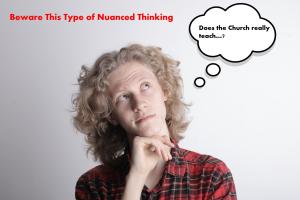
Images taken from Pixabay and Pexels
Politics and Religion
Previous Post

February 12, 2023
4 Ways the Catholic Church is a “Sign of Contradiction” to the World
Next Post
February 20, 2023 A Lenten Call for Prayer Requests
Recent Comments
"I agree that St John Paul II did not equivocate. He was insistent that the ..."
Amoris Laetitia Deserves a Better Defence
"Not a different answer.Peter, you have an occasional problem with the truth. Mike Lewis pointed ..."
Amoris Laetitia Deserves a Better Defence
"So, no answer."
Amoris Laetitia Deserves a Better Defence
"Thanks, Mike, but the history points in a different direction to the one you suggest.John ..."
Amoris Laetitia Deserves a Better Defence
Browse Our Archives
Select a Category Abortion Arius Atheists Catholic Apologetics Catholic Culture Catholic History Catholic Humor Catholic Poetry Catholic Politics Catholic Theology Dr. James White Faith Alone Joe Heschmeyer Kamala Harris Martin Luther Pope Francis Preborn Children President Biden Science and Catholicism Sola Scriptura Synod of Synodality Trinity
Select a Month October 2026 September 2026 August 2026 July 2026 June 2026 May 2026 April 2026 March 2026 February 2026 January 2026 December 2025 November 2025 October 2025 September 2025 August 2025 July 2025 June 2025 May 2025 April 2025 March 2025 February 2025 January 2025 December 2024 November 2024 October 2024 September 2024 August 2024 July 2024 June 2024 May 2024 April 2024 March 2024 February 2024 January 2024 December 2023 November 2023 October 2023 September 2023 August 2023 July 2023 June 2023 May 2023 April 2023 March 2023 February 2023 January 2023 December 2022 November 2022 October 2022 September 2022 August 2022 July 2022 June 2022 May 2022 April 2022 March 2022 February 2022 January 2022 December 2021 November 2021
Follow Us!
TAKE THE
Religious Wisdom Quiz
What city was Job from?
Select your answer to see how you score.
Uz Susa Edom Shiloh
Related posts from The Latin Right

Amoris Laetitia Deserves a Better Defence

Rich Man, Poor Man: Altruism and Agency

The Order We Did Not Make: The World...

The Poor Have Rights—and Responsibilities
TRENDING AT PATHEOS Catholic

The First Eucharistic Controversy: Christ’s Real Presence
For Catholics, the Eucharist is the source and summit of the Christian...

What a Stop Sign Can Teach Us About...
How to Make a Decision When You Can't Hear God Main point:...

Archdiocese Hosts Military Marriage Retreat in Germany
RASTATT, Germany — The transient military lifestyle, with its frequent deployments and...

Nearly every morning, I make the drive to Detroit with my high-school-age...

The Real AI Story Is Adoption Without Trust
Artificial intelligence has crossed a political threshold. It is no longer a...

A new article, written by Jeff Lindsay and Gale L. Pooley,...
view all Catholic blogs
What Are Your Thoughts?leave a comment
Ad-Free & Subscriber Log-In Subscription Support
- About Us
- 2026 Calendar
- Videos
- Podcasts
- Library of World Religions
- Faith In Media Tracker
- Advertise With Us
- Write for Us
- Privacy Policy
- Terms of Service
- Do Not Sell My Data
- Contact Us
- Radiant Digital
- Manage Newsletter Subscriptions
- Unsubscribe From Notifications
- Sitemap
Copyright 2008-2026, Patheos. All rights reserved.
Subscription Support Ad-Free & Subscriber Log-In
Follow Patheos